COFFEE TOOLS · MILK PITCHER RANGE · OEM/ODM OPTIONS
Milk Pitcher Options from Coffmach Coffee Tools
Coffmach offers milk pitchers for steaming, frothing, latte-art pouring, café service and private-label coffee-tool programs. Buyers can combine capacity, body and spout geometry, stainless steel grade, finish, measurement marks, branding and packaging—but the most reliable range begins with the drink and workflow, not the color chart.
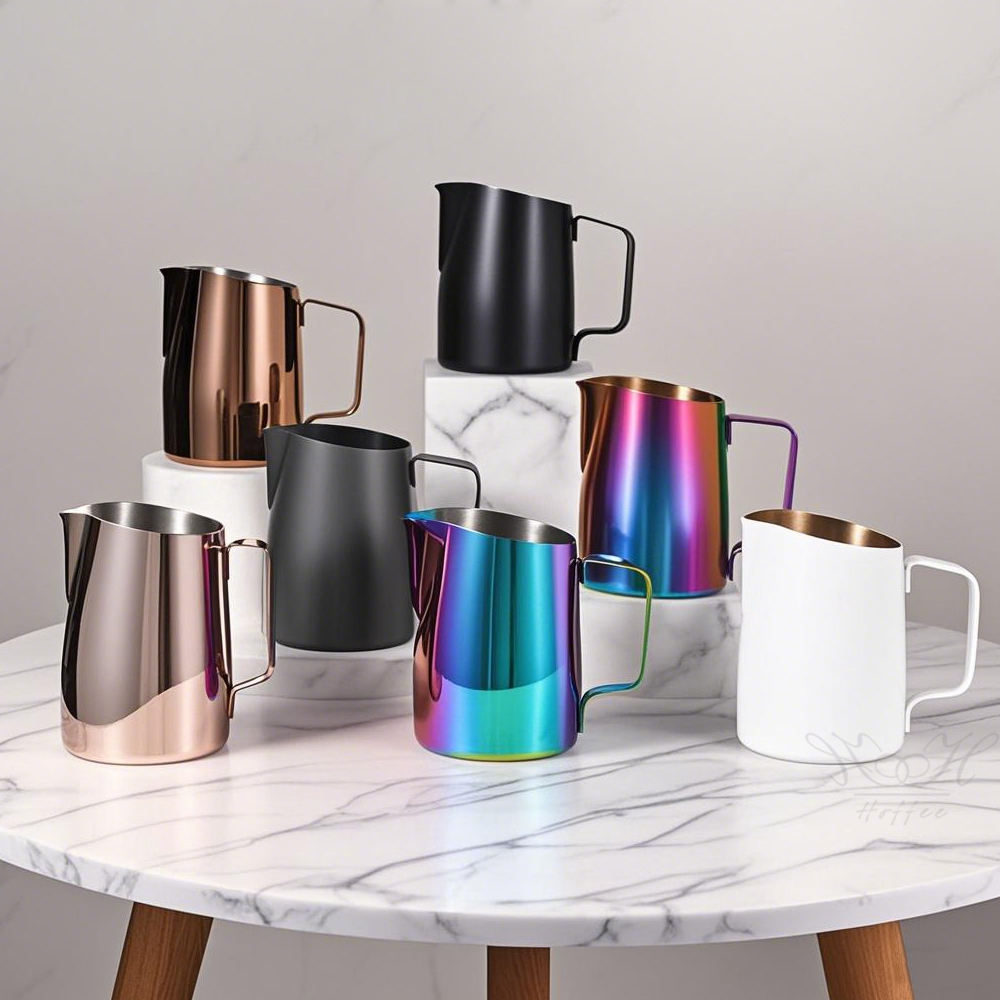
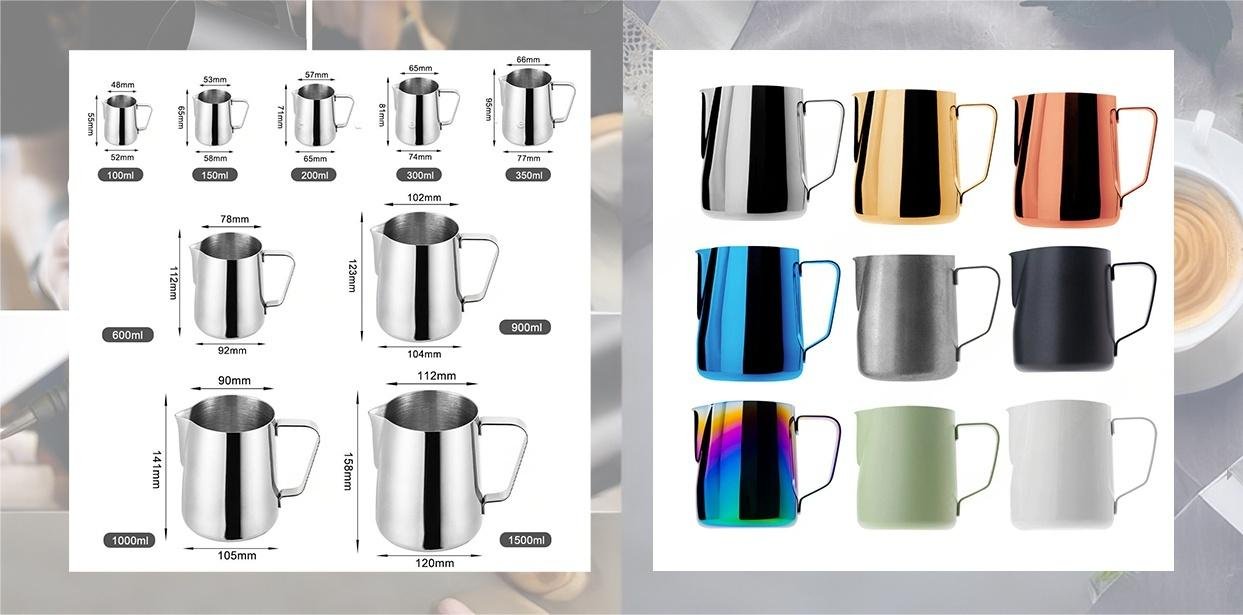
Quick answer: what milk pitcher options does Coffmach offer?
The full 100–1500ml range does not mean every capacity is equally suitable for latte art. Small 100–300ml pitchers can support tasting, sauce, small milk doses or compact drinks. A 350ml model is a practical single-drink starting point. A 600ml pitcher provides more room for a large drink or two smaller drinks. Larger 900–1500ml jugs are better treated as high-volume or transfer tools unless a real steam-and-pour test proves they suit the intended workflow.
Key takeaways
- Choose the milk dose, drink size and steam wand first; nominal pitcher capacity comes next.
- A practical first range often includes 350ml and 600ml rather than every available size.
- Spout, rim, taper and handle work together; a “sharp” spout name alone does not define pouring behavior.
- Separate the base metal from plating, PVD, paint or transfer decoration in every specification.
- Measurement marks, logos and packaging need measurable approval criteria, not only a digital mockup.
- Approve a physical golden sample with water, milk, cleaning and packaging tests before bulk production.
View the current product range on the Coffmach Coffee Milk Jug product page.
Coffmach milk pitcher options at a glance
A pitcher SKU is a combination of choices. Changing the capacity can also change height, opening diameter, balance and steaming depth. Changing the finish can change the cleaning test or logo method. Use the table as a selection map, then confirm the current model and production feasibility with a sample.
| Option group | Current Coffmach range or capability | What it changes | What the buyer should confirm |
|---|---|---|---|
| Capacity | Listed range from 100ml to 1500ml | Working milk depth, expansion room, filled weight and service quantity | Actual usable fill, dimensions, capacity tolerance and intended drink |
| Body geometry | Multiple heights, diameters, tapers and profiles | Steam-wand reach, vortex behavior, balance and storage footprint | Dimensioned drawing plus test on the target machine |
| Spout and rim | Different catalog geometries and custom development subject to approval | Stream width, release, cut-through and proximity to the cup | Centerline, lip finish, slow/medium/fast pour and pattern target |
| Handle | Handled models with different grip proportions | Orientation, heat separation, wet-hand grip and wrist angle | Clearance, weld strength, comfort and repeated-load performance |
| Base material | 304/316 stainless steel listed; other material options are project-specific | Forming, welding, corrosion behavior, mass and documentation | Exact grade, certificate/document needs and food-contact requirements |
| Surface appearance | Natural polish, electroplating, PVD, painted, engraved and transfer effects shown | Color, gloss, texture, scratch visibility and care limits | Substrate, coating stack, color standard and durability test |
| Measurement marks | Custom internal or external marks subject to model and process | Dosing speed, training and recipe repeatability | Units, positions, accuracy, readability and cleaning durability |
| Branding | Laser, stamp, engraving/etching, silk screen, transfer and sticker options shown | Brand visibility, tactile finish, color and unit cost | Artwork, size, location, contrast, adhesion and wear method |
| Packaging | Boxes, bags, labels, cards, inserts and barcode support listed | Retail presentation, protection, fulfillment and destination labeling | Dieline, material, pack-out, drop protection and required marks |
Capacity options: from 100ml to 1500ml
Nominal capacity is the total stated volume, not the recommended milk fill for steaming. Milk needs room to move and expand. Breville's manual guidance for specific machines uses a fill below the spout or between named marks, while La Marzocco's current steaming guide uses 12oz pitchers for drinks below 8oz and 20oz pitchers for 8–12oz drinks or two-drink steaming. These are useful examples, not universal rules for every machine and jug.
| Capacity family | Useful starting application | Main advantage | Main limitation |
|---|---|---|---|
| 100–200ml | Espresso tasting, sauce, syrup, small transfer or very small milk quantity | Compact and light | Limited expansion room and steam-wand access |
| 300–350ml / about 10–12oz | One small cappuccino, flat white or latte-art practice recipe | Good control with modest milk quantities | Can overflow when the starting dose is too high or steam power is strong |
| 500–600ml / about 17–20oz | One large milk drink or two smaller drinks | Flexible café service and more headspace | A small milk dose may sit too shallow for an easy vortex |
| 900–1000ml / about 30–34oz | Larger-volume steaming, transfer or non-detailed service tasks | Higher batch capacity | Greater filled weight and less agility for detailed single-cup art |
| 1500ml / about 51oz | Specialized high-volume use, mixing or transfer after equipment validation | Maximum listed capacity | Requires compatible wand reach, power, handling and safe fill procedure |
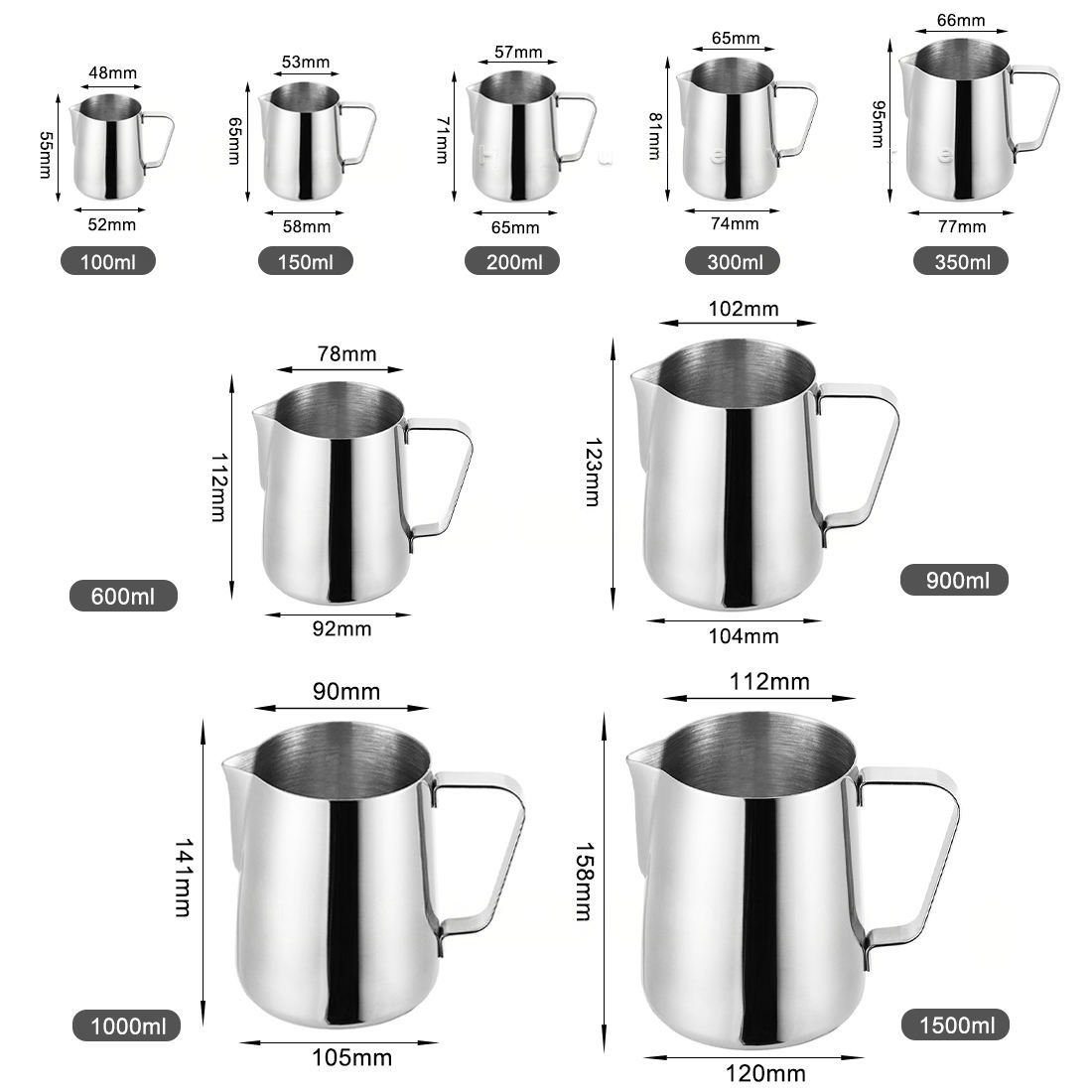
How to choose the working capacity
For a detailed metric and ounce comparison, see What Are the Common Sizes of Milk Jugs?.
Body, spout and handle options
The pitcher behaves as one piece of geometry. Capacity, opening diameter, wall taper, base curve, top angle, spout projection and handle position influence how the milk circulates and how the stream leaves. A buyer should not select the spout from a close-up photo and ignore the rest of the body.
Standard or rounder spout
A moderate, rounded or medium-width outlet is a practical default for hearts, simple tulips and general café use. It can build a broad white shape without demanding extremely precise wrist control. The limitation is that a wide stream may feel less exact for small rosetta leaves or fine finishing lines.
Narrow or sharper spout
A longer, narrower or sharper profile can focus the stream and bring the lip close to the coffee surface. It can support fine-line placement when the milk is already glossy and fluid. It does not fix dry foam, separation or a weak vortex. Terms such as “sharp,” “precision” and “eagle” are not universal geometry standards, so compare drawings and physical samples.
Why spout and body must be tested together
Fellow's Eddy is a useful model-specific example: its official page describes a fluted spout, sharp front crease and tapered body working together. The lesson is not that one shape is best; it is that the pouring result comes from the complete geometry.
For a Coffmach sample, pour the same measured amount of cool water at slow, medium and service speed. Look for a centered stream that does not twist, cling to one side or split unexpectedly. Then repeat with the actual milk, cup and pattern.
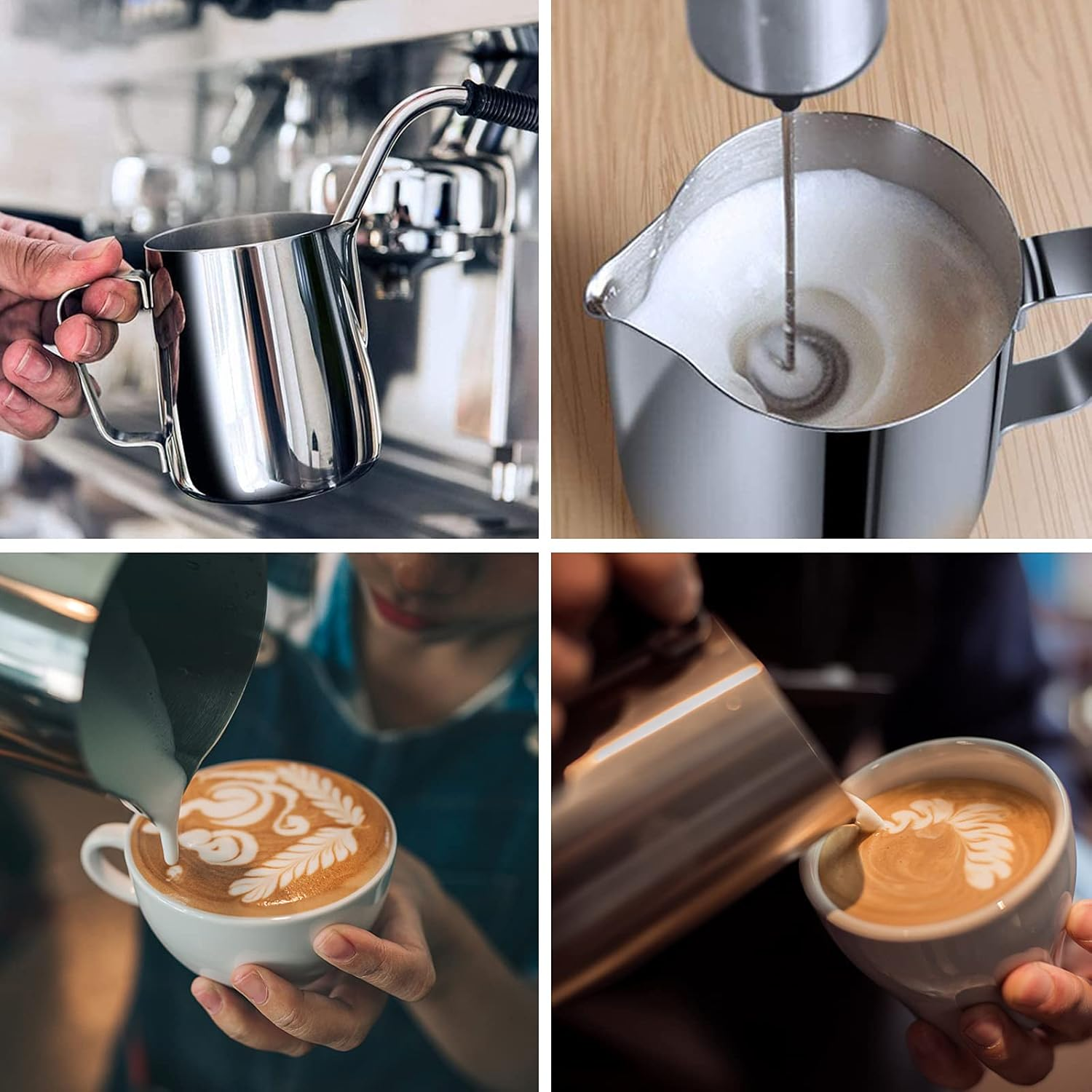
Handle geometry
A handle gives the barista an orientation reference and reduces direct contact with the hot wall. Compare opening size, distance from the body, upper and lower attachment, balance and clearance under the steam wand. Test with a wet hand and the maximum approved working fill. A decorative handle that twists the wrist or touches the machine is not an ergonomic success.
Which geometry is best for latte art?
For a first general-purpose SKU, use a centered moderate spout, a body that keeps the normal milk dose deep enough for stable circulation and a handle that lets different users repeat the same orientation. Add a specialist sharp-spout model only when advanced pouring is a real customer need. The dedicated Best Milk Pitcher for Latte Art guide explains that decision in more detail.
Material, wall construction and finish quality
Coffmach's current page lists 304 and 316 stainless steel options. It also presents copper, aluminum and titanium-related choices. These terms must be converted into a controlled specification: a pitcher may use a stainless steel substrate with a copper-colored or titanium-colored surface, or it may use a different base metal in a project-specific design. Appearance alone cannot identify the construction.
304 stainless steel: the practical default
Outokumpu identifies 304/4301 as an austenitic stainless steel with good corrosion resistance, formability and weldability, and lists kitchen and food-and-beverage equipment among typical applications. Those material-level properties help explain why 304 is common for formed pitchers. They do not prove that every finished jug has the same wall thickness, weld quality, finish or food-contact documentation.
316 stainless steel: specify the reason
316 may be requested for a project with a defined corrosion, market or documentation requirement. It should not be added simply as a premium label. Confirm the actual grade, forming process, weld area, finish, care routine and applicable destination-market requirements. A finished-product test is still necessary.
Does wall thickness matter?
Wall construction affects stiffness, dent resistance, mass and how quickly heat reaches the user's hand. A lighter wall can provide quick tactile feedback and lower filled weight; a heavier wall can feel more rigid but adds thermal mass and weight. Thickness does not create microfoam by itself. Steam power, milk quantity, wand position, air introduction and circulation remain decisive.
| Detail | Why it matters | How to verify |
|---|---|---|
| Material grade | Defines the intended alloy rather than a visual claim | Purchase specification and agreed material documentation |
| Wall and base thickness | Affects rigidity, mass, forming and heat feedback | Drawing points, tolerance and sample measurement |
| Rim and spout edge | Affects safety, cleanability and stream release | Visual/tactile inspection and controlled pour test |
| Handle weld or joint | Carries repeated lifting and pouring load | Position, finish, repeated-load test and inspection |
| Interior surface | Contacts milk and must be easy to inspect and clean | Roughness/finish criteria, bright-light inspection and care test |
| Base flatness | Affects stability and, for some automatic systems, sensor contact | Flat-surface check and target-equipment test |
Surface finish and color options
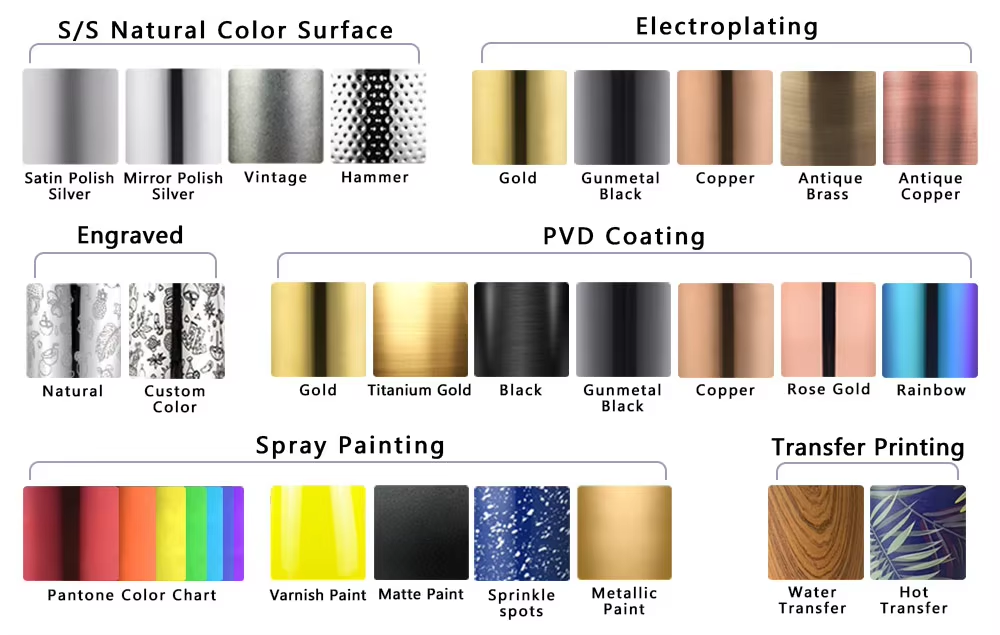
Finish creates shelf appeal and helps a café assign colors to milk types or station roles. It also changes the inspection and cleaning plan. Coffmach's option board shows natural stainless finishes, electroplated effects, PVD colors, painted surfaces, engraved patterns and transfer-printed designs. Availability depends on model, quantity, artwork and project approval.
Natural stainless
Satin, mirror, vintage and hammered looks keep the metal appearance visible. Compare scratch visibility, fingerprinting and cleaning effort.
Electroplated finish
Can create gold, copper, gunmetal or antique effects. Define the full plating stack, color reference, adhesion and care limits.
PVD color
Offers metallic color effects such as gold, black, copper or rainbow. Approve color range, edge coverage and abrasion testing.
Painted surface
Supports matte, gloss, custom color and special-effect designs. Check food-contact boundaries, coating adhesion and cleaning resistance.
Engraved pattern
Adds a permanent tactile design by removing or forming material. Inspect edge quality, cleanability and pattern consistency.
Transfer print
Supports wood-look or graphic patterns. Confirm seam placement, color repeatability, abrasion and heat/cleaning durability.
How to choose a color range
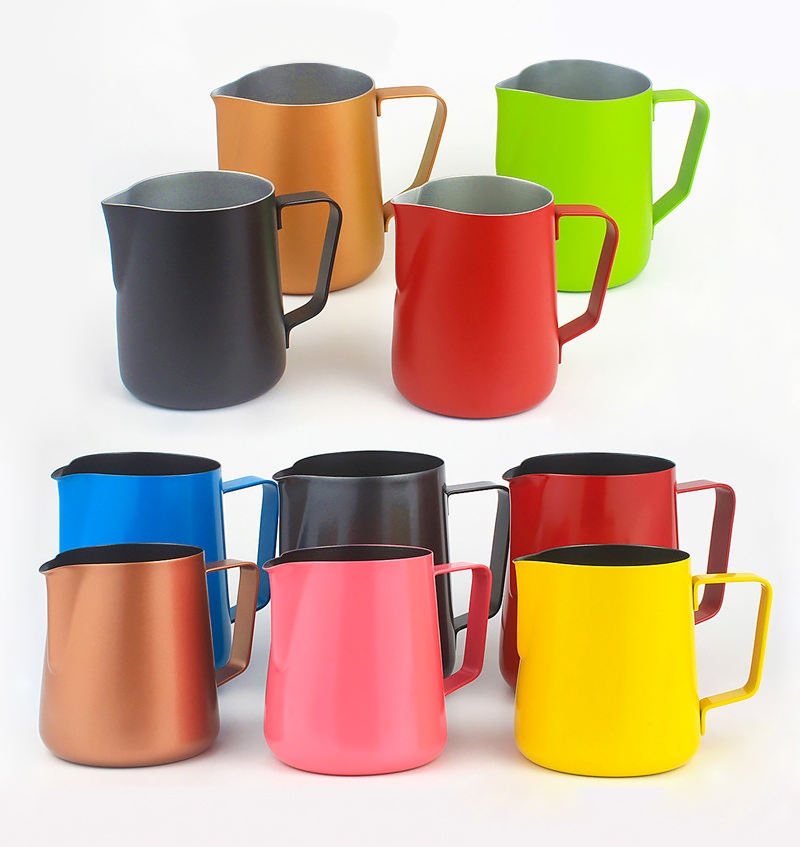
Start with the channel. Natural satin or mirror stainless can simplify a professional core line. One black or metallic color can create a premium tier. A controlled set of café colors can support milk-allergen or recipe identification only if the operator's food-safety system permits and documents that use.
Do not launch too many colors before testing demand and repeatability. Every additional finish can add artwork, sample, inspection, inventory and reorder complexity.
Finish approval checklist
- State the base metal, pre-treatment, finish process and intended food-contact boundary.
- Use a physical color master or defined color range; screen images are not a production color standard.
- Inspect the rim, spout, handle joint, base edge and internal transition for thin coverage or overspray.
- Agree on gloss, texture, acceptable variation and inspection lighting.
- Test the actual detergent, water temperature, brush and drying routine planned for the customer.
- Check nesting, individual protection and carton movement so finished pitchers do not rub during transport.
Measurement marks, logos and packaging
Branding is the visible part of a custom milk pitcher, but dosing and packaging often create more daily value. A strong specification treats all three as functional production features.
Measurement marks
Internal milliliter or ounce marks can support dosing, training and milk-waste control. Define the unit system, mark values, reference point, allowed position error, line thickness, contrast and durability. A top capacity mark is not automatically the correct steaming fill. Use recipe-specific guidance so a barista does not overfill simply because a line exists.
Logo methods
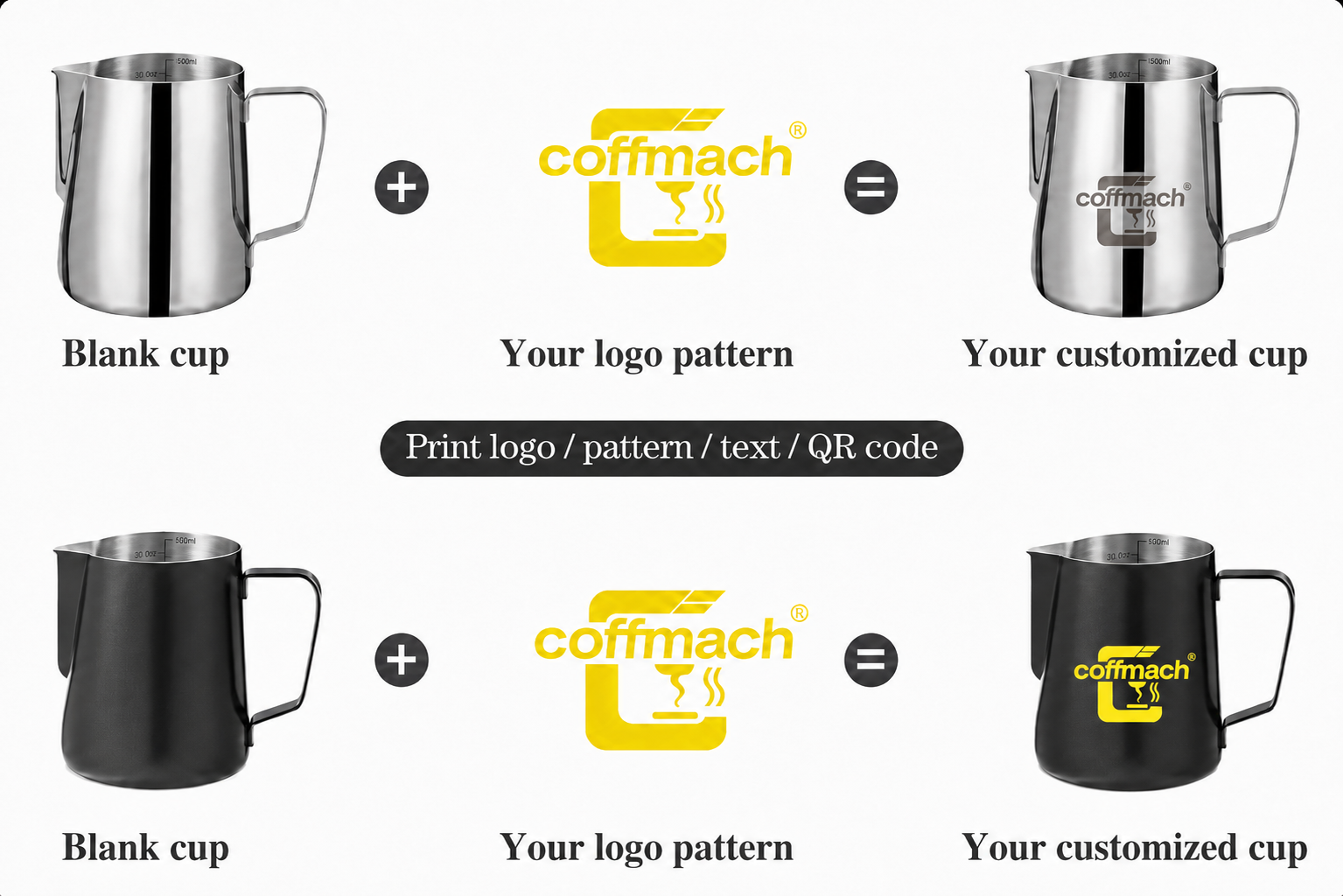
Coffmach's current product page shows laser, stamped, engraved/etched, silk-screen, transfer and UV-sticker methods. Each has a different visual effect and approval burden. Laser or engraving can create a durable monochrome mark. Stamping changes the surface physically and needs controlled depth. Printing and transfer methods can provide color but require adhesion and cleaning tests. A sticker may suit promotional or packaging use but should be evaluated carefully for heat, washing and food-contact boundaries.
Packaging options
Available project options can include a simple protective bag, plain or printed box, label, insert, barcode and retail-ready package. Select packaging by channel: café bulk packs prioritize protection and efficient unpacking, while retail and e-commerce packs also need shelf communication, barcode placement and delivery protection.
| Feature | Define before sampling | Check on the packed sample |
|---|---|---|
| Logo artwork | Vector file, size, position, orientation, color and clear space | Sharpness, alignment, contrast, distortion and durability |
| Measurement marks | Units, line values, origin, tolerance and marking process | Volume check, legibility, position and cleaning resistance |
| Individual protection | Bag, tissue, sleeve, film or divider appropriate to the finish | No rubbing, staining, trapped moisture or sharp contact |
| Retail box | Dieline, board, printing, insert, opening and required text | Fit, presentation, scuffing, barcode scan and closure |
| Master carton | Pack count, orientation, dividers, weight and destination marks | Movement, compression and appropriate transport/drop performance |
Which Coffmach milk pitcher options fit your customer?
The right range depends on who uses the product and what problem it solves. The examples below are starting configurations, not claims that one SKU fits every machine or market.
For home-barista retail
Begin with a 350ml handled 304 stainless steel pitcher and a centered medium spout. Natural polished stainless or one durable neutral color keeps the offer easy to understand. Add internal marks if they are accurate and readable. A 600ml companion SKU serves customers who make large drinks or two coffees.
For café chains
Prioritize a repeatable 350ml/600ml system, wet-hand grip, centered geometry, durable finish, clear dose marks and easy cleaning. Test on every espresso-machine family used by the chain. If colors identify dairy and plant recipes, integrate them into the documented allergen and cleaning procedure rather than relying on color alone.
For distributors and private-label brands
Build a small product ladder: a natural stainless core model, one premium finish and two capacities with common parts or artwork where possible. Confirm packaging, barcodes and reorder controls. Avoid launching many near-identical capacities or colors until sell-through data supports them.
For advanced latte-art customers
Offer a focused, longer spout only after testing it with the target milk dose and cup. Include a geometry drawing and useful product photography that shows the top opening and side profile. Do not market a sharp tip as a substitute for microfoam skill.
For promotional and gift programs
Logo visibility and packaging may lead the decision, but the pitcher must remain a usable coffee tool. Select a stable capacity, safe rim, clean interior and durable mark. If the item is mainly decorative, describe its intended use accurately rather than implying professional latte-art performance without testing.
How to evaluate a milk pitcher sample
A photo can approve color direction, but it cannot prove capacity, stream quality, handle comfort or cleaning performance. Use one written test plan for the supplier, buyer and inspector.
Simple scorecard
| Category | Pass question | Evidence to retain |
|---|---|---|
| Fit for recipe | Does the normal dose provide controlled milk depth and headspace? | Dose, machine, temperature, photos and operator notes |
| Pour control | Is the stream centered and repeatable at required flow rates? | Water and milk test video or recorded observations |
| Ergonomics | Can users hold and pour it safely as weight decreases? | Multi-user feedback and handle measurements |
| Cleanability | Can all milk-contact surfaces be inspected and cleaned? | Care method, post-cycle inspection and photos |
| Appearance | Does the finish match the approved range without visible defects? | Signed color/finish master and defect limits |
| Brand execution | Are the logo and marks correctly positioned and durable? | Artwork approval, position drawing and test results |
| Packaging | Does the product arrive without rubbing or distortion? | Packed sample, pack-out photos and transport test plan |
How to request a Coffmach milk pitcher quotation
A useful RFQ removes assumptions. “600ml black pitcher with logo” is not enough because it does not define the working geometry, stainless grade, coating, mark method or package.
| RFQ field | Information to send | Why it matters |
|---|---|---|
| Use case | Home, café, training, gift, retail, e-commerce or food-service program | Sets priorities for durability, appearance, pack-out and instructions |
| Drink and machine | Milk dose, cup size, target patterns, espresso machine and steam wand | Guides capacity, diameter, depth and geometry |
| Size and shape | Capacity, overall dimensions, opening, base, taper, spout and handle | Creates an inspectable functional product |
| Construction | Base material, grade, wall targets, weld/joint and interior finish | Separates real construction from appearance names |
| Finish | Process, color reference, gloss/texture, care limits and defect criteria | Controls visual variation and durability expectations |
| Markings | mL/oz values, locations, tolerance, logo artwork and marking process | Supports accurate dosing and consistent branding |
| Compliance | Destination market, intended use and required documents/tests | Lets the supplier assess applicable project requirements |
| Commercial details | Forecast, trial quantity, target quantity, delivery location and timing | Allows current MOQ, price, tooling and lead-time evaluation |
| Packaging | Bulk/retail/e-commerce pack, artwork, barcode, labels and carton marks | Prevents the product from being approved separately from its delivery system |
A practical development sequence
- Send the use case, target specification, artwork, forecast and destination market.
- Review current Coffmach models before requesting new tooling or geometry.
- Approve the drawing, material/finish route and quotation assumptions.
- Order and test the functional sample, branded sample and packed sample as needed.
- Sign the golden sample and inspection criteria before mass production.
- Check a production sample or pre-shipment lot against the same controlled references.
- Keep versioned artwork, drawings and change approvals for repeat orders.
Build the right milk pitcher range for your market
Send your milk dose, cup, steam machine, preferred capacity, spout, material, finish, measurement marks, logo, packaging, quantity and destination. Coffmach can review current models and support sample-based OEM/ODM development.
Care after purchase
Rinse milk before it dries, wash with warm water and mild detergent, use a soft non-abrasive tool, rinse fully and dry. KitchenAid's current espresso care guide provides the same warm-soapy-water approach for its milk pitcher. Give priority to the instructions for the exact Coffmach sample, especially when it has a colored coating, print or sticker. Do not promise dishwasher suitability unless the approved product documentation supports it.
See Coffmach's dedicated guide on how to clean a milk pitcher and remove dried milk.
Frequently asked questions
What milk pitcher sizes does Coffmach offer?
Coffmach's current product page lists ready-stock milk pitcher capacities from 100ml to 1500ml, with custom sizes also subject to project review. For many coffee programs, 350ml and 600ml are the most practical starting pair. The final choice should follow the actual milk dose, cup, steam wand, desired headspace and pouring workflow.
Which Coffmach milk pitcher is best for latte art?
Start with a 350–450ml handled stainless steel pitcher, a centered moderate spout and a body that gives the normal milk dose useful depth and expansion room. Add a 600ml option for larger drinks. A sharper specialist spout can help fine placement, but only after the barista can produce glossy, integrated microfoam consistently.
Does Coffmach offer 304 stainless steel milk pitchers?
Yes. The current Coffmach product page lists 304 stainless steel and also identifies 316 as an available option. Confirm the exact grade, model, wall construction, finish and documentation in the quotation. A grade name alone does not define the finished pitcher's weld, rim, capacity accuracy or coating quality.
Can I order a colored milk frothing pitcher?
Yes, subject to current model, finish process, quantity and sample approval. Coffmach shows natural stainless, electroplated, PVD, painted, engraved and transfer effects. State the base metal and surface system separately, approve a physical color range and test the chosen finish with the actual cleaning and packaging routine.
Can Coffmach add my logo to a milk pitcher?
Yes. Current options shown include laser, stamping, engraving or etching, silk screen, transfer and UV sticker methods. The best method depends on the finish, artwork, color requirement, cleaning routine, quantity and target cost. Supply vector artwork and approve the size, position, contrast and durability on a physical sample.
Can measurement marks be customized?
Yes, measurement marks can be included or customized subject to the selected model and process. Define whether the marks use milliliters, US fluid ounces or both; specify every line value and position; and agree on accuracy and durability tests. Marked capacity is not automatically the recommended milk fill for steaming.
Does Coffmach provide custom packaging?
Yes. The current page lists boxes, bags, labels, cards, inserts and barcode-related support. Choose bulk, retail or e-commerce packaging according to the sales channel. Approve the dieline, artwork, product protection, packed fit, barcode performance and master-carton configuration before mass production.
Can I request a sample before a bulk order?
Yes. Coffmach's current page states that samples can be provided, including custom-logo or packaging samples where applicable. Use the sample to test capacity, geometry, pouring, steaming, handle strength, finish, marks, cleaning and packaging. Retain the signed approved unit as the golden sample for production comparison.
What is the minimum order quantity for a custom milk pitcher?
MOQ depends on the current stock model, material, finish, logo method, packaging, tooling and production plan. The product page gives a general custom-order range, but buyers should request a current project-specific quotation rather than publish one number as permanent. Stock and custom orders may have different minimums.
How should I clean a colored Coffmach milk pitcher?
Follow the care instructions approved for the exact coating or decoration. As a safe general starting point, rinse promptly, wash with warm water and mild detergent using a soft tool, rinse completely and dry. Avoid abrasive pads and do not claim dishwasher compatibility unless the product documentation specifically permits it.
Technical sources and image credits
- Coffmach — Coffee Milk Jug. Current internal product reference for capacities, materials, finishes, logo methods, packaging and OEM/ODM options.
- La Marzocco — How to Steam Milk. Manufacturer examples for 12oz and 20oz pitcher selection, fill level and milk-steaming workflow.
- Breville — How to Steam Milk. Current manufacturer guidance on pitcher fill, expansion room and basic texturing.
- Fellow — Eddy Steaming Pitcher. Model-specific example showing how spout, crease and tapered body are presented as one geometry system.
- Outokumpu — Core Range Datasheet. Primary material reference for 304/4301 stainless steel characteristics and typical applications.
- KitchenAid — Espresso Machine Care and Cleaning. Manufacturer guidance supporting warm, soapy water for cleaning a milk pitcher.
- All seven images are internal Coffmach Coffee Milk Jug product-page images selected to match the capacity, geometry, finish, color and branding sections. Captions identify their content and source in plain text. The images are not clickable.