MILK PITCHER SIZES · ML & OZ · COFFEE WORKFLOW
What are the common sizes of milk jugs?
For coffee, the most common milk jug sizes are 350ml (about 12 US fl oz), 600ml (about 20 US fl oz) and 900–1000ml (about 32–34 US fl oz). Smaller 100–300ml jugs and larger 1.2–1.5L models serve more specialized jobs.
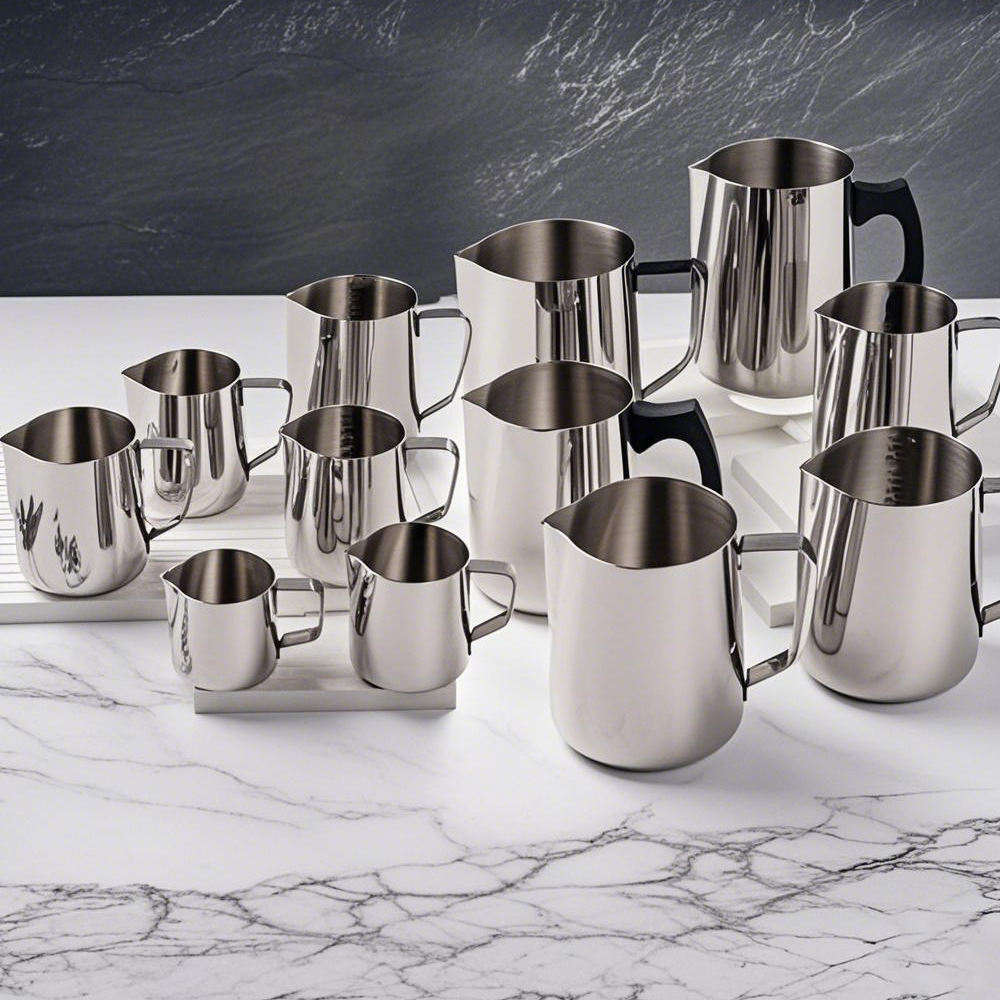
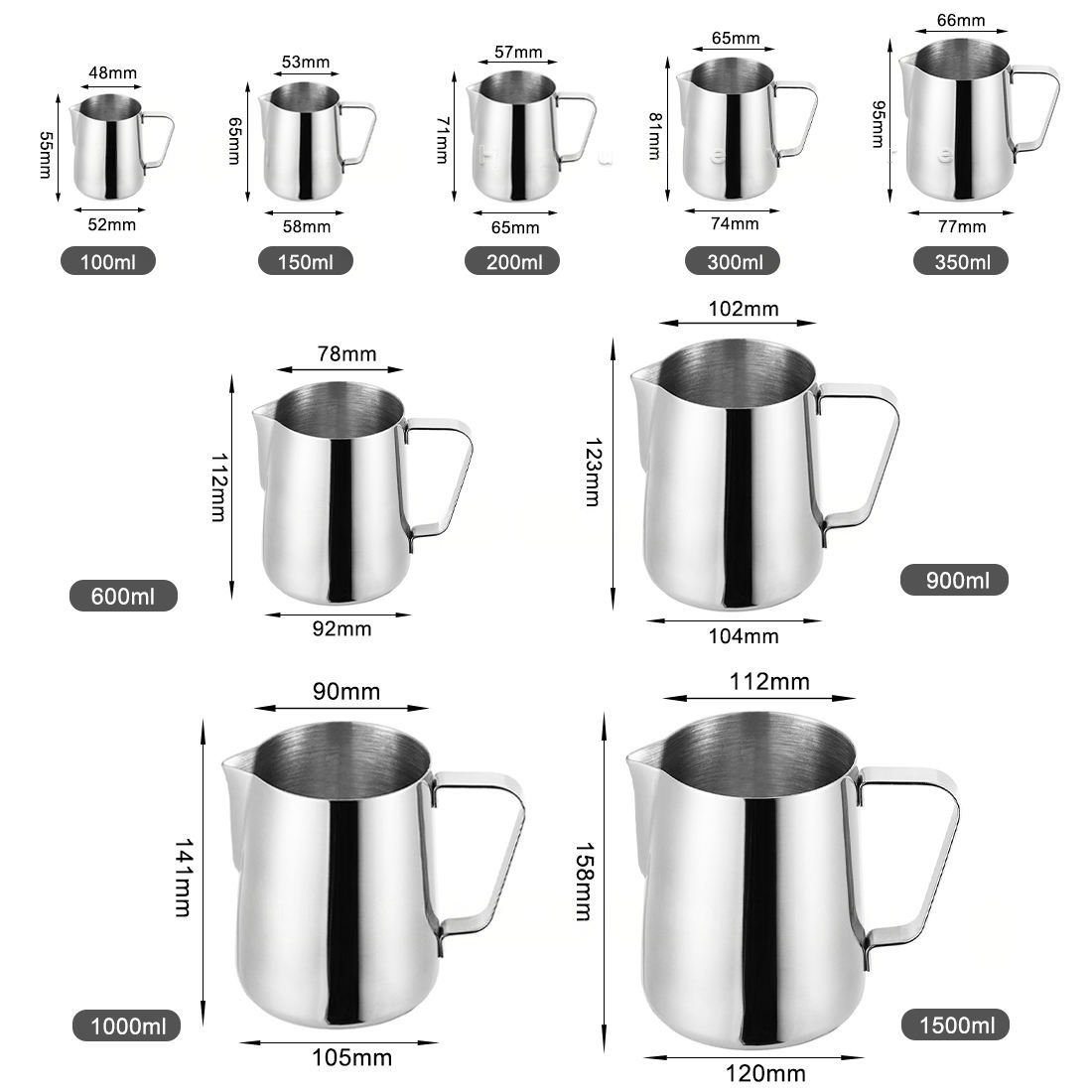
The short answer: 350ml, 600ml and 1L cover most coffee work
These are common market groupings, not compulsory standards. For example, La Marzocco currently offers 12oz and 20oz steam pitchers, while professional equipment guides also use 12oz, 20oz and 32oz classes. Individual suppliers may label similar products as 350ml, 600ml and 950ml, or round them to 360ml, 590ml and 1L.
- 350ml/12oz: the usual single-drink pitcher for a cappuccino, flat white or modest latte.
- 600ml/20oz: the versatile all-rounder for two small drinks or one large milk beverage.
- 900–1000ml/32oz: a supporting commercial size for tested high-volume recipes.
- A jug's stated capacity is larger than the amount of cold milk you should put into it.
- Height, diameter and spout placement can make equal-capacity pitchers behave differently.
- Home users usually need one or two sizes; cafés benefit from a recipe-based size system.
The rest of this guide gives a complete milk pitcher size chart, converts ounces to milliliters, and shows how to select a jug without overfilling it or wasting milk.
Common milk jug sizes: full chart
The chart below covers the sizes buyers are most likely to see in coffee-accessory catalogs. “Likely use” means a sensible starting application, not a guaranteed drink count. Cup volume, espresso, flavorings, target foam, and the amount left in the jug all change the result.
| Metric size | Approximate US fl oz | Likely coffee use | What to check |
|---|---|---|---|
| 100–200ml | 3–7oz | Espresso, cream, sauce, tasting or measuring | Often too shallow for steam-wand microfoam |
| 250–300ml | 8–10oz | One very small milk drink or compact-machine workflow | Limited expansion margin; wand fit is critical |
| 350–400ml | 12–14oz | One cappuccino, flat white or standard latte | Large single drinks may need the next size |
| 450–500ml | 15–17oz | One medium-to-large drink; bridge between core sizes | Less universally stocked than 350ml and 600ml |
| 590–650ml | 20–22oz | Two smaller drinks or one large takeaway drink | A small dose may be too shallow in a wide jug |
| 750ml | About 25oz | Two generous drinks or selected café recipes | Confirm steam power and finished pitcher weight |
| 900–1000ml | 30–34oz | Larger-volume steaming, automatic systems or batch tasks | Reduced precision for one drink; foam can separate while splitting |
| 1200–1500ml | 41–51oz | Special batch heating, mixing or serving | Requires compatible equipment and safe handling |
Why 350ml is a common single-cup size
A jug in the 350ml class holds enough cold milk for many one-cup recipes while leaving useful room for expansion. Its smaller body keeps a modest dose deep enough for the steam tip, and the lower finished weight makes detailed pouring easier. It is also a practical way to reduce leftover milk when a café prepares orders one at a time.
Why 600ml is the all-rounder
The 600ml milk jug sits in the middle of the useful range. It can handle two smaller coffee drinks, a large latte, or occasional guest service at home. For many buyers, this is the safest single size to test first. However, it does not replace a smaller pitcher when the daily recipe uses only a little milk.
Why 900–1000ml is not automatically better
A large steaming pitcher reduces the number of cycles only when the espresso workflow, drink queue and machine can use the extra volume. More milk takes more energy to heat. The full jug is heavier, a small steam wand may struggle to create circulation, and microfoam can lose uniformity while the batch waits or is divided. Treat a 32oz-class pitcher as a job-specific tool.
Milk jug sizes in milliliters and ounces
Capacity names can be confusing because some stores use milliliters and others use fluid ounces. NIST lists one US fluid ounce as approximately 29.5735ml. Using that conversion, 12 US fl oz is about 355ml, 20 US fl oz is about 591ml, and 32 US fl oz is about 946ml.
| US fluid-ounce label | Calculated metric volume | Common rounded product label | Buying note |
|---|---|---|---|
| 8oz | 237ml | 240ml or 250ml | Confirm whether this is a steaming or serving model |
| 10oz | 296ml | 300ml | Often used for a small single drink |
| 12oz | 355ml | 350ml or 360ml | Common single-drink class |
| 16oz | 473ml | 450ml or 500ml | Supplier labels vary more in this middle range |
| 20oz | 591ml | 590ml or 600ml | Common two-small-drink class |
| 25oz | 739ml | 750ml | Useful bridge size in some catalogs |
| 32oz | 946ml | 950ml or 1000ml | Common large professional class |
These conversions explain why two listings may describe nearly the same pitcher with different numbers. They do not prove the exact physical capacity. The declared volume may be rounded, and suppliers may use different measurement methods or tolerances. For wholesale orders, put the required milliliters, tolerance and measurement method on the approved specification.
US ounces and Imperial ounces are different
One Imperial fluid ounce is about 28.413ml, so it is not identical to a US fluid ounce. Coffee-accessory listings often use “oz” without saying which system is intended. The difference is modest for everyday use but matters when packaging, capacity marks and product data must agree. Ask the supplier to identify the unit.
Rated capacity is not working capacity
An illy professional preparation guide uses roughly 40–60% of pitcher capacity, or the bottom of the spout, as working guidance for its described process. This can be a useful first test, but it is not a universal fill rule. Spout height, body taper, milk formula and the desired foam level all vary.
Internal marks make size testing easier
Visible milliliter and ounce marks help operators repeat the starting quantity. A café can assign one line to each recipe, observe the finished yield and calculate leftover milk.
For product sourcing, specify mark positions, units, tolerance, production method and durability. A mark that is clear on a dry sample may be hard to read through moving milk or may not survive the intended cleaning process.
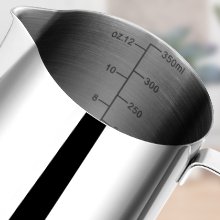
Which milk jug size fits each drink?
The jug should fit the amount of milk needed before steaming, not only the name of the beverage. A cappuccino and a flat white served in the same cup may need different starting amounts because their foam structures and final ratios differ. Recipes also vary between cafés.
Cortado or piccolo
Consider 250–350ml. Test that the steam wand reaches a useful depth and that the small milk amount can circulate without splashing.
Cappuccino or flat white
Start around 350ml for one standard drink. Move up when the cup, milk amount or aeration target exceeds the safe working range.
Large latte
A 500–600ml jug often provides better headspace. Base the decision on the actual milk recipe after espresso and syrup volume are subtracted.
Two smaller coffees
Around 600ml/20oz is the normal starting choice. Divide the textured milk promptly and control how foam is shared between cups.
Two large drinks
Test 750ml or individual cycles. One large batch may save motion but can reduce consistency if the machine heats slowly or the milk waits.
Hot chocolate or batch work
900ml to 1.5L may be useful with compatible equipment. Large models are less suited to fine single-cup latte-art pouring.
One drink: usually 350ml
For a typical single specialty-coffee drink, a 350ml pitcher provides a useful balance of milk depth, expansion room and pouring control. Smaller 250–300ml models can work for compact recipes, but they have less margin when the foam expands. Larger 500–600ml models work when the drink itself is larger, although a small dose may become too shallow.
Two drinks: usually 600ml
A 600ml/20oz pitcher is a practical starting point for two smaller cappuccinos, flat whites or similar coffees. It still needs a recipe check: two generous takeaway lattes may exceed its working range. See the dedicated guide to choosing a milk jug for two coffees for a more focused two-cup workflow.
Latte art: match milk quantity before spout style
A sharp or round spout changes how the stream leaves the jug, but neither compensates for the wrong working volume. Too little milk in a large jug can make steaming unstable. Too much milk in a small jug can overflow and leave no room to build microfoam. Select capacity first, then compare spout geometry, handle position and balance.
Plant milk: test the actual formula
Oat, soy, almond and other plant drinks do not all expand or hold foam in the same way. Even two barista-formula oat drinks can behave differently. Do not assign a larger jug only because a product is plant-based. Steam the normal measured quantity, observe expansion and choose the smallest pitcher that provides safe headspace and stable circulation.
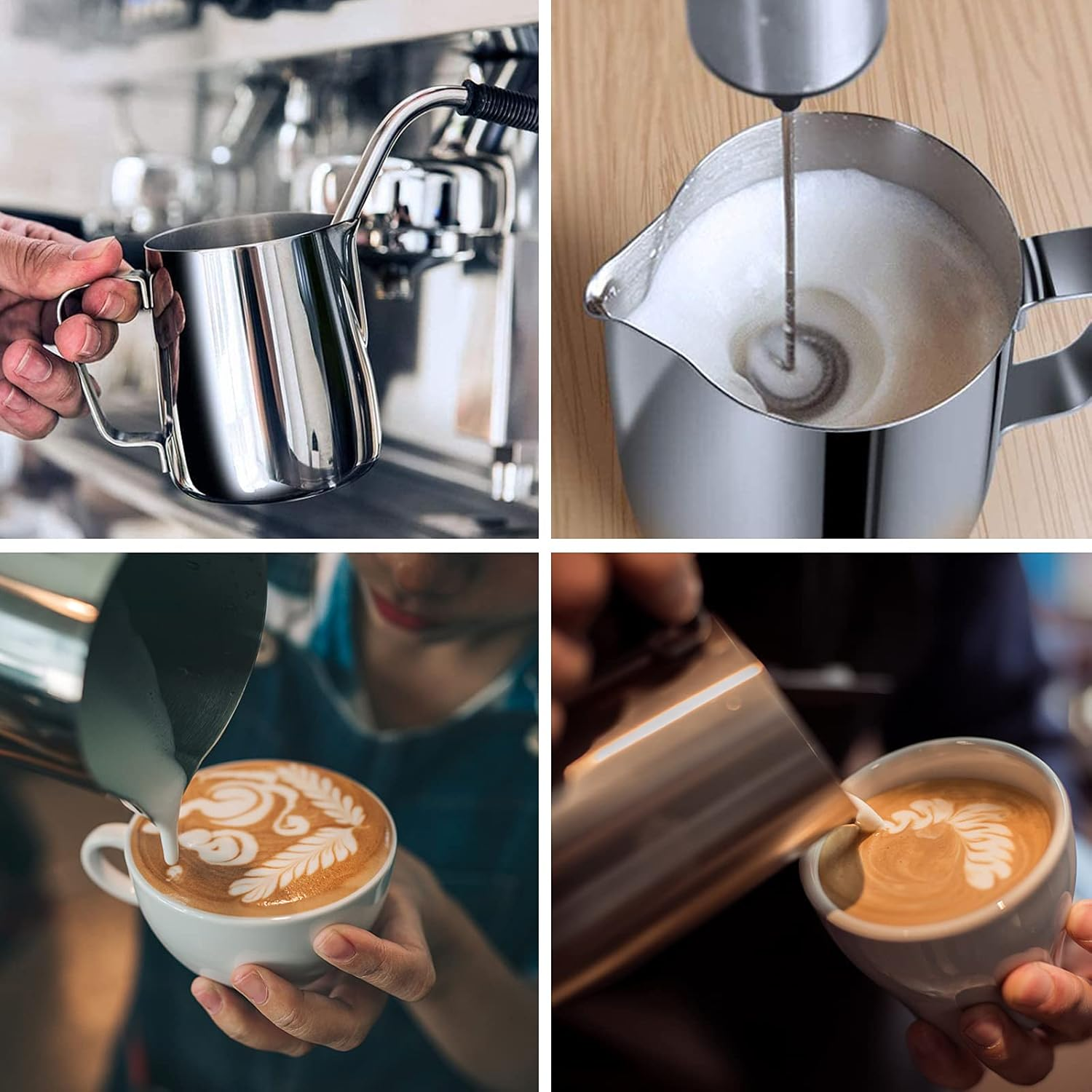
How to choose a milk jug size in seven steps
The following method works for a home machine, a café recipe rollout or an OEM coffee-accessory project. It replaces guesswork with a short practical test.
A quick sizing example
Illustrative scenario: a café's tested single-drink recipe starts with 180ml of cold milk. A 350ml pitcher leaves meaningful room for expansion and keeps the milk relatively deep. The same 180ml in a wide 1L jug may not cover the steam tip properly. If two orders use a verified combined starting amount of 330ml, a 600ml jug may be a better test. These figures illustrate the method; they are not universal drink recipes.
Why pitcher shape changes the answer
Capacity describes volume, but milk behavior depends on dimensions. A tall, narrow 600ml pitcher produces more depth than a short, wide 600ml pitcher at the same fill. Base shape and wall taper influence the roll that incorporates larger bubbles into a finer texture. Spout position changes the visual fill cue, and handle geometry changes the usable pouring angle.
Why the espresso machine matters
A commercial machine with strong, dry steam may heat a large milk mass quickly. A smaller home unit may take longer, allowing foam to become less uniform or the milk to overheat before a stable roll develops. Conversely, a powerful wand can inject air into a small volume very quickly. Test the jug as part of the complete machine, wand, milk and recipe system.
Three warning signs that the size is wrong
- Milk rises close to the rim: the jug is too small for the starting amount and expansion target.
- The steam tip cannot stay submerged: the jug may be too large, too wide or incompatible with the wand geometry.
- A large amount remains after pouring: the starting recipe, jug choice or order-batching method is creating waste.
Recommended size sets for home, café and retail
Most users do not need every capacity in a supplier's catalog. A small, well-tested set is easier to learn, clean and replace. The ideal combination depends on the range of drinks rather than the number of people using the equipment.
Best single jug for a home barista
If you normally make one smaller drink, begin with a 350ml/12oz class. If you alternate between one large drink and two smaller drinks, a 600ml/20oz model is more flexible. Before buying, check that your steam wand reaches the expected starting milk depth. A popular size can still be a poor match for a particular compact machine.
Best two-jug home set
A 350ml and 600ml pair is the most useful general combination. The small jug handles daily single cups with better depth and less waste; the larger jug covers guests and larger recipes. This pair also lets a learner compare how body width and fill level change the vortex.
Core café set
Build around enough 350ml and 600ml pitchers to support the normal bar cycle. Add 500ml or 750ml only when recipes fall between those core sizes. Add 900–1000ml only when a machine and service method have been tested for larger batches. Color coding can separate dairy, alternative milk or allergen-control workflows, but local hygiene procedures remain essential.
Retail or distributor assortment
A clear good-better-best range is easier for customers to understand than a wall of near-identical capacities. A retailer might use 350ml as the single-drink option, 600ml as the versatile option and 950ml as the large professional option, then carry specialty mini or 750ml sizes only when local demand supports them. Product descriptions should state both milliliters and the correct ounce system.
Private-label range planning
Keep shared features consistent across sizes: steel grade, finish, logo position, mark style, handle family and packaging language. Then validate each capacity individually because scaling the body can change balance, welding access, spout behavior and carton dimensions. Coffmach's current coffee milk jug range spans 100ml to 1500ml and supports capacity, finish, logo, marking and packaging customization.
What to check when buying milk jugs
Capacity gets the search, but construction and dimensions decide whether the pitcher works well. Use the following checklist for a single purchase, a café rollout or a wholesale request for quotation.
| Item | What to verify | Reason |
|---|---|---|
| Capacity | mL, ounce system, tolerance and measurement method | Prevents rounded labels from becoming specification disputes |
| Dimensions | Overall height, opening, base, spout height and handle clearance | Determines wand fit, milk depth and storage fit |
| Material | Grade, food-contact documents and surface finish | Supports durability, cleaning and market requirements |
| Wall construction | Thickness target, forming consistency and rim finish | Affects heat feedback, stiffness and perceived quality |
| Spout | Alignment, edge finish and flow with target recipes | Influences clean pouring and latte-art control |
| Handle | Weld quality, finger clearance and full-jug balance | Influences comfort and safe control |
| Measurement marks | Units, positions, readability and wash durability | Supports repeatable recipes and waste control |
| Branding | Artwork limits, color standard, process and approved sample | Makes visual expectations measurable |
| Packaging | Protection, barcode, insert, carton count and drop-test plan | Reduces damage and retail rework |
Do not approve a range from capacity labels alone
Request samples of the intended sizes and use them on the actual machine. Measure brim capacity and critical dimensions, steam every priority milk product, pour every target cup, then repeat cleaning. For a café chain, include operators with different experience levels. For a private-label buyer, retain an approved golden sample and inspection drawing.
Check workflow features after size
Internal marks help portion control. A comfortable handle supports repeated use. A centered spout and stable base assist clean pouring. The steel and finish should suit the cleaning system and sales market. For technique after selection, see Coffmach's guide on how to use a milk frothing pitcher. For daily care, follow the practical guide to rinsing and maintaining a coffee milk jug.
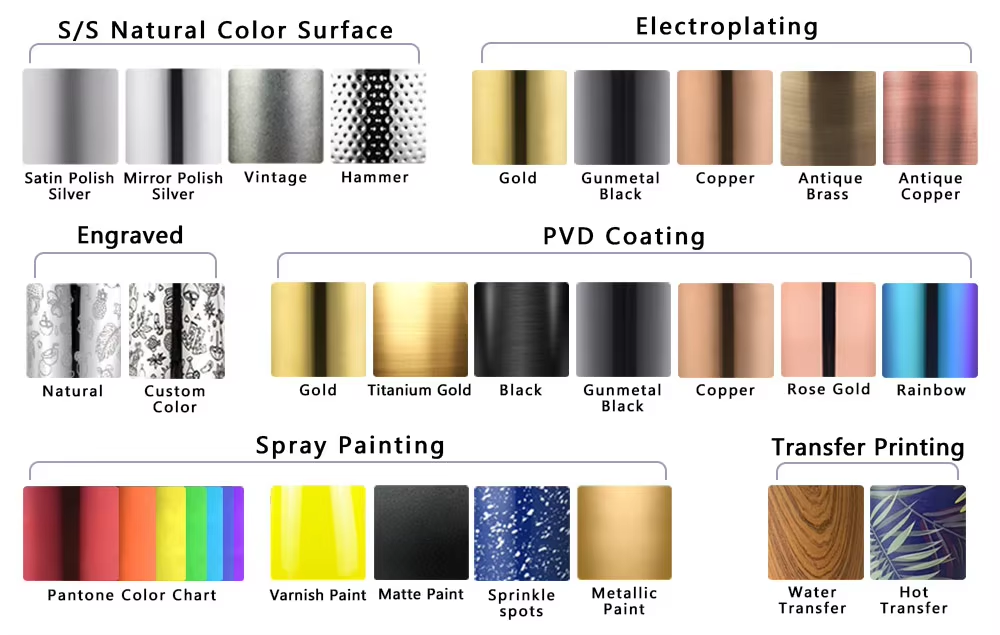
Need a tested milk jug size range for your market?
Coffmach supplies stock and custom coffee milk jugs with multiple capacities, food-grade stainless steel options, measurement marks, finishes, logos and retail packaging. Share your cup recipes, target machines and sales channel for a better sample plan.
Frequently asked questions about milk jug sizes
What are the three most common milk jug sizes?
For espresso drinks, the three common classes are about 350ml/12oz, 600ml/20oz and 900–1000ml/32oz. The first suits many single drinks, the second is a flexible two-small-drink size, and the third supports selected larger-volume café work. These are market conventions rather than mandatory standards.
What milk jug size is best for one coffee?
A 350ml/12oz-class pitcher is the usual starting point for one cappuccino, flat white or modest latte. Very small drinks may work in 250–300ml, while a large latte may need 500–600ml. Measure the cold milk and verify that the jug leaves headspace while keeping the steam tip submerged.
What milk jug size is best for two coffees?
Around 600ml/20oz is the common starting size for two smaller coffees. Two large takeaway lattes can require more capacity or two separate steaming cycles. Base the choice on the combined starting milk and expected expansion, then check that the machine can texture that volume efficiently.
Is a 12oz milk pitcher the same as 350ml?
They are close, but not mathematically identical. Twelve US fluid ounces is about 355ml, so 350ml is a convenient rounded product label. The physical brim capacity and tolerance can vary by model. Wholesale buyers should approve an exact metric capacity and test method rather than treating the labels as identical.
Is a 20oz milk jug the same as 600ml?
Nearly. Twenty US fluid ounces equals about 591ml, which manufacturers commonly round to 590ml or 600ml. A “20oz” name does not state how much cold milk should be used for steaming. Always leave room for expansion and validate the fill with the jug's actual shape.
Can I use a 600ml milk jug for one drink?
Yes, especially for a large latte, but it may be too wide for a small milk quantity. If the steam tip cannot sit at a useful depth or the milk does not form a stable roll, switch to a 350ml pitcher. The machine and body dimensions determine whether the larger jug works.
Should beginners buy a 350ml or 600ml milk pitcher?
Choose 350ml if you usually make one standard drink. Choose 600ml if you often make a large latte or two drinks. When budget permits, the 350ml-and-600ml pair is more useful than forcing every recipe into one pitcher. Test steam-wand reach before purchasing.
How full should a milk frothing jug be?
The milk needs enough depth for the steam tip and enough empty space to expand. Filling near the bottom of the spout or around half capacity is a common training reference, not a universal rule. Confirm the safe starting line for the exact jug, milk, drink and machine.
Does a larger milk jug make better microfoam?
No. A larger jug only helps when the recipe needs the capacity and the steam system can circulate the milk. Too large a body can leave a small dose shallow; too small a jug can overflow. Microfoam quality depends on correct fill, air introduction, circulation, temperature and prompt pouring.
What sizes should a café stock?
Most cafés can build their core around 350ml and 600ml pitchers, then add 500ml, 750ml or 900–1000ml only for documented recipes. Stock enough of each core size for the service cycle and cleaning routine. Standardize fill marks and test dairy and alternative milks before rollout.
Technical sources and image credits
- Coffmach — Coffee Milk Jug. Internal product reference for available 100–1500ml capacities, food-grade stainless steel options, measurement marks and OEM/ODM customization.
- La Marzocco Home — Steam Pitcher. Official current product example listing 12oz and 20oz steam pitcher sizes.
- La Marzocco — Wally Milk Quick Start Guide. Official equipment workflow example using 12oz, 20oz and 32oz pitcher classes.
- illy — Professional Espresso Preparation Guide. Official training source discussing a 12oz, 20oz and 32oz working set and suggested fill guidance for its described process.
- NIST — Guide to SI Conversion Factors. Authoritative reference for US and Imperial fluid-ounce conversions.
- All images in this article are internal Coffmach images from the Coffee Milk Jug product page. Their source is displayed as plain text, and the images are not wrapped in links.