ESPRESSO ACCESSORIES · COMPATIBILITY · CARE GUIDE
The Complete Guide to Portafilter: Types, Sizes & Cleaning
A portafilter looks simple, but its body, basket, locking ears and outlet must work as one system with the espresso machine. This practical guide explains the main types, common 51mm, 54mm and 58mm size families, compatibility checks and a safe cleaning routine.
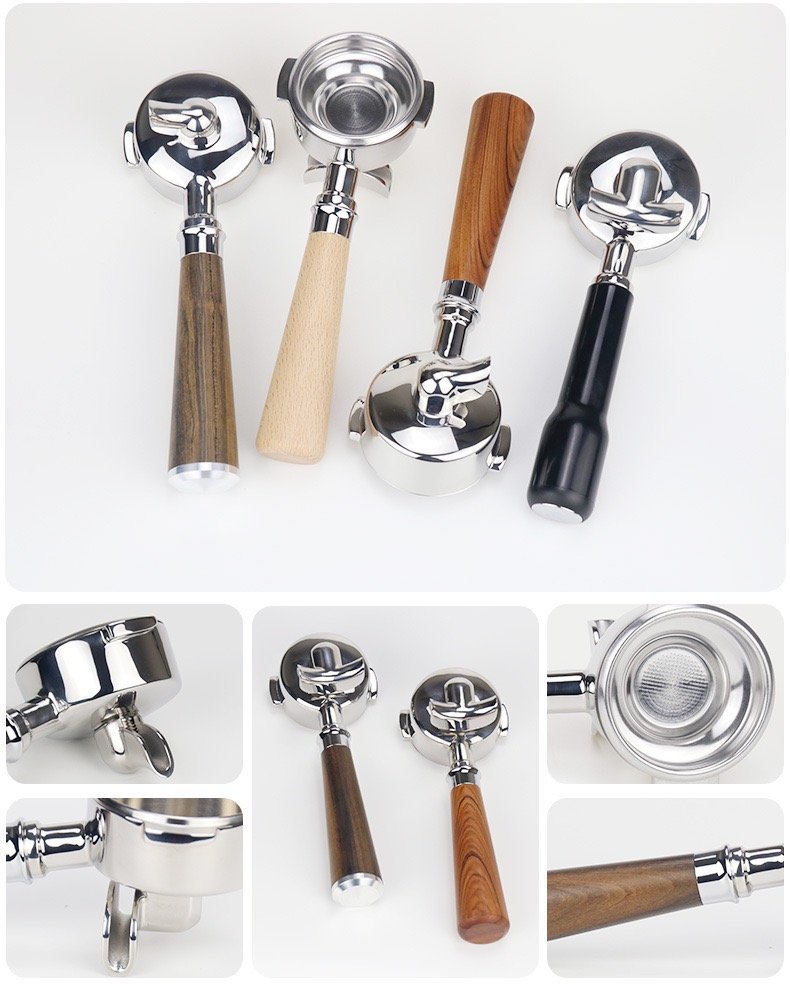
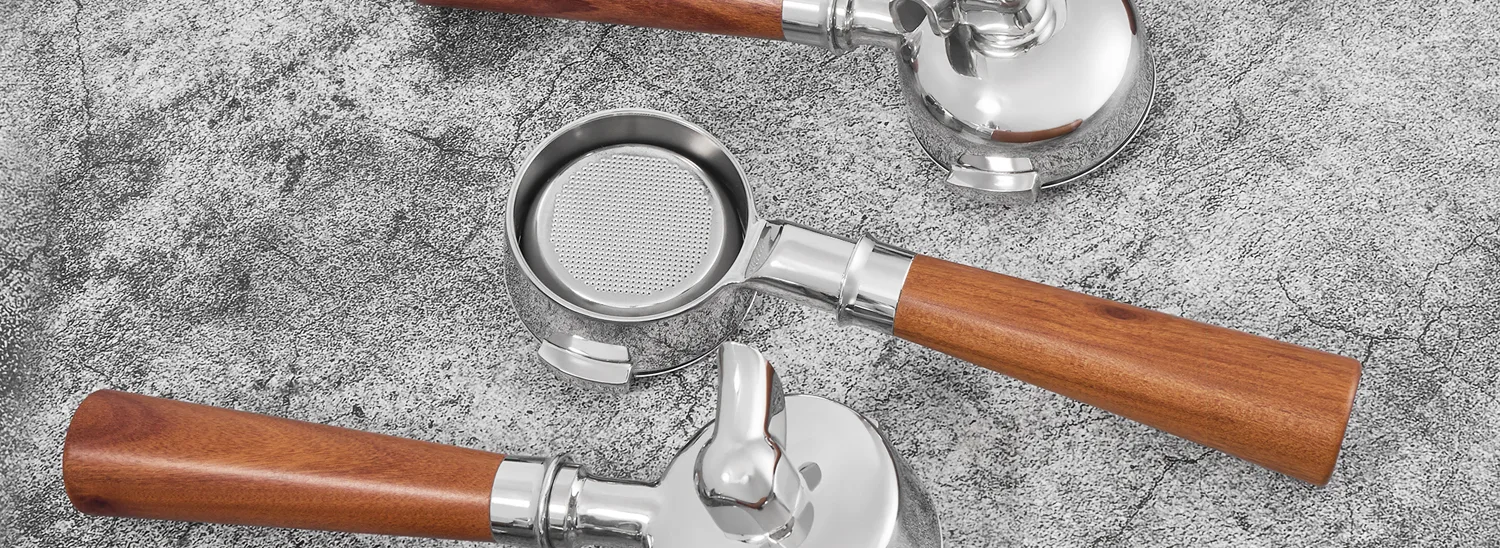
Quick answer: match the machine before choosing the style
For most beginners, the original machine-approved spouted portafilter is the safest starting point. A compatible pressurized basket is useful with pre-ground coffee or a limited grinder. A non-pressurized basket gives more recipe control when you have a capable espresso grinder. A bottomless portafilter is valuable for training because it exposes the underside of the basket, but it cannot correct poor puck preparation on its own.
Key takeaways
- Identify the exact espresso-machine brand, model, market version and original part number before ordering.
- Treat portafilter body style, basket pressure system and basket capacity as three separate decisions.
- Never assume two products with the same nominal diameter are interchangeable.
- Rinse the basket and portafilter after use so coffee oils do not dry inside holes and spouts.
- Soak only removable metal parts when their manufacturer permits it; protect wood, plastic and coated handles.
- Backflushing cleans an approved machine group. It is not the same task as washing the portafilter.
If you already know which area you need, use the navigation above. For a deeper comparison of body and basket categories, read Coffmach's 10 types of portafilters guide.
What is a portafilter, and how does it work?
The name combines “porta,” meaning carry or hold, with filter. In practical terms, it is the removable carrier that places a prepared coffee puck under the machine's water-delivery system. The user doses ground coffee into the basket, distributes and tamps it, wipes the rim, then rotates the portafilter into the group head. The locking action presses the basket rim against a gasket to form the brewing seal.
During extraction, hot water moves from the group head through the shower screen and coffee bed. The basket's perforated base allows brewed espresso to leave. A bottomless body lets it fall directly into the cup; a spouted body collects and guides it through one or two outlets.
Portafilter anatomy in plain language
| Part | What it does | What to inspect |
|---|---|---|
| Handle and end cap | Provides grip and leverage for insertion, locking and removal | Comfort, heat transfer, looseness, cracks and finish wear |
| Neck or connector | Joins the handle to the metal head | Secure thread or fastener, alignment and fatigue |
| Head or body | Supports the basket and, in spouted models, forms the lower collection chamber | Material, depth, cleanliness, basket seating and cup clearance |
| Locking ears / lugs | Rotate under matching surfaces inside the group head | Count, position, width, thickness, profile and wear |
| Filter basket | Holds the coffee puck and controls the perforated flow area | Rim, depth, capacity, wall shape, holes and pressure design |
| Retaining spring | Grips the basket so it remains in the body during normal knock-out | Tension, approved basket profile, corrosion and residue |
| Spout or open base | Directs one or two streams, or leaves the basket underside visible | Thread, blockage, split, alignment and cleaning access |
Portafilter, basket and group head are not the same part
The group head is fixed to the espresso machine. It delivers water and contains the machine-side locking and sealing features. The portafilter is removable. The filter basket sits inside it and holds coffee. Confusing the three can lead to the wrong replacement: for example, a leak around the rim may come from a dirty basket edge, worn group gasket, excessive dose or incompatible portafilter.
See the dedicated explanation of portafilter vs group head when diagnosing a machine-side problem.
Main types of portafilters
Portafilter labels overlap. One assembly can be bottomless by body style, non-pressurized by basket design, ridgeless by basket wall profile and fitted with a double-dose basket. Do not treat every label below as a completely separate product.
Bottomless / naked
No floor or spout below the basket. It shows flow formation, offers cup clearance and helps training, but spray can make weak preparation messy.
Single-spout
Guides the full extraction through one outlet. It suits one-cup service and narrow cups but does not split a shot.
Double-spout
Divides flow toward two outlets for two-cup service. The split may be uneven if the body, spouts or machine are not level or clean.
Pressurized system
A dual-wall basket or restricted outlet adds resistance. It is more forgiving of pre-ground coffee but gives less direct feedback from grind and puck preparation.
Non-pressurized system
A single-wall basket lets the coffee puck create most flow resistance. It rewards fresh coffee, a suitable grinder and repeatable preparation.
Pod-specific system
Designed for a named coffee pod format rather than loose grounds. Use only the machine-approved basket or assembly for that format.
Bottomless vs spouted: which should you choose?
Choose bottomless when you want to see how espresso forms under the basket, train distribution and tamping, or gain vertical cup clearance. Choose a spouted body when contained delivery, cleaner service and one- or two-cup routing matter more than extraction visibility.
A bottomless portafilter is a diagnostic window, not an automatic flavor upgrade. Centered flow can still hide problems inside the puck, while spray can result from grind, dose, distribution, tamp, basket condition, headspace or uneven group water. Use the observation as evidence, then change one variable at a time.
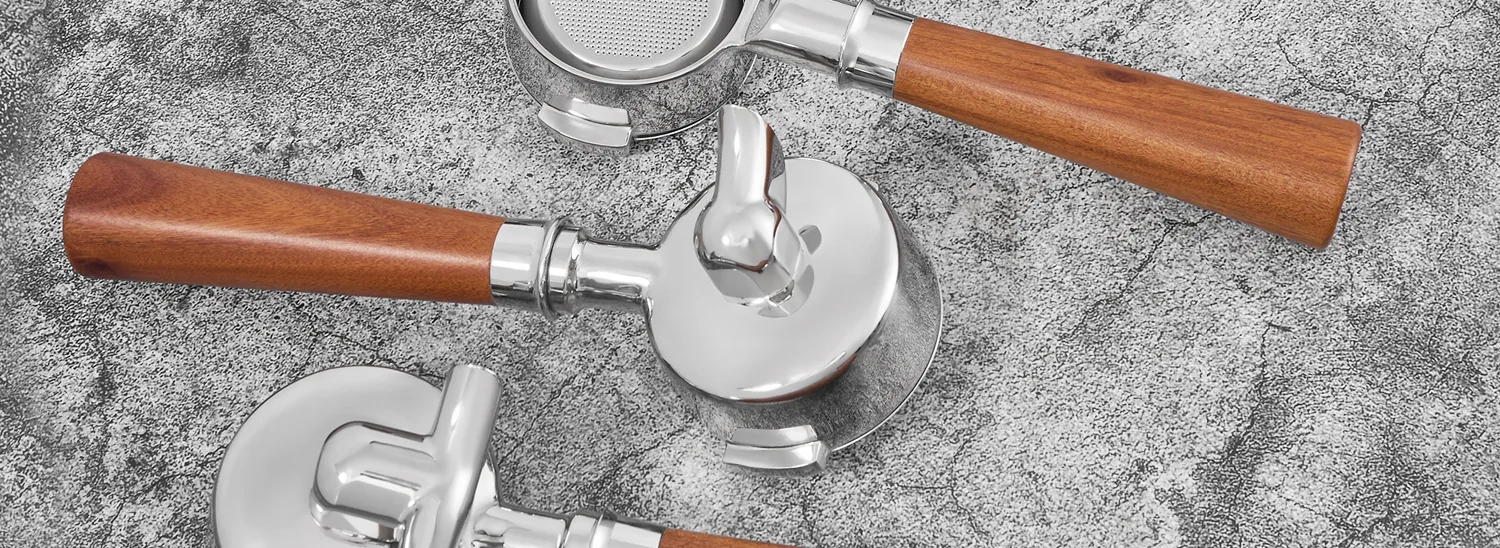
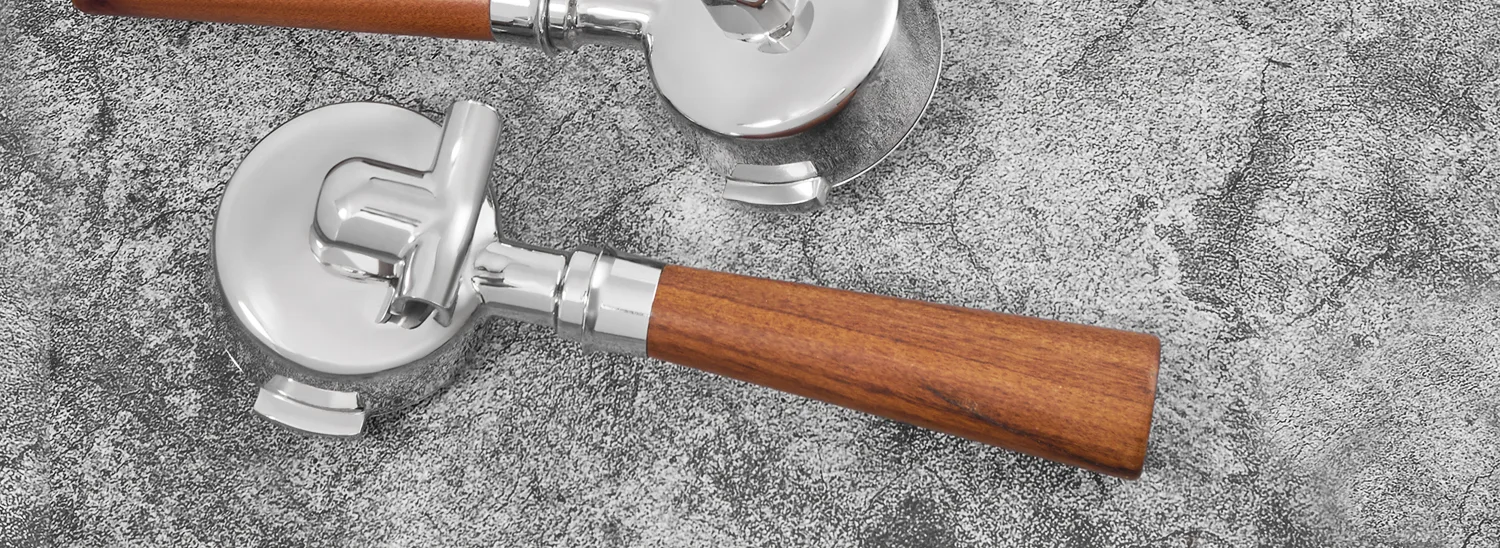
Single spout vs double spout
A single spout delivers one guided stream. A double spout can divide one extraction between two cups, but “double spout” does not mean “double basket.” Basket capacity and outlet count are independent.
For a busy café, inspect cup spacing, under-machine clearance, spout thread strength and cleaning access. If equal splitting matters, test the approved sample with the machine level and the outlets clean. Small alignment or flow differences can move more espresso to one cup.
Pressurized vs non-pressurized baskets
Breville's current explanation separates dual-wall pressurized baskets from single-wall non-pressurized baskets. In a typical dual-wall design, coffee passes through the perforated inner layer and then a restricted second outlet. This added restriction makes the setup more tolerant of pre-ground coffee and limited grind control. In a single-wall basket, the prepared coffee bed and grind create most of the resistance, so recipe changes are more visible.
| Question | Pressurized / dual-wall | Non-pressurized / single-wall |
|---|---|---|
| Best suited to | Convenience, pre-ground coffee or a grinder with limited fine adjustment | Fresh coffee, an espresso-capable grinder and recipe control |
| Main flow resistance | Coffee plus a restricted basket or outlet system | Mainly the ground-coffee puck and perforated basket floor |
| Feedback | Can mask some grind and preparation variation | Makes grind, dose and puck-prep changes more obvious |
| Cleaning focus | Perforations plus the small restricted outlet or insert | Basket holes, body chamber and spouts or open base |
Portafilter sizes: 51mm, 54mm and 58mm explained
The numbers most shoppers see—51mm, 54mm and 58mm—refer to a nominal basket or group family. Other sizes, including 53mm and 57mm, also exist. The label is useful for narrowing options, but it is not a complete mechanical standard.
Official examples show why. De'Longhi sells a 51mm bottomless portafilter for named La Specialista and Dedica Maestro families. Breville sells 54mm baskets for selected machines. La Marzocco describes a cleaning basket for its standard 58mm portafilters. Each statement combines a size with a brand or model family; none says every product with that diameter will fit every machine.
| Nominal family | Where buyers often see it | What the number does not confirm |
|---|---|---|
| 51mm | Many compact and entry-level home-machine accessory searches | Exact model, ear count and position, pressurized system, gasket seal, basket rim or tamper fit |
| 53–54mm | Selected home and prosumer machine families | Whether 53 and 54 labels describe compatible working geometry, cradle fit, lugs, depth or basket wall taper |
| 57mm | Specific legacy or model-dependent systems | Interchangeability with a 58mm accessory or a different 57mm group |
| 58mm | Widely used professional and prosumer size family | Group design, lug geometry, lock angle, basket rim, body depth, handle clearance or safe seal |
Why two “58mm” portafilters may not fit
The upper interface is more complex than one circle. Locking ears can differ in number, clock position, width, thickness, projection and profile. The body can sit at a different depth. The basket rim must meet the group gasket correctly, and the handle must rotate to a safe locking position without hitting the machine. Manufacturing tolerance and machine-gasket condition also affect feel.
That is why forcing a nearly compatible portafilter is unsafe. It can damage the gasket or locking surfaces and may fail to seal under hot-water pressure. Start with the exact machine's manual and official part reference. If developing an aftermarket product, use a dimensioned drawing, an approved original sample, the target machine and a controlled fit-and-leak test.
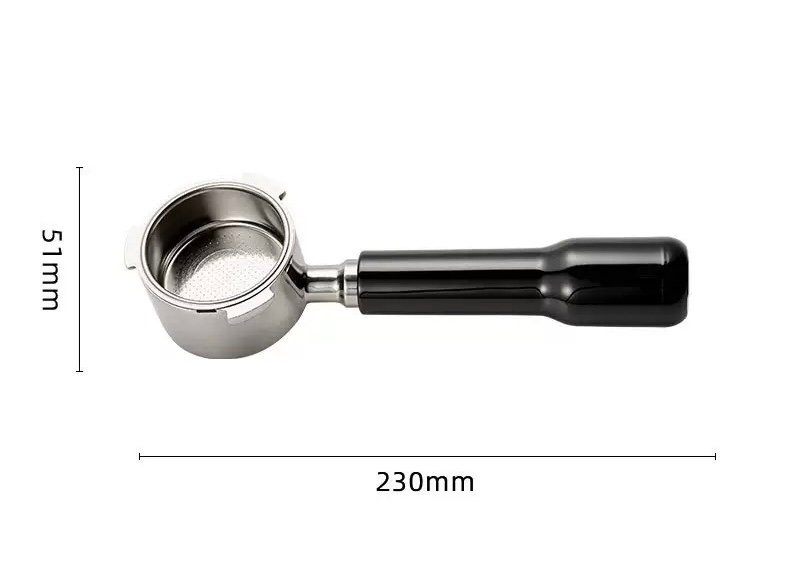
How to check portafilter compatibility
For measurement diagrams and a fuller compatibility checklist, use the Portafilter Size Guide for Espresso Machines.
Filter baskets: capacity, wall shape and retention
The basket may be removable, but it is central to how the system works. It defines the coffee chamber, perforated flow area, dose range and contact with the group gasket. “Single,” “double” and “triple” are capacity categories, not universal gram values. A manufacturer should publish or validate the intended dose for the exact basket.
Single, double and triple baskets
Single basket
Lower capacity and often tapered or asymmetric. It can reduce coffee dose but may be less forgiving to distribute and tamp evenly.
Double basket
A common everyday format with a broader coffee bed. Actual dose depends on depth, taper, hole area, coffee density and recipe.
Triple / high-capacity
Deeper for a larger dose. It requires enough portafilter-body depth and safe clearance below the shower screen or screw.
Do not force an overfilled basket into the group. If the dry puck contacts the shower screen or central screw before brewing, reduce the dose or use the correct basket. More basket capacity also does not mean the machine should use higher brew pressure; pressure remains a machine- and recipe-specific setting.
Ridged vs ridgeless baskets
A ridged basket has a circumferential indentation that engages the retaining spring. It can stay secure during knock-out but may take more effort to remove. A ridgeless basket has a smooth outer wall and is held by spring friction. It can be easier to change, but retention depends closely on basket dimensions and spring tension.
The ridge is not a locking ear. It sits on the basket wall and interacts with a spring inside the portafilter. The external ears belong to the portafilter body and lock into the machine.
Straight-wall vs step-down baskets
A straight-wall basket keeps a similar chamber width through much of its depth. A step-down basket uses a wider machine-side rim, then narrows into a smaller lower coffee chamber. At the same dose, that smaller chamber can create a deeper puck and may require different grind, tamper, funnel, paper and screen sizes. It is a recipe choice, not an automatic upgrade. Read the full step-down portafilter basket guide before changing the complete prep system.
Precision baskets
“Precision” usually describes tighter control over dimensions, hole pattern and finish. It should not be treated as a guarantee of better taste without a defined test. A different hole area or geometry can change flow and require a new grind setting. Check the maker's dose range, compatibility and care instructions; fine holes can be damaged by aggressive tools.
How to choose the right portafilter
A good buying decision follows the order in which the system must work. Compatibility is non-negotiable. Basket and coffee determine the brewing workflow. Outlet and handle then shape how the barista uses the part.
| User or need | Practical starting point | Main reason | Watch for |
|---|---|---|---|
| Beginner using pre-ground coffee | Original compatible spouted body with approved pressurized basket | Contained delivery and greater tolerance of limited grind control | Restricted outlet blockage and model-specific basket design |
| Home barista with espresso grinder | Compatible non-pressurized double basket; spouted or bottomless body | More direct recipe control and useful training options | Grind adjustment, distribution, headspace and basket fit |
| Training or shot diagnosis | Model-matched bottomless portafilter | Visible underside helps observe flow and spray | Mess, false conclusions and poor puck preparation |
| Two-cup café service | Compatible double-spout body with approved basket | Can route one extraction toward two cups | Uneven split, cup spacing and extra cleaning surfaces |
| Tall cup or scale clearance | Compatible bottomless or low-profile outlet | Removes part of the lower body or spout height | Basket exposure and splash management |
| Private-label product line | Controlled model list, drawing, golden sample and functional test | Turns a visual concept into a repeatable technical product | Claims based only on nominal diameter or appearance |
Material and handle choices
Stainless steel is valued for corrosion resistance and cleanability; chrome-plated brass can provide mass and a traditional polished appearance; other alloys and coatings depend on the product design. Do not judge durability from material name alone. Ask for the grade or substrate, manufacturing route, wall thickness where relevant, plating or coating specification, thread design and appropriate corrosion, torque and cycle tests.
Wood feels warm and supports a premium look but needs protection from long detergent soaks and standing water. Polymer handles can be durable, light and easy to standardize. Metal handles can offer a modern appearance but need a design that controls heat and grip. Test the complete handle for balance, wet-hand grip, rotation clearance and repeated locking load.
How to clean a portafilter safely
Coffee grounds and oils collect on the basket floor, under the basket rim, inside the body and in spouts. Rinsing before residue dries is faster than removing an old coating later. The correct routine depends on the machine and portafilter materials, so the manufacturer's manual always takes priority.
After every brewing session
Daily close-down cleaning
- Allow components to cool enough for safe handling and depressurize the machine as its manual directs.
- Remove the basket with the proper basket-removal method; do not damage its rim or the retaining spring.
- Wash the basket, the metal body cavity and removable metal spouts with hot water and a suitable brush.
- Check all basket holes against the light. Use only the manufacturer-approved cleaning pin or method for a blocked hole.
- Clean spout threads and internal passages where the design allows safe removal.
- Rinse thoroughly, dry the parts and reassemble them without cross-threading or excessive torque.
- Inspect the handle joint, lugs, basket rim and spring before the next service.
Deep cleaning with espresso detergent
Use a detergent made for espresso coffee oils and follow its label for concentration, water temperature, contact time and rinsing. Separate removable metal parts when the design permits. Do not immerse wood, painted parts, coated parts, plastic handles or a non-removable handle unless its manufacturer specifically approves that method. Long or overly strong soaking can discolor finishes, dry wood, weaken adhesives or leave residue.
After soaking approved metal components, brush the body, spring channel, basket and spouts, then rinse repeatedly with clean water. Reassemble and flush as the machine manual directs before making a drink. If any detergent odor or foam remains, continue rinsing.
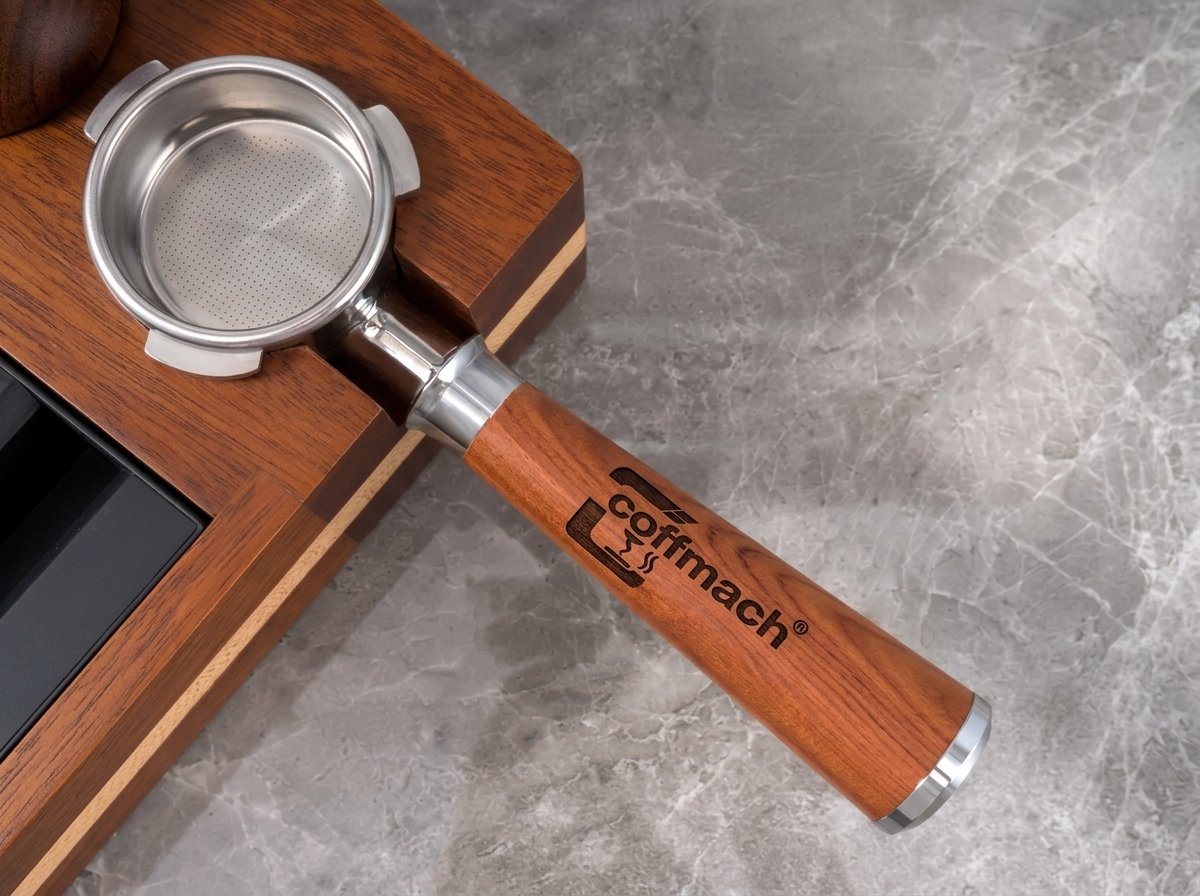
Backflushing is a different cleaning task
A blind basket has no brewing holes. On machines designed for backflushing, it redirects water through the group's cleaning path. La Marzocco's current app instructions for named machines call for a blind basket, cleaning detergent when applicable, an automated cycle and thorough rinsing. Other machines use different discs, cycles or no user backflush at all.
What not to do
- Do not put the portafilter or basket in a dishwasher unless the manufacturer clearly says it is dishwasher-safe.
- Do not use steel wool, abrasive pads or harsh chemicals that can scratch or attack the finish.
- Do not enlarge precision basket holes with a random needle or drill bit.
- Do not soak a wooden handle or leave it submerged with metal parts.
- Do not tighten a removable spout or handle beyond the approved torque.
- Do not clean hot, pressurized equipment until the manual's safe shutdown steps are complete.
Portafilter troubleshooting guide
A visible symptom does not prove one cause. Check cleanliness and the recipe first, then inspect compatibility and wear. Stop using a part that is cracked, severely corroded, distorted or unable to lock securely.
| Symptom | Check first | Other possible causes | Practical action |
|---|---|---|---|
| Water leaks around the rim | Coffee on basket rim and correct lock | Worn group gasket, overfilled basket, damaged rim or wrong interface | Clean and retest; verify dose and compatibility; service the gasket if required |
| Portafilter will not lock | Exact model match and empty-basket fit | Wrong ears, excessive dose, basket not seated, debris or swollen gasket | Stop—never force it. Compare the approved part and inspect the group safely |
| Handle locks too far | Gasket condition and specified lock position | Wear at lugs or locking surfaces, thin basket rim or mismatched body | Have the machine and part inspected; do not solve it with uncontrolled shims |
| Slow or blocked flow | Grind, dose and basket holes | Oil buildup, blocked pressurized outlet or clogged spout | Clean approved passages; keep the recipe controlled; replace damaged parts |
| Bottomless spray | Distribution, grind, dose and tamp | Basket damage, headspace, coffee freshness or uneven group water | Change one variable at a time and inspect the basket and group |
| Uneven two-cup split | Machine level, spout cleanliness and cup position | Spout alignment or uneven flow entering the lower chamber | Clean and level first; verify the spout assembly and controlled test |
| Basket falls out when knocking | Spring seating and basket profile | Weak spring, mismatched ridge or worn body channel | Fit the approved spring and basket; test retention over a safe surface |
| Metallic taste or stale odor | Old coffee oils in basket, body and spouts | Detergent residue, machine contamination or water issue | Deep-clean and rinse; isolate the component before replacing anything |
| Loose handle or spout | Thread and fastener condition | Repeated torque, heat cycling or damaged adhesive | Remove from service until repaired with approved parts and method |
When should a portafilter be replaced?
Surface scratches alone may be cosmetic, but deep corrosion, cracks, bent ears, damaged basket seating, severely worn locking surfaces or a connection that will not remain secure require attention. A loose or distorted pressure-bearing assembly should not remain in service. Compare it with the maker's wear limits and have the machine interface inspected as well; replacing only the portafilter will not repair a worn group.
Buying and OEM checklist for portafilters
“58mm bottomless portafilter with a wooden handle” is a product idea, not a complete specification. A reliable wholesale or private-label program controls the invisible machine interface as carefully as the visible handle and finish.
| Specification block | What to define | How to verify |
|---|---|---|
| Target machine | Brand, exact model, market, revision or serial range and original part reference | Current manual, parts catalog, original unit and approved model list |
| Locking interface | Head dimensions; ear count, position, width, thickness, projection, profile and insertion depth | Dimensioned drawing, gauge or fixture, golden sample and no-force fit |
| Seal and clearance | Basket rim, gasket contact, lock position, body depth, dose and screen clearance | Controlled hot functional and leak test on the intended machine |
| Body and outlet | Bottomless, single or double; removable spout thread; cup clearance and cleaning access | Flow, split, assembly torque, repeated use and cleaning inspection |
| Basket system | Pressure design, capacity range, rim, ridge, depth, hole specification and retaining spring | Approved sample, dimensions, retention and brewing test |
| Materials and finish | Metal grade or substrate, coating/plating, handle material, surface target and care limits | Documents plus suitable corrosion, adhesion, abrasion, heat and cleaning tests |
| Branding and packaging | Logo method, artwork zone, color, barcode, instructions, protection and destination labels | Signed artwork, packed sample and relevant transport testing |
Approve a functional sample, not only a photo
- Compare critical dimensions with the approved drawing and an original reference part.
- Check clean insertion, normal lock position, handle clearance and gasket seal on each named machine.
- Test all approved baskets for seating, retention, puck headspace and safe removal.
- Run repeated extraction, pressure, temperature, torque and cycle checks suitable for the intended use.
- Inspect cup clearance, spout routing, bottomless visibility and cleaning access.
- Repeat the approved care routine to check finish, handle and marking durability.
- Retain a signed golden sample and measurable acceptance criteria for production inspection.
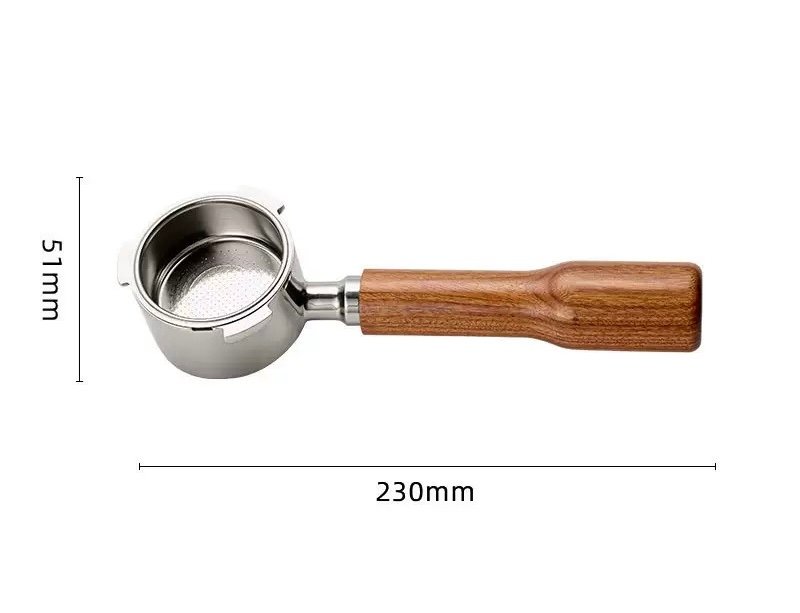
Coffmach offers bottomless, single-spout and double-spout portafilter options with material, handle, finish, logo and packaging development for distributors and coffee brands. Available configurations and compatibility are project-specific, so start with the exact machine model, original part and drawings rather than a diameter label alone.
Need a portafilter matched to your machine or brand?
Send the machine model, original part, interface drawing, basket, outlet style, handle, finish, quantity, logo and packaging requirements. Coffmach can support catalog evaluation, sampling and OEM/ODM development.
Explore current designs and customization options on the Coffmach Coffee Portafilter product page.
Frequently asked questions
What is a portafilter?
A portafilter is the removable handled assembly that holds an espresso filter basket and locks into the machine's group head. It supports the coffee puck during brewing and either guides espresso through one or two spouts or leaves the basket underside open in a bottomless design.
What portafilter size do I need?
Use the exact size and interface approved for your espresso-machine model. A 51mm, 54mm or 58mm label is only a starting point. Locking-ear geometry, insertion depth, basket rim, gasket contact and handle clearance must also match. Confirm an official part number or compatible-model list before buying.
Are all 58mm portafilters compatible?
No. Fifty-eight millimeters is a widely used nominal family, not a universal locking standard. Two products can differ in ear count, position, width, thickness, profile, body depth and sealing geometry. Never force a portafilter into a group because the diameter sounds correct.
Is a bottomless portafilter better?
It is better for visibility, training and cup clearance, but it does not improve extraction by itself. A spouted portafilter is better for contained delivery and one- or two-cup routing. Both need correct machine compatibility, basket choice, grind, dose, distribution and tamping.
What is the difference between a pressurized and non-pressurized portafilter?
In a pressurized system, a dual-wall basket or restricted outlet adds flow resistance, making it more forgiving of pre-ground coffee. In a non-pressurized system, the prepared coffee puck creates most resistance, giving more direct recipe control. The restriction is often in the basket, not the handle-and-body assembly.
Can I use a double basket in a single-spout portafilter?
Often yes when the basket, body depth, retaining spring and machine are designed for that combination. “Double” describes basket capacity, while “single spout” describes the outlet. Verify the exact parts rather than assuming every basket fits every body.
How often should I clean my portafilter?
Knock out the puck and rinse the basket and portafilter after each brewing session or as the machine maker directs. In a café, clean the body, basket, spring area and spouts during daily close-down. Deep-clean approved removable metal parts when residue remains, using the detergent instructions and thorough rinsing.
Can I soak a portafilter overnight?
Only if the portafilter and detergent manufacturers specifically approve that concentration and contact time. Do not soak wood, plastic, coated or painted handles unless allowed. Excessive soaking can damage finishes and joints. Usually it is safer to separate approved metal parts, follow the detergent label and rinse thoroughly.
Can a portafilter go in the dishwasher?
Do not use a dishwasher unless the product maker clearly states that the complete part or named components are dishwasher-safe. Dishwasher heat and chemicals can damage wood, plastic, plating, coatings, adhesives and finishes. Hand-cleaning with the approved method is the safer default.
Is backflushing the same as cleaning a portafilter?
No. Backflushing uses a blind basket or cleaning disc to clean the internal group path of an espresso machine designed for that procedure. Washing the basket, body and spouts removes residue from the portafilter itself. Follow the machine manual because not every machine should be backflushed.
Why does my portafilter leak around the group head?
First clean the basket rim and group area and confirm normal locking. Possible causes include a worn gasket, too much coffee, a damaged basket rim, incorrect seating or an incompatible portafilter. Stop if the part cannot lock safely; do not force the handle farther to hide the problem.
What information does a supplier need for a custom portafilter?
Provide the machine brand and exact model, original part, complete locking-interface drawing, basket system, outlet type, handle, materials, finish, logo, quantity, packaging and target market. Approve fit, seal, repeated use and cleaning on the real machine before mass production.
Technical sources and image credits
- Breville — Pressurized vs Non-Pressurized Portafilter Baskets. Manufacturer explanation of dual-wall and single-wall basket behavior and selection context.
- De'Longhi — DLSC085 51mm Bottomless Portafilter. Model-specific example showing why nominal diameter must be paired with a compatible-machine list.
- Breville — Bambino Espresso Parts. Current manufacturer example of 54mm filter baskets for a named machine family.
- Breville — How to Clean a Portafilter and Filter Basket. Manufacturer care guidance supporting hot-water rinsing after use.
- La Marzocco — Cleaning and Backflush. Model-specific instructions using a blind basket, cleaning cycle and thorough rinse.
- Coffmach — Coffee Portafilter. Internal product reference for portafilter styles, materials, handles and OEM/ODM development.
- All seven images are internal Coffmach product-page images selected to match the type, size, component and custom-buying sections. Captions identify each image in plain text. The images are not clickable.