ESPRESSO TAMPING · PRESSURE TEST · PUCK PREPARATION
What Is the Perfect Tamping Pressure for Espresso?
There is no universal magic number. Tamp until the coffee bed is fully compacted and level, then stop. A comfortable, repeatable force in the 15–30 lbf range is a useful training target, but grind, dose, distribution and tamper alignment matter more than hitting exactly 30 pounds.
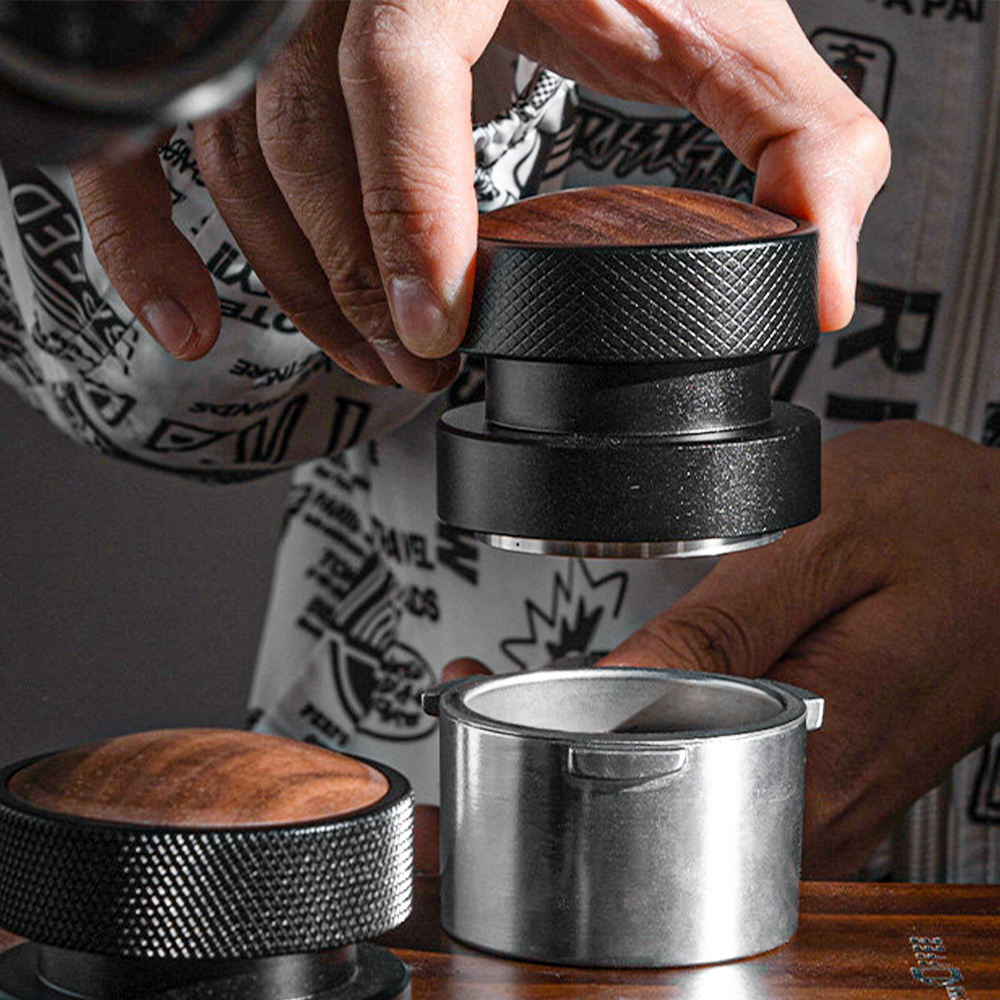
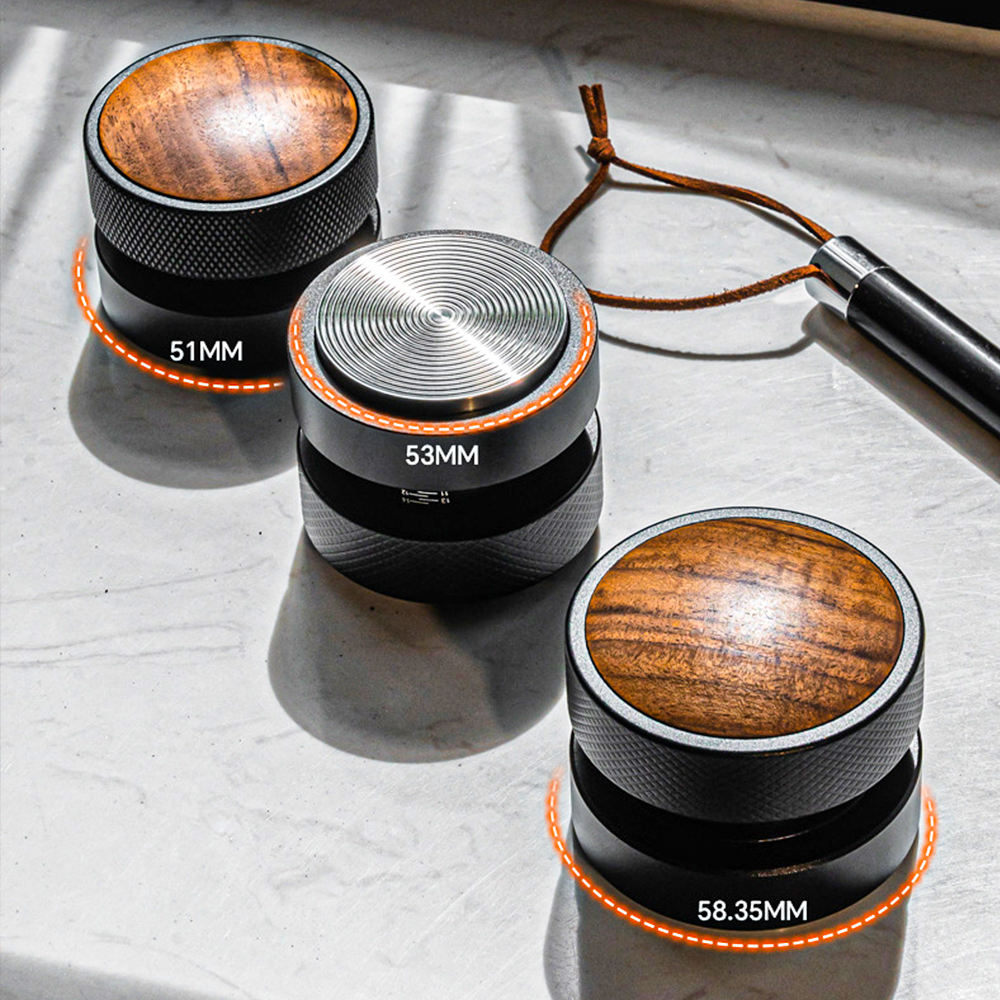
Quick answer: complete compaction beats one exact number
Why is the answer a range? Current manufacturer guidance and product settings differ. Breville teaches 20–30 lbf in its manual-tamping guide, while Decent states that its own tests found full compression at 15 lbf. Peer-reviewed espresso studies have also reported little or no detectable extraction change from tamp-force variation under the conditions they tested; one research team standardized later tests at 98 N, or about 22 lbf.
The practical conclusion is not that tamping can be careless. A very weak press may leave a partly settled bed, and a tilted press can create uneven puck thickness. The conclusion is that after full compaction, extra force gives diminishing benefit. Levelness, distribution and repeatability deserve more attention than maximum strength.
- Use 15–30 lbf as a training range, not a universal espresso law.
- Press once until the coffee bed reaches a firm endpoint, then release.
- Align the tamper before loading it; levelness matters more than an exact force reading.
- Distribute coffee before tamping because a flat top can hide uneven density below.
- Keep tamping constant and adjust grind—not arm strength—when dialing shot flow.
- In a busy café, lower comfortable force plus good tooling can reduce unnecessary physical load.
15 lb, 20 lb or 30 lb: why recommendations differ
The familiar “30-pound tamp” is a useful teaching cue, but it is not the only number used in real equipment. The table below separates general instruction, model-specific settings and experimental findings. These figures should not be blended into a fake average because they were produced for different tools and purposes.
| Source or example | Published force | Correct interpretation | Limitation |
|---|---|---|---|
| Breville manual-tamping guide | 20–30 lbf | A practical consumer training recommendation with an emphasis on even, consistent force | Not proof that every basket needs this range |
| Decent Tamper V6 | 15 lbf | Decent reports that its tests found grounds fully compressed at this setting | Product- and test-specific claim |
| Cameron et al., Matter | Automated tamp standardized at 98 N, about 22 lbf | Researchers explored a range, observed no appreciable change in shot time or extraction yield, then held tamping constant | Other recipe variables and sensory effects still require context |
| Kuhn et al., Journal of Food Engineering | Two tested tamping pressures | Particle size changed extraction kinetics; tamping pressure had no detectable effect in the tested commercial-machine conditions | Two conditions cannot cover every coffee and machine |
What the research supports
A peer-reviewed study from the Technical University of Munich examined espresso made with different particle-size distributions and tamping pressures. Under its test conditions, particle size significantly affected caffeine and trigonelline extraction kinetics, while tamping pressure had no detectable effect. The result supports treating grind as a stronger dial-in control after a complete tamp. It does not prove that a barely touched, visibly loose puck will behave the same as a fully compacted one.
In the peer-reviewed Systematically Improving Espresso work, researchers explored a range of tamp pressures and reported no appreciable variation in shot time or extraction yield. They then standardized the experiment with an automated 98 N tamp. Again, this is evidence against chasing a magic number—not permission to ignore distribution or alignment.
Why manufacturers can choose different settings
A spring-loaded or assisted tamper is a complete mechanical system. Spring rate, travel, leveling plate, base diameter, basket compatibility and the point at which the mechanism stops all affect the user experience. One tool can deliver a repeatable 15 lbf endpoint while another is designed around 22 or 30 lbf. Compare the complete action rather than the number printed on the package.
Why “harder” stops helping
Loose coffee first rearranges and settles as downward force is applied. Gaps reduce, particles move into a denser structure and the bed height falls. As that structure becomes stable, a larger increase in force produces much less additional movement. At that point, extra effort does not redistribute hidden clumps, correct a tilted base or make an undersized tamper reach the basket wall.
Tamping force and tamping pressure are not identical
Baristas commonly say “30 pounds of pressure,” but a scale reading in pounds or kilograms is a measure of force. True pressure depends on how that force is spread across the tamper base. The distinction matters when comparing 51mm and 58mm tools.
For a flat circular base, area is π × radius². Applying 30 lbf—about 133 newtons—to a nominal 58mm base produces an average theoretical pressure of roughly 50 kilopascals across the base. The same force over a nominal 51mm base is about 65 kilopascals because the area is smaller.
| Force reading | Approx. kilogram-force | Average pressure on 58mm base | Average pressure on 51mm base |
|---|---|---|---|
| 15 lbf | 6.8 kgf | About 25 kPa | About 33 kPa |
| 20 lbf | 9.1 kgf | About 34 kPa | About 44 kPa |
| 22 lbf | 10.0 kgf | About 37 kPa | About 48 kPa |
| 30 lbf | 13.6 kgf | About 50 kPa | About 65 kPa |
These are simplified calculations using nominal circular diameters and evenly distributed force. Real coffee beds are granular, basket walls taper, tamper bases may be patterned or convex, and force is not perfectly uniform. Use the table to understand terminology, not to specify a “perfect” puck pressure to the nearest kilopascal.
Do not compare tamp pressure directly with brew pressure
Espresso machine pressure is hydraulic pressure applied during brewing. Tamping force is a short mechanical input used to consolidate dry grounds before water arrives. Saying that a machine brews near a certain number of bars does not tell you how many pounds your hand must apply. The two values act in different ways and at different stages.
Force is not the same as tamper weight
A 500g tamper does not automatically apply 500g of tamping force. Its own weight contributes slightly, while the user supplies most of the downward load. A heavier tool can feel stable, but base fit, balance and alignment normally matter more than adding mass for its own sake.
How to apply the right tamping pressure
The best technique creates a clear endpoint with minimal extra movement. It should be easy to teach, observe and repeat. This short method assumes the dose and grind are already appropriate for the basket.
For a more complete workflow covering dosing, WDT, distribution, tamping and lock-in, use Coffmach's guide to tamping espresso for even, repeatable shots.
Should you polish the puck?
A shiny surface is not a brewing requirement. Rotating the tamper while it remains loaded can disturb the bed or change the bond at the basket wall. If coffee sticks to the base, release all pressure first and lift straight. Improve base cleanliness, dose, fit or removal technique instead of adding a heavy twist.
Should you tamp twice?
One complete press is easier to reproduce. A second tamp usually adds another opportunity to tilt, rock or disturb the puck. If the first press is visibly uneven, note the cause and correct distribution, portafilter support or initial alignment on the next dose rather than building a multi-press ritual.
Do you need to feel exactly 30 pounds?
No. You need to recognize complete compaction. Practicing at 20–30 lbf can teach what a firm press feels like, but the number should not become the goal of every shot. If 15–20 lbf fully compacts the bed with your coffee and tool, forcing your shoulder to reach 30 lbf adds little value.
How to test tamping pressure without guessing
A simple test can separate pressure variation from grind, dose and distribution. Perform it during practice, not in the middle of a service rush. Use the same coffee, basket, dose, distribution, beverage yield and machine settings for every shot.
Calibrate your feel with a scale
- Use a sturdy scale rated for the expected load. Do not press directly on a fragile coffee scale.
- Place a flat protective block on the scale so the force is stable and does not damage the platform.
- Hold the tamper with the same posture used at the espresso station.
- Press smoothly to a comfortable endpoint and record the peak reading.
- Repeat ten times without watching the display, then compare the spread.
- Aim to reduce variation while keeping the wrist, elbow and shoulder comfortable.
This exercise develops repeatability; it does not prove that the measured number is chemically optimal. Once you can reach the same comfortable force, move attention back to the basket and coffee bed.
Run a controlled espresso comparison
Illustrative scenario: a home barista pulls three repeatable sets at 15, 22 and 30 lbf. The average shot times overlap, but the 30 lbf set causes visible shoulder strain. The useful decision is to keep the lower comfortable force and standardize alignment—not to claim that every coffee behaves identically at all forces.
Use this troubleshooting order
| Symptom | Check first | Pressure-related check | Better next action |
|---|---|---|---|
| Shot runs too fast | Dose, grind, yield, coffee freshness | Confirm the bed reached full compaction | Keep tamp stable and grind finer in a controlled step |
| Shot runs too slowly | Grind, dose, basket capacity, yield | Do not assume “over-tamping” | Keep tamp complete and grind coarser or correct the recipe |
| Shot time varies | Grinder output, distribution, dose and retention | Check force and angle repeatability | Standardize preparation and change one input at a time |
| Puck is visibly tilted | Loose-bed level and portafilter support | Check alignment before loading | Use a level reference or self-leveling design |
| Edge ring remains loose | Tamper-to-basket fit | More force will not increase base diameter | Test a correctly sized base that does not bind |
| Wrist or shoulder discomfort | Station height, posture, repetitions and tool grip | Reduce unnecessary peak force | Trial an ergonomic, assisted or automatic solution |
Which tamper gives the most repeatable pressure?
No tool guarantees an even internal puck, but different mechanisms can remove different sources of variation. Choose by the problem you need to control.
Standard manual tamper
Simple and durable. Pressure and level depend on the operator, so it works best with stable support and practiced alignment.
Calibrated spring tamper
Provides a force cue or mechanical endpoint. Useful for training, but calibration does not prove levelness or correct basket fit.
Self-leveling tamper
A collar references the basket rim to reduce tilt. Check that the base can travel far enough for every approved dose.
Palm or puck tamper
Offers a broad hand contact area and can encourage a straighter press. Adjustable-depth versions must be set for the recipe.
Lever-assisted tamper
Controls motion and can reduce operator force. It occupies station space and must fit the portafilter and workflow.
Automatic tamper
Delivers programmable or fixed cycles at speed. It requires cleaning, maintenance, power and a compatible backup method.
What a spring-loaded tamper actually controls
A spring can provide a repeatable load cue, while a leveling collar can reference the basket rim. These are separate functions. A spring without a level guide may still enter at an angle; a level guide without adequate travel may stop on the rim before the coffee is fully compressed.
When comparing options, review Coffmach's detailed spring-loaded versus manual coffee tamper guide.
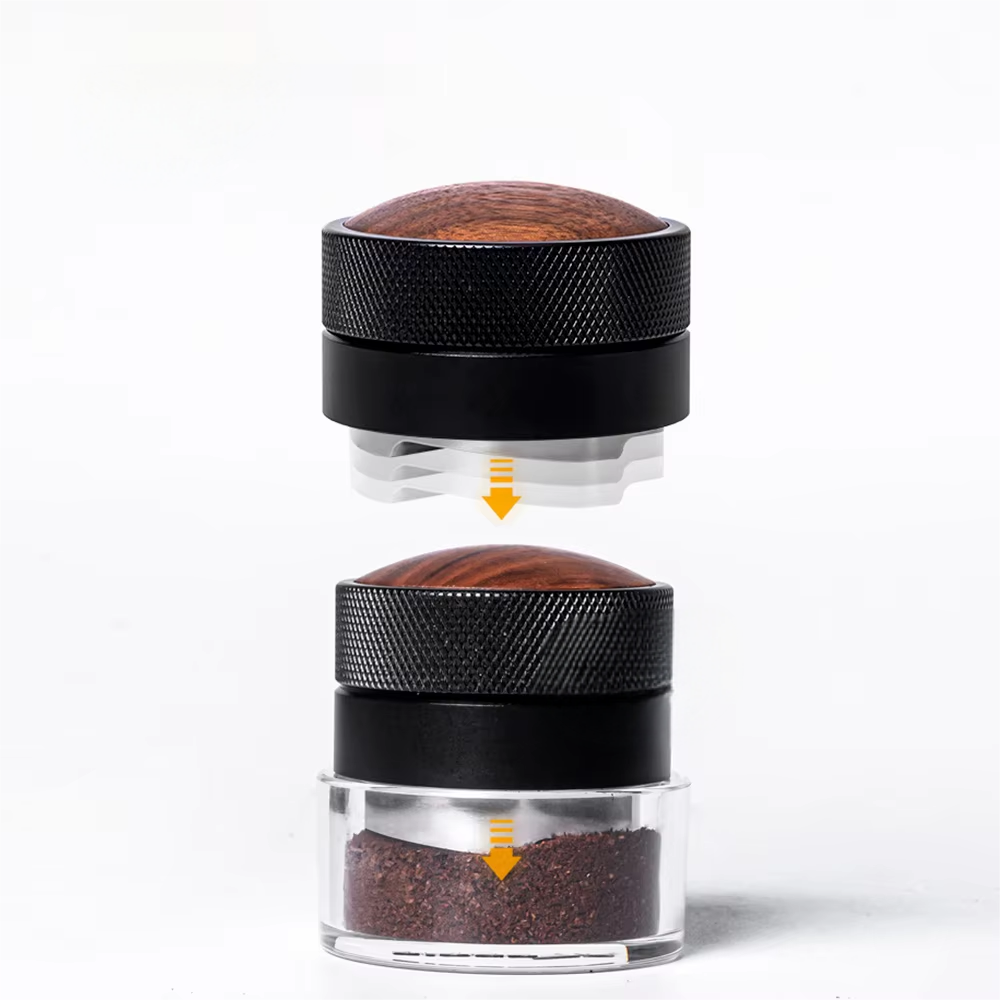
Pressure consistency is only one part of consistency
A calibrated tamper can repeat force while the grinder delivers different doses or the user leaves clumps on one side. A self-leveling collar can repeat angle while the base is too small. An automatic tamper can repeat a program while the basket changes. Specify the complete puck-preparation system: grinder, dose, distribution, basket, base, tamp cycle and inspection method.
For a broader architectural comparison, see eight espresso tamper types compared.
A practical tamp-pressure SOP for busy cafés
A café procedure should use observable instructions. “Tamp as hard as you can” is difficult to repeat and creates needless physical load. “Distribute, align, press to the tool's endpoint, release and lift straight” is easier to train and audit.
Pressure and ergonomics
Repeated manual tamping combines force, posture and frequency. A peer-reviewed study involving ten experienced baristas compared a traditional vertical-handle tamper with one flat, handleless design. Under that study's procedure, the alternative design produced more neutral measured postures and lower assessed upper-limb risk. The sample was small and the result was design-specific, but it supports testing grip, counter height and effort rather than demanding maximum force from every employee.
When an automatic tamper makes sense
Automation becomes attractive when shot volume is high, operators rotate frequently or manual tamping causes consistency and workload problems. Evaluate cycle time, cleaning access, force range, basket compatibility, noise, footprint, service support and backup procedure. Automation repeats the action it is given; it does not solve an unstable grinder or poor dose distribution.
Training target for multiple baristas
Choose the lowest comfortable force that fully compacts the approved coffee across the café's normal dose range. Confirm it with several employees and repeated shots. A setting around 20–25 lbf can be a reasonable trial point, but the final SOP should come from your tool, basket and coffee test—not from this number alone.
How to specify a coffee tamper for consistent pressure
For a home purchase, basket fit and comfortable alignment come first. For a café chain, espresso-machine kit or private-label range, the specification must also make pressure claims and quality checks measurable.
| Specification | What to state or test | Why it matters |
|---|---|---|
| Basket compatibility | Actual internal diameter, taper, ridge, approved dose depth and representative baskets | Prevents a loose edge ring, wall rubbing or suction |
| Base diameter | Drawing dimension, tolerance, roundness and edge geometry | Controls real fit more clearly than a nominal “58mm” label |
| Base profile | Flat, convex or patterned; surface finish and edge condition | Affects contact geometry, cleaning and product positioning |
| Force mechanism | Nominal force, tolerance, test fixture, actuation point and cycle life | Makes calibrated-pressure claims inspectable |
| Level reference | Collar diameter, rim contact, wobble and vertical travel | Confirms the base can reach the coffee while staying aligned |
| Handle and ergonomics | Diameter, height, shape, texture, mass and intended grip | Affects comfort, posture and repeatability |
| Materials and finish | Base alloy, handle material, coating, cleanability and documentation | Supports durability, appearance and target-market requirements |
| Branding and packaging | Logo method, artwork zone, color standard, box protection and labeling | Turns private-label expectations into approval criteria |
Sample approval test
- Measure the base diameter at several positions and compare it with the approved drawing.
- Test insertion at the lowest and highest approved dose because tapered baskets narrow with depth.
- Measure calibrated force using the agreed fixture and procedure, not an unsupported hand estimate.
- Complete repeated cycles and record force variation, wobble, sticking, return action and loose components.
- Prepare espresso with multiple operators and compare puck level, shot data, taste and comfort.
- Inspect the base, finish, engraving and packaging after the intended cleaning and handling tests.
- Retain a signed golden sample for mass-production comparison.
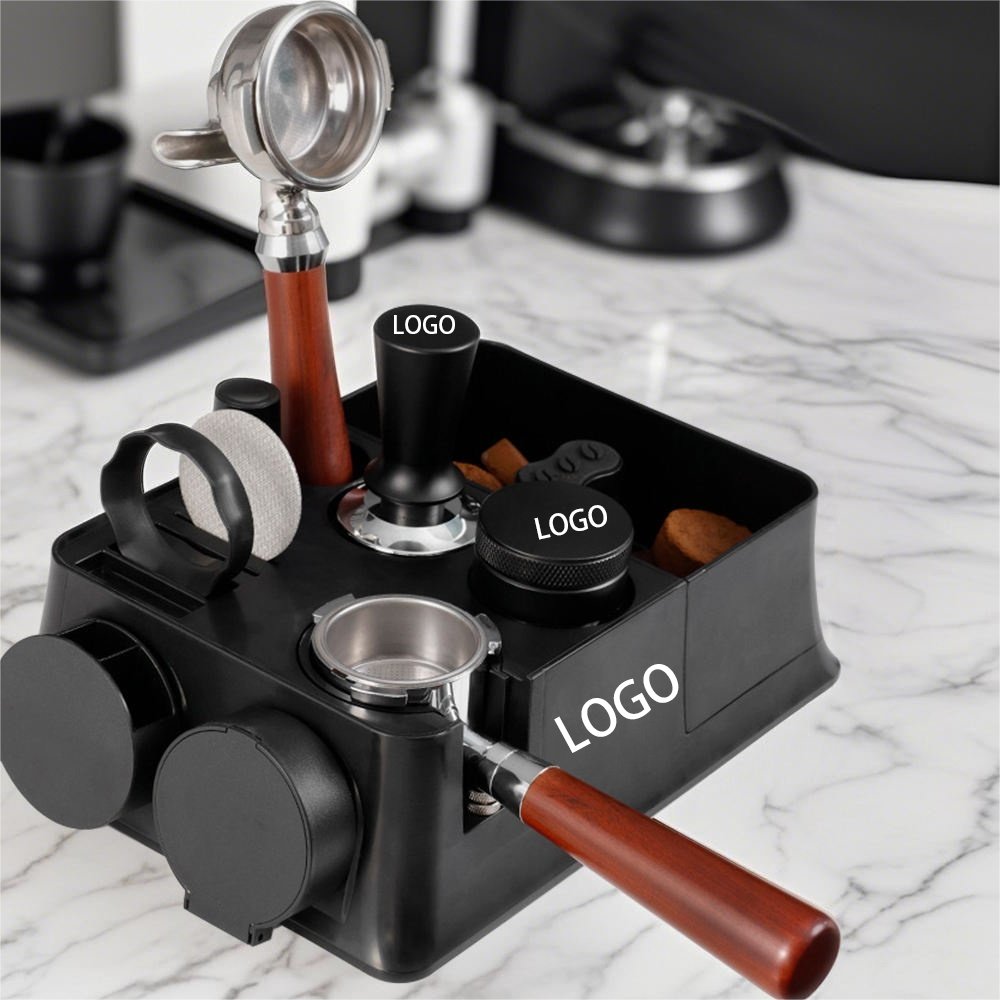
Coffmach currently supplies standard 51mm, 53mm and 58mm coffee tampers plus custom options, with stainless steel, aluminum and wood choices as well as logo, finish and packaging services. These are catalog capabilities, not a guarantee that one nominal size fits every basket. Start with drawings and sample testing.
Need a tamper matched to your basket and force target?
Share the basket model or measured working diameter, dose range, preferred base, force mechanism, handle, finish, quantity, packaging and target market. Coffmach can support stock evaluation and OEM/ODM sample development.
Explore the full Coffmach Coffee Tamper product page for current size, material and customization options.
Frequently asked questions
How many pounds of pressure should I use to tamp espresso?
Use enough force to fully compact the prepared coffee bed while keeping it level. Roughly 15–30 lbf is a practical training range, but there is no universal perfect number. Once the puck reaches a firm endpoint, more effort adds little value. Keep the force repeatable and adjust espresso flow with grind and recipe.
Is 30 pounds the perfect espresso tamping pressure?
No. Thirty pounds is a familiar teaching target, not a requirement for every coffee, basket or tamper. Manufacturer examples use 15 and 20–30 lbf, while one research method standardized tamping at about 22 lbf after exploring a range. A complete, level and repeatable tamp is the better goal.
Can you tamp espresso too hard?
Extra manual force after full compaction is usually unnecessary and can increase physical strain. A very hard press does not fix clumps, poor distribution, tilt or an undersized tamper. Instead of trying to diagnose a slow shot as “over-tamped,” keep the tamp complete and stable, then review grind, dose, yield and basket capacity.
What happens if I tamp too lightly?
If the coffee bed is not fully consolidated, its final height and resistance may vary from shot to shot. A very light touch can leave the puck more vulnerable to later movement. Press smoothly until the bed reaches a clear firm endpoint. “Light” is acceptable only when it still completes compaction with the chosen coffee and tool.
Does tamping pressure change espresso extraction time?
It can affect an incompletely compacted puck, but after full compaction, additional force is usually a weak dial-in variable. Peer-reviewed work has reported no detectable or appreciable change under tested conditions. If shot time is wrong, hold tamping constant and adjust grind while controlling dose and beverage yield.
Is level tamping more important than pressure?
Yes, once sufficient compaction is reached. A level base creates similar puck depth across the basket, while an angled tamp can preserve different path lengths. Pressure cannot correct a tilt or uneven distribution below the surface. Align the unloaded tamper first, then apply one straight press.
Should I use a scale to practice tamping?
Yes, as a short training exercise. Use a sturdy scale rated for the load with a flat protective block; do not risk a delicate coffee scale or unstable portafilter spouts. Repeat several presses and learn the feel of a comfortable force. The scale trains consistency—it does not discover one universal optimal number.
Is a calibrated tamper better than a manual tamper?
It is better when force variation is the problem. A calibrated mechanism gives a repeatable cue, but it may not control angle, distribution or basket fit. A skilled user with a compatible manual tamper can also produce repeatable results. Choose the mechanism that removes the real weakness in the workflow.
Why does my espresso run fast even when I tamp hard?
The grind may be too coarse, the dose may be low, the yield target may be large or the puck may have uneven density or damage. Once the bed is fully compacted, pushing harder is unlikely to be the best correction. Keep tamping stable, verify the recipe and make a controlled finer-grind adjustment.
What tamper size should I buy?
Choose for the basket's actual internal diameter at the intended puck depth. Nominal 51mm, 53mm and 58mm labels do not define every basket precisely. The base should minimize the edge gap without scraping, binding or lifting the puck. Test representative baskets before a café rollout or bulk order.
Technical sources and image credits
- Technical University of Munich — Time-resolved extraction with varying particle sizes and tamping pressures. Peer-reviewed study record reporting a detectable particle-size effect and no detectable tamp-pressure effect under tested conditions.
- Cameron et al. — Systematically Improving Espresso. Peer-reviewed modeling and experiment paper that explored tamp pressures and standardized tamping at 98 N.
- Breville — How to Tamp Espresso. Current manufacturer guidance using 20–30 lbf as a practical recommendation while emphasizing consistency and levelness.
- Decent Espresso — Portafilter Tamper. Product-specific example of a 15 lbf calibrated setting and basket-fit design claims.
- International Journal of Industrial Ergonomics — Alternative tamper design study. Peer-reviewed comparison of posture, force and assessed upper-limb risk in ten experienced baristas.
- Coffmach — Coffee Tamper. Internal product reference for current size, material, application and OEM/ODM options.
- All four images are internal Coffmach product-page images. Each caption states its content and source in plain text; neither the images nor their captions are clickable.