Quick answer: buy the mechanism that improves your repeatability, not the most features
Choose a spring-loaded tamper when a consistent completion cue and a basket-referencing leveling plate will help beginners or a mixed-skill team repeat the same motion. Choose a manual tamper when the user already enters straight, the base fits the real basket, and simplicity, easy cleaning and tactile control are the priorities. Neither choice fixes poor distribution, an incorrect base diameter, unsuitable dose, basket taper or inadequate effective stroke.
Key takeaways
- Spring-loaded, calibrated and self-leveling are separate features. One product can have all three, but one label does not prove the others.
- Fit and flatness come before a force number. The base must cover the coffee close to the wall without scraping or binding.
- A leveling collar guides the tool, not the grounds. It cannot redistribute a clumpy or uneven dose below the surface.
- Manual is not obsolete. A durable manual tamper with the correct base can be fast, precise and highly repeatable for a practiced user.
- B2B buyers need measurable requirements. Define diameter, alignment, effective stroke, force test method, return behavior, cleaning and acceptance limits.
| Decision factor | Spring-loaded tamper | Manual tamper |
|---|---|---|
| Completion cue | May provide resistance, a click, release or stop; behavior is model-specific | User feels compaction directly and stops by technique |
| Leveling support | Available only when a functional collar or plate references the basket | Depends on setup, posture and a straight entry |
| Best workflow | Training, shared stations and repeatable setup cues | Experienced single-user or minimalist workflow |
| Maintenance | Guides, springs, threads and moving surfaces need cleaning and inspection | Few parts; base and handle are typically simple to wipe clean |
| Main compatibility risk | Collar clearance or short effective stroke for the chosen basket and dose | Incorrect base diameter or tilted entry |
| Main buying risk | Assuming an advertised force equals real puck performance | Choosing by nominal portafilter size instead of actual basket fit |
Need tamper samples matched to your basket?
Send Coffmach the basket family, inner diameter, dose range, base profile, preferred mechanism, finish, packaging and target user for a more useful sample recommendation.
Spring-loaded, calibrated and self-leveling are not interchangeable terms
A manual tamper is a handle and base moved directly by the user. A spring-loaded tamper contains a spring, but that spring may resist the downward stroke, return the handle, preload a moving base or trigger a tactile event. A calibrated tamper is intended to indicate a stated force or designed event. A self-leveling tamper uses a collar, flange or plate to reference the basket rim while the base travels down. Treat each function as a separate buying question.
| Feature | Useful contribution | What it does not prove |
|---|---|---|
| Resistance spring | Creates progressive resistance and may make a stroke feel repeatable | That one exact advertised force reaches every coffee puck |
| Click, release or hard stop | Gives the user a clear completion event | That the base is level, the dose is correct or the puck was evenly distributed |
| Return spring | Brings the moving handle or base back after pressure is released | Consistent delivered tamp force |
| Leveling plate | Can constrain tilt when it contacts a compatible basket rim evenly | Uniform density under an initially uneven coffee bed |
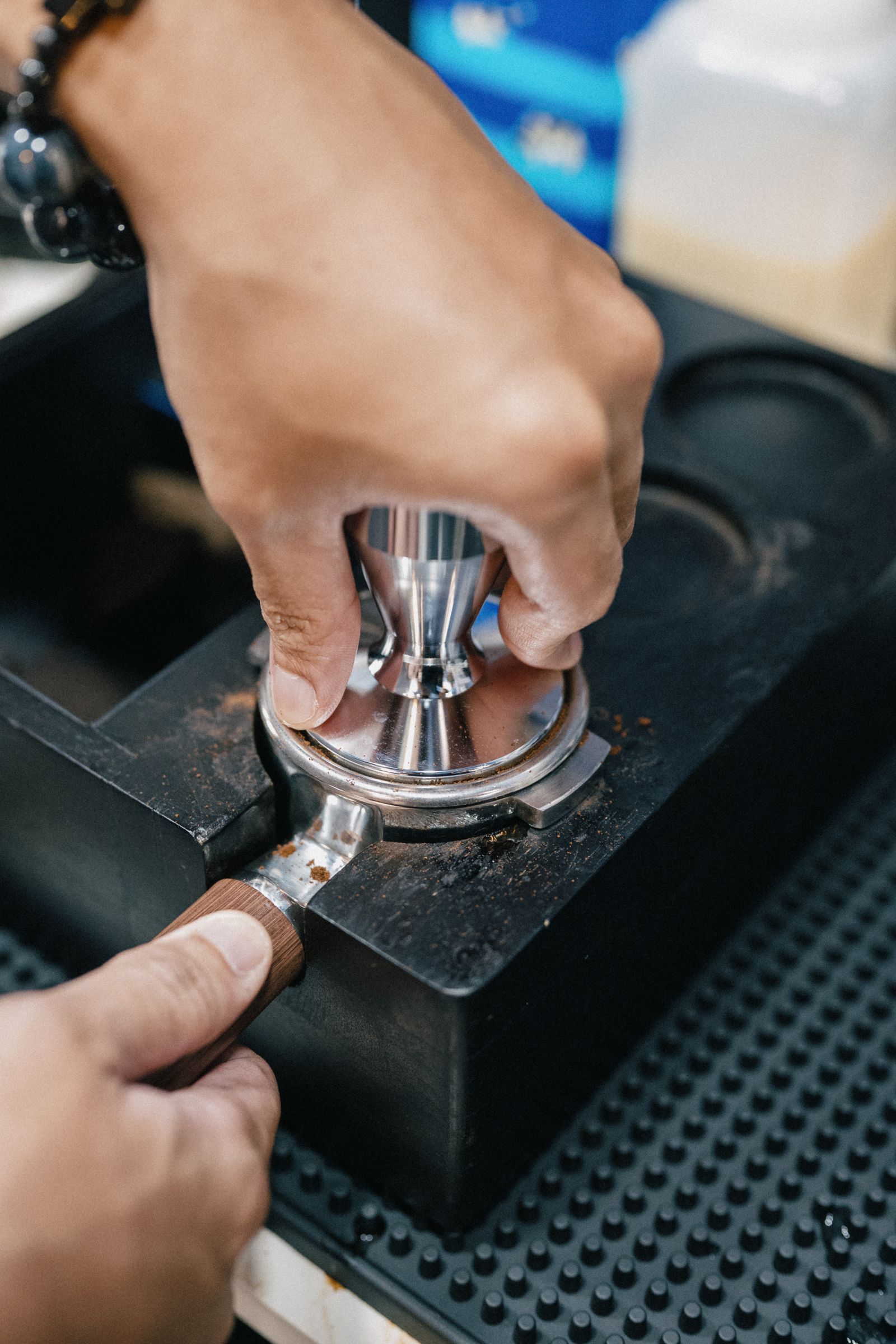
For example, Normcore’s V4 is a model-specific spring-loaded design offered with interchangeable springs and a leveling plate; it demonstrates a combination of features rather than defining every spring-loaded tamper.[1] A product description should answer: what touches the basket, what moves, where the base stops, how the adjustment changes travel, and how the user knows the tamp is complete.
What actually changes puck preparation and shot repeatability
Base diameter and basket fit
The base should reach close to the basket wall without binding at the tamping depth. Too much clearance can leave a perimeter of loose coffee; too little clearance can scrape, stick or suction the puck when removed. Nominal labels such as “58 mm” are only a starting point because baskets can differ in inner diameter, taper, ridge, coating and manufacturing variation. Measure representative baskets or use documented compatibility for the exact basket family.
Distribution before tamping
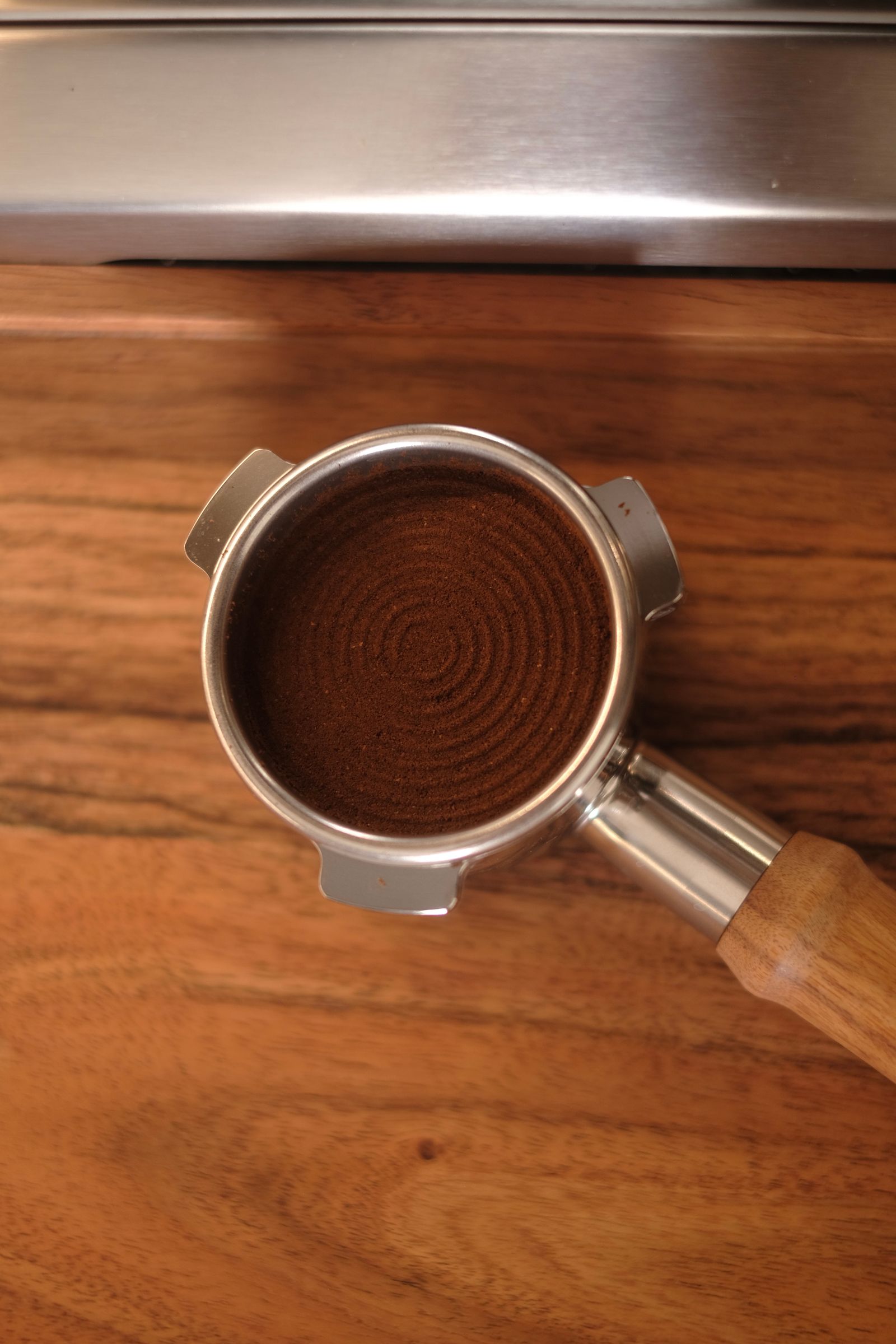
Tamping compresses what is already in the basket; it does not reliably repair a dense mound beside a low void. A collar can make the top look flat while the density beneath remains uneven. Barista Hustle emphasizes homogeneous distribution, a straight entry and flat tamping rather than correcting the angle after partial compression.[2] Keep grinding, dosing and distribution consistent before comparing mechanisms.
Effective stroke, dose and headspace
Effective stroke is the useful downward base travel after a leveling surface contacts the rim. It is not the same as total handle movement. An underfilled basket may place the puck below the reach of a shallow mechanism; an overfilled basket can cause the collar to contact early. Test the actual recipe range, not only an empty basket or one showroom dose.
Force after adequate compaction
The mechanism can change how the user experiences pressure, but pressure labels need context. In a Technical University of Munich study of the tested espresso conditions, particle size affected extraction kinetics while tamping pressure showed no detectable effect.[3] That finding does not mean tamping is irrelevant; it means a buyer should not let a nominal force number overshadow fit, distribution, levelness and the complete recipe.
When a spring-loaded tamper is the better choice
A spring-loaded tamper is most useful when the mechanism reduces one real source of variation. That is commonly a clear completion cue for a new barista, a level-reference plate for a stable basket family, or a repeatable motion for people sharing one station. It can shorten the learning curve because the user has fewer degrees of freedom to manage at once.
Where it can help
- Provides a repeatable feel, stop or cue when the design is functioning correctly.
- Can support more consistent vertical alignment with a well-fitted leveling plate.
- Useful for training environments and multi-user workstations.
- May reduce unnecessary over-pressing when the cue is clear.
- Can create a more repeatable starting workflow for a retailer or school.
What to verify
- Spring rate, preload, friction and hard stops affect real behavior.
- Grounds or residue can make moving parts stick or return poorly.
- A collar may bottom out before the base reaches a low puck.
- More parts create more tolerance, cleaning and durability variables.
- Feature claims require a defined test method, not marketing language alone.
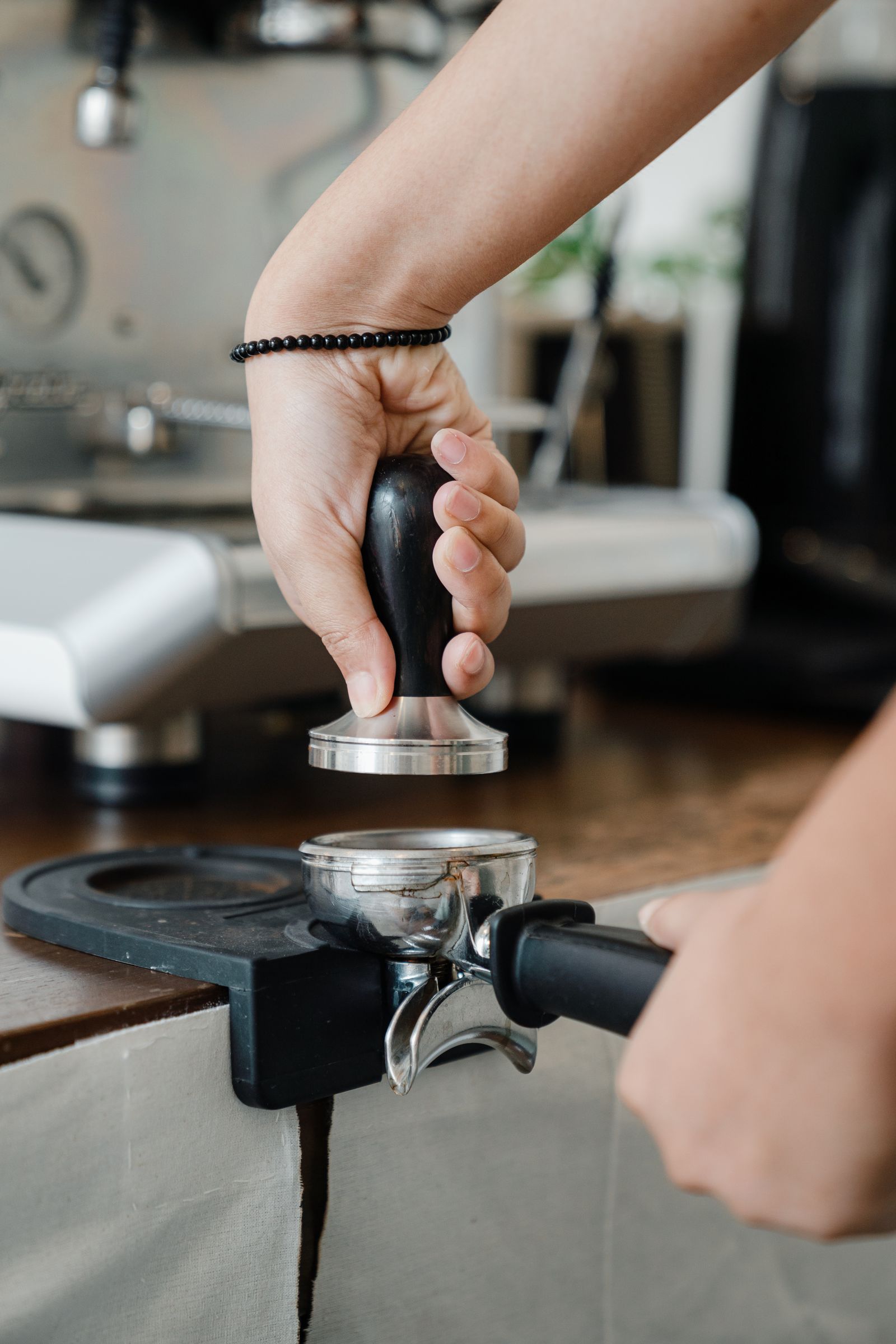
A self-leveling feature is only as good as its reference. Coffee on the rim, a damaged basket, a collar that hits the portafilter body, an off-center shaft or a base that does not travel far enough can defeat the benefit. Wipe the rim, lower the tool vertically and confirm even plate contact before relying on the guide.
When a manual coffee tamper is the better choice
A manual tamper is often the better choice for an experienced user with a stable setup: the basket is known, the base fits, the dose is repeatable and the user already enters straight. It offers direct tactile feedback, has fewer moving parts and can be quick to clean. A manual tool is not less professional simply because it has no internal mechanism.
Why manual remains strong
- Simple construction with few parts to trap grounds or wear.
- Direct feedback from the coffee bed and handle position.
- Easy to inspect, wipe and maintain in a busy workflow.
- Often lower complexity for wholesale and spare-parts planning.
- Wide choice of base profiles, weights, materials and handle shapes.
What the user controls
- Entry angle and levelness rely more heavily on technique.
- Different staff may use different force and wrist movements.
- Manual skill still needs a firm workflow around dose and distribution.
- Wrong diameter cannot be corrected by better technique.
- Users may benefit from a tamper station or training reference.
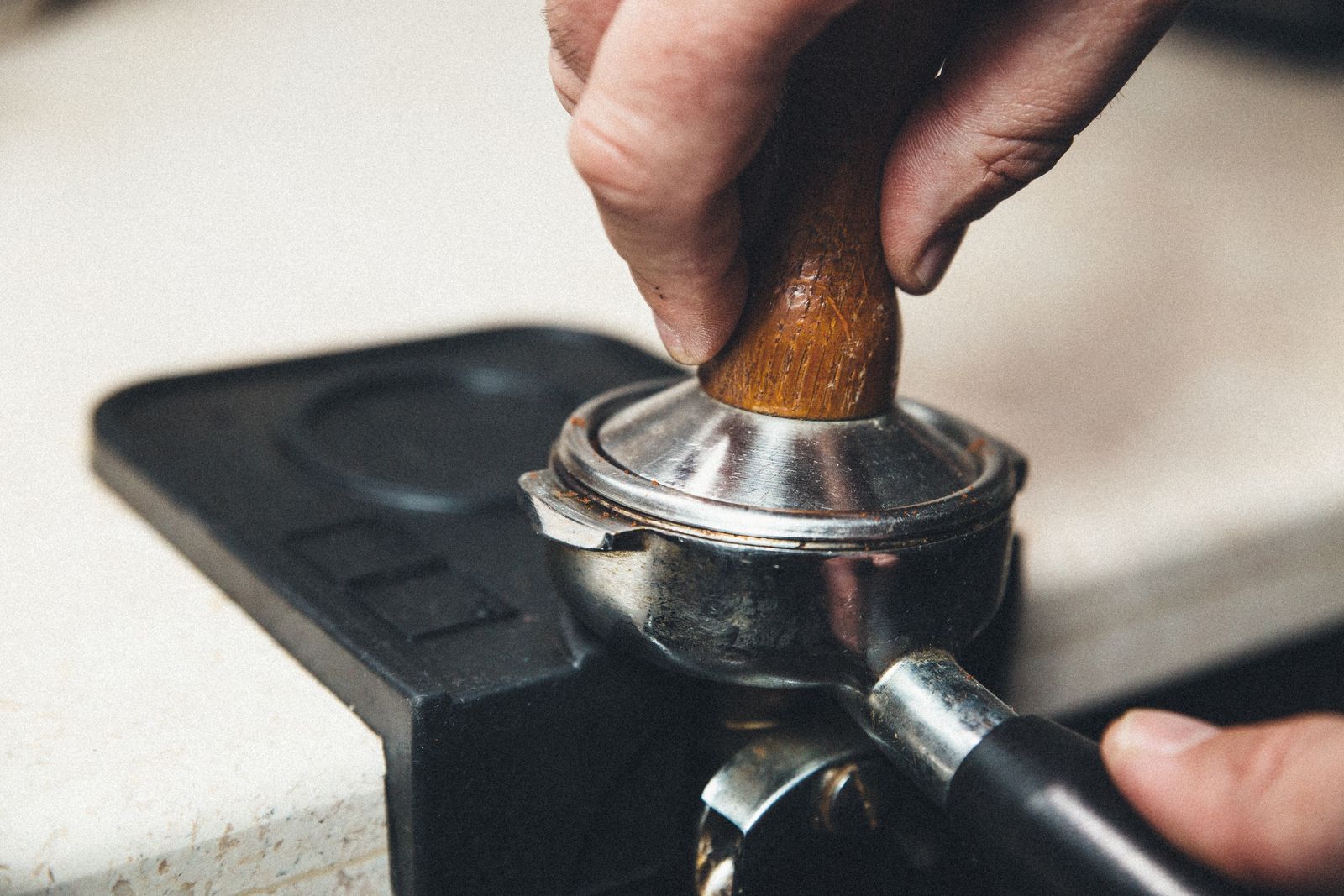
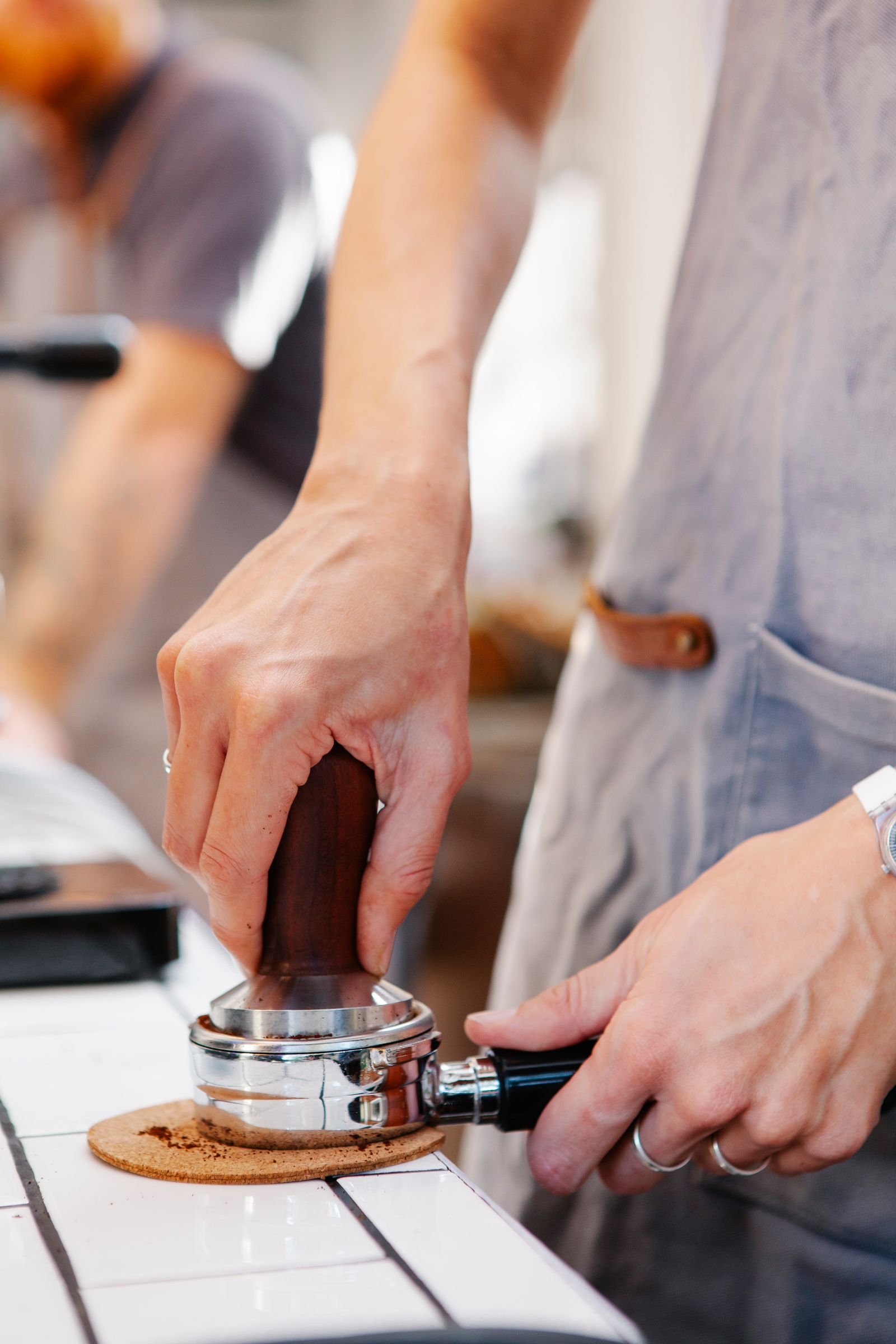
For a conventional manual tamper, use a relaxed, vertical press, allow the base to compact the coffee, then lift straight without twisting or knocking the portafilter. The goal is not to chase a dramatic number; it is to produce a level, fully compacted puck without disturbing it after the tamp.
Which tamper should you choose?
| User or setting | Recommended start | Why | Check before buying |
|---|---|---|---|
| Home beginner | Spring-loaded with a compatible leveling plate, or a simple manual plus practice | Helps organize a repeatable learning sequence | Base fit, collar clearance and enough stroke |
| Experienced home user | Manual or tested spring-loaded model | Personal workflow and tactile preference can justify either | Same basket, dose and distribution during comparison |
| Busy mixed-skill café | Test a self-leveling, spring-cue design against the established manual workflow | Cross-user repeatability may justify the mechanism | Cleaning time, grounds ingress, return, breakage and service speed |
| Training school | Matched manual and guided sample set | Shows students which variables the mechanism changes | Same base diameter, basket and recipe |
| Private-label brand | Define the target user before choosing complexity | Prevents features from replacing a clear customer benefit | Functional samples, drawings and measurable QC limits |
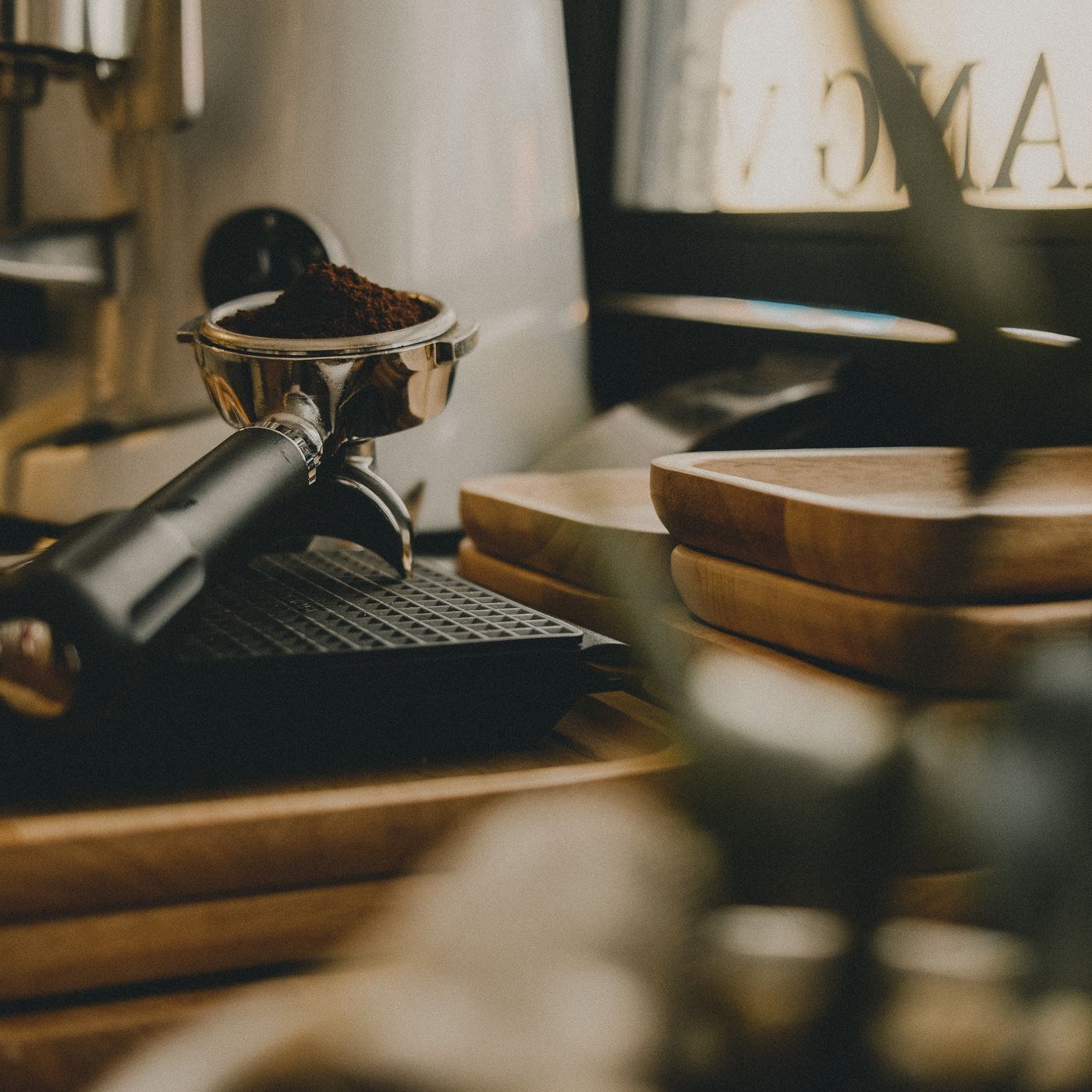
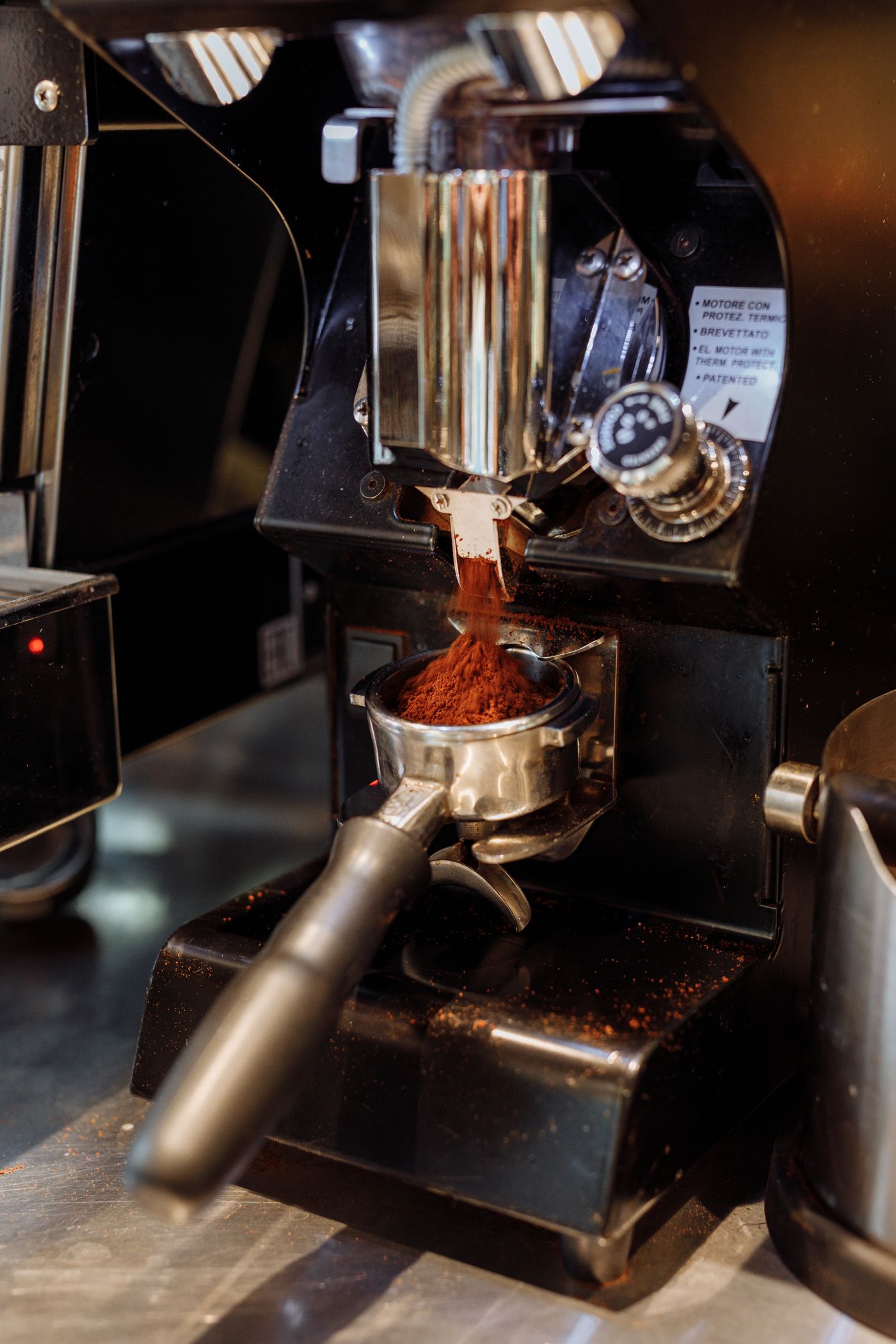
Capacity in this decision is not a pitcher volume—it is the usable geometry of the basket, dose and puck depth. If the recipe changes, repeat the compatibility check. Coffmach’s coffee tamper guide and selection guide provide additional size and buying context.
Run a fair spring-loaded vs manual tamper test
- Match base fit. Use the same basket family and as-close-as-possible base diameter and profile. Record the actual basket and tamper dimensions.
- Fix the recipe. Keep coffee, grind setting, dose, distribution method, puck screen choice and brew recipe constant.
- Check working travel. With the real dose, observe whether the guided tamper’s base reaches the puck without the collar stopping prematurely.
- Use a simple scorecard. Record levelness, edge coverage, clean lift-off, return behavior, service time, user comfort, shot flow and cleanup.
- Alternate tools and users. Do not let one tool always follow the other. For a café, test representative staff rather than one expert alone.
- Inspect after cleaning. Repeat the test after the intended wipe-down or disassembly routine, especially for springs, guides and collars.
| Symptom | Likely cause | Quick check | Corrective action |
|---|---|---|---|
| Collar stops early | Puck too low or effective stroke too short | Measure puck depth and base travel | Adjust the product, basket-dose combination or mechanism setup |
| Untamped ring at edge | Base is undersized for the basket at tamping depth | Inspect edge coverage and basket taper | Select a compatible base diameter; do not compensate with extra force |
| Guided tamper feels tilted | Dirty rim, damaged basket, collar interference or alignment error | Clean rim and check contact points | Correct the reference geometry before relying on the guide |
| Click occurs but shots vary | Distribution, dose or grind is changing | Audit preparation before tamping | Stabilize the complete puck-prep workflow |
| Return is slow or sticky | Grounds ingress, residue, wear or incorrect assembly | Follow manufacturer cleaning and inspection instructions | Clean, service or reject the unit according to the defined criteria |
Specify the full tamper system for OEM and wholesale
For a manual tamper, a drawing should define the base diameter and profile, flatness, base-to-handle alignment, materials, finish, handle geometry, weight range, edge condition and packaging protection. For a spring-loaded product, add spring type and range, preload, guide or bushing design, leveling-plate dimensions, effective stroke, activation definition, return, lateral play, cleaning method and change-control requirements.
Turn subjective claims into measurable checks
Terms such as calibrated, ergonomic, smooth and non-slip are not acceptance criteria. Define the test fixture, contact point, loading rate, preconditioning cycles, sample quantity, tolerance, activation position and whether the result is force, travel, click or a combination. Retain a signed golden sample, but pair it with drawings, material declarations, inspection methods and controlled revisions.
| Characteristic | What to specify | Why it matters |
|---|---|---|
| Base geometry | Diameter, profile, flatness, edge radius and finish | Controls basket fit, edge coverage and clean removal |
| Concentricity | Base, shaft, collar and handle relationship | Supports straight entry and reliable rim reference |
| Effective stroke | Usable base travel after plate contact | Prevents premature bottoming on the target dose range |
| Force behavior | Measured point, method, tolerance and cycle condition | Prevents unqualified “calibrated” claims |
| Moving assembly | Play, return, friction, sticking, noise and wear limits | Separates assembly faults from user compatibility issues |
| Care and packaging | Cleaning instructions, spare parts and transit protection | Reduces corrosion, contamination and damage claims |
Need a manual or spring-loaded tamper RFQ review?
Provide your target basket, base size, dose range, mechanism, force event, effective stroke, material, branding, packaging, quantity and proposed test plan.
Frequently asked questions
Is a spring-loaded coffee tamper better than a manual tamper?
It is usually better for beginners and shared stations when its force cue, leveling plate and effective stroke genuinely fit the basket and recipe. A skilled user with a correctly sized manual tamper may gain little from the added mechanism. Compare the complete workflow rather than buying from the label alone.
Does a spring-loaded tamper guarantee the same pressure every time?
No. It can provide a more repeatable cue, but delivered behavior depends on spring tolerance, preload, friction, travel, stops, operator movement and puck depth. Treat an exact-force claim as model-specific and ask for its definition and production verification method.
Is spring-loaded the same as calibrated or self-leveling?
No. Spring-loaded means a spring is present. Calibrated refers to a stated force event or range, while self-leveling refers to alignment against a basket reference. A product can combine these functions, but none automatically proves the others.
Do I still need to distribute coffee with a self-leveling tamper?
Yes. A collar can guide the tamper relative to the rim, but it does not reliably equalize density inside an uneven dose. Keep grinding, dosing and distribution consistent before tamping.
How hard should I press with a manual tamper?
Press smoothly and vertically until the coffee bed is fully compacted and no longer moves meaningfully, then stop. A level, repeatable tamp and compatible base are more useful than chasing one dramatic force number by feel.
What tamper size should I buy?
Buy for the actual basket inner diameter at tamping depth, not only the portafilter’s nominal category. The base should minimize the edge gap without scraping or binding as the basket tapers. Check manufacturer compatibility information and test representative baskets.
Why does my self-leveling tamper bottom out too early?
The coffee bed may sit too low, the adjustment may be incorrect or the mechanism may lack effective stroke for that basket-dose combination. Measure puck depth and usable base travel before changing a working recipe just to suit a tool.
Are manual tampers more durable?
They are mechanically simpler and therefore have fewer moving parts that can stick, wear or collect grounds. Actual durability still depends on materials, joints, finish, cleaning, impact exposure and manufacturing quality. A well-built spring-loaded tamper can also be durable when maintained as intended.
Which tamper is better for a busy café?
Test both with representative staff. A guided spring-loaded model may improve cross-user consistency, while a simple manual tool may clean faster and tolerate heavy use well. Compare levelness, service time, grounds ingress, maintenance, failure modes and basket compatibility across the complete fleet.
Technical sources and image credits
- Normcore — Spring Loaded Tamper V4. Official product example of a spring-loaded, self-leveling design with interchangeable springs; model-specific features only.
- Barista Hustle — Tamping and Brewing Technique. Guidance on straight entry, flat tamping and avoiding angle correction after partial compression.
- Technical University of Munich — Time-resolved extraction study. Journal of Food Engineering research record on tested particle-size and tamping-pressure conditions.
- Decent Espresso — Portafilter Tamper. Model-specific example of a self-leveling, calibrated spring tamper and basket-fit guidance.
- Coffmach — Coffee Tamper. Product, material and OEM/ODM context.
- Coffmach — Coffee Tamper Guide. Internal link for tamper types, sizes and use.
- Coffmach — How to Choose a Coffee Tamper. Internal link for basket fit and selection context.
- Coffmach — How Hard Should You Tamp Coffee?. Internal link for tamping workflow context.
- Coffmach — Coffee Accessories Supplier Audit Checklist. Internal link for supplier and quality-control review.
- All seven article photographs are real, unbranded coffee-workflow images from Pexels. Each image is credited in plain text directly below the photo; neither the photograph nor its image credit is a clickable link.