


19.07.2026
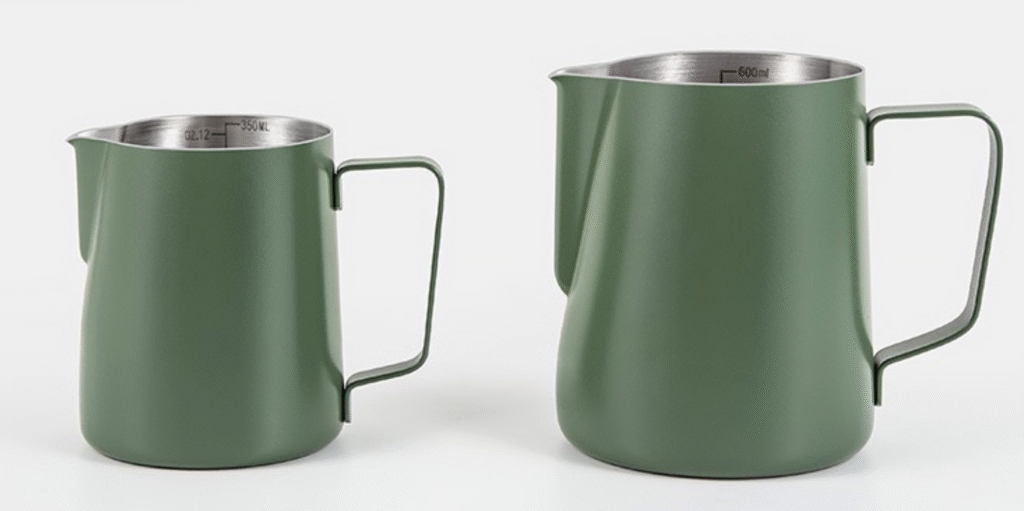
If you make one small drink at a time, choose a 350ml Milk Pitcher.
If you want one practical size for most drinks, choose a 600ml Milk Pitcher.
For cafés, distributors, and coffee accessory buyers, the better answer is usually not “350ml or 600ml.” The better answer is to offer both sizes because they solve different problems.
A 350ml pitcher gives better control for single cups and helps reduce milk waste. A 600ml pitcher is more versatile for daily service, larger lattes, and two small drinks at once.
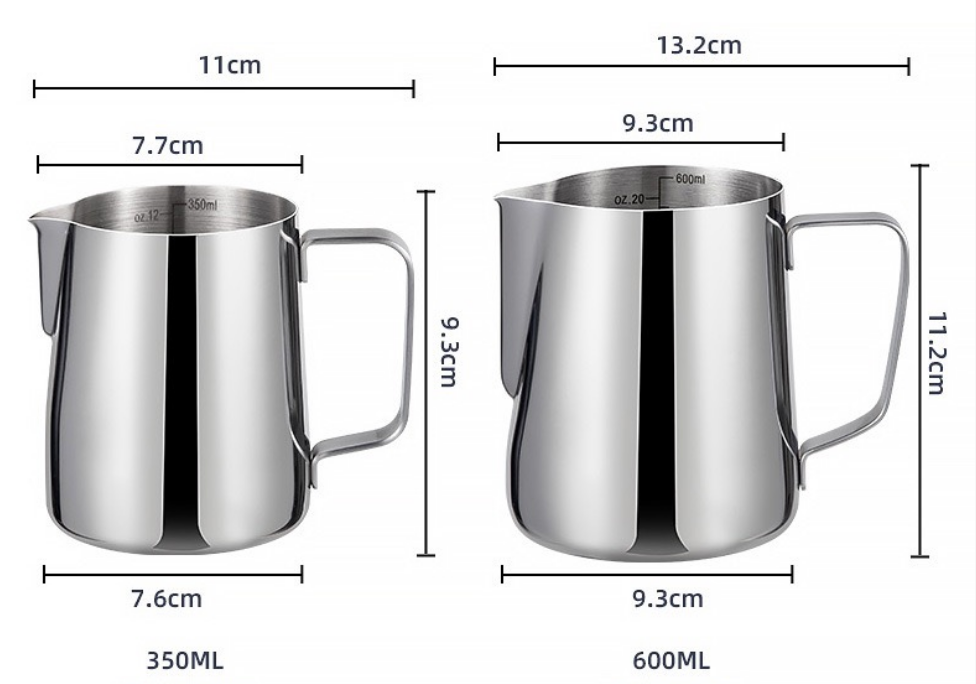
Table of Contents
Understanding the Tool
A Milk Pitcher is not just a small container for milk.
It helps create the milk vortex during steaming, controls milk expansion, and affects how smoothly microfoam pours into espresso.
The right size makes milk texturing easier. The wrong size can cause overflow, poor foam, wasted milk, or weak latte art control.
The Coffmach milk frothing pitcher guide explains that pitcher size affects steaming control and milk expansion. It also recommends choosing the size based on pre-steaming milk volume, not only final cup size.
Key Pitcher Features
Material
Most professional pitchers use stainless steel.
304 stainless steel is popular because it is durable, easy to clean, and suitable for repeated food-contact use.
Spout
A sharper spout gives better control for latte art.
A wider spout may feel easier for beginners or faster service.
Shape
A good pitcher shape helps the milk roll during steaming.
This rolling motion helps create smoother microfoam.
Size
Size controls how much milk you can steam safely and effectively.
This is where the 350ml vs 600ml decision matters most.
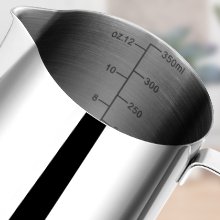
350ml vs 600ml Milk Pitcher Size Comparison
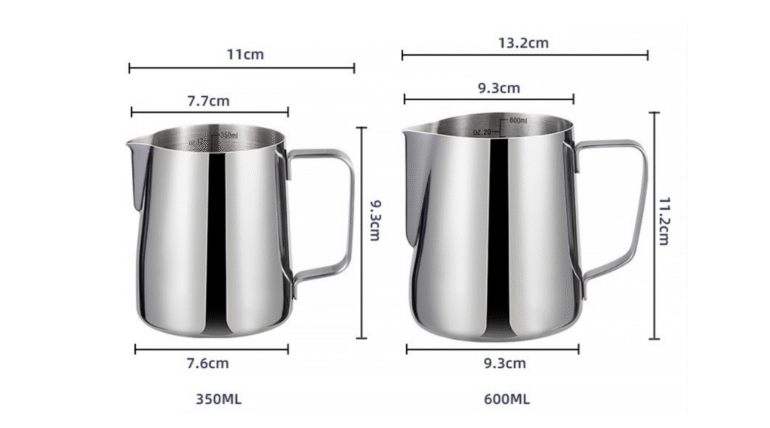
| Feature | 350ml Milk Pitcher | 600ml Milk Pitcher |
| Common oz size | 12 oz | 20 oz |
| Best pre-steaming milk volume | About 120–180ml | About 240–300ml |
| Best for | One small drink | One large or two small drinks |
| Latte art control | Very good | Good and versatile |
| Milk waste control | Better | Moderate |
| Café workflow | Useful for single orders | Better for standard service |
| Wholesale value | Good as a precision size | Best as a main selling size |
When Is a 350ml Milk Pitcher Better?
A 350ml pitcher is better when you need control, small milk volume, and less waste.
It is especially useful for single drinks such as cappuccino, flat white, cortado, or small latte.
Best Uses for 350ml
Single-Cup Service
If the customer usually makes one drink at a time, 350ml is efficient.
It gives enough room for milk expansion without forcing the user to steam too much milk.
Latte Art Practice
A smaller pitcher can feel easier to control.
The barista can keep the spout closer to the coffee surface and manage a smaller milk volume.
Home Baristas
Many home users do not need to steam milk for multiple drinks.
For them, a 350ml Milk Pitcher can reduce waste and improve control.
Café Portion Control
Busy cafés may use 350ml pitchers for small drinks to keep milk portions consistent.
This helps reduce waste over time.
Main Limitation
The 350ml size is not ideal for large lattes or two drinks at once.
If users often make 12 oz or 16 oz drinks, they may find it too small.
When Is a 600ml Milk Pitcher Better?
A 600ml pitcher is better when you need flexibility.
It is one of the most common all-round sizes because it works for many drink types and user levels.
Best Uses for 600ml
One Large Latte
A 600ml Milk Pitcher can handle milk volume for larger drinks more comfortably.
It gives enough headspace for expansion and enough capacity for practical service.
Two Small Drinks
For cafés or offices, making two cappuccinos or flat whites together can save time.
This is where 600ml becomes more efficient than 350ml.
Training and Daily Café Use
A 600ml pitcher gives baristas a balanced size for general service.
It is not too small, not too large, and works well for most menus.
Wholesale Product Lines
For importers and distributors, 600ml is often the safest main size to stock.
It appeals to home users, cafés, online sellers, and coffee equipment brands.
Main Limitation
A 600ml pitcher can waste milk if the user only makes one small drink.
It can also feel less precise than 350ml for small-volume latte art.
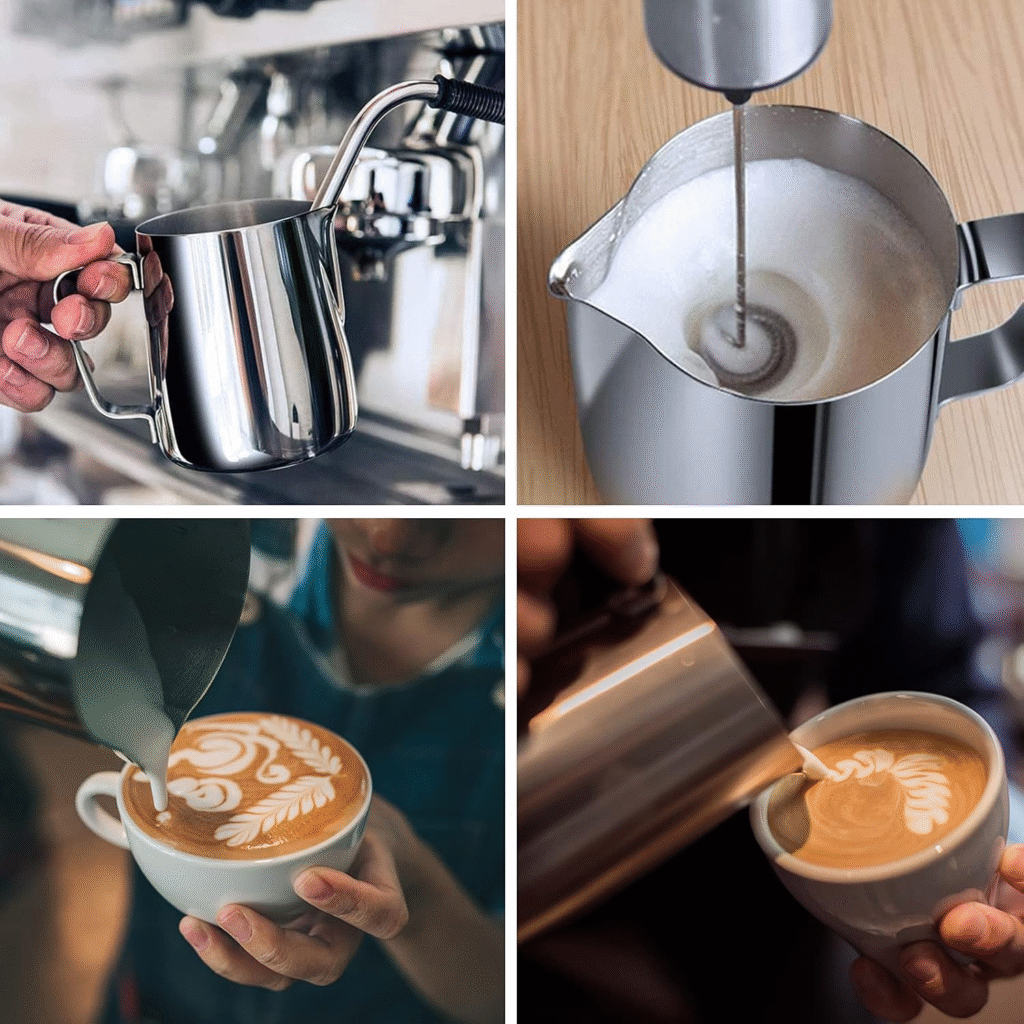
Does Pitcher Size Affect Milk Texture?
Yes, pitcher size can affect milk texture.
Milk needs space to expand during steaming. It also needs enough volume to form a stable vortex.
If the pitcher is too full, milk may overflow.
If the pitcher is too empty, the steam wand may not sit correctly and the milk may not roll well.
Simple Fill Rule
Fill cold milk to just below the bottom of the spout.
This usually leaves enough empty space for expansion.
It also helps the milk roll properly during steaming.
The Specialty Coffee Association is a useful external reference for understanding why consistency matters in professional coffee preparation.
Which Size Is Better for Latte Art?
For detailed latte art, 350ml gives more precision for single cups.
For daily café latte art, 600ml gives better flexibility.
Latte Art Comparison
| Latte Art Need | Better Size | Why |
| Single cappuccino | 350ml | Easier control and less milk waste |
| Flat white | 350ml | Works well with smaller milk volume |
| Large latte | 600ml | More suitable capacity |
| Two drinks | 600ml | Better workflow |
| Training beginners | 600ml | More forgiving and versatile |
| Advanced detail work | 350ml | More direct spout control |
The World Latte Art Championship shows how important pouring control and milk texture are in professional latte art.
Which Size Is Better for Cafés?
or cafés, the best setup is usually both.
Use 350ml for single small drinks.
Use 600ml for standard lattes, multiple drinks, and busier service periods.
Café Buying Recommendation
| Café Scenario | Recommended Size |
| Small espresso bar | 350ml + 600ml |
| High-volume café | Multiple 600ml pitchers |
| Latte art-focused café | 350ml for detail work |
| Hotel coffee service | 600ml plus larger pitchers |
| Training room | 350ml and 600ml together |
For commercial buyers, using only one pitcher size often creates workflow problems.
A mixed-size set gives staff more control and helps reduce waste.
Which Size Is Better for Wholesale Buyers?
For B2B buyers, the answer depends on sales strategy.
If you want one main SKU, 600ml is safer.
If you want a stronger product line, offer both 350ml and 600ml.
B2B Product Line Strategy
Entry-Level Line
Offer 600ml as the main size.
This covers the widest market.
Barista Line
Offer 350ml and 600ml together.
This feels more professional and gives users a reason to buy a set.
Custom Brand Line
Offer multiple sizes with logo engraving, measurement marks, custom colors, and retail packaging.
This is better for coffee brands, roasters, and distributors.
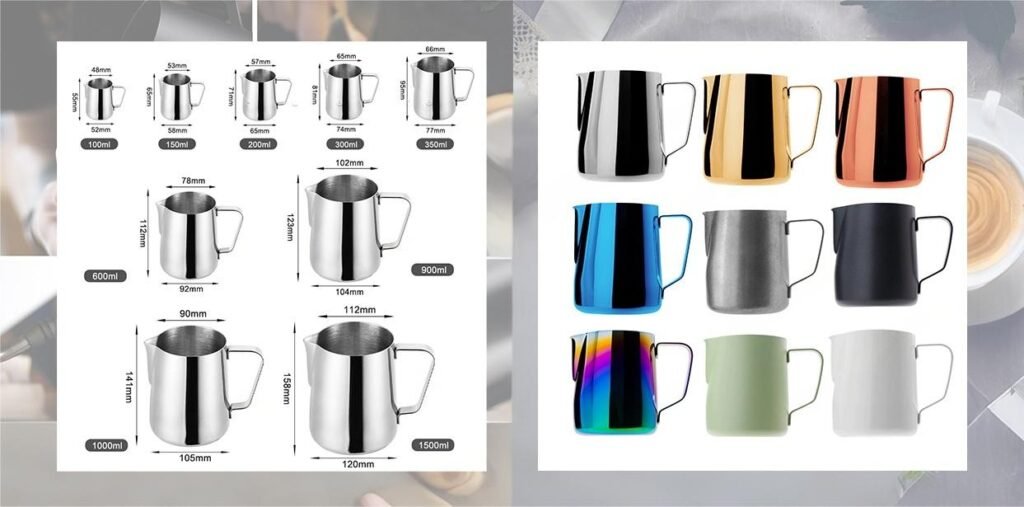
Coffmach’s Coffee Milk Jug product page offers multiple sizes from 100ml to 1500ml, along with stainless steel materials, custom logo service, measurement marks, packaging, and OEM/ODM support.
Material and Safety Considerations
Size matters, but material still matters too.
A good Milk Pitcher should be durable, smooth, and easy to clean.
For food-contact products, buyers should consider material quality and surface finish.
The FDA Food Code 2022, NSF food equipment standards, and European Commission guidance on food contact materials are useful references for general food-contact product expectations.
What to Check
Stainless Steel Grade
304 stainless steel is a strong default choice.
Inner Polishing
A smooth inner surface makes cleaning easier.
Spout Finish
The spout should pour smoothly without dripping.
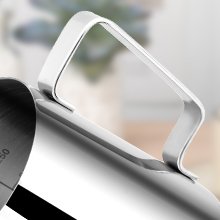
Handle Welding
The handle should feel stable for repeated daily use.
Common Mistakes When Choosing 350ml or 600ml
Mistake 1: Buying by Cup Size Only
Milk expands during steaming.
The pitcher must fit pre-steaming milk volume and expansion space, not only final drink size.
Mistake 2: Using 600ml for Every Small Drink
This may increase milk waste.
It can also make small-volume steaming less controlled.
Mistake 3: Using 350ml for Large Lattes
This can cause overflow and slow down workflow.
Mistake 4: Ignoring Customer Type
Home users, cafés, distributors, and gift set buyers do not always need the same size.
Mistake 5: Forgetting Packaging and Branding
For wholesale and retail, size is only one part of the product.
Logo, box, barcode, finish, and carton strength also affect sales.
Procurement Checklist
Before ordering 350ml or 600ml milk pitchers in bulk, check the full product specification.
| Buying Factor | What to Check | Why It Matters |
| Size | 350ml, 600ml, or mixed set | Matches different drink needs |
| Material | 304 stainless steel | Durability and cleaning |
| Wall thickness | Stable but not too heavy | Better hand feel |
| Spout | Sharp and smooth | Better pouring control |
| Handle | Strong welding | Supports daily use |
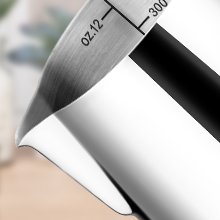
| Measurement marks | Optional inner scale | Helps portion control |
| Logo | Laser, engraving, printing | Supports branding |
| Packaging | Box, label, barcode, carton | Supports resale and shipping |
Recommended Supplier Option
If you are comparing 350ml and 600ml milk pitchers for wholesale, café supply, or private-label projects, Coffmach is a practical supplier to consider.
Coffmach provides Coffee Milk Jug options with multiple capacities, stainless steel materials, custom logo support, measurement marks, colors, packaging, and bulk order solutions.
For custom development, buyers can also review Coffmach Services.
If you need samples, MOQ details, or a quotation, contact the team through the Coffmach contact page.
Final Verdict: 350ml or 600ml?
Choose 350ml if you mainly make one small drink, care about control, and want to reduce milk waste.
Choose 600ml if you want the most versatile size for lattes, two small drinks, daily café service, or general resale.
For serious coffee programs and wholesale buyers, the best answer is to carry both.
A 350ml Milk Pitcher gives precision. A 600ml Milk Pitcher gives flexibility. Together, they create a stronger and more practical product range.
As a professional manufacturer specializing in the research, development, and production of Coffee machine accessories, we not only offer a diverse product selection but also support OEM/ODM customization to meet the needs of diverse markets and customers. With consistent quality control, fast delivery, and innovative designs, our coffee machines are used by numerous brands and channels worldwide. Whether you're a distributor, wholesaler, or brand owner, we can provide you with reliable solutions to help you grow your business. Contact us to explore potential collaboration opportunities.

Facebook
Twitter
LinkedIn
X
Categories: Buying/Customization Guide Product Knowledge


