ESPRESSO MAINTENANCE · BASKET INSPECTION · BUYING GUIDE
How Often Should You Change Your Portafilter Basket?
A condition-based guide to cleaning, inspection, controlled comparison and replacement—so a coffee basket is changed for evidence of failure, not simply because it has reached a calendar date.
Quick answer: replace for condition, not age alone
A home basket may remain serviceable for years. In a busy café, inspect baskets during the closing routine, keep matched spares and use logged comparison tests at a frequency that reflects volume and quality risk. One fast shot, slow shot, spray pattern or leak does not prove basket failure: grind, dose, coffee age, puck preparation, group gasket and machine condition can cause the same symptoms.
- Use calendar dates as review reminders, not automatic disposal dates.
- Rinse after each session and follow the machine and cleaner instructions for deep cleaning.
- Remove a cracked, sharply deformed or deeply pitted basket from service immediately.
- Test a suspect basket against the same unused or known-good model before blaming it for inconsistent shots.
- Different hole fields and basket geometries need a new recipe; do not use a different basket type as a wear-test control.
- For wholesale, qualify rim profile, depth, perforation, dose range and tamper fit—not only nominal diameter.
| Use profile | Routine care | Condition check | Replacement rule |
|---|---|---|---|
| Light home use | Rinse after the session; remove oils according to the machine manual | Backlight and rim check monthly; compare when symptoms persist | Replace on failed inspection or confirmed A/B fault—not because a year has passed |
| Heavy home use | Rinse daily; deep-clean when residue persists or at the documented interval | Inspect every 2–4 weeks; compare with a spare when consistency matters | Replace for damage, permanent blockage, corrosion or confirmed performance drift |
| Café or training lab | Rinse through service and clean under the daily closing SOP | Inspect at close; log a matched-spare test monthly or quarterly by risk | Remove from service on damage; otherwise replace only when control testing shows a fault |
| Pressurized / dual-wall basket | Clean the restricted outlet exactly as the machine manual directs | Inspect outlet and hidden cavity more often | Replace when the restriction cannot be restored safely, or rim/walls/outlet are damaged |
Planning rule: a six-month or annual date can be helpful for stock checks, café audits or a spare-to-working-basket comparison. It is not proof that every basket has reached end of life.
What a portafilter basket does—and what actually wears
The basket is the removable metal cup that holds ground coffee. Its rim seats inside the portafilter, the walls define puck geometry and the perforated floor forms a controlled exit area for the beverage. It is not the portafilter body, retaining spring, group gasket, shower screen, puck screen or blind backflush basket. Replacing one component does not automatically correct a fault in another.
Normal age is a weak failure indicator because a basket has no moving parts. Useful life is shortened more by residue that is never removed, mechanical damage during knocking or removal, unsuitable pins or abrasives, aggressive chemicals, corrosion-promoting contamination, severe deformation and a mismatch with the portafilter or group.
Hole field
Hole count, diameter, placement and open area influence how liquid exits the coffee bed. A blocked or mechanically altered hole field is not merely cosmetic.
Rim and body
The rim must seat and seal as intended. A basket can be clean yet fail because the rim is wavy, out of round or permanently distorted.
Surface condition
Oils, fines and mineral residue can mimic wear. True pitting, flaking, sharp roughness and cracks are different: they need a conservative replacement decision.
Why one unusual shot is weak evidence
Espresso is a system. Grind setting, coffee mass, freshness, distribution, tamping, beverage yield, temperature, pressure or flow and water delivery can all change the result. A basket becomes a credible root cause only when the symptom remains after those variables are controlled and then moves with the basket during a swap.
Likewise, a leak around the portafilter can come from coffee on the rim, excessive dose, incomplete lock-in, wrong basket fit or a worn group gasket. Inspect and test the sealing system before replacing a clean basket.
Seven signs you should replace the basket
Replace when a basket fails a structural, hygiene, fit or controlled-performance check. These are stronger signals than age or general appearance. If damage is severe, stop using the basket rather than trying to straighten, drill, grind or aggressively polish it.
| Observation | First interpretation | Replace now? |
|---|---|---|
| Oils or dark film | Usually a cleaning issue | No; use an approved cleaner and inspect again |
| One or two blocked holes | Usually residue or fines | Not yet; follow the documented rinse, pin or soak procedure |
| Crack or split | Structural failure | Yes; remove from service |
| Bent rim that rocks or leaves a gap | Fit and sealing surface damaged | Yes, after checking the portafilter is sound |
| Leak around the portafilter | Could be rim dirt, overdose, lock-in, gasket or basket | Diagnose first; replace only when damage is visible or the fault follows the basket |
| Sudden fast or slow shot | Could be recipe, coffee, prep, machine or blockage | No; clean and run a controlled comparison |
| Deep pitting or flaking | Material or finish damage | Usually yes; do not rework the hole field aggressively |
Clean or replace? Run this 10-minute decision test
Use this sequence before ordering a new basket. The goal is to separate removable residue, a machine fault and an incompatible recipe from irreversible basket damage. Stop immediately if a crack, sharp edge or major deformation is already visible.
How to clean a portafilter basket without shortening its life
Good cleaning extends useful life because it removes oils and fines before they are mistaken for mechanical wear. Start with the manual for the exact machine, then follow the cleaner label for concentration, temperature, contact time, compatible materials, rinsing and any required discard shot.
After each session
Knock out the puck without striking the rim on a sharp metal edge. Rinse when the manual allows, wipe the rim and group sealing area, then dry or drain as the equipment maker recommends.
Periodic deep cleaning
Use coffee-equipment detergent only as directed. Published soak recipes vary by cleaner and machine; do not transfer concentration or time from one product to another.
Avoid damage
Avoid steel wool, carbon-steel brushes, bleach, hydrochloric-acid cleaners, random needles, drill bits, torch cleaning and unattended soaking beyond the stated time.
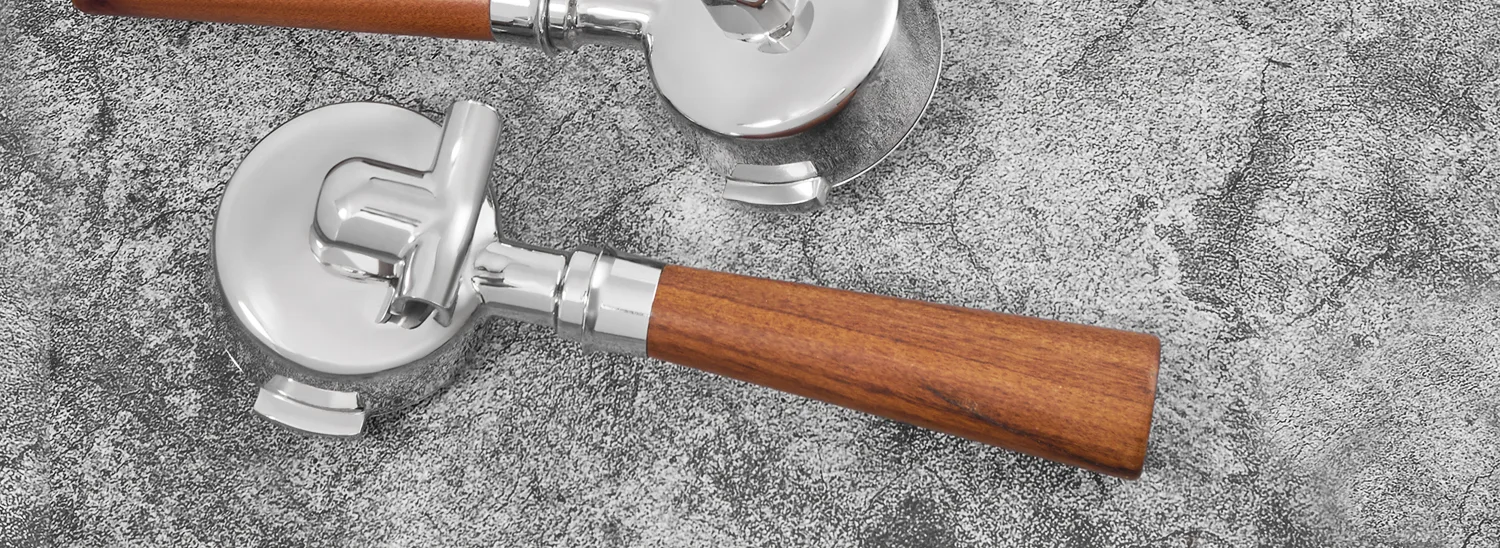
Why chemicals and tools matter
Hard abrasives can scratch a finish and leave carbon-steel particles that later appear as rust-coloured staining. Chloride-heavy and hydrochloric-acid cleaning products can stain or pit stainless steel under unsuitable conditions. Rinse thoroughly, and choose a cleaner only when the basket and equipment documentation permits it.
For a persistent blocked hole, use only the tool and method specified for the machine or basket. Enlarging a hole may create a visual “fix” while permanently changing the designed exit geometry.
Need matched replacement baskets or complete portafilters?
Provide Coffmach with the machine model, current basket code, target dose, rim and height requirements, material or finish, and sample quantity. Matching the basket to the actual portafilter workflow reduces return and fit risk.
Do different basket types need different replacement rules?
The core replacement criteria are similar, but cleaning access, diagnostic sensitivity and correct comparison change with construction. Identify the basket before applying any rule.
| Basket type | What changes | Replacement emphasis |
|---|---|---|
| Standard single-wall | Perforated bottom is directly visible and usually easy to backlight | Clean first; replace for damage, permanent blockage, corrosion or confirmed drift |
| Precision / competition | Hole geometry, open area, finish and dose range may be tightly controlled | Use a matched replacement; avoid tools that alter the perforated field |
| High-flow | Different open area or hole system can require a revised recipe | Do not confuse a recipe change with wear; compare only with the same model |
| Pressurized / dual-wall | Secondary restriction can hide trapped residue | Prioritise outlet cleaning; replace if restriction cannot be restored without damage |
| Ridged / ridgeless | Retention depends on ridge geometry or portafilter spring tension | A basket falling out may be a spring issue; inspect before blaming the hole field |
| Coated / treated | Cleaning compatibility depends on the exact finish | Replace for flaking or damaged food-contact surface; follow maker care instructions |
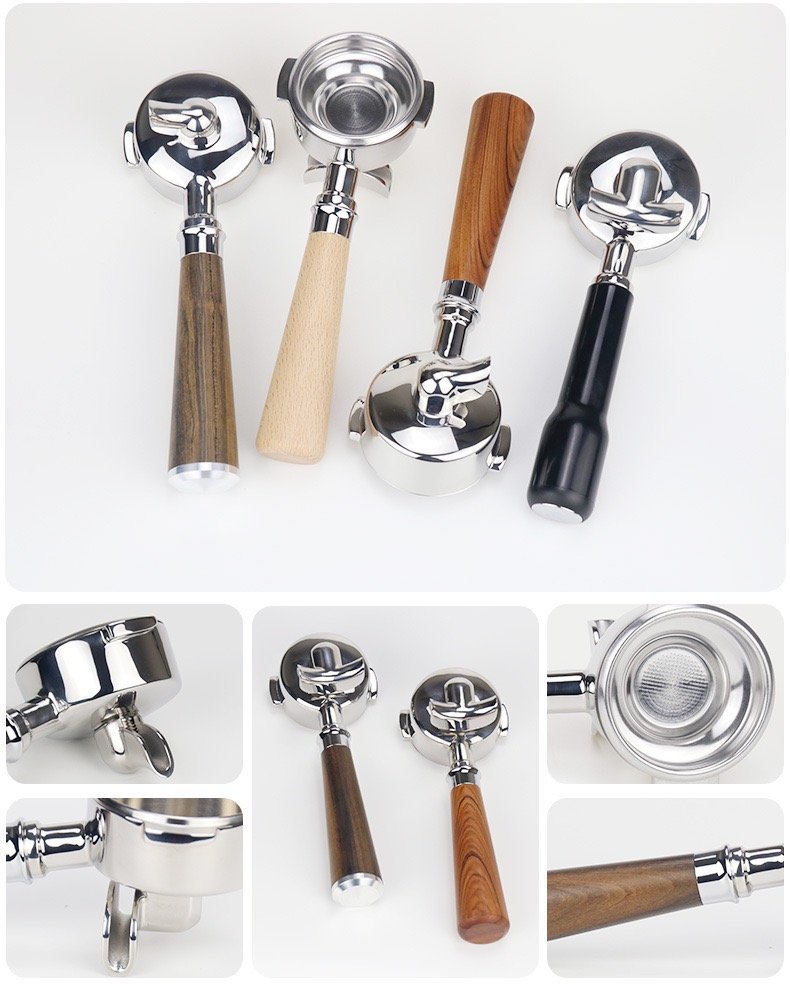
Replacement selection and OEM / wholesale checklist
“58mm stainless basket” is not a sufficient specification for a café, distributor or private-label project. A nominal-diameter match can still fail because the rim profile, total height, body taper, ridge, floor geometry, portafilter clearance or tamper fit is wrong. Approve samples in the real brewing system before bulk production.
- Compatibility: exact machine models, group interface, approved part numbers and portafilter drawings.
- Critical dimensions: rim outside diameter and profile, body diameter, total height, taper, ridge position, floor geometry and tolerance.
- Dose and workflow: target dose range, headspace approach, target tamper, funnel, puck screen and spout/bottomless clearance.
- Perforation: hole pattern, perforated diameter, hole-size range, open-area target and inspection method.
- Material and finish: steel grade, surface finish or coating, food-contact documentation for the market and cleaner compatibility.
- Quality evidence: dimensional report, visual criteria, hole inspection, lot traceability, golden sample and change control.
- Commercial terms: samples, packaging, logo method, replacement policy, MOQ and lead time—confirmed for the actual project.
Start with a sample qualification plan
Send the target machine, basket/portafilter drawings, dose range, material, finish, branding, packaging, quantity and acceptance checks. Coffmach can support coffee portafilter and basket sourcing with wholesale and custom project discussion.
Frequently asked questions
How long does a portafilter basket last?
There is no universal service life. A clean, undamaged stainless basket in home use can remain functional for years, while one basket may need immediate replacement after a crack, bent rim, deep pitting or damaging cleaning attempt. Inspect regularly and replace for condition or a confirmed matched-basket test result.
Should a café replace portafilter baskets every six months?
Not automatically. Six months can be a useful audit or comparison date, not a universal standard. A café should clean and inspect daily, keep matched spares and set a logged test interval based on shot volume, quality risk and observed drift. Replace immediately when a structural or hygiene check fails.
Can cleaning restore a clogged basket?
Often, yes. Coffee oils and fines can block holes, and official manuals describe rinsing, supplied cleaning pins and product-specific detergent soaking. Follow the exact machine and cleaner guidance, then rinse thoroughly. If blockage remains, replace rather than drilling or forcing the opening.
Does espresso pressure make basket holes larger?
Do not assume normal use automatically enlarges every hole. Construction and fatigue resistance vary. Damage from an oversized pin, drilling, aggressive abrasion, a severe dent or a crack is clearer replacement evidence than calendar age. Compare to an unused matching basket if geometry is in doubt.
Is leaking around the portafilter a basket problem?
Sometimes, but not by itself. Coffee on the rim, excess dose, incomplete lock-in, an incorrect basket, dirt on the group seal or a worn gasket can all leak. Clean the sealing surfaces, verify dose and fit, then test a known-good basket. Replace when the rim is damaged or the fault follows the basket.
Do precision baskets need replacement more often?
No fixed rule says they do. Tighter manufacturing control can make a matched comparison more informative, but it does not make a basket automatically disposable sooner. Protect the perforated field, use approved cleaning methods and replace for damage or confirmed drift.
Can a portafilter basket go in a dishwasher?
Only when the basket or machine manufacturer allows it. Detergent, contact with dissimilar metals, retained chemicals, heat and the basket finish can change the risk. When documentation is unclear, hand cleaning with the approved coffee-equipment method is the safer default.
Do I need to replace the portafilter when replacing the basket?
Usually not. The basket is a separate removable component. Reuse the portafilter if its body, lugs, handle, retaining spring, spout and basket seat are sound and the new basket is compatible. Service the complete portafilter only when one of those parts has its own fault.
Technical sources and image credits
- Breville — Barista Express Instruction Book. Official model-specific guidance on rinsing, clearing blocked basket holes and troubleshooting flow and leakage.
- Urnex — Cafiza Espresso Machine Cleaning Powder. Manufacturer instructions for accessory cleaning; use the product label for current concentration and contact time.
- La Marzocco — GS3 Operating Manual. Official maintenance reference for machine, portafilter and filter cleaning.
- IMS — B702TH26.5M Filter Basket. Model-specific basket geometry and perforation example; not a universal basket specification.
- VST — Precision Filter Baskets. Manufacturer information on basket manufacturing and hole-quality controls.
- British Stainless Steel Association — Cleaning Stainless Steel. General cautions about chloride, bleach, hydrochloric-acid and abrasive contamination risks.
- Systematically Improving Espresso: Insights from Mathematical Modelling and Experiment. Peer-reviewed context for interacting espresso variables and controlled tests.
- Coffmach images are real product photographs from the Coffee Portafilter product page. The one external coffee-basket photograph is credited in plain text directly below the image. Images and photo credits are not clickable.