


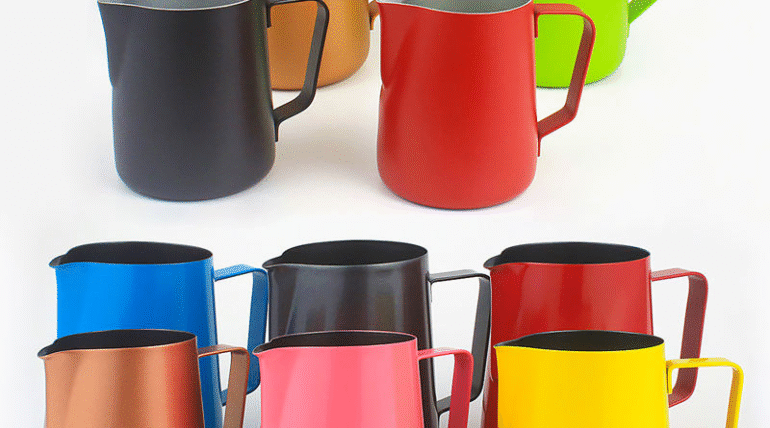
27.06.2026
Bottom line: the best milk frothing pitcher with measurements in 2026 is a 304 stainless steel jug with clear internal markings, a balanced handle, and a spout that gives baristas real control. For most cafés, 600ml is the safest all-round choice.
This is not just a milk container. It is a workflow tool. It affects milk waste, drink consistency, training speed, and latte art quality. For café owners, purchasing managers, distributors, Amazon sellers, and training schools, the right milk frothing pitcher with measurements is a small purchase with a big operational impact.
Table of Contents
Your Quick Selection Guide
Most cafés should choose a 600ml milk frothing pitcher with measurements. That size covers one large latte or two medium drinks without wasting too much milk. It is the industry workhorse.
For material, choose 304 stainless steel. That is the safest commercial default. It handles daily use, repeated washing, and heavy service without becoming a problem later.
For measurements, look for clear internal marks in ml and oz. If your team cannot read the lines quickly, the feature loses value. Good markings reduce guesswork. Bad markings create noise.
For latte art, choose a narrow, controlled spout. A wide spout may be faster, but a sharper spout gives better line control and cleaner patterns.
Here is the key insight: spend more on construction and consistency, not decoration. A better pitcher saves milk, reduces breakage, and makes training easier.
A Critical Business Decision
Your milk frothing pitcher with measurements is not just a barista accessory. It is part of your production system.
In a busy café, the jug controls how much milk enters the steam process. That starting volume affects foam texture, temperature control, and final drink balance. If the amount is wrong, the result changes.
That is why this product matters to business buyers. A standard pitcher helps standardize output. A standardized output helps reduce complaints. Lower complaints mean stronger repeat business.
For chain stores, this matters even more. One location cannot steam milk differently from another and still claim the same product. The pitcher helps close that gap.
For training schools, the logic is simple. Students learn faster when the tool gives them a visual target. They stop guessing. They start repeating. That is how quality becomes teachable.
For a broader industry view on consistency and professional standards, the Specialty Coffee Association is a useful reference, and training resources from Barista Hustle and Perfect Daily Grind reinforce the same point: control produces better drinks.
Choosing the Right Capacity
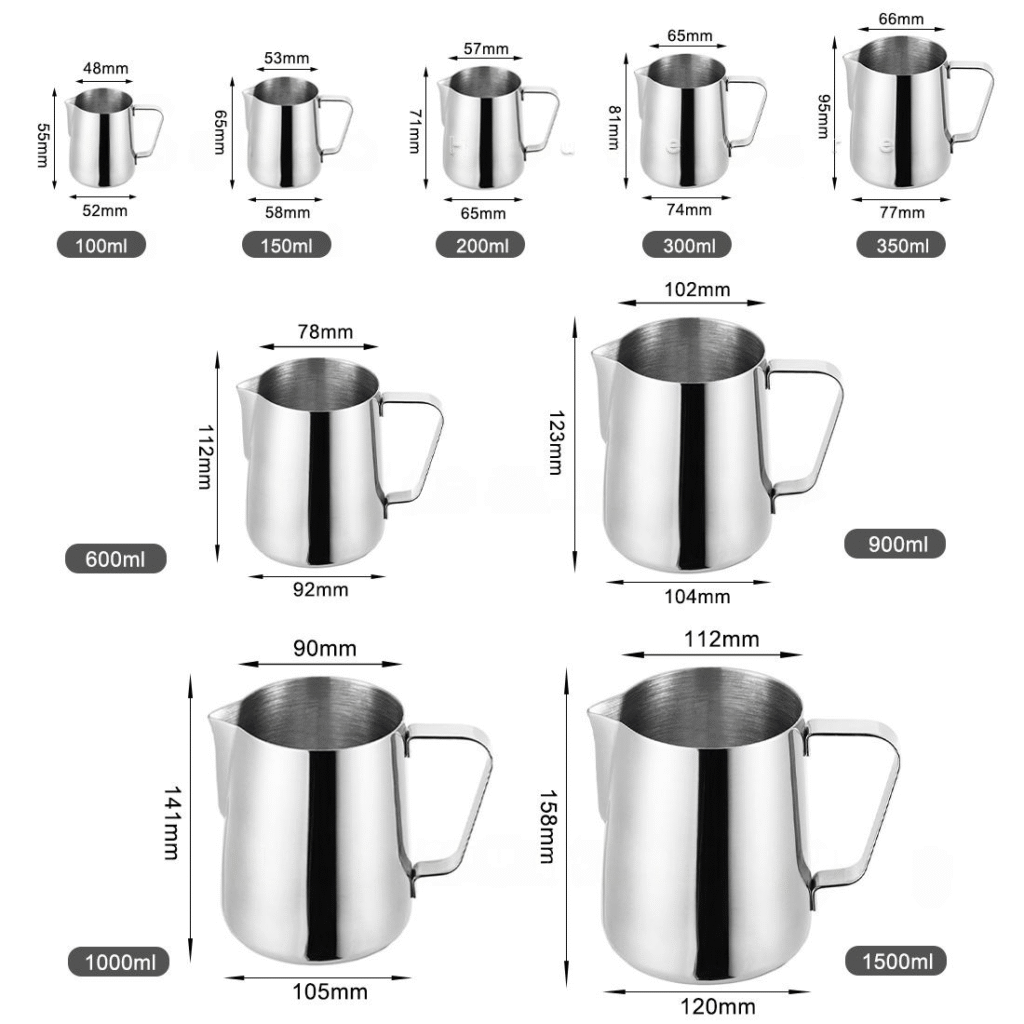
Capacity is the first practical decision. Wrong size costs money. Too large, and you waste milk. Too small, and you slow down service.
350ml
This size is best for practice, single drinks, cortados, flat whites, and training use. It gives you tighter control and reduces waste.
600ml
This is the safest commercial all-rounder. It handles most café orders, works well for two small drinks, and is easy to standardize across a team.
900ml
This size is for higher throughput, larger drinks, or batch-style service. It is useful, but it is not the best choice for detailed latte art work.
| Capacity | Best For | Pros | Cons |
| 350ml | Practice, single drinks, home baristas | Less waste, faster heating | Not ideal for multi-drink service |
| 600ml | Most cafés, daily service | Versatile, efficient, standard size | Slight waste on very small drinks |
| 900ml | High-volume service, larger drinks | Good throughput | Less control, more waste risk |
If you are buying one model first, start with 600ml. If you are building a multi-SKU line, launch 350ml and 600ml first, then add 900ml for commercial buyers.
Understanding Materials
Material choice is non-negotiable.
For commercial use, 304 stainless steel is the right answer. It is durable, corrosion resistant, and widely accepted in food-contact equipment. That matters because milk is acidic, water is constant, and cleaning is aggressive.
If you want a technical reference, the British Stainless Steel Association explains why grade selection matters. For food-contact context, the FDA Food Contact Substances page is a useful checkpoint.
The cheaper alternative is usually 201 stainless steel. It can look similar at first glance, but it is a weaker commercial choice. Over time, it is more likely to show corrosion, dents, and long-term wear.
Wall thickness matters too. Thin pitchers heat up too fast and feel unstable. Thicker pitchers hold temperature better, feel more solid in the hand, and survive commercial use more reliably.
A good commercial pitcher should feel controlled, not flimsy. That sensation is not cosmetic. It affects how confidently a barista steams and pours.
Design for Performance
A milk frothing pitcher with measurements must do three jobs well. It must measure, steam, and pour.
The spout
The spout controls the pour. A narrow spout gives better line control, cleaner shapes, and more precise latte art. It is the better choice for brands and cafés that care about presentation.
A wider spout is faster, but speed alone is not enough. If the pour becomes messy, the drink loses visual quality. For most specialty cafés, control wins.
The handle
The handle needs to be comfortable over long shifts. A good handle supports different grip styles, reduces wrist strain, and makes the jug feel stable when full.
The body shape
A tapered body helps with steam dynamics. It supports better vortex movement, which helps milk texture become smoother and more consistent. That is a practical advantage, not a design detail.
Balance
Balance matters more than most buyers think. A well-balanced pitcher feels natural in the hand. That makes steaming easier, pouring steadier, and training smoother.
Advanced Commercial Features
This is where a basic jug becomes a real business product.
Internal measurement marks
Internal volume markings are the main reason many buyers search for a milk frothing pitcher with measurements in the first place. They remove guesswork. They help baristas fill the same amount every time. They also speed up training.
OEM and private label support
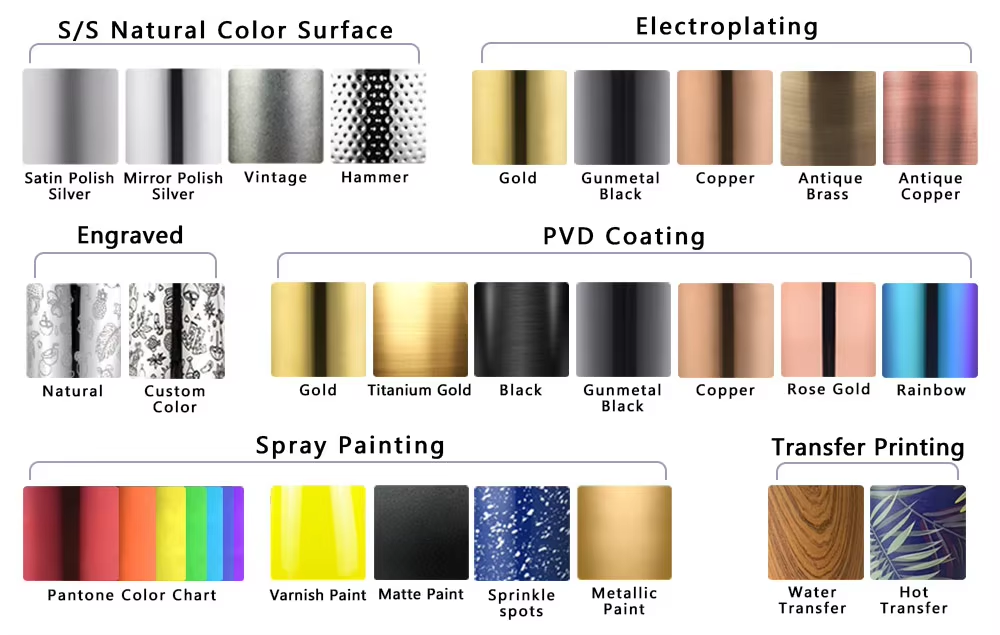
For distributors, brands, and chain buyers, customization is a major value driver. Logo engraving, color finishing, packaging, and measurement mark customization all turn a generic pitcher into a branded product.
If you are building a branded line, start with Coffee Milk Jug. If you are working on a sourcing or branding project, the guide OEM & Private Label Coffee Milk Jug: A Guide for Importers is the right next read.
Product pairing
A milk pitcher does not work alone. It performs better in a consistent workflow that also includes accurate dosing and strong espresso prep. That is why a Coffee Scale and a Coffee Tamper are smart companion products.
How It Improves Latte Art and Workflow
The real value of a milk frothing pitcher with measurements is not the line on the wall. It is the repeatability behind that line.
When the milk amount is consistent, the stretching stage becomes easier to control. When steaming becomes easier to control, the foam texture becomes more stable. When the foam texture becomes more stable, the pour becomes more predictable. That is how latte art improves.
This also saves time. There is no need to move back and forth between a pitcher and a separate measuring cup. The workflow becomes shorter. The barista moves faster. The whole station becomes cleaner.
For home baristas, this means fewer failed attempts. For cafés, it means less waste and fewer remake drinks. For training schools, it means better student results in less time.
Calculating the True Cost
One common mistake is buying the cheapest pitcher available.
That is usually a false economy.
A cheap pitcher may work for a short time, but if it dents easily, corrodes, or creates inconsistent pours, the hidden cost rises fast. You pay in replacements, training friction, wasted milk, and drink inconsistency.
This is total cost of ownership. The cheapest item is not always the lowest-cost item.
Here is the simple version:
Pitcher A costs less upfront, but it needs frequent replacement. It also causes more waste.
Pitcher B costs more upfront, but it lasts longer, performs better, and keeps the team more consistent.
Over time, Pitcher B is the better commercial decision.
That is why café buyers should evaluate the pitcher as an operational asset, not a retail novelty.
Recommended Coffmach Product
If you are building a standardized espresso and milk setup, these Coffmach pages fit together well.
- Coffee Milk Jug – main SKU for measured steaming, B2B purchasing, and custom branding.
- Coffee Scale – helps keep dose and recipe control consistent.
- Coffee Tamper – supports stable espresso extraction before the milk stage.
- OEM & Private Label Coffee Milk Jug: A Guide for Importers – useful for brands, wholesalers, and private label buyers.
For cafés and distributors, this bundle works because it covers the full workflow. Dose, extraction, and milk control stay aligned. That is how standardization becomes real.
Final Purchasing Checklist
Before you place an order, check these points.
- Size: Is 600ml the primary option?
- Material: Does the spec clearly state 304 stainless steel?
- Markings: Are the measurement lines clear and durable?
- Spout: Does the pour shape support latte art?
- Handle: Is the grip comfortable for long service?
- Supplier: Can they support bulk orders and customization?
- Packaging: Is it suitable for retail, wholesale, or OEM shipping?
If the answer is no on two or more of these items, keep looking.
FAQ
Q1: What size milk frothing pitcher with measurements is best for most cafés? 600ml is the best all-round size for most commercial use.
Q2: Why is 304 stainless steel recommended? It gives better durability, corrosion resistance, and long-term commercial reliability.
Q3: Do measurement marks really improve latte art? Yes. They reduce guesswork and help baristas start from the same milk volume every time.
Q4: Can this product be customized for my brand? Yes. It can support logo work, packaging changes, and measurement mark customization.
Q5: What should I bundle with a milk pitcher? A coffee scale and a coffee tamper are the most useful companion products.
As a professional manufacturer specializing in the research, development, and production of Coffee machine accessories, we not only offer a diverse product selection but also support OEM/ODM customization to meet the needs of diverse markets and customers. With consistent quality control, fast delivery, and innovative designs, our coffee machines are used by numerous brands and channels worldwide. Whether you're a distributor, wholesaler, or brand owner, we can provide you with reliable solutions to help you grow your business. Contact us to explore potential collaboration opportunities.

coffmach.com
contact us
Facebook
Twitter
X
LinkedIn


