


05.03.2026
Finding the right OEM & Private Label Coffee Milk Jug: What Importers Should Know is crucial for building a profitable brand in the coffee accessories market. Success doesn’t happen by chance. It rests on four key pillars. You need a deep understanding of customization. Quality control must be non-negotiable. Brand differentiation requires strategy. And you must choose a reliable manufacturing partner. This guide gives importers, distributors, and brand owners an actionable framework. It helps you navigate this process with confidence and transform a simple product into a brand cornerstone.
Table of Contents
1. The Strategic Advantage
Choosing an OEM or private label strategy for coffee milk jugs is a smart business move. It shifts your business from reselling generic goods to creating branded assets.
This change lets you capture more value from the supply chain. You build direct customer relationships. You create a product that reflects your brand’s unique identity and quality standards.
OEM vs. ODM vs. Private Label
Understanding these terms is your first step. Each path offers different levels of control, investment, and speed to market.
OEM (Original Equipment Manufacturer) means you provide a complete, custom design to a factory for production. This gives you the highest level of uniqueness.
ODM (Original Design Manufacturer) involves choosing an existing design from a factory’s catalog and adding your branding. People often use this term interchangeably with Private Label.
This approach gets you to market much faster. It also requires less upfront investment in research and development.
Feature | OEM (Your Design) | ODM/Private Label (Their Design) |
Design Control | Total Control | Limited to Branding/Packaging |
Initial Investment | High (Molds, R&D) | Low to Medium |
Time to Market | Longer | Faster |
Uniqueness | High | Low to Medium |
Best For | Established brands seeking a signature product | Startups, Amazon sellers, quick market entry |
The Core Business Benefits
Choosing a private label or OEM path delivers real returns for your business.
Higher profit margins are the most direct benefit. When you source directly from a coffee milk jug manufacturer, you cut out domestic distributors and wholesalers. This substantially improves your profit on every unit sold.
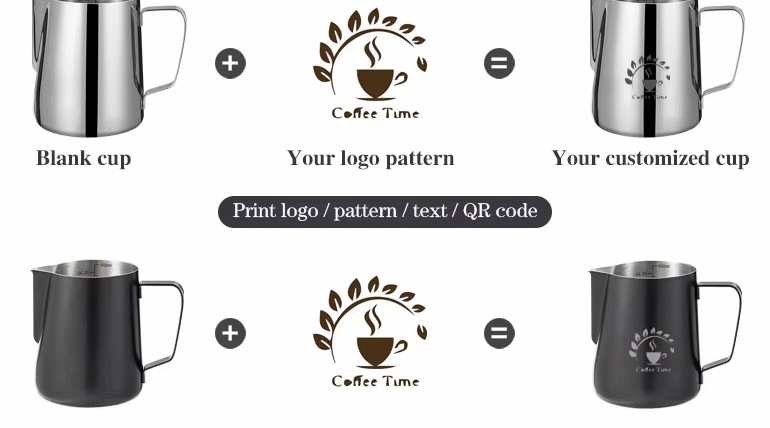
Total brand control extends from the product’s physical features to the customer’s unboxing experience. You decide the material finish. You choose the handle’s shape. You control logo placement and packaging design. This ensures a consistent brand message.
Market differentiation matters in a competitive landscape. Instead of competing only on price with identical products, a custom coffee milk pitcher lets you compete on quality, features, and brand story.
The global specialty coffee market keeps growing. This drives demand for high-quality, professional-grade accessories. Publications like Perfect Daily Grind note that consumers and baristas increasingly invest in superior tools. This creates a prime opportunity for differentiated brands.
2. The Sourcing Journey
Navigating the OEM and private label process for the first time can seem complex. We break it down into clear, step-by-step instructions from initial concept to final delivery.
This guide demystifies the entire process. It provides an actionable plan for sourcing coffee accessories from China or other manufacturing hubs.
Step 1: Initial Inquiry
Your journey starts with a clear Request for Quotation (RFQ). A detailed RFQ saves time and gets you accurate pricing.
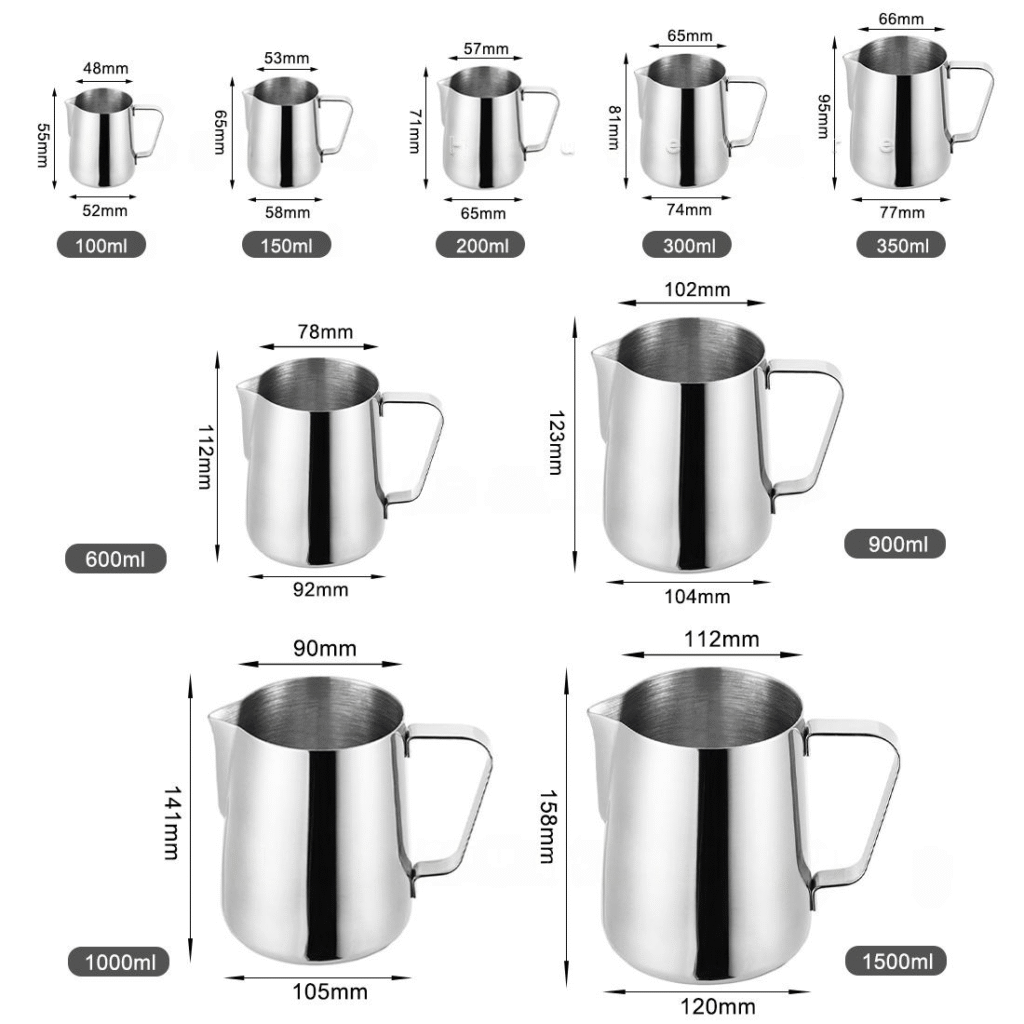
Include these critical details: desired material (like 304 stainless steel), capacity (such as 350ml, 600ml, 900ml), surface finish (matte, polished, or colored), logo application method, and your estimated order quantity.
This is also when you discuss Minimum Order Quantity (MOQ). For standard milk jug designs, reasonable MOQs for coffee accessories often start between 500 and 1,000 units. Fully custom designs requiring new molds will have much higher MOQs.
Remember, MOQ is often negotiable. A supplier may be more flexible for a promising long-term partnership.
Step 2: Sampling & Prototyping
Never proceed to mass production without first approving a physical sample. This step verifies the manufacturer’s capability and the product’s quality, not just its appearance.
The goal is to receive and approve the “Golden Sample.” This is the final, perfected prototype that you and the factory agree upon. It becomes the benchmark for all units in the mass production run.
The process is often repetitive. You’ll receive a T1 (first-off-tool) sample. You’ll inspect it and provide detailed feedback for revisions. This may involve several rounds of adjustments until the sample is perfect. Don’t rush this stage. Any flaw in the Golden Sample will be replicated thousands of times.
Step 3: Mass Production
Once you provide written approval of the Golden Sample and submit your purchase order, mass production begins.
Typical lead times for a production run of coffee milk jugs are between 30 and 45 days. This doesn’t include shipping time.
Stay in regular contact with your supplier during this period. Ask for periodic updates and, if possible, photos or videos of the production line. This helps ensure the project stays on track and allows for early intervention if issues arise.
Step 4: Quality Control
Quality control isn’t a final step but an ongoing process. The most critical inspection, however, happens before the final payment and before the goods leave the factory.
You have several options for inspection. You can travel to the factory yourself, but this often isn’t feasible.
A more common and effective approach is hiring a professional third-party inspection service. Companies like QIMA or SGS can perform a detailed inspection on your behalf. They provide a comprehensive report with photos and data.
Step 5: Packaging & Logistics
The importance of packaging cannot be overstated. It must be durable enough to protect your product during international transit. It must also be appealing enough to serve as a key branding element.
Work with your supplier on custom-designed retail boxes that enhance your brand’s image.
You must also coordinate logistics. Understand basic shipping terms like FOB (Free On Board), where the supplier gets the goods to the port, and EXW (Ex Works), where you handle pickup from the factory door. You’ll need to partner with a freight forwarder to manage international shipping, customs clearance, and final delivery. For guidance on this process, resources like FedEx’s international shipping guide are invaluable.
3. Mastering Quality Control
A premium milk jug is defined by its details. For importers, establishing and enforcing strict quality standards is non-negotiable. It’s the single most important factor in building a reputation for quality and avoiding costly product returns.
This section provides a technical checklist for evaluating a bulk coffee frothing pitcher.
Material Integrity
The foundation of any quality milk jug is the material it’s made from.
Insist on food-grade 304 stainless steel, also known as 18/8 stainless steel. This grade is the industry standard for good reason. The “18/8” refers to its composition of 18% chromium and 8% nickel. The British Stainless Steel Association explains that this composition provides excellent resistance to corrosion from milk acids and cleaning agents. This ensures durability and food safety.
Always request material safety and food-grade compliance reports from your supplier. Certifications like FDA (for the US market) or LFGB (for the EU market) provide third-party validation that the material is safe for food contact. A reputable stainless steel milk jug supplier will have these readily available.
Craftsmanship Details
The difference between a generic jug and a premium barista tool lies in the manufacturing details. Use this inspection checklist to evaluate your samples and mass production.
Milk Jug Inspection Checklist:
- Handle Welding: The point where the handle connects to the body is a common failure point. The weld should be smooth and fully penetrated, with no gaps, sharp edges, or burn marks. A clean TIG weld shows good craftsmanship.
- Internal Seams: Ideally, the interior should be seamless, drawn from a single piece of steel. If a seam exists, run your finger along it. It must be perfectly smooth and flush. Any crevice can trap milk residue, leading to bacteria growth.
- Polishing and Finish: The interior finish should be a smooth brushed or polished surface for easy cleaning and optimal milk swirling. There should be no visible machine lines, scratches, or blemishes. The exterior finish, whether mirrored, matte, or colored coating, must be consistent across the entire surface.
- Spout and Handle Alignment: This is critical for performance. The pouring spout must be perfectly symmetrical and precisely shaped to allow controlled, fine lines required for latte art. It must be perfectly aligned with the handle. Hold the jug and check its balance. It should feel comfortable and stable, even when full.
4. Building Your Brand
Brand differentiation is how you move from selling a commodity to selling an experience. For private label barista tools, this goes far beyond simply adding a logo.
It’s about creating a product with a distinct identity that resonates with your target audience. Whether they are home enthusiasts or professional baristas.
Level 1: Surface Branding
This is the most common and accessible form of customization.
Laser engraving is a popular choice. It creates a sharp, precise, and permanent mark with a modern, high-end feel. It works best for single-color logos and text.
Etching or screen printing allows for color use and more complex graphics. However, you must verify the print’s durability. Make sure it won’t chip or fade after repeated use and washing.
Level 2: Functional Customization
This level of customization adds real value and sets your product apart functionally.
Internal measurement lines are a highly sought-after feature. Etched or stamped volume markings (in ml and oz) inside the pitcher help baristas reduce milk waste and ensure consistency. This makes your product a more practical tool.
Custom colors and finishes can dramatically change the product’s appearance. PVD (Physical Vapor Deposition) coatings can create stunning and durable finishes in black, gold, copper, or even iridescent rainbow. Matte or sandblasted finishes offer a different feel compared to standard polished steel.
Handle modifications, such as a unique ergonomic shape or wood accents, can also create a signature look and feel. A good supplier can guide you through the available options. You can see these in a quality Coffee Milk Jug portfolio.
Level 3: Proprietary Design
This is the true OEM route. You invest in creating a completely unique product.
This involves developing custom molds and tooling to produce a milk jug with a proprietary shape, spout design, or feature that’s exclusive to your brand.
This path requires significant upfront investment in tooling (often thousands of dollars) and a longer development timeline. However, it provides the ultimate competitive advantage and the highest potential for brand differentiation.
Level 4: The Unboxing Experience
Your brand’s story doesn’t end with the product itself. The packaging is the first physical interaction a customer has with your brand.
Invest in high-quality, custom-printed retail boxes. This elevates the perceived value of your product and provides a canvas for your brand story and instructions.
Consider details like branded tissue paper, a custom-printed user guide, or a thank-you card. These small touches create a memorable unboxing experience that customers appreciate and share. For inspiration on what’s possible, browse packaging design showcases like The Dieline.
5. Finding Your Partner
Your choice of manufacturing partner is the single most important decision in the private label process. A great partner acts as an extension of your team. A poor one can lead to delays, quality issues, and financial loss.
Use a structured process to select the right supplier for your OEM coffee equipment needs.
Supplier Vetting Checklist
Evaluate potential manufacturers against these critical criteria:
- ✅ Industry Specialization: Do they specialize in coffee accessories and housewares, or are they a general metal fabricator? A specialist understands the specific functional requirements of a barista tool.
- ✅ Clear Communication: Are their responses prompt, clear, and professional? Do they understand your questions and provide detailed answers? A communication breakdown is a major red flag.
- ✅ Proven Experience: Ask to see their portfolio of past OEM and private label projects. Can they show you examples of custom coffee milk pitchers they’ve produced for other brands?
- ✅ Quality Management: Do they have a documented quality management system, such as ISO 9001 certification? Can they readily provide the material safety and food-grade compliance reports mentioned earlier? An overview of the ISO 9001 standard shows the process commitment this implies.
- ✅ Flexibility and Support: Are they willing to discuss your specific needs regarding MOQ? Do they offer design support or suggestions to improve your product? A true partner collaborates with you.
A reliable manufacturer will have a professional and easy way for you to start the conversation. The ability to contact them and get a timely, helpful response is a key indicator of a good partner.
A Partner for Growth
Finding a supplier that meets all these requirements is the key to a successful, long-term sourcing relationship.
For businesses seeking a stable partner focused specifically on coffee hardware, a manufacturer like Coffmach serves as an excellent example. They are a B2B-focused supplier that specializes in supporting brands, wholesalers, and distributors with wholesale and custom projects. This demonstrates the kind of partnership that fosters growth.
Before committing, it’s crucial to explore a potential supplier’s full range of services. Understanding their customization services in detail is critical to ensuring they can bring your vision to life.
6. Conclusion: Your Next Steps
Successfully launching your own private label coffee milk jug is an achievable goal when you follow a structured approach.
Your success will be built on four pillars: a clearly defined Process that you manage carefully, an uncompromising standard for Quality that you enforce, a smart Branding strategy that differentiates you, and a trustworthy manufacturing Partner who shares your vision.
By mastering these elements, you’re not just importing a product. You’re building a valuable brand asset. The journey begins with a single, well-informed step. You now have the map to take it.
As a professional manufacturer specializing in the research, development, and production of Coffee machine accessories, we not only offer a diverse product selection but also support OEM/ODM customization to meet the needs of diverse markets and customers. With consistent quality control, fast delivery, and innovative designs, our coffee machines are used by numerous brands and channels worldwide. Whether you're a distributor, wholesaler, or brand owner, we can provide you with reliable solutions to help you grow your business. Contact us to explore potential collaboration opportunities.
Facebook
Twitter
LinkedIn
X


