


07.11.2025
A broken coffee machine can ruin your morning routine. It can also bring a busy café to a complete stop. The frustration is real when you need a specific part right now.
You might be dealing with a broken component. Or maybe you want an upgrade to make better coffee. Either way, the search can feel overwhelming. This guide will show you exactly where to buy coffee machine accessories and replacement parts.
We’ll explore many different suppliers. These include brand websites, global marketplaces, specialty retailers, and B2B sourcing platforms. This roadmap works for everyone. It helps the home user who needs a single gasket. It also helps the business owner sourcing commercial coffee machine parts in bulk.
First, Identify Your Needs
You need to know exactly what you’re looking for. This is just as important as knowing where to find it. A few minutes of preparation can save you from ordering the wrong part. It prevents wasted money and extends your machine’s downtime. This initial check is your first step toward a successful purchase.
Know Your Machine
The most important information you have is your machine’s identity. Without it, you’re navigating without a compass.
Start with the brand and model name. This is usually printed on the front, top, or side of the unit.
You may also need the serial number for specific internal components. Check the base of the machine, the back panel, or behind the water tank. If all else fails, your original manual or box will have this information.
We’ve seen countless users order the wrong-sized portafilter because they guessed their machine’s model. Taking 30 seconds to verify can save weeks of hassle and return shipping fees.
Define The Part Type
Coffee machine accessories fall into three main categories. Understanding which one you need will narrow your search to the most relevant channels.
First are replacement parts. These fix broken functions. Examples include a new group head gasket, a cracked water tank, or a worn-out grinder burr. Your goal here is restoration.
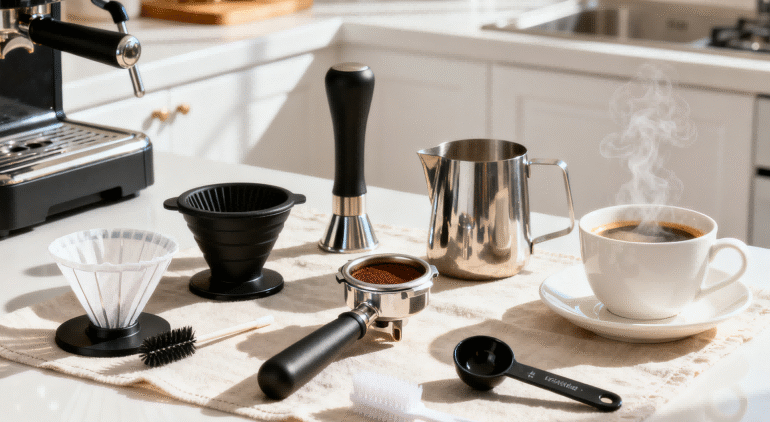
Second are upgrades and enhancements. These items improve your machine’s performance or your workflow. Think of a bottomless portafilter for diagnosing your shots. Or a precision tamper for consistent puck pressure. A high-quality milk frothing pitcher also fits here.
Finally, there are maintenance supplies. These are the consumables required to keep your machine in peak condition. This includes cleaning tablets, descaling solutions, and brand-specific water filters.
B2C or B2B Buyer?
Your purchasing goals determine the best sourcing strategy. You must clarify your buyer profile.
You are a B2C (Business-to-Consumer) buyer if you’re buying one or a few items for your personal home or small office machine. Your primary concerns are availability, competitive pricing, fast shipping, and a straightforward return policy.
You are a B2B (Business-to-Business) buyer if you’re a café owner, roaster, technician, or a purchasing manager for a corporation. You need to buy coffee machine accessories in bulk. You require wholesale pricing and are looking for a long-term coffee machine parts supplier. Your focus is on reliability and building a supply chain.
Top B2C Online Channels
For individual consumers, the digital marketplace offers many options. Finding where to buy coffee machine parts online is easier than ever. But each channel has distinct advantages and disadvantages.
Direct From The Brand
Going straight to the source is often the safest bet. Major manufacturers like Breville, De’Longhi, Jura, and La Marzocco all maintain online stores for parts and accessories.
This channel is best for sourcing genuine OEM (Original Equipment Manufacturer) parts. This is especially true if your machine is still under warranty. Using official parts ensures you don’t void your coverage.
The primary advantage is guaranteed compatibility. You’re buying a part made by the same company that built your machine. You also gain access to the full, official parts catalog. You can contact their support team for guidance.
However, prices are often higher than third-party options. Shipping can sometimes be slower. Manufacturers may discontinue support for much older models, making it hard to find parts for vintage machines.
Global E-commerce Sites
Marketplace giants like Amazon and eBay are a popular starting point for many. They offer an immense selection and often very competitive pricing.
These platforms are ideal for common accessories. Things like tampers, milk pitchers, and generic cleaning supplies work well here. The sheer volume of sellers creates a competitive environment that can drive down prices. Fast shipping, especially with services like Amazon Prime, is a major draw.
The pros are a massive selection and the ability to compare prices from numerous sellers. You also get access to a wealth of customer reviews. For generic items, you can often find the lowest price here.
The significant con is the high risk of counterfeit or low-quality third-party parts. Compatibility can be a gamble, as product listings may be inaccurate. Seller reliability varies wildly. This makes it a “buyer beware” environment for critical espresso machine accessories.
Always check a seller’s rating and read recent reviews that specifically mention the part you need. On Amazon, look for items “Fulfilled by Amazon” as they generally offer better customer service and easier returns.
Specialty Coffee Retailers
Online stores like Whole Latte Love, Seattle Coffee Gear, and Clive Coffee are run by and for coffee enthusiasts. They represent a curated middle ground between manufacturers and mass-marketplaces.
This is the best channel for high-quality upgrades, expert advice, and parts for prosumer and high-end machines. If you want to buy coffee machine parts online with a layer of expert guidance, this is the place.
These retailers are staffed by coffee experts. They can often help diagnose a problem and recommend the correct part. This level of service is something Amazon cannot match. They’ve vetted the products they sell, so you can trust the quality.
The curated selection of high-quality products is a major pro. Their knowledgeable customer service can be a lifesaver. They often stock hard-to-find parts for enthusiast-level machines.
On the downside, their prices can be higher than on Amazon. Their inventory, while curated, is naturally smaller. You’re paying a premium for expertise and quality assurance. If you’re considering an upgrade, check out our guide on the Best Espresso Machines for Home Baristas.
Online Parts Specialists
For the user who knows exactly what internal component they need, dedicated parts websites are an invaluable resource. Sites like eReplacementParts.com and PartSelect are libraries of components.
These specialists are best for sourcing specific internal parts. Things like pumps, solenoids, heating elements, and circuit boards for a wide range of brands.
Their greatest strength is the use of extensive diagrams and schematics. You can often pull up an exploded view of your exact machine model and click on the specific part you need. This eliminates any guesswork. They cover a vast array of brands and models, often going back many years.
The main drawback is that these sites can be overwhelming for beginners. Their focus is squarely on repairs rather than performance upgrades or general accessories. The user interface is functional but not always as polished as a modern e-tailer.
B2B Sourcing Guide
For businesses, the process of sourcing commercial coffee machine parts is fundamentally different. It’s not about a single purchase. It’s about establishing a robust and reliable supply chain.
Key B2B Differences
The B2B buyer’s focus shifts from a simple checkout process to more complex considerations.
Wholesale pricing is paramount. You will be negotiating prices based on volume. This often involves Minimum Order Quantities (MOQs). This means you must commit to buying a certain number of units to get the discounted rate.
Logistics and freight become a major part of the equation, especially with international suppliers. The goal is not a one-time transaction. You want to build a lasting relationship with a trusted coffee machine parts supplier.
Leading B2B Platforms
For sourcing generic accessories or developing your own private-label products, global B2B platforms are the entry point.
Alibaba and Made-in-China.com connect you directly with manufacturers, primarily located in Asia. These platforms are best for items like tampers, pitchers, knock boxes, and cleaning brushes. For these items, brand is less important than cost and function.
A critical safety tip: Always use the platform’s trade assurance features to protect your payment. Vet suppliers thoroughly by checking their years in business, transaction history, and certifications (like ISO 9001). Most importantly, always order and approve samples before placing a large bulk order.
Industry Trade Shows
There is no substitute for meeting a supplier face-to-face. Industry events are where real business relationships are forged.
Major shows like the Specialty Coffee Expo in the USA, World of Coffee in Europe, and HostMilano in Italy are essential for anyone serious about the coffee business. The Specialty Coffee Association (SCA) organizes many of these key events.
Attending a trade show allows you to handle the products and assess their quality firsthand. You can negotiate terms in person and build personal rapport. This is also where you will discover the latest innovations in coffee machine accessories and technology.
Direct Distributor Agreements
For established businesses like a café chain that uses a specific brand of equipment, the most efficient sourcing method is a direct account.
If your entire fleet of machines is from a brand like La Marzocco or Nuova Simonelli, you should establish a relationship with the official national distributor or the manufacturer itself. This guarantees you access to genuine parts, technical support, and the best possible pricing for your volume.
For businesses looking to equip a new café from scratch, our Commercial Coffee Machine Buying Guide is an essential starting point for choosing the right anchor equipment.
Choosing The Right Supplier
Whether you are a home user or a purchasing manager, a final checklist can help you avoid common pitfalls and make a smart, safe purchase. This is your gauntlet for vetting any potential supplier.
Verify Part Compatibility
This is the most fundamental step. Does the product listing clearly state if the part is OEM or a third-party alternative? There’s nothing wrong with third-party parts. They just need to be advertised as such and priced accordingly.
Double-check the part number against your machine’s manual or the manufacturer’s official parts website. When in doubt, contact the seller with your machine’s full model and serial number before you click “buy.” A good seller will be happy to confirm compatibility for you.
Compare The Total Cost
The sticker price is only one part of the story. You must factor in the total landed cost.
Always calculate shipping costs. These can sometimes exceed the price of the part itself. For international orders, be aware of potential import duties and taxes that will be levied by your country’s customs agency. A $20 part from overseas can quickly become a $50 part by the time it reaches your door.
Check Return Policies
A clear and fair return policy is the hallmark of a trustworthy seller. It is your safety net if the part is defective or incompatible.
Before purchasing, ask yourself: What is the return window? Who is responsible for paying return shipping costs? Is there a restocking fee? Avoid sellers with a “no returns” or “final sale” policy on parts.
We learned this lesson the hard way after a frustrating experience with an eBay seller who refused to accept a return on a faulty solenoid. A good return policy isn’t just a feature. It’s insurance.
Read Reviews Critically
Reviews are a powerful tool, but they must be read with a critical eye. Don’t just look at the star rating.
Filter for recent reviews to ensure the seller’s quality hasn’t declined. Look for detailed comments from customers who bought the same product. Are they happy with the product quality, the shipping speed, and the customer service?
For lesser-known online stores, use third-party review sites like Trustpilot or the Better Business Bureau (BBB) to get an unbiased view of their reputation. A pattern of negative reviews is a major red flag.
Test Customer Service
A company’s true character is revealed in how they treat their customers. You can test this before you even spend any money.
Before making a significant purchase, send the seller a question via email or their contact form. Ask about compatibility or shipping details. How quickly do they respond? Is their answer helpful and professional?
A responsive and knowledgeable pre-sales team is often a strong indicator of reliable post-sales support should you encounter any issues.
Common Accessories Quick Guide
To bring all this information together, here is a quick-reference table for some of the most commonly sought-after coffee machine accessories and the best places to find them.
Accessory Type | Description | Best Place to Buy (Primary) | Pro Tip |
Water Filters | Brand-specific cartridges designed to prevent scale buildup and improve water quality. | Direct from Manufacturer or Specialty E-tailer | Using genuine filters is often crucial for maintaining your machine’s warranty. Third-party filters can be a false economy. |
Portafilters | Standard spouted replacements or bottomless (naked) versions for diagnostic upgrades. | Specialty E-tailer | Ensure you buy the correct diameter (e.g., 54mm vs. 58mm) and lug pattern. Not all 58mm portafilters are interchangeable. |
Grinder Burrs | Replacement conical or flat burrs for built-in or standalone grinders. | Online Parts Specialist or Specialty E-tailer | Burrs are a wear item. Replacing them every few years can dramatically improve your shot consistency and flavor clarity. |
Milk Frothing Pitchers | Stainless steel pitchers used for steaming and texturing milk for lattes and cappuccinos. | Amazon or Specialty E-tailer | Look for pitchers made from thick-gauge stainless steel with volume markings etched on the inside for easier, more consistent use. |
Cleaning Tablets/Descalers | Essential maintenance supplies for backflushing the group head and removing scale from the boiler. | Direct from Manufacturer or Amazon | You can often buy effective generic versions (like Cafiza), but always check compatibility, especially with super-automatic machines. |
Gaskets & O-rings | Small rubber or silicone seals, most commonly the group head gasket, that wear out over time. | Online Parts Specialist or Direct from Manufacturer | These are very cheap and relatively easy to replace. It’s a good practice to buy a spare when you order one. |
Drip Trays & Grates | The replacement tray or metal grate that sits under the group head. | Direct from Manufacturer | These parts are almost always highly model-specific due to their shape and size. Sourcing an OEM part is the safest bet. |
Keeping your machine clean is just as vital as using the right parts. Learn the proper techniques in our Guide to Cleaning Your Espresso Machine.
Your Path to Perfect Parts
Finding the right place to buy coffee machine accessories doesn’t have to be a complex journey. The best channel ultimately depends on who you are as a buyer and what specific part you need.
For the home user, a specialty e-tailer offers a fantastic blend of quality and expertise. Manufacturers provide peace of mind for warranty-safe replacements. For a business, building relationships with distributors or vetting suppliers on B2B platforms is the key to a healthy supply chain.
Start by identifying your machine and the part required. Then apply the “Buyer’s Gauntlet” checklist to any potential supplier. This way, you can navigate the market with confidence. You are now equipped to make a smart, informed purchase and get your machine back to brewing perfect coffee.
As a professional manufacturer specializing in the research, development, and production of Coffee machine accessories, we not only offer a diverse product selection but also support OEM/ODM customization to meet the needs of diverse markets and customers. With consistent quality control, fast delivery, and innovative designs, our coffee machines are used by numerous brands and channels worldwide. Whether you're a distributor, wholesaler, or brand owner, we can provide you with reliable solutions to help you grow your business. Contact us to explore potential collaboration opportunities.
Facebook
Twitter
LinkedIn
WhatsApp
Categories: Uncategorized


