What Size Gooseneck Kettle Do You Need? 600ml vs 800ml vs 1L
Choose 600 mL for compact single-brew routines, 800 mL for the most flexible home and two-person setup, and 1 L for larger recipes or shared service. The right answer comes from total water required—not cup count alone—then a check of the model's minimum and maximum fill lines.
The best default is usually 800 mL
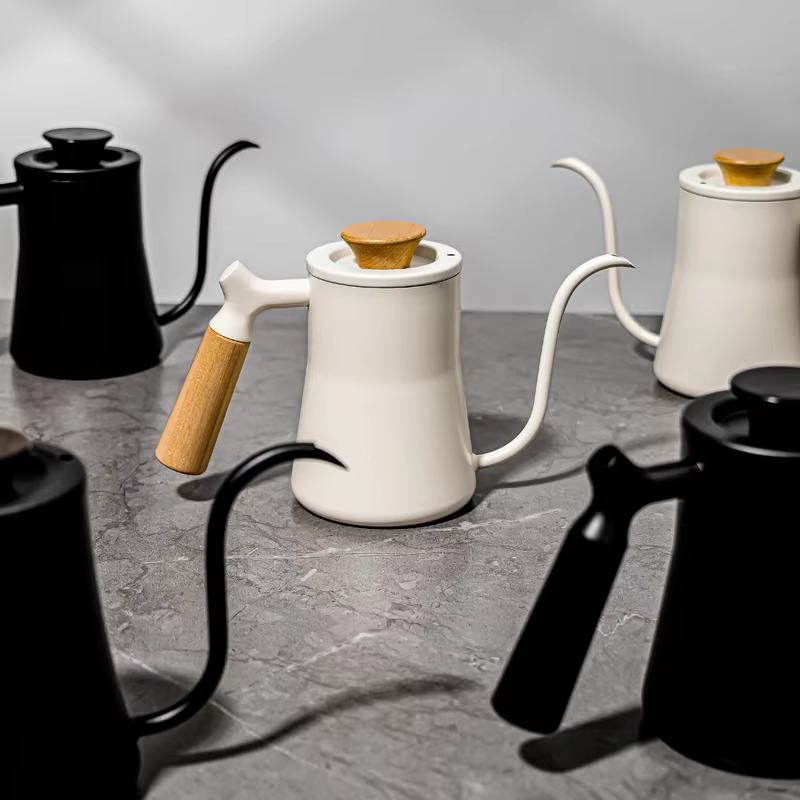
If you do not yet know your exact workflow, 800 mL offers the broadest balance of reserve capacity, manageable filled weight, and common pour-over recipe coverage. Move down to 600 mL for compact single-brew control; move up to 1 L when your measured cycle, shared station, or large-format dripper justifies the extra reserve.
600 mL
Best for roughly 250–400 mL brew-water routines, small counters, travel kits, tasting stations, and buyers who value low filled weight.
800 mL
Best for varied home brewing, many two-person routines, offices, training stations, and a first private-label capacity with a wide use story.
1 L
Best when the total cycle approaches 700–900 mL, several people share one station, or a full-size product tier needs extra reserve.
Capacity is more than the number on the box
A gooseneck kettle may be sold as 600 mL, 800 mL, 900 mL, or 1 L, but the label does not tell you how much water you should heat and pour. A useful buying comparison separates the marketing size from the model's safe and comfortable operating range.
Why the distinctions matter
Nominal capacity is useful for grouping models, but it is not permission to fill to the rim. The maximum line preserves headspace and is the controlling limit for a careful capacity calculation. An electric kettle may also specify a minimum level so its heating system and sensor operate in the intended condition.
Model-specific documents show how much these boundaries vary. Hario's V60 Power Kettle Buono manual lists a 0.15 L minimum and 0.8 L maximum, while KitchenAid's Precision Kettle guidance lists a 0.25 L minimum and a 1 L maximum for its named model. Those numbers are examples, not universal rules.
Some manufacturers also publish a practical capacity. Hario's catalog uses practical-capacity language for its Buono range. For a buyer, that is helpful because practical capacity describes the volume that can be planned around, not merely the space inside a vessel.
Capacity rule: select the smallest kettle whose permitted working range covers your largest normal cycle. Do not solve a mismatch by filling past the marked maximum, and do not assume a bigger kettle is more precise for small pours.
Filled weight reminder: 1 L of water adds approximately 1 kg before the kettle itself is counted. Handle geometry and balance therefore matter more as capacity increases.
References: Hario V60 Power Kettle Buono manual, KitchenAid Precision Kettle fill guidance, and Hario 2024 catalog.
Calculate kettle size from brew water, not cup count
The most reliable method is to calculate the total water available during one preparation cycle. A common brewing-ratio convention is around 60 g of coffee per liter of water, or approximately 1:16.7 by mass, but your established recipe should take priority.
Required kettle water = brew water + filter-rinse water + brewer/server preheat water + operational reserve
Brew water = coffee dose × water-to-coffee ratio
For everyday planning, one gram of water is close enough to one milliliter to compare a scale reading with kettle capacity. Rinse, preheat, and reserve quantities are workflow-specific. Measure them once rather than copying an arbitrary allowance from another brewer.
| Illustrative recipe | Brew water | Preparation allowance* | Total to plan | Practical starting point |
|---|---|---|---|---|
| 20 g coffee at 1:16 | 320 mL | 80 mL | 400 mL | 600 mL works comfortably |
| 30 g coffee at 1:16 | 480 mL | 80 mL | 560 mL | 600 mL is tight; 800 mL is easier |
| 40 g coffee at 1:15 | 600 mL | 100 mL | 700 mL | 800 mL can work; 1 L gives more reserve |
| 50 g coffee at 1:16 | 800 mL | 100 mL | 900 mL | 1 L class, subject to its max line |
*Preparation allowances are transparent editorial examples, not standards. Filter size, rinse technique, dripper material, server temperature, and a separate hot-water source can change the amount. Ratio reference: Specialty Coffee Association, Talking About Water.
600 mL vs 800 mL vs 1 L: which use case fits?
The capacity choice is a trade-off between reserve, filled weight, counter space, and the largest recipe you want to complete without a refill. The table below is a planning guide; the exact manual and sample still control.
| Capacity class | Best fit | Why buyers choose it | Main limitation |
|---|---|---|---|
| 600 mL / 0.6 L | One compact pour-over, travel or small counter, tasting station, entry SKU | Lowest filled weight and a responsive feel for small pours | Limited reserve when brew water approaches 500–600 mL and rinse water comes from the same fill |
| 800 mL / 0.8 L | Flexible home use, one generous brew, many two-person routines, office or training use | Best balance of reserve capacity, manageable weight, and broad recipe coverage | May still be tight when brew water alone is near 700–800 mL |
| 1 L | Large manual brews, shared households, cafés, demonstrations, or full-size product tiers | More reserve and fewer refills between sequential preparations | Heavier when full; oversizing can reduce comfort when most brews are small |
Choose it for compact control
600 mL is a sensible fit when most routines use roughly 250–400 mL of brew water and the user values low weight, compact storage, or a single-user product story. It can be excellent for a single V60-style drink or a tasting station.
- Lower filled weight can make starting, stopping, and correcting a narrow pour feel immediate.
- A smaller body uses less counter, shelf, carton, and travel space.
- It becomes the wrong size when the largest normal brew plus preparation water exceeds the model's maximum line.
Choose it for the widest everyday coverage
800 mL is the strongest default for a broad consumer audience. It accommodates many 300–500 mL recipes with useful headroom and supports two-person routines without the filled weight of a full 1 L body.
- It can support larger single mugs and many two-serving routines.
- It is easy to position across home, office, training, gift, and distributor channels.
- It is not automatically enough for an 800 mL brew once filter rinsing and preheating are included.
Choose it for reserve and shared service
A 1 L kettle makes more sense when the normal total water plan approaches 700–900 mL, several people share one brewing station, or the product needs a full-size commercial-style position. More capacity reduces refills, but it also makes balance, handle geometry, and low-flow control more important.
- Large-format drippers and sequential demonstrations may justify the extra reserve.
- A full kettle adds roughly 1 kg of water, so test it at real working weights.
- A 1 L household or similar-use model should not be called heavy-duty commercial equipment without the appropriate evidence and duty specification.
The same capacity can pour very differently
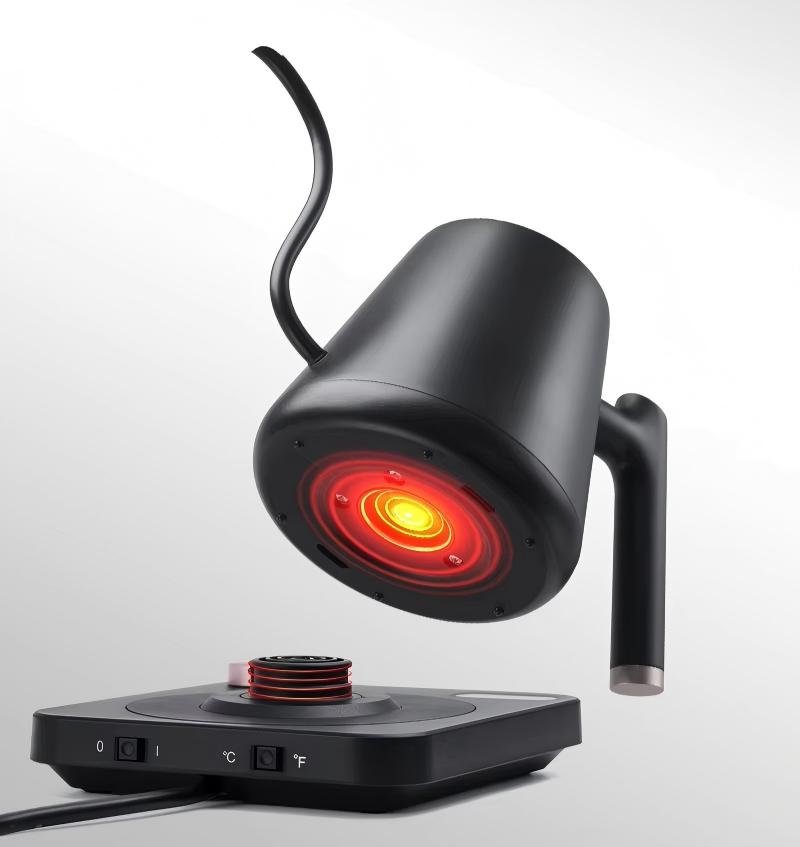
Capacity answers whether enough water fits. It does not answer whether the kettle controls that water well. Once the size class is shortlisted, evaluate the physical and electrical system that determines real performance.
Five checks that protect the buying decision
- Spout geometry: internal diameter, length, bend, outlet angle, attachment point, and flow restriction affect start, stream stability, and stop behavior.
- Handle and balance: test the kettle empty, at a normal fill, and near the maximum line. Look for wrist rotation, lid movement, and fingers approaching hot surfaces.
- Minimum fill and sensor location: the smallest practical brew may be more important than the largest one, especially on electric models.
- Power and voltage: heating time depends on water mass, starting temperature, heater power, mains voltage, control logic, ambient conditions, and heat loss—not capacity alone.
- Electric vs stovetop: variable temperature, automatic shutoff, boil-dry protection, hold functions, and unit switching are model-specific features, not consequences of capacity.
Approve the sample before you approve the size
A supplier quotation cannot prove that a kettle pours well. Approve capacity only after a representative sample is evaluated under the fills and use cases the final customer will encounter. Record the water mass, set temperature, room conditions, and method so later samples and production lots can be compared against the same reference.
Map the range
Record nominal, maximum, minimum, and any published practical capacity. Align the kettle, manual, carton, listing, and data sheet.
Test three weights
Evaluate minimum permitted, most common recipe, and maximum permitted fills for grip, flow, drips, lid retention, and balance.
Measure the cycle
Use a defined volume and starting temperature. Record time to target, overshoot, hold cycling, and temperature after a pour delay.
Review evidence
Check shutoff, boil-dry behavior, handle and lid security, marking, warnings, instructions, and target-market requirements.
Lock the sample
Approve the exact model, branding, packaging, quality criteria, documentation, and commercial terms before production.
What the RFQ should specify
- Capacity definitions and the largest normal recipe
- Electric or stovetop format, destination voltage, frequency, plug, power, and base
- Boil-only or variable temperature, range, increments, hold, memory, timer, and display
- Spout behavior, handle geometry, lid retention, and sample test method
- Water-contact materials, seals, plastics, finishes, and market documentation
- Branding, packaging, manual languages, MOQ, lead time, warranty, and spare parts
Compliance is not one checkbox.
Electrical safety and food-contact evidence are separate workstreams. IEC 60335-2-15:2024 covers household and similar appliances for heating liquids, while it explicitly distinguishes appliances intended professionally to process food for commercial consumption. For EU-bound projects, food-contact materials must also follow the applicable European framework.
Use qualified laboratories and destination-market requirements for formal conformity work. Do not turn a product-page phrase such as “food grade” or a household rating into a universal commercial certification claim.
References: IEC 60335-2-15:2024 scope and European Commission food-contact materials framework.
Estimate your gooseneck kettle capacity
Enter the largest coffee dose you normally brew, your water ratio, and the water used for rinsing or preheating. This calculator is a planning aid, not a product standard or a substitute for the model manual.
Your planning result
Check the chosen model's maximum and minimum fill lines, then test pouring at the actual working weight.
Need a model comparison, sample, or private-label quotation?
Send the target market, preferred capacity, electric or stovetop format, voltage, control features, order quantity, logo method, packaging, and required documentation. Coffmach can then review the right model path instead of quoting from capacity alone.
Six common gooseneck kettle size mistakes
1. Buying by cup count
“Two cups” can describe very different water volumes. Replace cup count with the largest brew-water target in grams or milliliters, then include preparation water.
2. Treating capacity as usable to the rim
The controlling limit is the model's maximum fill line or manual, not the visual space remaining in the vessel.
3. Assuming bigger means more professional
Professional results depend on repeatable flow, appropriate temperature, sound technique, and a product suited to its duty. A balanced 600 mL kettle may be better for a tasting flight; a 1 L household model may be wrong for continuous café service.
4. Ignoring the minimum fill
A buyer can choose a large kettle for flexibility and then discover that a normal 200 mL heating cycle is below the stated minimum. Record both ends of the working range.
5. Comparing heating time without test conditions
A time-to-boil claim needs water volume, starting temperature, voltage, power, altitude, and endpoint. Compare samples under the same conditions.
6. Giving three sizes the same use story
For e-commerce and SEO, position 600 mL, 800 mL, and 1 L around distinct jobs while keeping this comparison as the authoritative hub. Link to genuinely different product pages rather than creating near-duplicate size pages.
Turn the comparison into a confident purchase
- Write down the largest normal coffee dose and brew ratio. Calculate the brew-water target in grams or milliliters.
- Measure filter-rinse water, brewer/server preheating, and any reserve required to finish without an awkwardly empty kettle.
- Add those values and shortlist only models whose published maximum covers the total. Check that the smallest normal cycle is above the minimum fill.
- Test the shortlisted kettle at minimum, normal, and maximum fills. Compare balance, start/stop control, stream quality, heating behavior, cleaning access, and safety instructions.
- For a B2B order, approve the exact sample, specification, compliance plan, branding, packaging, quality criteria, and commercial terms before mass production.
Questions buyers ask before choosing a size
Is a 600 mL gooseneck kettle big enough for pour-over coffee?
Yes, a 600 mL kettle is big enough for many single pour-over recipes when brew water is roughly 250–400 mL and preparation water also fits below the model's maximum line. It becomes restrictive for large travel mugs, two full servings, or recipes near 500–600 mL.
Is an 800 mL kettle enough for two coffees?
Often, but “two coffees” is not a precise volume. An 800 mL kettle can support many two-serving recipes around 500–600 mL while retaining some preparation-water margin. If brew water is close to 700–800 mL, check the model's maximum line and consider 1 L.
Should I buy an 800 mL or 1 L gooseneck kettle?
Choose 800 mL for the broadest balance of home-brewing capacity and manageable pouring weight. Choose 1 L when measured total water regularly exceeds the 800 mL model's limit, several people share the station, or you use a large-format dripper. Compare minimum fill and handle balance too.
What size gooseneck kettle is best for a V60?
For a common single V60-style recipe, 600 mL is usually sufficient and 800 mL provides more flexibility. Larger recipes or multiple servings may justify 1 L. Use coffee dose, brew ratio, filter-rinse water, and the dripper's batch range instead of treating V60 as one fixed drink size.
Does a larger kettle pour more slowly?
Not necessarily. Flow behavior depends on spout geometry, water level, tilt angle, and any restriction in the pour path. A larger kettle becomes heavier when filled, which can affect control. Test stream quality at several fills rather than using capacity as a proxy for flow rate.
Which gooseneck kettle size should a private-label brand launch first?
For a broad home-brewing audience, 800 mL is usually the strongest first capacity because it covers common single and many two-person routines. A compact entry line may start with 600 mL, while a premium multi-cup line may favor 1 L. Validate the choice with channel demand, sample tests, compliance cost, and packaging.
Sources used for the capacity guidance
These references support model-specific limits, brewing-ratio context, product documentation, and target-market compliance framing. They do not certify any untested kettle or replace the destination market's conformity process.
- Specialty Coffee Association — Talking About Water: Key Principles — brewing-ratio terminology including 60 g/L and approximately 1:16.7.
- Hario — V60 Power Kettle Buono manual — named-model 0.15 L minimum and 0.8 L maximum.
- Hario — 2024 English catalog — model-specific practical-capacity terminology.
- Fellow — Stagg Pour-Over Dripper X/XF instructions — 300 mL single and 600 mL double recipe examples, including filter wetting.
- KitchenAid — Filling the Precision Kettle with Water — named-model minimum and maximum fill limits.
- Brewista — Artisan Gooseneck Kettle manual — 0.6 L and 1.0 L fill-line examples.
- IEC 60335-2-15:2024 — scope for household and similar appliances heating liquids, including kettles.
- European Commission — Food Contact Materials — EU framework for materials placed on the European market.
- Coffmach — Gooseneck Kettle — current product and OEM/ODM context; confirm exact model specifications in the quotation.
Image note: the product images in this draft are first-party Coffmach URLs. For production, rehost optimized copies in the site's media library and retain meaningful alt text. Header and footer are intentionally excluded from this Elementor body-only file.