


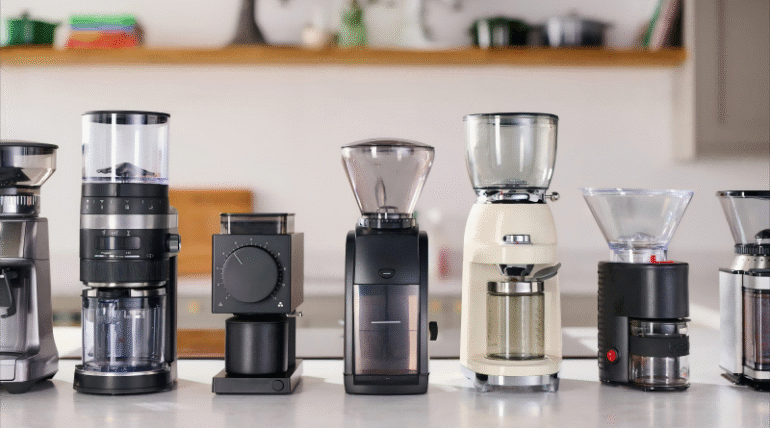
13.10.2025
Ever wonder why café coffee tastes so much better than your home brew? You buy the same beans. Yet the result never matches. The secret isn’t always an expensive espresso machine. It’s often a much simpler tool.
This guide reveals that secret weapon. We’ll answer the key question: What is a coffee grinder?
More importantly, you’ll learn why this single piece of equipment makes the biggest difference in your daily coffee. It’s the most significant upgrade you can make.
We’ll explore different coffee grinder types. We’ll explain blade versus burr grinders. And we’ll give you a clear roadmap for choosing the best one. By the end, you’ll know how to take complete control of your coffee’s flavor.
Table of Contents
The Simple Answer
So, what is a coffee grinder in the simplest terms? Let’s get right to it.
The Definition
A coffee grinder breaks down whole roasted coffee beans into smaller, uniform particles called coffee grounds. This device is essential for any brewing method. From simple drip machines to complex espresso setups.
The Core Principle
The core principle is unlocking flavor. Grinding dramatically increases the bean’s surface area.
This new surface area lets hot water efficiently extract oils, acids, sugars, and aromatic compounds. These create the flavor and aroma we love.
Without grinding, a roasted coffee bean keeps all its potential locked inside. Grinding releases it.
Why You Need a Grinder
Understanding what a coffee grinder is leads to the next question: why do you absolutely need one? The answer rests on three pillars for great coffee: freshness, flavor, and control. Moving from pre-ground coffee to grinding your own beans is the single biggest quality leap you can make.
Pillar 1: Freshness
Roasted coffee is a volatile agricultural product. Once ground, its quality degrades rapidly through oxidation.
Think of cutting an apple. The moment flesh meets air, it browns and loses its crisp flavor. Coffee does the same, but with aroma.
Grinding increases coffee’s surface area thousands of times. This exposes delicate aromatic compounds to oxygen, causing them to disappear. Coffee can lose up to 60% of its aroma within just 15 minutes of grinding.
Pre-ground coffee in a bag is already significantly stale, no matter how well sealed. Grinding beans moments before brewing captures maximum aroma and vibrancy in your cup.
Pillar 2: Flavor Potential
A coffee grinder unlocks flavors that pre-ground coffee simply cannot offer. Flavor extraction connects directly to grind size.
Different brewing methods need different grind sizes for optimal results. Water needs specific time to pass through grounds and extract the right flavor balance.
Too coarse a grind lets water pass through too quickly. This creates under-extraction. Your coffee tastes sour, weak, and underdeveloped.
Too fine a grind slows water down or clogs it completely. This leads to over-extraction, pulling out bitter and harsh compounds. Your coffee tastes astringent and unpleasant. A good grinder prevents both outcomes.
Pillar 3: Absolute Control
Owning a coffee grinder puts you in the driver’s seat. It transforms you from passive coffee drinker to active home barista.
You can dial in your grind perfectly for your specific brewing device. French press, pour-over dripper, or espresso machine – you can produce the exact grind size required.
This control goes even further. You can make tiny adjustments for different beans, coffee age, or personal taste on any given day. Want stronger brew? Grind finer. Finding it bitter? Make it coarser.
This level of control achieves consistently delicious coffee every time. It’s the difference between making coffee by accident and making coffee with intention.
Main Grinder Types
When you start looking, you’ll discover two main categories of coffee grinders: blade and burr. Understanding the fundamental difference between these coffee grinder types is critical for your purchasing decision. They are not created equal.
Blade Grinders
A blade grinder doesn’t actually grind coffee. It’s more accurate to call it a chopper.
It uses a spinning blade, like one in a blender or spice grinder, to violently shatter and chop coffee beans into smaller pieces. The final “grind” size depends simply on how long you let the blade spin.
The result is highly inconsistent particles, ranging from large chunks to fine powder, all in the same batch. This inconsistency is the enemy of good coffee. Different-sized particles extract at different rates, creating a cup that’s simultaneously sour (from under-extracted chunks) and bitter (from over-extracted dust).
Their main advantage is being very inexpensive and widely available. However, the spinning blade generates significant heat, which can scorch grounds and introduce burnt flavor before you even start brewing. We only recommend this if budget is your absolute, singular priority.
Burr Grinders
A burr grinder is a true grinder. It operates on a completely different principle.
It uses two revolving abrasive surfaces, called burrs, to crush beans between them. One burr stays stationary while the other rotates. Whole beans feed between the burrs and get milled into uniform size.
You can precisely adjust the distance between the two burrs. Closer settings produce finer grinds. Wider settings produce coarser grinds. This mechanism provides consistency and control.
The result is remarkably uniform coffee grounds. This uniformity allows even and predictable extraction, which is the foundation of balanced and flavorful coffee. They also generate minimal heat, preserving delicate bean flavors. While more expensive, burr grinders are the gold standard for anyone serious about improving their coffee.
Comparison: Blade vs. Burr
To make the choice clear, here’s a direct comparison of what is a coffee grinder’s most important distinction.
Feature | Blade Grinder | Burr Grinder |
Mechanism | Spinning blade chops beans | Two burrs crush beans |
Grind Consistency | ❌ Poor / Inconsistent | ✅ Excellent / Uniform |
Grind Size Control | ❌ None (only time-based) | ✅ Precise adjustments |
Heat Generation | High (can damage flavor) | Low / Minimal |
Flavor Potential | Limited / Uneven | Maximized / Balanced |
Price | $ | $$ -$$$$ |
Best For | Absolute beginners on a tight budget | Anyone serious about coffee |
A Deeper Look: Burrs
Once you’ve decided on a burr grinder, you might encounter another distinction: conical versus flat burrs. For most users, this is a secondary detail. For enthusiasts, it’s relevant. Understanding this shows deeper expertise.
Conical Burr Grinders
Conical burr grinders feature a cone-shaped center burr that spins inside a serrated, ring-shaped outer burr. Gravity helps pull beans down through the burrs.
They produce what’s called a “bimodal” grind distribution. This means grounds consist of one major group of particle sizes and a secondary group of finer particles. Some baristas believe this combination adds body and complexity to the final cup.
Conical burrs generally operate at lower speeds, making them quieter. They also tend to have lower retention, meaning less coffee gets trapped inside the grinder after use. For these reasons, they’re very common in high-quality home grinders.
Flat Burr Grinders
Flat burr grinders use two parallel, ring-shaped burrs that sit horizontally, one on top of the other. Beans get drawn between the burrs and exit from the outside edge.
These grinders are prized for producing very “unimodal” grind size. This means particles are exceptionally uniform. This consistency is often praised for creating cups with high clarity, allowing bright, acidic, and delicate notes to shine through.
Flat burrs can have slightly higher retention. Some grounds may be held between parallel plates by static. They’re traditionally found in commercial café grinders and high-end “prosumer” grinders, especially those designed for espresso.
Which Is Better For You?
For most home brewers, the debate is largely academic. A well-engineered conical burr grinder will produce fantastic coffee for any brew method.
The differences become more apparent at the highest end of the spectrum. This is particularly true for espresso enthusiasts chasing maximum flavor clarity.
Ultimately, overall build quality, motor stability, and precision of the adjustment mechanism matter far more than burr shape alone.
The Language of Grind Size
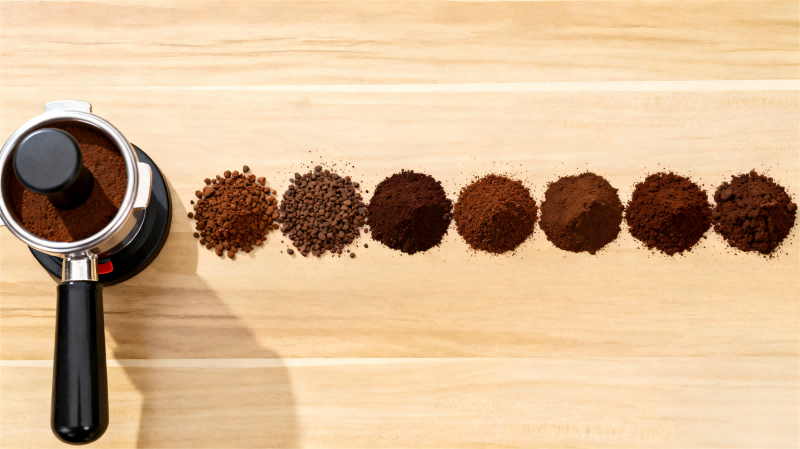
Understanding the coffee grind size chart is like learning the secret language of brewing. It’s the most practical knowledge you can have. This connects your grinder to your coffee maker, ensuring you get the best possible result from your equipment. Each brew method has an ideal grind size for a reason.
The Grind Size Spectrum
Here’s a breakdown of the grind spectrum, from chunkiest to most powdery.
Extra Coarse
- Looks Like: Very chunky, like cracked peppercorns or breadcrumbs.
- Used For: Cold Brew Coffee.
- Why: Cold brew involves very long steeping time, often 12 to 24 hours. Very large particle size is necessary to slow extraction and prevent the final brew from becoming intensely bitter and over-extracted.
Coarse
- Looks Like: Coarse sea salt. Particles are distinct and don’t clump.
- Used For: French Press, percolators, and coffee cupping.
- Why: These are full-immersion methods where coffee grounds steep in water for several minutes (typically 4 minutes for French Press). Coarse grind prevents a muddy, silty cup and avoids bitterness from prolonged contact with finer grind.
Medium-Coarse
- Looks Like: Rough, gritty sand.
- Used For: Chemex, Clever Dripper, and some larger format pour-over brewers.
- Why: These methods have slightly longer contact time or use thicker filters than other pour-overs. Medium-coarse grind provides the right balance, allowing for clean cup without stalling the brew.
Medium
- Looks Like: Regular table sand. This is often the default “all-purpose” grind.
- Used For: Automatic drip coffee makers, siphon brewers, and AeroPress (for longer 2-3 minute brews).
- Why: This is the sweet spot for typical brew time and basket shape of most home coffee machines. It provides balanced extraction that’s neither too fast nor too slow.
Medium-Fine
- Looks Like: Smooth table salt. It starts to feel softer.
- Used For: Pour-over brewers like Hario V60 or Kalita Wave, AeroPress (for shorter 1-minute brews), and most Moka Pots.
- Why: These manual brewing methods require finer grind to increase surface area and allow quick, efficient extraction. For Moka Pot, this grind provides enough resistance without being so fine that it chokes the device. To learn more about this classic brewer, read our guide on What is a Moka Pot?.
Fine
- Looks Like: Finer than table salt, approaching flour texture. It will clump together when pinched.
- Used For: Espresso and some Moka Pot preparations.
- Why: Espresso is an extreme brewing method, using high pressure to force water through compact coffee puck in just 25-30 seconds. Very fine, consistent grind is absolutely essential to create enough resistance for the water. This is the heart of what an espresso machine does. Fine grounds are packed tightly into a tool known as a portafilter.
Extra Fine
- Looks Like: Powdered sugar or flour. It has no discernible grit.
- Used For: Turkish Coffee (Ibrik).
- Why: In this method, coffee grounds aren’t filtered out but are boiled with water and consumed as part of the beverage. The grind must be powder
Manual vs. Electric
Another key decision is choosing between a manual vs electric coffee grinder. This choice is less about ultimate quality and more about your personal lifestyle, budget, and daily routine. Each has distinct advantages and disadvantages.
Manual Hand Grinders
Manual grinders, also known as hand grinders, are powered by you. You pour beans in the top and turn a crank to operate the burrs.
The primary advantage is getting exceptional grind quality for the price. A high-quality manual grinder often contains burrs superior to those found in electric grinders at similar or even slightly higher price points.
They’re also completely portable, making them perfect for travel, camping, or brewing great cup at the office. They operate silently, which is a blessing in early morning. Many people enjoy the tactile, engaging ritual of grinding their own beans.
The downside is physical effort. It’s a small morning workout that can take a minute or two. This makes them slow and not ideal if you need to grind large quantities of coffee, for example, for a full pot in a drip machine or for multiple people. Adjusting grind settings can also be less intuitive than on electric models.
Electric Grinders
Electric grinders do the work for you at the push of a button. They are the definition of convenience.
Their main benefit is speed and ease of use. They can grind a dose of coffee for any brew method in seconds. This is essential for busy mornings or households with multiple coffee drinkers.
Most electric models have very clear, easy-to-use settings. Often with stepped adjustments or digital timers that allow for repeatable results day after day.
The cons are that they’re more expensive for good quality. A cheap electric grinder is almost always a blade grinder, which should be avoided. A good electric burr grinder is an investment. They can also be quite loud and take up permanent spot on your kitchen counter. It’s important to note that many entry-level electric burr grinders may not outperform a premium manual grinder in terms of pure grind consistency.
Our Recommendation
We find that the right choice depends entirely on the user’s context.
For the solo coffee drinker, the traveler, or the budget-conscious person seeking absolute best quality for their money, a high-quality manual grinder is an unbeatable value proposition.
For the busy household, anyone brewing for multiple people, the dedicated espresso drinker, or the user who prioritizes convenience above all else, a good electric burr grinder is the best long-term investment.
How to Choose Your Grinder
You now understand what a coffee grinder is, the different types, and why grind size matters. It’s time to synthesize this information into a practical guide. When helping someone choose their first grinder, we always walk them through these three simple questions.
Step 1: Your Brew Method
The most important question is: how will you be making coffee most of the time? Your primary brew method dictates the type of grinder you need.
Are you primarily an espresso drinker? If so, your needs are specific. You require a grinder capable of producing very fine, consistent grind with the ability to make tiny “micro-adjustments.” Espresso is very demanding, and a dedicated espresso grinder is often the best choice. Learning how to make espresso at home truly begins with the grinder.
Do you primarily use a drip machine, French press, AeroPress, or pour-over? In this case, you need a good all-purpose grinder. You have much more flexibility. There are fantastic options in both manual and electric categories that can cover this entire range.
Do you want to do a mix of everything, from French press to occasional espresso shot? Look for an all-purpose electric grinder known for having wide range of settings that are easy and quick to switch between.
Step 2: Your Budget
Be realistic about what a good grinder costs. It’s an investment in every future cup of coffee you’ll make. We often advise spending as much on your grinder as you do on your coffee maker, if not more.
In the entry-level quality tier, from about $50 to $100, you’ll find the best manual grinders and some very basic electric burr grinders. This is an excellent starting point and a massive upgrade from a blade grinder or pre-ground coffee.
The sweet spot for most home users is between $100 and $300. This range is home to outstanding all-purpose electric burr grinders that deliver fantastic consistency, are built to last, and are perfect for daily use across various brew methods. This is where you see the biggest jump in quality.
Above $300, you enter the prosumer and enthusiast category. These are high-performance grinders, often with features like large flat burrs, extremely low grind retention, and precise digital dosing. They are typically specialized for espresso but represent the peak of home grinding technology.
Step 3: Your Lifestyle
Finally, consider your daily routine and environment.
How many people are you making coffee for? A solo drinker can easily get by with a manual grinder. A family of four will find an electric grinder to be an essential, time-saving appliance.
How much counter space do you have? Manual grinders can be stored in a drawer. Electric grinders vary in size, but all will occupy permanent footprint on your countertop.
How important is convenience versus the ritual? Do you want to push a button and have coffee grounds in 10 seconds? Or do you enjoy the quiet, hands-on process of manually grinding your beans as part of your morning routine?
By honestly answering these three questions—about your brew method, budget, and lifestyle—you will build a clear profile of the perfect grinder for you.
Your Investment in Coffee
The journey to better coffee is filled with information, but one truth stands above the rest. The single biggest, most impactful upgrade you can make to your home coffee setup is not a new coffee machine—it’s a quality coffee grinder.
It is the tool that respects the hard work of the coffee farmer. It is the key that unlocks the incredible spectrum of flavor and aroma sealed inside every roasted bean. A good grinder gives you the consistency and control to brew coffee with intention.
You now know what a coffee grinder is and how to choose the best one for you. You are equipped to move beyond stale, pre-ground coffee and take the most important step toward brewing truly exceptional coffee at home.
As a professional manufacturer specializing in the research, development, and production of coffee machines, we not only offer a diverse product selection but also support OEM/ODM customization to meet the needs of diverse markets and customers. With consistent quality control, fast delivery, and innovative designs, our coffee machines are used by numerous brands and channels worldwide. Whether you're a distributor, wholesaler, or brand owner, we can provide you with reliable solutions to help you grow your business. Contact us to explore potential collaboration opportunities.

Facebook
Twitter
LinkedIn
WhatsApp
Categories: Buying/Customization Guide Product Knowledge


