CAFÉ OPERATIONS · ESPRESSO WORKFLOW · BUYING GUIDE
Manual vs Automatic Coffee Tamper for Busy Cafes
An automatic tamper is often the stronger operational choice for a genuinely busy, multi-barista café when it fits the exact station and is supported locally. A manual tamper remains a practical choice for lower-volume bars, mobile service, backup stations and budgets where tamping is not the measured bottleneck.
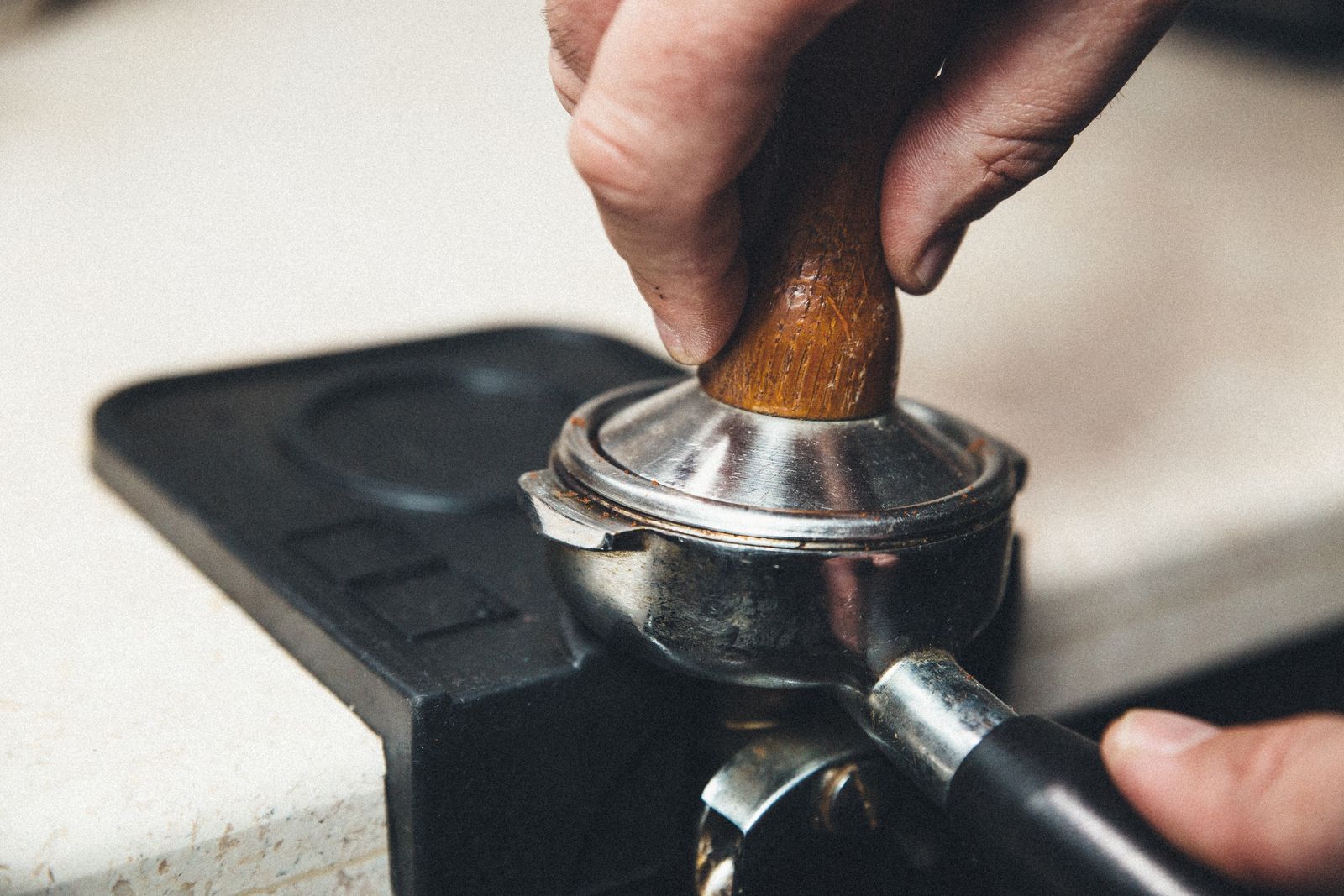
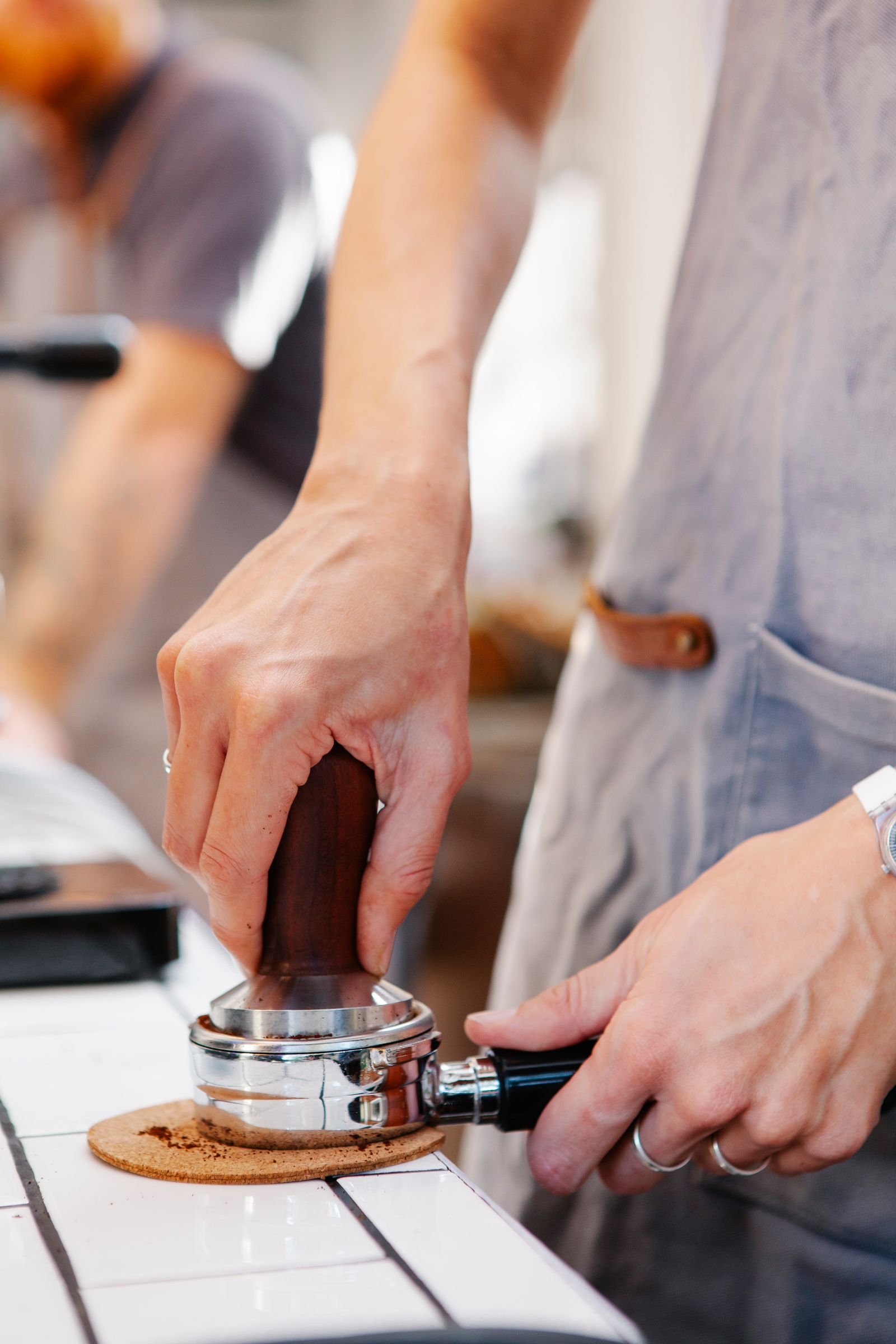
The decision starts with your busiest 15 minutes
An espresso auto tamper standardizes the tamping movement. It does not correct an uneven dose, clumps, poor distribution, unsuitable grind, damaged basket, incorrect headspace or an unstable espresso recipe. Treat it as one control within the complete puck-preparation system—not a replacement for barista judgment.
- Automatic tamping is most useful on shared, high-volume stations where a repeatable movement matters on every shot.
- Manual tampers cost less, travel easily, need no power and remain essential as the fallback method.
- Measure peak espresso demand and full station time, not only average daily drink sales or the machine’s advertised cycle.
- Pressure is not a universal quality target; a stable, level, fully compacted puck matters more than a maximum number.
- Confirm the exact basket, portafilter, support/fork, grinder, clearance, cleaning method and local service plan before purchase.
- Self-leveling or calibrated manual tampers are a useful middle ground when training support is needed without powered equipment.
| Decision factor | Manual tamper | Automatic tamper |
|---|---|---|
| Core action | Barista positions, presses and releases the tamper | Powered unit runs a selected tamp cycle after correct portafilter placement |
| Repeatability | Depends on fit, distribution, entry angle and operator technique | Standardizes the programmed motion once setup and compatibility are correct |
| Best use case | Lower-volume, mobile, single-user, flexible or backup workstations | Busy shared stations, repeatable procedures and measured peak bottlenecks |
| Space & power | Minimal; no electrical dependency | Needs counter or under-grinder space, safe cable routing and power |
| Maintenance | Simple cleaning and inspection | Model-specific cleaning, alignment, service, parts and downtime planning |
| What it cannot fix | Bad dose, distribution, grind or recipe | The same upstream variables; automation does not diagnose extraction |
What counts as manual or automatic tamping?
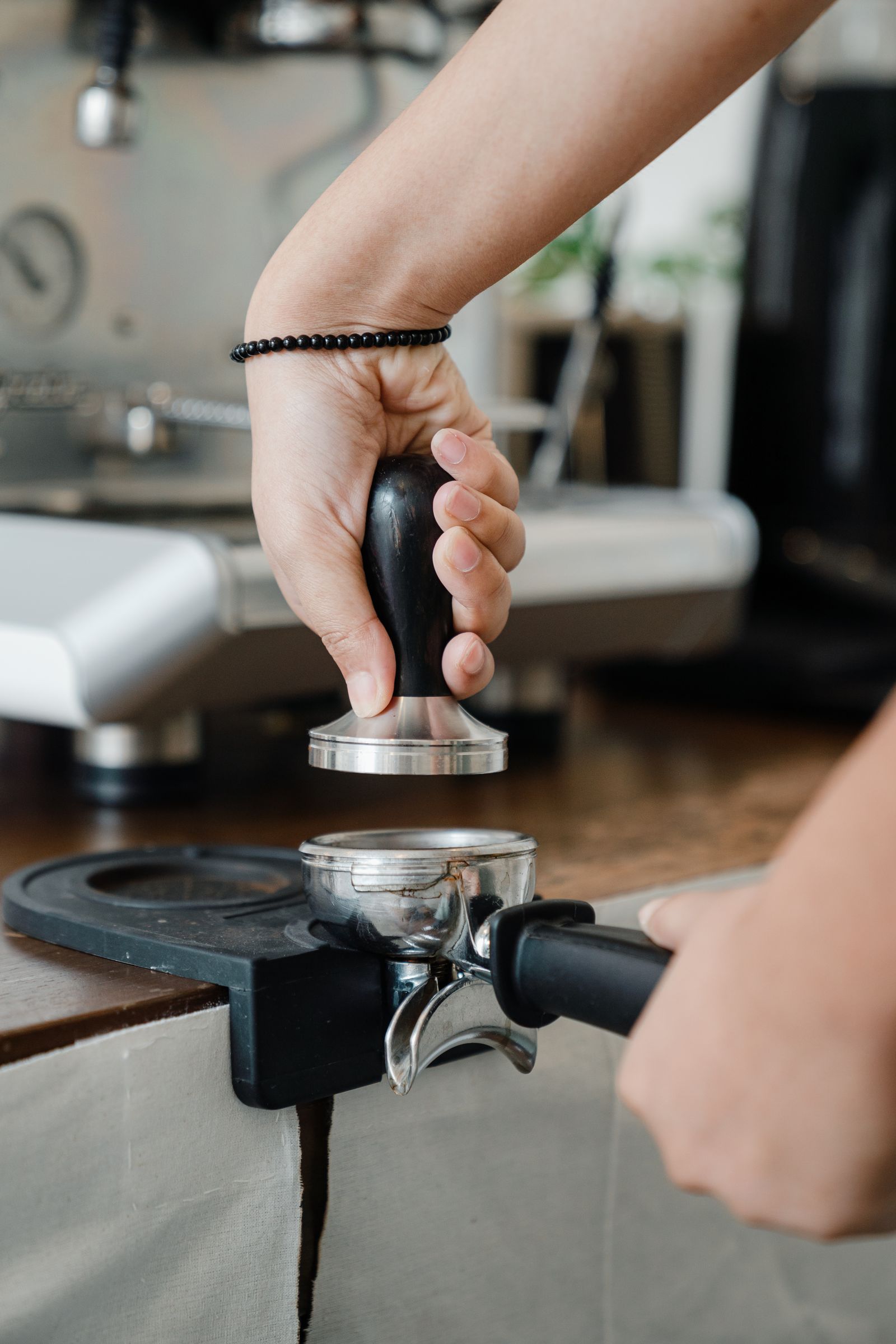
A traditional manual espresso tamper is a base and handle. The barista positions the base, applies downward force, decides when the bed is compact and lifts it away. It is mechanically simple and can be entirely adequate in commercial espresso, provided basket fit, distribution, entry angle and workstation posture are controlled.
Traditional manual
Direct tactile feedback, minimal parts and easy portability. Output depends on repeatable technique and a correctly sized base.
Calibrated manual
Provides a force cue or defined compression event. “Calibrated” should be verified by its test method, tolerance and use condition.
Self-leveling manual
Uses a collar or plate to reference the basket rim and help reduce tilt. It still needs compatible basket geometry and adequate effective stroke.
Spring-loaded manual
Contains a spring, which may provide return, resistance or a pressure cue. The label alone does not prove a calibrated delivered force.
Stand-alone automatic
A powered tamper placed independently on the counter. It can suit changing grinder layouts if the portafilter and basket are compatible.
Under-grinder automatic
Designed to fit specific grinders or mounting systems. It may shorten movement but requires exact compatibility and service access.
Current PUQ product families distinguish stand-alone and grinder-integrated machines, while Compak’s Cube Tamp provides a separate automatic model with adjustable support. These are examples of product variation, not universal category specifications. For manual sizing and terminology, review Coffmach’s coffee tamper guide.
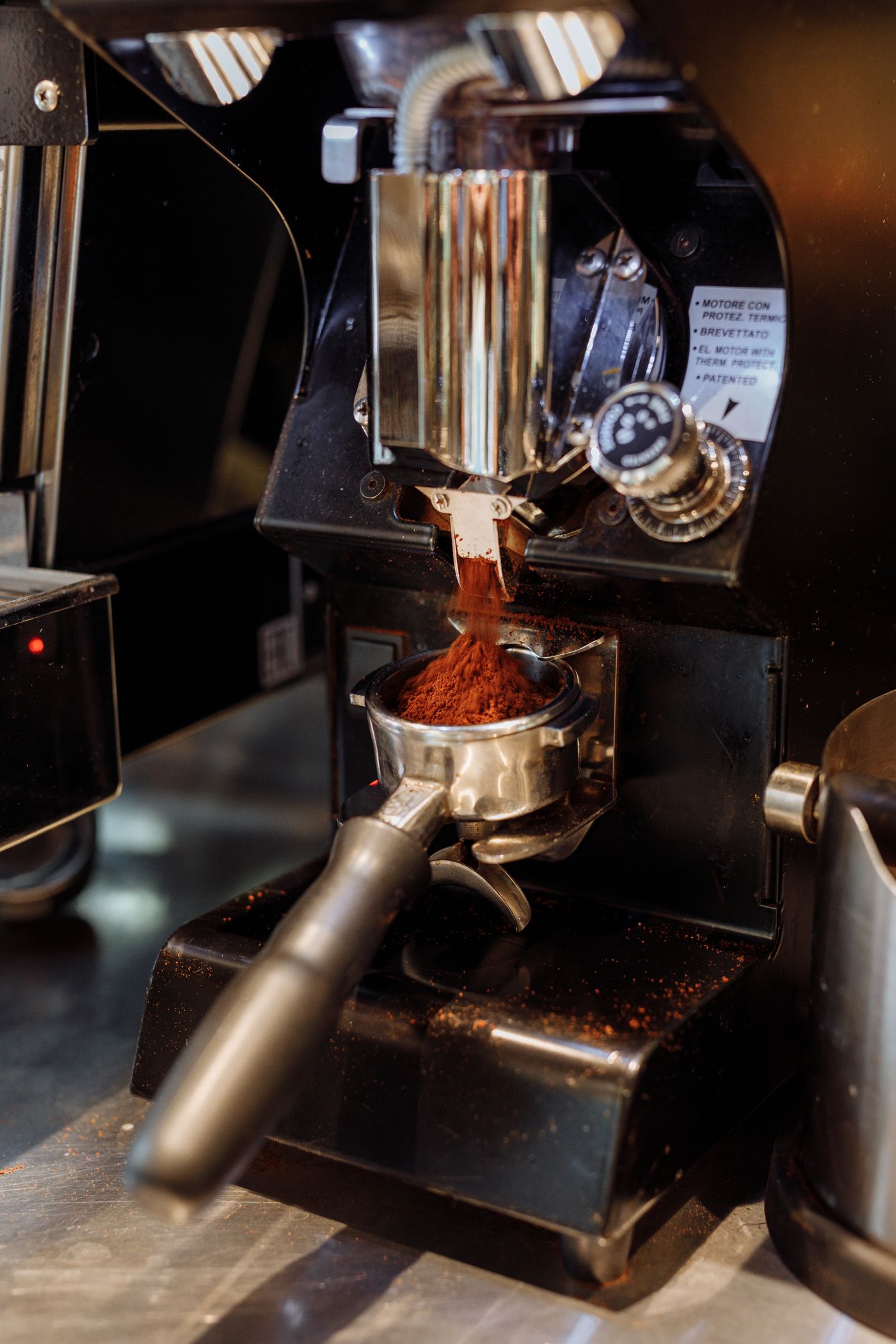
What a busy café actually needs from tamping
A busy café does not need the most complicated tamper. It needs a puck-preparation process that stays predictable when orders arrive in clusters, operators rotate, coffee dust accumulates and attention is split between grinding, steaming, pouring, serving and customer communication. The target is operational control: a level, repeatable action that is quick to verify, comfortable over a shift and easy to recover when something fails.
Measure peak demand, not average demand
Daily drink count can hide the operational problem. One café might sell a moderate number of coffees but receive half of its espresso demand in a short commute rush; another can sell more across a long, even day with little queue pressure. Track espresso shots—rather than only transactions—in 15-minute intervals and review the real movement from grinder to group head.
- Peak espresso shots per 15 minutes and per hour.
- Number of baristas sharing the grinder, tamper and group head.
- Seconds from portafilter arrival at the grinder to group-head insertion during normal and peak periods.
- Re-tamps, tilted pucks, rim-cleanup delays, remakes and waiting between operators.
- Staff feedback about wrist, shoulder or back discomfort during and after shifts.
- Whether the actual queue is caused by tamping, grinder recovery, milk service, payment or machine capacity.
Think in station sequences, not isolated cycles
A unit with a short programmed cycle can still slow the café if the barista must cross hands, turn around, reach past another worker or wait for a shared machine. It helps only when the portafilter moves naturally from grinder to distribution to tamper to group head—and when cleaning and maintenance do not obstruct that sequence.
Under-grinder designs may save lateral counter width and shorten travel. That potential benefit is conditional: they must match the named grinder and still leave room to clean, adjust and service both products.
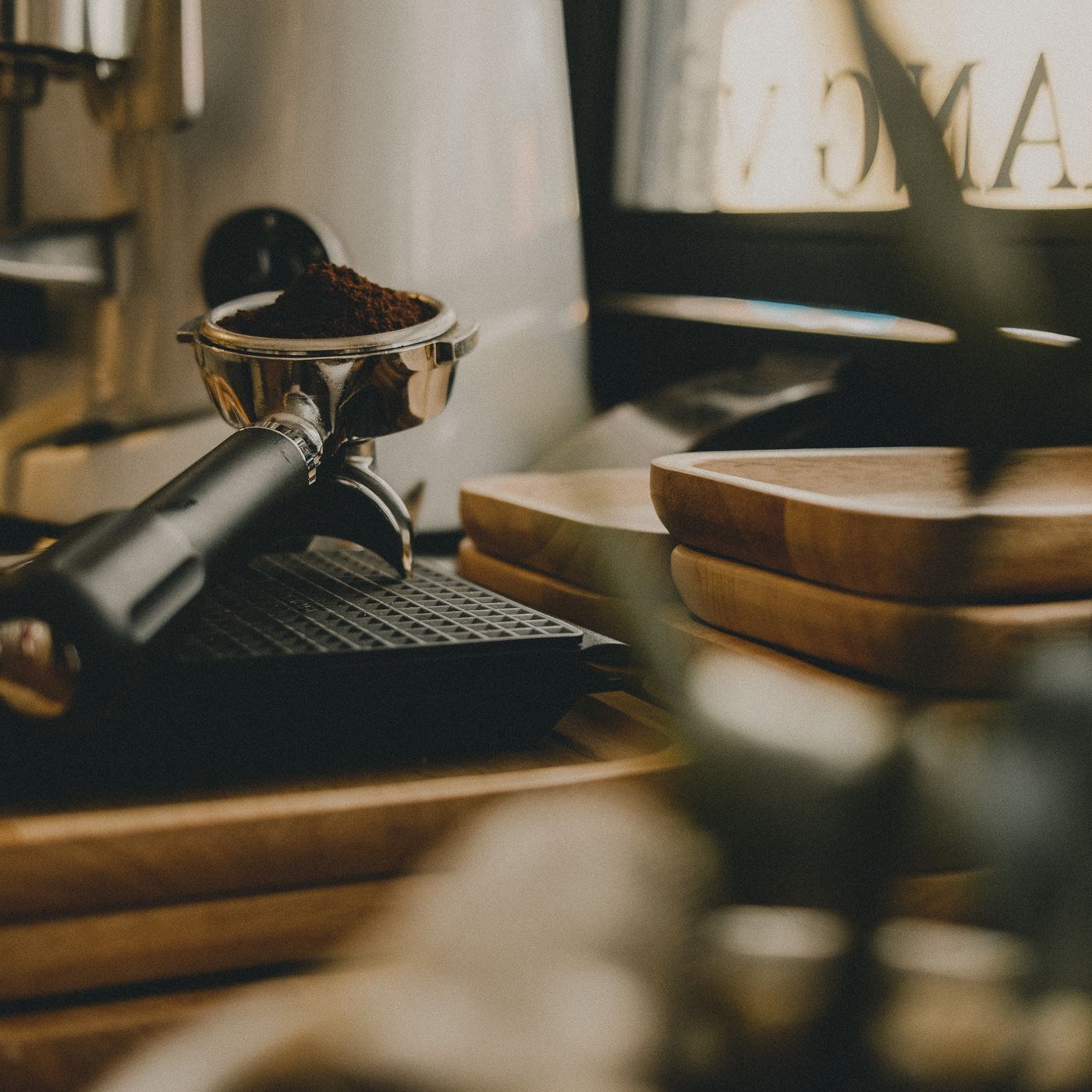
Consistency: where automatic tamping helps—and stops
Once the correct program, portafilter support and hardware setup are established, an automatic machine can apply the same selected cycle regardless of whether the operator is new, experienced, tired, tall, short, right-handed or left-handed. This makes the tamping action easier to standardize across shifts and locations. Managers can audit one documented setup rather than infer force or angle from each person’s technique.
What an automatic tamper does not control
Dose & distribution
It cannot correct a wrong coffee mass, clumps, density differences or an uneven mound delivered by the grinder.
Grind & recipe
It does not solve grind drift, coffee age, headspace, brew ratio, water temperature or machine-pressure issues.
Basket condition
It cannot make a damaged or unsuitable basket compatible, or eliminate clearance caused by an incorrect base diameter.
Barista Hustle’s tamping guidance emphasizes a straight entry, a flat puck and careful removal. The principles apply whether force comes from a hand or motor. A well-set automatic tamper can reproduce the movement; it cannot taste espresso or find the upstream cause of an extraction problem.
How much tamping pressure is enough?
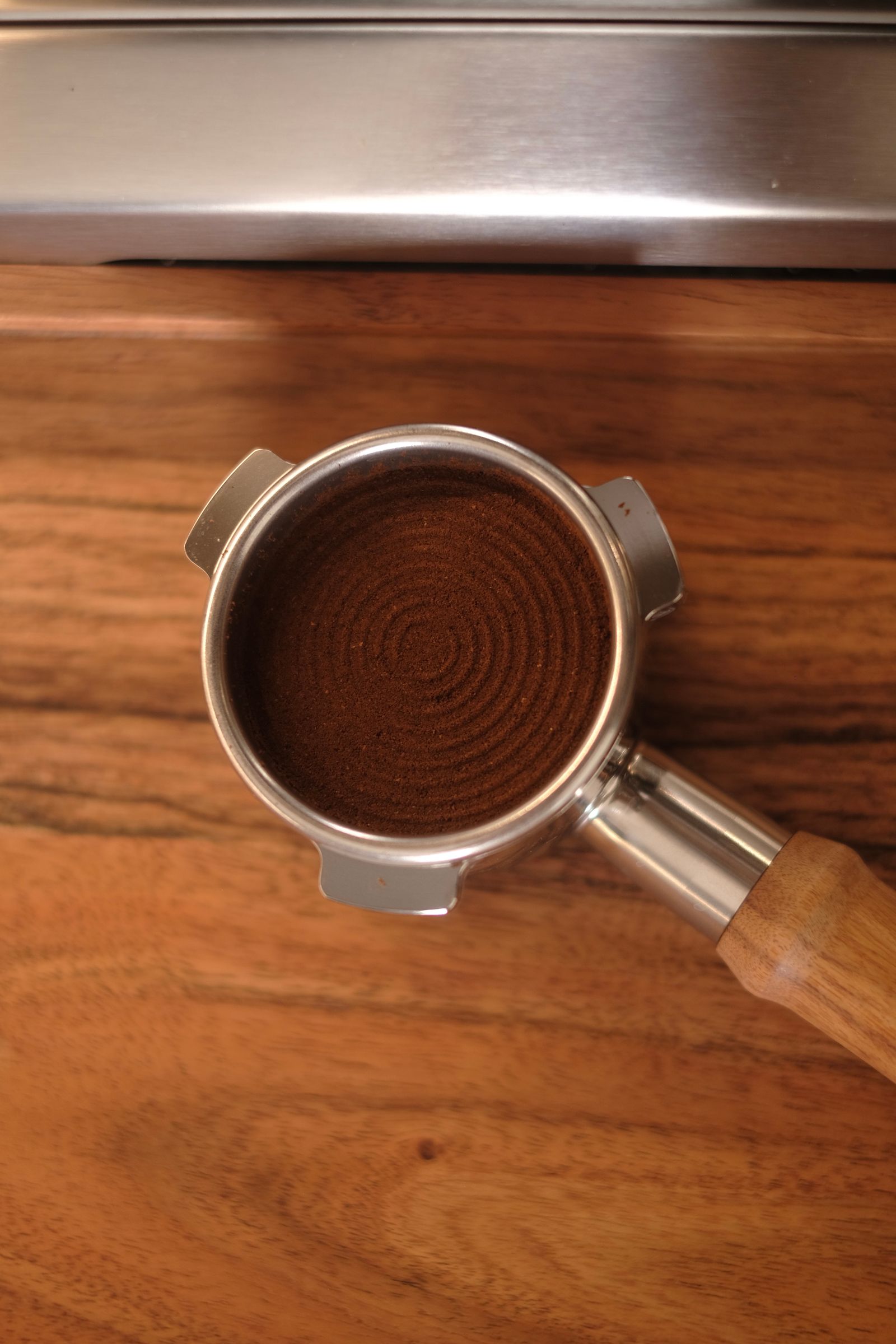
The goal is a stable, level bed—not the highest displayed force. Once coffee is fully compacted, extra force does not correct poor distribution or unsuitable grind. A 2017 Technical University of Munich study found particle size affected extraction kinetics while tamping pressure had no detectable effect under its tested conditions. That finding is condition-specific, but it supports avoiding exaggerated claims about one universal tamp pressure.
Speed and ROI: measure the full process
A powered tamper can reduce active pressing and checking time, but the total station cycle is the useful comparison. Product-cycle figures and selected profiles vary by manufacturer and model. Time pickup, insertion, activation, removal, rim check, walking, cleaning and any waiting before deciding whether the installed station is actually faster.
Run a simple peak-hour time study
Transparent ROI calculation
Illustrative scenario: If a café prepares 500 espresso shots per day, measures a net two-second saving per shot and operates 360 days each year, the arithmetic is 100 hours potentially reallocated annually. This is not a promised saving. It gains economic value only when those hours increase constrained peak throughput, reduce paid time, prevent overtime or release staff for work that otherwise remains undone.
| Input | How to measure it | Buyer implication |
|---|---|---|
| Installed cost | Machine, delivery, counter change, power, setup and backup tool | Compare total project cost, not only headline equipment price |
| Net time change | Complete station cycles during actual peaks | Count only time that removes a real bottleneck |
| Quality/rework | Remakes, tilt, contamination, inconsistent procedure and staff feedback | Do not assume a repeatable tamp fixes every espresso fault |
| Service & downtime | Cleaning time, parts lead time, local technician and fallback procedure | Protects the benefit when the powered unit requires attention |
| Ergonomic value | Task repetition, station height, posture, staff feedback and task rotation | Evaluate the whole bar; do not treat automation as a medical guarantee |
Planning a café tamper project?
Send Coffmach your machine, grinder, portafilter and basket information, dose range, layout constraints, expected peak workflow, tamper preference and project requirements for a more useful discussion.
Choose the setup that matches the station
| Situation | Recommended starting point | What to verify |
|---|---|---|
| Low or moderate peak volume | Manual tamper; consider self-leveling/calibrated design | Correct base fit, straight-entry technique and whether tamping actually delays service |
| Single skilled operator | Manual or guided manual tamper | Repeatability during real peaks and whether other bottlenecks dominate |
| Mobile bar, cart or pop-up | Manual tamper with stable tamping support | Power, counter space, transport, cleaning and fast fallback |
| Multi-barista high-volume station | Test a commercial automatic tamper | Portafilter/basket compatibility, layout, service support, cleaning and measured benefit |
| Multi-site standardization | Automatic or guided manual approach with written procedure | Identical hardware, setting lock, training, documentation and parts coverage |
| Frequent basket/recipe changes | Manual or highly tested automatic configuration | Every intended basket/dose pair, clearance and revalidation after changes |
Ergonomics belongs in the decision
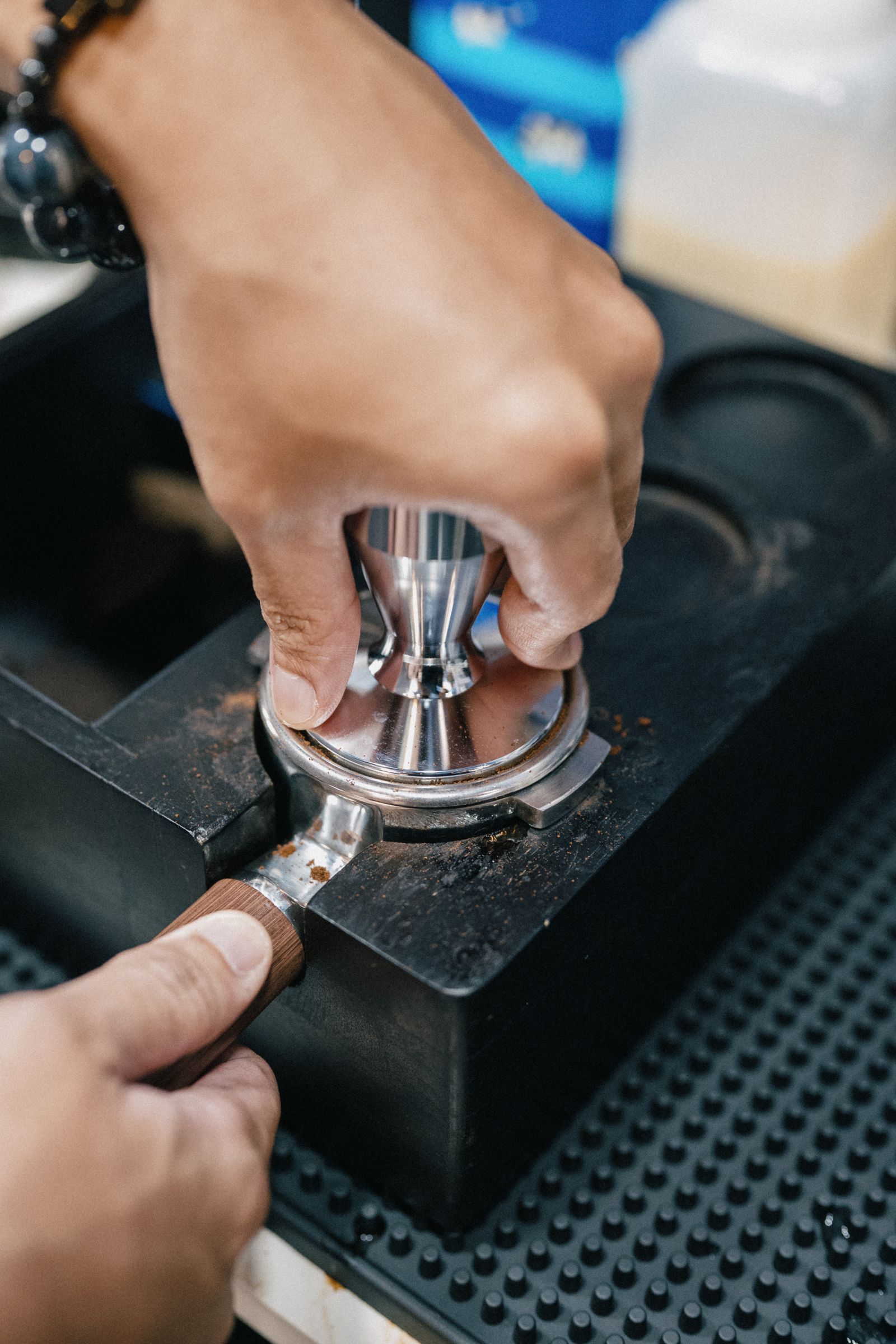
Manual tamping combines grip, wrist stabilization, shoulder loading and downward force throughout the shift. Total risk depends on repetitions, station height, reach, handle geometry, operator posture, recovery time and other work. A peer-reviewed study of ten experienced baristas compared a traditional vertical-handle tamper with a flat, handleless alternative; under the study procedure, the alternative design showed more neutral postures and lower assessed upper-limb risk. This small, model-specific study does not prove every powered tamper prevents injury, but it supports evaluating tool geometry and posture rather than ignoring them.
The middle ground: guided manual tampers
A self-leveling manual tamper references the basket rim to reduce tilt; a calibrated design provides a pressure cue or endpoint. This can support training without the space, power, service and downtime requirements of a powered machine.
Its limits remain manual repetition, actual basket compatibility and grounds ingress in moving gaps. A leveling plate can touch the rim before the base reaches a very low dose, and a spring may return a handle rather than accurately control delivered pressure. Test the real basket and dose range instead of buying from a label.
Implementation: install a workflow, not just a machine
Troubleshooting common automatic-tamping problems
| Symptom | Likely checks | Corrective direction |
|---|---|---|
| Puck surface is tilted | Portafilter support, basket seating, fork and tamping-head alignment | Clean and realign using the manufacturer procedure |
| Loose coffee near wall | Base diameter, basket taper, dose position and grounds on rim | Confirm compatible geometry; do not solve edge clearance with more force |
| Machine stops too early | Dose height, basket depth, piston travel, profile, obstruction | Verify approved recipe and setup; do not add coffee only to meet the head |
| Shot flow varies | Grind, dose, distribution, coffee age, basket and machine condition | Diagnose upstream preparation and extraction before changing pressure |
| Noisy or inconsistent cycle | Coffee ingress, loose support, maintenance interval, wear or sensor fault | Stop and follow the maker’s inspection/service process |
| Peak is still slow | Station travel, milk bottleneck, grinder recovery, group capacity and payment queue | Re-measure the entire system instead of blaming one step |
Buyer checklist, maintenance and backup plan
Coffee grounds and oils accumulate wherever the portafilter enters a powered tamper. Follow the exact model manual for cleaning frequency, approved tools, safe isolation and removable parts. Do not spray liquid into the mechanism or improvise disassembly. A machine that is never cleaned will not remain a consistency tool.
| Check | What to confirm | Why it matters |
|---|---|---|
| Espresso hardware | Exact grinder, portafilter, basket, dose range and distribution workflow | Nominally similar systems can differ in support, diameter, taper and travel |
| Physical fit | Stand-alone/under-grinder configuration, clearance, cable route and access | A compatible cycle can still create congestion if the station layout is poor |
| Machine setup | Base diameter, fork/support adjustment, activation, profiles and setting access | Defines repeatable operation and restricts casual changes during service |
| Support & service | Warranty, exclusions, local technician, parts lead time and escalation path | Powered equipment needs a credible downtime plan |
| Cleaning | Daily/periodic procedure, approved cleaners, service interval and spare parts | Protects function, hygiene and long-term reliability |
| Fallback | Correct-size manual tamper, labeled location and practiced switch-over | Prevents espresso service stopping during cleaning, faults or power loss |
Keep the manual backup visible and tested
Every shift should have a correctly sized manual tamper within reach, not hidden in an unknown drawer. Label its station, confirm its basket fit and include manual tamping in periodic training. If the automatic unit fails during a rush, staff should switch methods without guessing dimensions or attempting unauthorized repairs.
Need manual tamper or OEM/ODM project support?
Provide your basket dimensions, dose range, base profile, manual or guided mechanism, material, finish, packaging, branding, sample quantity and target market for specification review.
Frequently asked questions
Is an automatic coffee tamper worth it for a café?
It is worth evaluating when a busy multi-barista station has documented tamp variation, repetitive-force concerns, rework or peak congestion. It is not automatically worthwhile for every café. Compare installed cost with measured throughput, productive time, rework, training, maintenance and downtime value.
How many coffees per day justify an automatic tamper?
There is no reliable universal threshold. Measure espresso shots during the busiest 15-minute and 60-minute periods, operator count, net workflow time, rework and discomfort. A concentrated rush can justify automation at a lower daily total than higher but evenly spread demand.
Is an automatic tamper faster than manual tamping?
Its programmed press may be quick, but the useful comparison is the complete station workflow. Include pickup, insertion, activation, removal, checking, cleaning and travel. A fast device can still slow a poor layout.
Can an automatic tamper replace barista training?
No. It standardizes tamping motion, not espresso preparation as a whole. Staff still need to dose, distribute, keep the rim clean, dial the grinder, judge extraction, maintain equipment, recognize faults and use the manual backup.
Does automatic tamping prevent channeling?
No. A level, repeatable tamp removes one potential source of uneven resistance, but channeling can also come from clumps, poor distribution, grind inconsistency, basket issues, headspace, puck damage or machine condition.
What tamping pressure should a café use?
Use a stable setting that fully compacts the coffee bed and produces clean, repeatable pucks. Avoid treating maximum pressure as a quality target. Keep the setting stable while adjusting espresso flow with grind and evaluating recipe data and taste.
Should a café choose stand-alone or under-grinder?
Choose from physical workflow and verified compatibility. A stand-alone unit is easier to place independently and may remain useful if the grinder changes. An under-grinder unit can save lateral space but must match the named grinder and preserve cleaning and service access.
How often should an automatic tamper be cleaned?
Follow the exact model manual. Loose grounds may need attention during service, and the maker can specify separate daily and periodic routines. Never assume a powered unit can be rinsed, sprayed, soaked or disassembled like a solid manual tamper.
Do we still need a manual tamper after buying an automatic one?
Yes. Keep a compatible manual tamper as a tested backup for cleaning, maintenance, power loss, sensor faults or unexpected downtime. Staff should periodically practice the backup method so a failure during a rush does not stop espresso service.
Technical sources and image credits
- PUQ — Automatic Tamper Families. Official overview showing stand-alone and grinder-integrated product families; exact specifications must be checked by model.
- Compak — Cube Tamp. Official product example covering automatic detection, adjustable support, cleaning mode and 10–30 kg displayed setting range.
- Compak — Cube Tamp Instruction Manual. Official manual for safe installation, adjustment, operation and cleaning boundaries.
- Barista Hustle — Tamping and Brewing Technique. Technical guidance on straight tamper entry, a flat puck and automated/self-leveling tools.
- International Journal of Industrial Ergonomics — Alternative Tamper Design Study. Peer-reviewed comparison of posture and upper-limb risk measures for two named manual-tamper designs.
- Technical University of Munich — Time-resolved Extraction Study. Research record on particle size and tested tamping-pressure conditions.
- Coffmach — Coffee Tamper. Product and OEM/ODM context.
- Coffmach — Coffee Tamper Guide. Internal reading on tamper types, sizes and use.
- Coffmach — How Hard Should You Tamp Coffee?. Internal technique context for tamping-force decisions.
- Coffmach — How to Choose a Coffee Tamper. Internal buying guidance for basket fit and selection.
- All seven article photographs are real, unbranded coffee-workflow images from Pexels. Each image is credited in plain text directly below the photo; neither the photo nor its image credit is a clickable link.