


11.11.2025
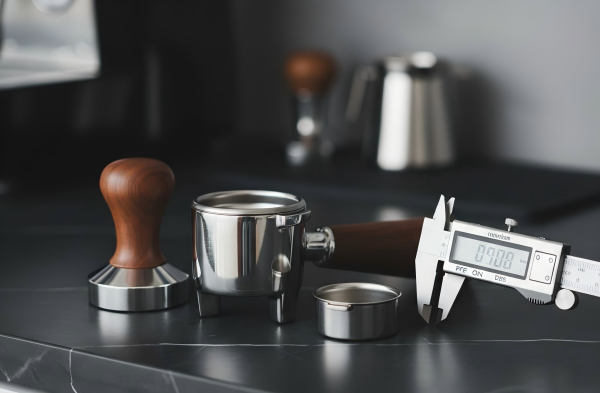
Want to know the most reliable way how to evaluate the quality of coffee machine accessories for business and home? Focus on three key areas. First, check the material science. Second, examine the manufacturing craftsmanship. Third, assess the structural and design precision.
This simple framework cuts through marketing hype. It helps you judge an item’s real worth.
The market overflows with choices. You’ll find cheap knock-offs alongside expensive “pro” gear. Coffee shop owners, distributors, and serious home enthusiasts need to spot genuine quality. This matters for both coffee flavor and your wallet.
This guide gives you practical evaluation tools. We’ll show you exactly what to look for. You’ll learn how these details affect your coffee and business. We’ll provide specific criteria for checking products and suppliers.
By the end, you’ll make confident, smart purchasing decisions.
Table of Contents
Why Quality Is Non-Negotiable
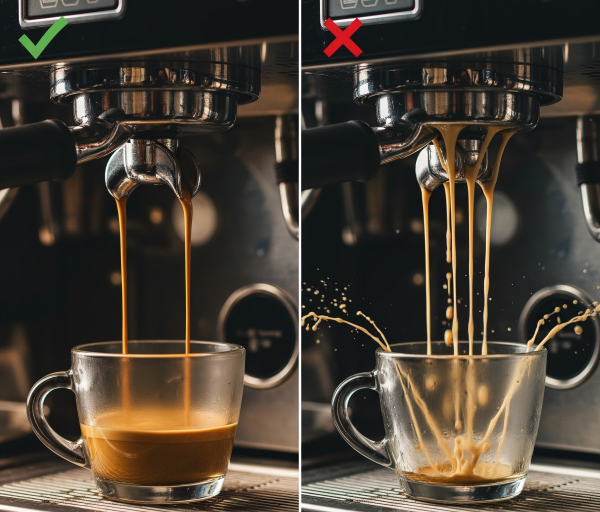
Poor quality doesn’t just inconvenience you. It actively ruins your coffee. It hurts taste, efficiency, and profit.
Extraction and Flavor Consistency
Low-precision accessories cause problems. Take unevenly drilled filter baskets. They create channeling. This mixes sour under-extracted flavors with bitter over-extracted ones in the same shot.
Quality ensures repeatable, balanced extraction. This is the foundation of great coffee.
Thermal Stability
The material and weight of accessories matter for temperature. This is especially true for portafilters. They help maintain stable brew temperature.
Poor materials steal heat from the group head. This results in sour, underdeveloped espresso. Consistent temperature is essential for consistent flavor.
Impact on Business Operations
Well-made tools with tight tolerances help workflow. They reduce barista frustration and speed up service. A tamper that fits the basket perfectly saves seconds on every shot.
During busy service, these seconds add up. They directly affect customer wait times and staff efficiency.
Durability and Long-Term ROI
High-quality accessories cost more upfront. But they’re built to handle commercial use. This means fewer replacements and less downtime. Your total cost of ownership drops.
A cheap portafilter handle that breaks during rush hour creates problems. It’s a business liability, not a saving.
Understanding these impacts shows why learning how to evaluate the quality of coffee machine accessories is critical.
- Better Quality = Better Coffee Taste & Consistency
- Better Quality = Higher Workflow Efficiency
- Better Quality = Greater Durability & Lower Long-Term Costs
- Better Quality = Enhanced Brand Perception & Customer Satisfaction
The Three Evaluation Pillars
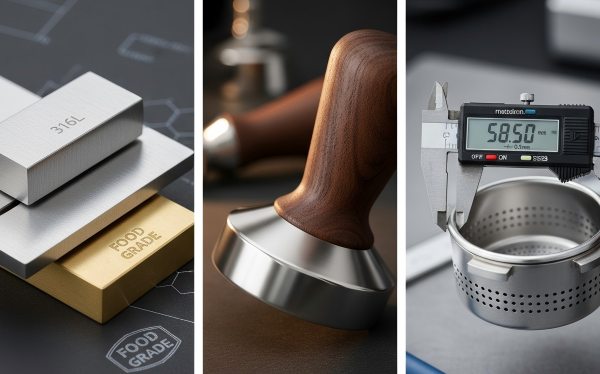
This framework gives you a systematic method for assessing any coffee accessory. It provides expert-level knowledge.
Pillar 1: Material Science
What an accessory is made of matters deeply. It affects heat, durability, and coffee safety.
Stainless Steel: The Standard
Not all steel is equal. Understanding the grade is your first step in material evaluation.
304 Food-Grade is the industry workhorse. It offers good corrosion resistance and high durability. It’s ideal for most uses like milk pitchers, tamper bases, and many portafilter bodies.
316L/Marine-Grade steel provides superior corrosion resistance. It handles acids and chlorides better. This is a premium choice for parts constantly touching coffee and aggressive cleaning agents.
The key difference is molybdenum. 316L contains this element. It significantly increases resistance to corrosion from chlorides in water and detergents. This makes it excellent for high-end filter baskets and internal machine components. It costs more, though.
Brass: The Heat Champion
Brass is often used for high-end commercial portafilter heads. These are then chrome-plated for durability and a clean finish.
Its key advantage is superior thermal mass and stability compared to stainless steel. It holds heat exceptionally well. This contributes to temperature consistency from shot to shot.
Aluminum: Lightweight with Caveats
Aluminum is often anodized for surface protection. It’s good for parts where low weight matters. Think certain distribution tools or handles.
However, it’s less durable. It has significantly lower heat retention than steel or brass. Be careful with raw, uncoated aluminum touching acidic coffee.
Wood and Plastics
These materials are mainly used for handles and aesthetic components.
When checking wood, look for hardwoods like Walnut, Oak, or Ash. They’re more durable and resist cracking better than softer woods. The quality of the finish or sealant is also crucial for longevity.
For plastics, assess the type. Is it cheap-feeling, brittle ABS plastic? Or is it more durable, heat-resistant material like POM (Polyoxymethylene) or Bakelite? The feel in hand often reveals quality.
Material | Key Advantage | Best For… | Key Disadvantage |
304 Steel | Durability, Good Value | Tampers, Pitchers, Baskets | Lower heat retention than brass |
316L Steel | Ultimate Corrosion Resistance | High-end Baskets, internal parts | Higher Cost |
Brass | Excellent Thermal Stability | Commercial Portafilter Heads | Heavy, requires plating |
Aluminum | Lightweight | Distribution Tools, some handles | Low durability, poor heat retention |
Pillar 2: Manufacturing Craftsmanship
The look and feel of an accessory reveal production care. This is where you can physically inspect for quality.
Weight, Balance, and Haptics
When you hold a premium tamper, you notice its satisfying weight first. This isn’t just about being heavy. It’s about feeling dense and solid, not hollow or flimsy.
The balance in your hand matters. Whether it’s a portafilter or milk pitcher, good balance indicates thoughtful design and quality materials.
Surface Finish and Coatings
A polished finish often looks premium out of the box. But it shows fingerprints and micro-scratches easily. A brushed or satin finish is often more practical for daily use. It’s better at hiding minor wear.
Advanced coatings like PVD (Physical Vapor Deposition) or DLC (Diamond-Like Carbon) signal a premium product. These coatings significantly increase surface hardness. They reduce friction and can provide non-stick properties. This is particularly useful for steam wands or distribution tools.
Edges, Joins, and Marks
Pick up the product. Run your finger along the edges. Are they smooth and chamfered? Or are they sharp and unfinished?
Look where different materials meet. For example, where a wooden handle joins a steel portafilter. Is the transition seamless and tight? Or is there a noticeable gap?
The absence of rough machining marks or burrs indicates higher finishing levels. It shows better quality control during manufacturing.
Pillar 3: Structural Precision
This is arguably the most critical factor for performance. Precision manufacturing ensures parts fit together and function exactly as intended.
The Importance of Tolerances
Tight tolerances are the hallmark of high-performance accessories.
Take a tamper and filter basket. A high-quality 58.7mm VST basket paired with a 58.5mm tamper is a perfect example. That tiny 0.2mm gap is intentional. It allows the tamper to move freely without creating a vacuum. Yet it’s tight enough to prevent edge channeling.
In contrast, a cheap “58mm” tamper might actually measure 57.5mm. This leaves a large ring of un-tamped coffee around the puck edge. It guarantees uneven extraction. You can learn more about basket diameter importance from precision manufacturers like VST Baskets.
Symmetry and Concentricity
Is the part perfectly symmetrical? For a tamper, the base must be perfectly perpendicular to the handle. If it’s not, you’ll never achieve a level tamp.
For a WDT (Weiss Distribution Technique) tool, are the needles perfectly straight and evenly spaced?
You can check for wobbles by placing the accessory on a perfectly flat surface. Use a stone countertop. Any rocking or instability clearly shows poor precision.
Ergonomics and Functional Design
Does the design serve a clear purpose? Or is it purely for show?
An ergonomic handle on a portafilter or tamper reduces barista wrist strain over long shifts. A bottomless portafilter is a diagnostic tool. It helps you see and fix extraction problems. A milk pitcher with a sharp, well-defined spout allows precise, high-contrast latte art.
Question purely aesthetic features that add significant cost but offer no functional improvement. Good design enhances function, not just appearance.
Practical Application: A Spotter's Guide
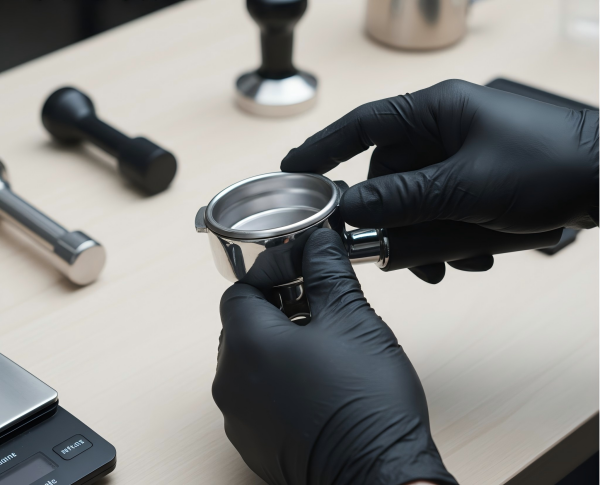
Let’s apply the three-pillar framework to specific accessories. This is your checklist for making smart purchasing decisions.
Evaluating Portafilters
A portafilter is one of the most handled pieces of equipment in a cafe.
- Material: Look for heavy chrome-plated brass for maximum thermal stability in commercial settings. For home use or cafes prioritizing lighter weight, high-quality stainless steel offers excellent durability. It’s also easier to care for.
- Craftsmanship: Check the handle-to-head connection. It must feel solid and secure. A weak joint will loosen over time with repeated knocking. If it has a wood or plastic handle, ensure the finish is smooth and feels durable.
- Precision: The single most important factor is the fit with your machine’s group head. It should lock in smoothly and create a firm seal without excessive force or wobbling. Also check that your chosen filter basket fits snugly inside the portafilter without rattling. When vetting a supplier, ask to test a sample on your machine. You can see examples of well-crafted options by browsing a professional portafilter collection.
Evaluating Tampers and Tools
These tools directly create the coffee puck. Their precision is vital.
- Material: The base must be a solid piece of 304 or 316L stainless steel. Avoid bases that are coated or plated. These can chip over time and potentially contaminate your coffee.
- Craftsmanship: The weight should feel substantial and well-balanced. The connection between handle and base must be perfectly rigid. No play or flex allowed.
- Precision: The base diameter is critical. It must be precisely matched to your filter basket’s internal diameter. For example, a 58.5mm tamper for a precision 58mm basket. The base must also be perfectly flat or have a precisely machined convex shape. You can check for flatness by placing it on a known flat surface.
Evaluating Filter Baskets
This is where a small investment in precision yields the biggest return in taste.
- Material: Stainless steel is the universal standard.
- Craftsmanship: The difference is almost invisible to the naked eye. This is why precision is the dominant factor here.
- Precision: This is 100% about the precision and uniformity of the holes. A quality basket, like those from VST or IMS, has perfectly circular, evenly spaced holes. This is achieved through secondary finishing, imaging, or laser processes after initial punching. A cheap basket has ragged, inconsistently sized and spaced holes from a single stamping process. This directly impacts water flow and leads to inconsistent extraction. For a deep dive on this, resources like the analysis on Barista Hustle are invaluable.
Evaluating Milk Pitchers
For a cafe, a pitcher is a tool for both texture and art.
- Material: Food-grade stainless steel (304) is the best choice. It’s durable, easy to clean, and has a neutral effect on milk taste.
- Craftsmanship: The alignment of the spout is key for latte art. A well-defined, sharp spout that’s perfectly aligned with the handle is essential for control. The handle should be securely spot-welded with no gaps where milk can get trapped.
- Precision: If the pitcher has internal volume markings, they should be accurate. This helps baristas reduce milk waste. The overall symmetry of the pitcher also affects pouring dynamics and consistency.
For Business Buyers: Vetting Suppliers
This advice is for coffee shop owners, purchasers, and distributors. It helps you look beyond the product and evaluate source reliability. This reduces business risk.
Beyond the “Golden Sample”
A single perfect sample from a potential supplier doesn’t guarantee consistent production quality.
Your goal is to evaluate the supplier’s entire process. Look at their commitment to quality control, not just their single best product. Consistency is key to a reliable supply chain.
The Supplier Questionnaire
When engaging with a potential manufacturer or wholesaler, asking the right questions is crucial. This demonstrates your expertise and forces transparency.
- Material Sourcing: “Can you provide material specification sheets or certifications for the stainless steel (e.g., 304 or 316L) you use?” A reputable supplier will have this readily available.
- Quality Control (QC) Process: “What are your QC checkpoints during manufacturing? How do you test for dimensional accuracy and finish quality? Can you share your QC checklist?” A lack of documented process is a major red flag.
- Manufacturing Capabilities: “Are you the factory or a trading company? What parts of the process do you handle in-house versus what is outsourced?” This helps you understand who is truly responsible for quality.
- Certifications: “Do you hold any quality management certifications like ISO 9001?” This standard shows commitment to process management. For relevant components, ask about food-safety certifications like NSF International.
- Client References: “Can you provide references from other clients in the coffee industry, particularly in our market?” Speaking to their existing customers is one of the best forms of due diligence.
Red Flags in Communication
Be wary of suppliers who are evasive about material specifications. Watch out for those who cannot provide documentation for their QC process.
Inconsistencies between different samples are warning signs. Poor communication or unwillingness to answer detailed questions are also red flags. Trust is built on transparency and consistency.
A transparent supplier will welcome these questions. At Coffmach, we are open about our processes and standards. You can always inquire with us about how we ensure quality.
Decoding Price vs. Quality
This section directly addresses budget and value concerns. It helps you allocate funds wisely.
Identifying Value vs. Hype
Knowing how to evaluate the quality of coffee machine accessories helps you spot the difference between genuine value and clever marketing.
Value is found in precision. High prices are justified when they result from tight manufacturing tolerances, advanced materials science, or research and development that demonstrably improves coffee extraction. This includes precision filter baskets, high-end grinders, or thermally stable portafilters.
Hype is often rooted in aesthetics. Be skeptical of high prices driven purely by exotic materials in non-functional places. Think rare wood handles that triple a tamper’s price. Designer branding with no proven performance benefit is another red flag. Features that sound scientific but have no proven impact on coffee are also suspect.
We’ve tested accessories that cost five times as much as their competitors. We found zero difference in the cup. The extra cost was purely for a brand name or cosmetic flourish.
Where to Invest Your Money
- Filter Baskets: This is the #1 point of impact on your extraction quality. A precision basket isn’t a luxury. It’s a necessity for consistency.
- Tamper and Distributor: These tools are crucial for ensuring a level and evenly compacted puck. This is the foundation for avoiding channeling.
- Scale: A reliable scale with 0.1g accuracy is essential for repeatable dosing and measuring yield. These are the two most important variables in any brew recipe.
Where “Good Enough” Is Great
- Knock Boxes: Durability and size are the key factors here. Precision is completely irrelevant. A sturdy, well-made box will do the job perfectly.
- Tamping Mats: A simple, thick piece of silicone or rubber is all that’s needed. It protects your counter and portafilter. There’s no need for expensive, branded versions.
- Basic Milk Pitchers: Unless you’re a competitive latte artist requiring a highly specialized spout, a well-made standard pitcher works great. Choose one from a reputable brand. It’s more than sufficient for texturing beautiful milk for daily service.
Conclusion: Your Toolkit for Decisions
Navigating the world of coffee machine accessories no longer needs to be a guessing game.
By consistently applying the three pillars—Material Science, Manufacturing Craftsmanship, and Structural Precision—you can objectively assess any product. This method allows you to cut through marketing noise. Focus on what truly matters for performance and longevity.
You now know how to identify the difference between high-cost, low-value items and genuinely high-quality tools. The right tools will elevate your coffee and serve you for years.
Whether you’re outfitting a new café, stocking your distribution warehouse, or upgrading your home setup, use this guide as your quality benchmark.
Now that you know how to evaluate quality, explore our curated selection of professional-grade accessories. All have been vetted against these high standards. You can browse our full collection here.
For further reading on the science of espresso and extraction, we highly recommend the resources at Scott Rao’s blog. He’s a trusted and authoritative voice in the coffee industry.
As a professional manufacturer specializing in the research, development, and production of Coffee machine accessories, we not only offer a diverse product selection but also support OEM/ODM customization to meet the needs of diverse markets and customers. With consistent quality control, fast delivery, and innovative designs, our coffee machines are used by numerous brands and channels worldwide. Whether you're a distributor, wholesaler, or brand owner, we can provide you with reliable solutions to help you grow your business. Contact us to explore potential collaboration opportunities.

Facebook
Twitter
LinkedIn
WhatsApp
Categories: Buying/Customization Guide Product Knowledge


