


13.09.2025
Table of Contents
Your Perfect Cup, in a Perfectly Small Package
Choosing the right mini coffee machine can feel overwhelming. The market overflows with options. When every inch of counter or desk space matters, picking the wrong machine feels like a costly mistake.
This guide cuts through the confusion. We’ll give you a clear, step-by-step plan. You’ll find the perfect machine for your lifestyle, budget, and taste preferences.
The Overwhelm is Real
Pod machines, manual presses, automatic brewers—the choices seem endless. This leads to decision paralysis. You’re not just looking for any small coffee maker. You need one that fits perfectly into your daily routine.
Here’s our promise: After reading this guide, you’ll feel confident choosing a mini coffee machine you’ll love using every day.
A Quick Look at Your Options
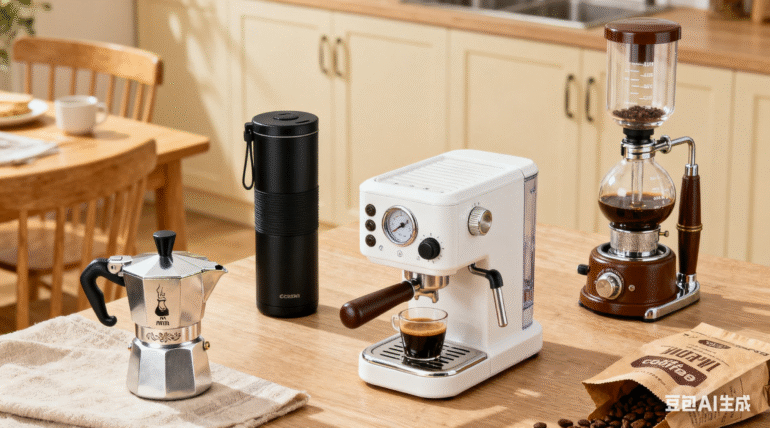
Let’s simplify things first. Most mini coffee machines fit into four main categories. See which one appeals to you.
Machine Type | Best For (User Type) | Key Pro | Key Con |
Single-Serve Pod Machine | Office Users & Beginners | Unbeatable convenience and speed | Higher cost per cup, environmental waste |
Compact Drip Coffee Maker | Small Households & Traditionalists | Makes multiple cups, very affordable | Less versatile, larger footprint than pods |
Manual/Portable Espresso Maker | Coffee Enthusiasts & Travelers | Excellent coffee quality, ultimate portability | Requires a learning curve and manual effort |
Compact “Bean-to-Cup” Machine | The Ultimate Enthusiast | Freshest coffee, all-in-one solution | Most expensive, requires more maintenance |
Step 1: Your Coffee Identity
First, decide what type of coffee you want to drink. This single choice eliminates 90% of your options. It makes everything else much simpler.
Single-Serve Pod Machines
These machines work simply. They pierce a pre-packaged pod and force hot water through it. Think Nespresso or Keurig. Insert a capsule, press a button, and you’re done.
The biggest advantage? Unbeatable convenience. You get consistent coffee in under a minute with zero mess or prep work.
The downsides are real though. You’ll pay more per cup over time. The disposable pods create environmental waste, though recyclable options are becoming more common. Your coffee choices are limited to what the brand offers.
This type works perfectly for busy professionals who need quick caffeine between meetings. It’s ideal for dorm room students who prioritize speed. Choose this if you value a no-fuss experience above everything else.
Compact Drip Makers
This is the classic coffee maker, just smaller. A compact drip coffee maker heats water and slowly drips it over coffee grounds in a filter basket. The coffee brews into a small carafe.
The main advantage is brewing multiple cups at once—typically 4 to 5 cups. This makes them perfect for couples or small households. They’re also among the most affordable options. You can use any ground coffee you like.
The downsides include slower brew times, often several minutes. While compact, they still take up more counter space than slim pod machines. The flavor can be less intense than espresso-based drinks.
These work best for people who drink more than one cup in the morning. They’re perfect for budget-conscious buyers and anyone who enjoys traditional, straightforward coffee.
Manual Espresso Makers
True coffee connoisseurs love manual and portable espresso makers. They offer unparalleled control. You use hand-generated pressure to force hot water through finely-ground coffee. This produces genuine espresso shots.
The result is exceptional coffee quality. It rivals much larger, more expensive machines. You control every variable—water temperature, pressure, timing. Many models like the AeroPress or Wacaco Minipresso are incredibly portable and need no electricity.
The catch is the learning curve and manual effort. You’ll need a separate grinder for fresh beans and a kettle for hot water. It’s a hands-on process.
We find deep satisfaction in this ritual. Grinding your beans, tamping the grounds perfectly, feeling the resistance as you press down—it connects you to the coffee-making process. The reward is a rich, syrupy espresso shot crowned with beautiful crema. It’s worth the effort.
Super-Automatic Luxury
Miniature super-automatic espresso machines represent the pinnacle of compact coffee technology. These devices do everything. They grind whole beans, tamp the grounds, and brew espresso at the touch of a button.
The primary benefit is the freshest possible coffee. Grinding beans moments before brewing unlocks flavor and aroma that pre-ground coffee or pods can’t match. All with incredible convenience.
The main drawbacks are a significantly higher price and a “mini” footprint that’s still larger than other compact options. They also require regular cleaning and maintenance—descaling and cleaning the brew group—to keep them working properly.
This machine is for serious coffee enthusiasts who want bean-to-cup freshness and push-button ease. Perfect if you don’t want to dedicate an entire countertop to a commercial-sized machine.
Step 2: Your Machine's Home
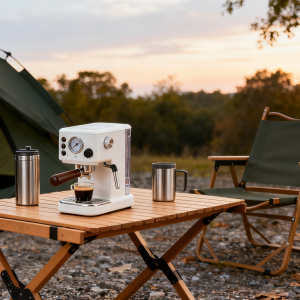
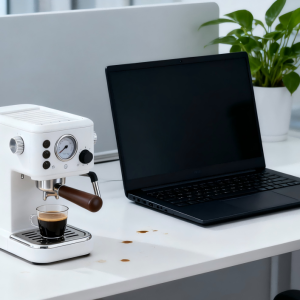
Now let’s talk about where your machine will live. Matching the machine to your environment is key to long-term satisfaction.
The Home Office Hero
Your desk is your productivity fortress. The challenge? Extremely limited space. You need speed between calls and minimal noise that won’t disrupt your focus.
Our top pick for this scenario is a slim single-serve pod machine. Models like the Nespresso Essenza Mini have an incredibly narrow footprint—often less than 5 inches wide. They sit unobtrusively next to your monitor. They’re whisper-quiet and deliver coffee in under 60 seconds.
For the office enthusiast, an AeroPress is a fantastic alternative. It requires no electricity at your desk. It’s simple to clean in an office kitchen. It produces a single, superb cup of coffee brewed to your exact specifications.
The Small Kitchen Dweller
In a tiny kitchen, every inch of counter space is precious. The challenge is battling clutter while still making space for a quality daily coffee ritual.
The perfect match here is often a 5-cup compact drip maker. These machines are designed to fit neatly under standard kitchen cabinets. They serve one or two people easily, making them perfect for a couple’s morning routine.
If espresso is non-negotiable, consider a compact semi-automatic espresso machine. While more of an investment, these models offer the full barista experience—pulling shots, steaming milk—in a much smaller form factor than full-sized counterparts.
The Compact Enthusiast
You crave quality, control, and freshness. But you don’t have space for a sprawling coffee bar with a giant grinder and commercial-style machine.
Your ideal machine is likely a high-end manual espresso maker, such as a Flair or Wacaco Picopresso. These provide unparalleled control over pressure profiling and extraction. You can pull true, cafe-quality espresso shots. They can also be disassembled and stored in a drawer, freeing up counter space completely.
An alternative is focusing your investment where it matters most: the grind and the brew. A high-quality single-dose grinder paired with a premium pour-over cone (like a Hario V60 or Kalita Wave) has a minimal physical footprint but delivers world-class coffee quality.
The Dorm Room Renter
For those in dorms or their first apartment, the challenges are clear. Strict space limits, tight budgets, and the need for simplicity and safety.
The top pick is almost always an entry-level pod machine like the Keurig K-Mini. It’s affordable and incredibly simple to use. It comes in various colors to match any decor. Crucially, most models have an auto-off feature—a key safety element for busy or forgetful users.
For the most budget-conscious, a simple French Press is an excellent choice. It costs very little and requires no electricity. It makes a full-bodied cup of coffee. It’s also multi-purpose and can brew loose-leaf tea.
Step 3: Decoding Key Features
Technical specifications can be confusing. Let’s break down the features that truly matter and connect them to your daily experience.
Size and Footprint
“Small” is relative. You need to consider the actual measurements: width, depth, and height.
We’ve found that machines under 5 inches wide, like the Nespresso Essenza Mini, are true game-changers for crowded counters. Always measure your space before buying. Pay special attention to clearance height under your cabinets—a commonly overlooked dimension.
Brew Speed Breakdown
How quickly do you need your coffee? The answer depends entirely on your lifestyle.
Pod machines are the sprinters. They deliver a cup in under a minute. Compact drip makers take a bit longer—typically 3-5 minutes to brew a small pot. Manual methods are a patient ritual, often taking 5-7 minutes including prep time for grinding and heating water.
Is your morning a frantic rush out the door? Or is it a slow, deliberate start to the day? Your answer will point you toward the right machine.
Water Reservoir Details
The water tank is a key element of a machine’s convenience. The main trade-off is size versus refills. A larger reservoir means a larger overall machine, but you’ll fill it less often.
We strongly recommend choosing a machine with a removable reservoir. This makes filling it at the sink infinitely easier. More importantly, it makes cleaning much simpler than trying to pour water into a fixed, built-in tank.
Build Quality and Materials
The materials used in a coffee machine affect its longevity, stability, and even the taste of your coffee. Look for stainless steel components where possible. They often indicate a longer lifespan and provide better temperature stability during brewing compared to all-plastic models.
For any plastic parts that contact water, look for a “BPA-free” designation. This is a key trust signal for health-conscious consumers. Also, pay attention to the machine’s weight. A heavier base often means more stability on the counter, preventing it from sliding around during use.
The Cleaning Factor
A machine you hate to clean is a machine you’ll stop using. This is a non-negotiable aspect of ownership.
The process varies wildly by type. Cleaning a pod machine involves a simple weekly rinse of the drip tray and monthly or quarterly descaling to remove mineral buildup. In contrast, a manual espresso maker needs to be completely disassembled and rinsed after every single use.
We find that machines with removable, dishwasher-safe parts drastically improve the long-term ownership experience. Descaling, in particular, is crucial for all machine types. It extends the machine’s life and ensures your coffee continues to taste fresh, not bitter.
Evaluating Extra Features
Many mini coffee machines come with bells and whistles. Here’s how to decide if they’re worth the extra cost.
Milk frothing is a common add-on. Integrated steam wands offer convenience but are often less powerful on mini machines. A separate, dedicated frother like an Aeroccino often produces better quality foam and is easier to clean.
Programmability can be a huge bonus. An auto-start timer on a drip maker means you can wake up to the smell of fresh coffee. Cup size memory on a pod machine lets you dial in your perfect volume once and never think about it again.
Temperature control is a premium feature found on higher-end machines. It allows you to adjust water temperature to perfectly suit different coffee beans. This is a key factor for enthusiasts looking to optimize extraction and flavor.
Step 4: The True Daily Cost
The price tag on the box is only the beginning. Understanding the total cost of ownership is crucial for making a smart financial decision.
Initial vs. Long-Term Cost
A compact drip machine might cost as little as $30. A mini super-automatic can easily cost over $500. Pod machines and manual presses typically fall in the $100-$250 range. But the initial investment is often inversely related to the long-term running cost.
The Cost-Per-Cup Breakdown
The real expense is the coffee itself. The cheap machine might be the most expensive to run over a year. Here’s an approximate breakdown based on average market prices.
Coffee Type | Average Cost per Cup (USD) | Notes |
Nespresso Pod (Original) | $0.80 – $1.20 | Varies by brand and rarity. Third-party pods can be cheaper. |
Keurig K-Cup | $0.50 – $0.80 | Wide variety available. Bulk discounts can lower the cost. |
Ground Coffee (Drip/Press) | $0.20 – $0.40 | Depends heavily on the quality and origin of the beans. |
Whole Beans (for Espresso) | $0.30 – $0.60 | Often the most cost-effective way to get high-quality coffee. |
As the chart shows, the convenience of pods comes at a significant premium. They cost two to four times more per cup than brewing with ground coffee.
Hidden and Environmental Costs
Beyond the coffee, consider the hidden costs. Drip machines require paper filters. All machines require periodic purchases of descaling solution to maintain performance.
Finally, consider the environmental impact. Billions of plastic and aluminum pods end up in landfills each year. While recycling programs exist, they’re not always convenient. In contrast, used coffee grounds are fully compostable and great for your garden.
Our Top Picks for 2025
After extensive testing and analysis based on the criteria in this guide, we’ve selected our top recommendations.
Best Overall Mini Coffee Machine
Our pick is the Nespresso Essenza Mini. It perfectly balances size, performance, and convenience.
We love it because its ultra-slim, 4.3-inch profile fits virtually anywhere. Yet its 19-bar pressure pump is powerful enough to extract genuine espresso with rich crema. It heats up in under 30 seconds and is incredibly simple to operate.
- Best For: Office users, small kitchens, and anyone prioritizing speed and a tiny footprint.
- Key Specs: 19-Bar Pressure, 20.3 oz Removable Tank, 4.3″ Width, Auto-Off.
- Pros: Extremely compact, fast heat-up, consistent espresso quality.
- Cons: Pods are costly, limited to Nespresso’s ecosystem.
- [Link to Product]
Best for Small Households
For brewing more than one cup, we recommend the Cuisinart 4-Cup Coffeemaker with Stainless Steel Carafe.
It’s a workhorse that does one thing and does it well. The thermal stainless steel carafe keeps coffee hot longer than glass. The brew-pause feature lets you grab a cup mid-brew. It’s compact and reliable.
- Best For: Couples, traditional coffee drinkers, and budget-conscious buyers.
- Key Specs: 4-Cup Capacity, Stainless Carafe, Brew Pause, 30-Min Auto-Off.
- Pros: Very affordable, durable carafe, makes multiple cups.
- Cons: Basic features, slower brew time.
Best for the Aspiring Barista
The Wacaco Picopresso is our choice for the enthusiast who demands quality without compromise.
This is a marvel of engineering. It’s a pocket-sized manual device that uses a professional-grade 52mm portafilter. It produces an extraction that rivals machines costing ten times as much. It’s the ultimate tool for control and portability.
- Best For: Coffee connoisseurs, travelers, and minimalists who value quality over convenience.
- Key Specs: 18-Bar Max Pressure, 52mm Portafilter, All-Metal Construction, Requires Manual Effort.
- Pros: Exceptional espresso quality, total brew control, extremely portable.
- Cons: Steep learning curve, requires a good grinder and kettle.
- [Link to Product]
Best Budget-Friendly Option
The Keurig K-Mini Plus offers incredible value and simplicity. This makes it a perfect entry-level choice.
It features a “strong brew” setting for a more robust cup. It has a unique single-cup reservoir, so water is always fresh. Its slim profile and cord storage make it ideal for tight spaces.
- Best For: Dorm rooms, first-time renters, and anyone seeking maximum simplicity on a budget.
- Key Specs: Brews 6-12 oz, <5″ Width, Removable Drip Tray, Strong Brew Option.
- Pros: Very affordable, incredibly easy to use, huge variety of K-Cup pods.
- Cons: Can be noisy, plastic construction feels less premium.
Conclusion
Choosing a mini coffee machine doesn’t have to be complicated. By following this simple, four-step process, you can find the ideal model for your needs.
First, identify your preferred brew type. Second, match the machine’s function to your specific lifestyle and environment. Third, decode the features that truly matter to you. Finally, consider the true, long-term cost of your daily cup.
The perfect mini coffee machine is out there. It’s the one that not only fits your space but also fits seamlessly into your life. It will deliver your perfect cup, day after day.
As a professional manufacturer specializing in the research, development, and production of coffee machines, we not only offer a diverse product selection but also support OEM/ODM customization to meet the needs of diverse markets and customers. With consistent quality control, fast delivery, and innovative designs, our coffee machines are used by numerous brands and channels worldwide. Whether you're a distributor, wholesaler, or brand owner, we can provide you with reliable solutions to help you grow your business. Contact us to explore potential collaboration opportunities.
Facebook
WhatsApp
LinkedIn
Twitter


