


01.11.2025
Sourcing a product for your market is completely different from buying one for yourself. As a brand manager, private label entrepreneur, or procurement specialist, your choice affects inventory, customer reviews, brand reputation, and profits. This isn’t about making one perfect cup of coffee. It’s about thousands of happy customers and a profitable product line.
This guide gives you a strategic framework for this important business decision. We’ll go beyond simple product reviews. Instead, we’ll explore the critical business factors that make a manual coffee grinder program successful.
We’ll break down component selection, analyze market segments, set quality control standards, explore customization options, and manage costs effectively.
Our main goal is clear: show you exactly how to choose a manual coffee grinder for your market. The right product must match your brand identity perfectly.
It must meet customer expectations and hit your profit targets. Making the right choice here sets the foundation for market success.
Table of Contents
Anatomy of a Profitable Grinder
To make a smart sourcing decision, you need to understand the product inside and out. A manual coffee grinder is simple in concept. But the quality and materials of each part dramatically affect performance, durability, how customers perceive it, and manufacturing cost. This knowledge protects you when evaluating samples or supplier specification sheets.
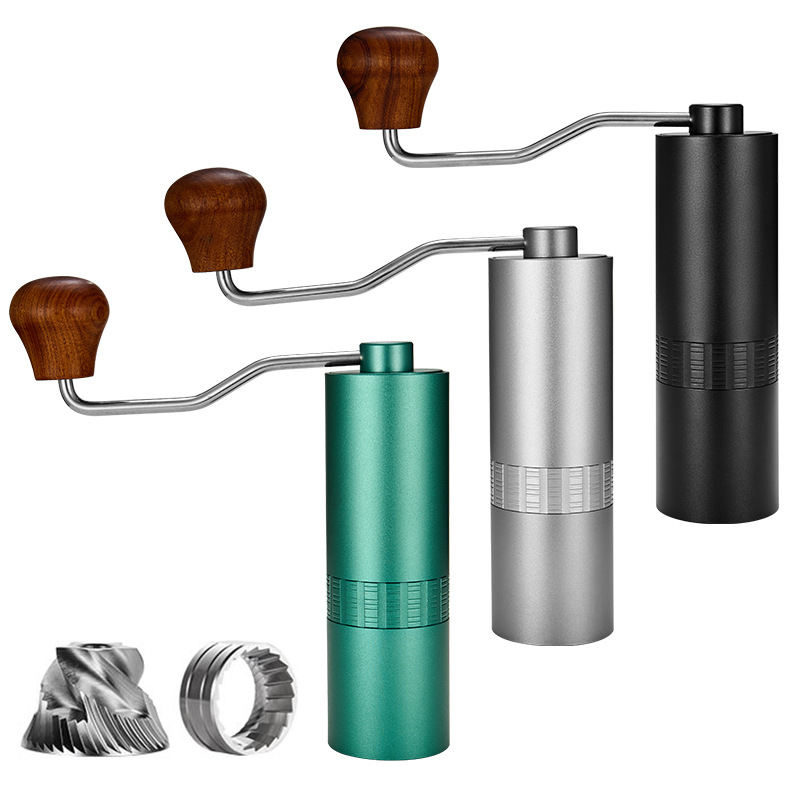
The Heart: Burrs Explained
The burr set is the most important component for grind quality. Cheap blade “grinders” simply smash beans into uneven pieces. Burr grinders use two abrasive surfaces to crush and cut beans into uniform sizes.
This uniformity is essential for balanced coffee extraction. The material, size, and shape of these burrs determine the grinder’s core capability and market position.
Burr material drives both cost and performance. The two main materials are ceramic and stainless steel.
Ceramic burrs transfer little heat and never rust. They’re made by casting ceramic slurry into molds and firing at high temperatures. This makes them relatively cheap to produce.
However, ceramic breaks easily. A dropped grinder or small stone in the beans can chip or shatter the burrs. Their edges are also less sharp than steel. This creates more “fines” (coffee dust), especially for fine grinds needed for espresso. This makes them perfect for entry-level markets where cost matters most.
Stainless steel burrs are standard for mid-range to professional grinders. They’re machined from hardened steel, creating incredibly sharp, precise cutting edges. This sharpness produces more uniform grinds with fewer fines. This is critical for clear pour-over coffee and precise espresso.
The material costs more. But the main cost increase comes from CNC (Computer Numerical Control) machining. This process takes more time and requires sophisticated equipment. Their durability is exceptional. They easily handle daily use for years.
Feature | Ceramic Burrs | Stainless Steel Burrs | Best For Market Segment |
Cost | Lower | Higher | Entry-Level |
Sharpness | Good | Excellent | Mid-Range to Pro |
Durability | Brittle | Very Durable | Mid-Range to Pro |
Heat Transfer | Low | Low-to-Moderate | All |
The Foundation: Body Materials
The grinder’s body is its skeleton. It determines weight, feel, durability, and aesthetic possibilities. Material choice directly reflects the product’s intended market position.
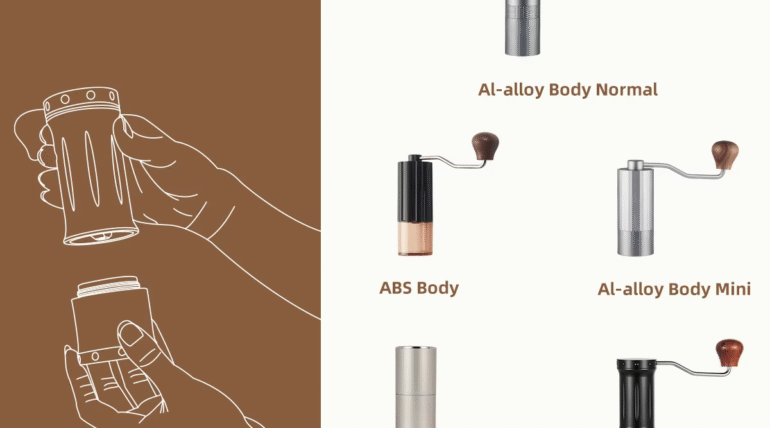
Aluminum alloy is most common for quality manual grinders. It balances lightweight design with strength and durability.
Critically, it works well with finishing processes like anodizing. This creates a hard, corrosion-resistant surface and allows many colors with a premium matte or satin feel. This combination of premium perception and manageable cost makes it versatile for mid-range products.
Stainless steel bodies represent a step up in perceived quality and cost. They’re much heavier, giving the product a substantial, indestructible feel that enthusiasts appreciate.
The classic polished or brushed look is timeless. However, raw material costs more. It’s also harder to machine than aluminum, increasing both material and production costs.
Wood and plastic accents are often used strategically. A wooden handle knob or lid can give an aluminum grinder a warmer, more natural look. This targets specific “Japandi” or rustic design trends.
Plastic components like the lid or grounds catch can significantly reduce overall cost and weight. This makes the product more accessible for entry-level markets.
The Engine: Axle and Bearings
Grind consistency isn’t just about burrs. It’s about how stably those burrs stay in place. The central axle turns the inner burr and must be perfectly straight. It must rotate without wobble. Any deviation creates “burr wobble.” This causes the gap between burrs to change during rotation, resulting in inconsistent grinds.
The gold standard for stability is a dual bearing system. One bearing sits at the top of the axle (near the handle). A second sits at the bottom (near the burrs). These two contact points prevent the axle from tilting under grinding pressure. This keeps burrs perfectly aligned.
This is a key quality indicator. It’s a major difference between cheap, sub-$30 grinders and quality grinders.
Entry-level models may use a single bearing or plastic bushings to save cost. But this inevitably leads to less consistency and lower user satisfaction. Highlighting a dual bearing system in your product marketing clearly signals quality to discerning customers.
The Interface: Handle Ergonomics
The handle is the user’s primary interaction point with the grinder. Its design directly impacts the “feel” and perceived effort of grinding. This is crucial for user experience.
Handle length determines leverage. A longer handle requires less force to turn. This makes grinding feel easier, especially for harder, light-roast beans.
The knob where users hold the handle also matters. Wooden knobs offer a classic, warm touch. Metal knobs can feel more robust and modern. The shape and size should be comfortable for extended grinding sessions.
Rotation smoothness, influenced by bearing quality, completes the experience. Smooth, effortless rotation feels premium. Gritty or difficult rotation feels cheap. These ergonomic details often separate 5-star reviews from 3-star reviews.
Matching Grinders to Markets
Turning technical specifications into a successful product line requires deep understanding of your target customer. Different market segments have vastly different expectations for performance, aesthetics, and price.
While many product reviews focus on brewing methods, B2B buyers must focus on market segments. This roadmap helps you choose a product configuration that resonates with customers and drives sales.
According to market analysis, global demand for high-quality home brewing equipment is expanding. A 2023 report from Grand View Research highlights specialty coffee market growth.
This directly fuels consumer interest in upgrading their gear. Your ability to serve these distinct consumer tiers is paramount.
Segment 1: Entry-Level Market
Customers in this segment are new to specialty coffee. They’re likely upgrading from a blade grinder or pre-ground coffee for the first time.
They’re highly price-sensitive and want tangible improvement without significant investment. They shop on large e-commerce platforms like Amazon, Shopee, and eBay. Reviews and price are their biggest purchasing factors.
For this market, grinder configuration must be ruthlessly optimized for cost while still delivering noticeable upgrades.
The recommended configuration starts with ceramic burrs or entry-level stainless steel to manage cost. The body should be primarily aluminum alloy. But incorporating quality plastic components like the lid or grounds container smartly hits lower price points.
For stability, a single bearing system or well-designed bushing system can provide “good enough” consistency. These users likely brew with French press or simple drip machines. Focus for this segment is visually appealing design, simple operation, and very attractive pricing.
Segment 2: Mid-Range Home Barista
This is the largest and fastest-growing segment. These customers are daily coffee drinkers who’ve moved beyond basics.
They use methods like Pour Over (V60, Kalita), AeroPress, or high-end French presses. They understand grind consistency importance, value durability, and will pay fair prices—typically $80-$150 retail—for products that perform well and last years.
For home baristas, performance and feel are non-negotiable.
Burrs must be high-quality, sharp stainless steel. This is the core feature they’re paying for. It directly impacts clarity and flavor of their daily brew. The body should be full aluminum alloy or stainless steel construction to convey durability and quality.
A dual bearing system is absolutely essential for this segment. It’s a key marketing point that signals this is serious equipment. Overall focus is achieving excellent grind consistency, long-term durability, and premium tactile experience.
Segment 3: The Prosumer Enthusiast
This is the market’s top tier. These customers are hobbyists and connoisseurs. They demand absolute precision, often for demanding brewing methods like espresso.
Espresso requires extremely fine and consistent grounds. They frequent forums like Reddit’s r/coffee, watch in-depth video reviews, and are highly critical of build quality and performance. They’ll pay premiums for the best.
To capture this market, the grinder must be a statement of engineering excellence.
Burrs should be large—48mm or more is common—and precision-machined from high-grade stainless steel.
Offering options like titanium-coated burrs for extended sharpness can be powerful upsells. The body should be CNC-machined unibody design, often from single aluminum alloy or stainless steel blocks. This ensures perfect alignment and rigidity.
Stability must be impeccable. Achieve this with high-quality, pre-loaded dual bearings and extremely tight manufacturing tolerances. Every design aspect should optimize performance.
Include features like minimal grind retention (coffee left in grinder) and stepless or micro-stepped adjustment mechanisms for dialing in perfect grinds. Focus here is ultimate precision, flawless build quality, and the best possible materials.
Sourcing and Supplier Vetting
Choosing the right product specifications is only half the battle. The other half is choosing the right manufacturing partner. Great designs can be ruined by poor execution.
This leads to inconsistent quality, high return rates, and brand damage. Reducing costly manufacturing mistakes and negative customer reviews starts with rigorous supplier vetting.
This section provides an insider’s guide to quality control and supplier assessment. It’s a checklist of critical questions and discussions. These empower you to gauge a manufacturer’s true capabilities and quality commitment.
Essential QC Checkpoints
When engaging potential suppliers, you need to move beyond surface-level questions. From our manufacturing experience, these are non-negotiable quality checks that form the basis of reliable partnerships.
Use this as a checklist for supplier conversations:
- Burr Alignment: Ask them to detail their process. How do they ensure burrs are perfectly centered and parallel in every unit? Do they use jigs? What’s their rejection rate for misaligned components?
- Part Tolerances: Vague terms like “high quality” aren’t enough. Ask for specific numbers. What are acceptable engineering tolerances (e.g., in millimeters or microns) for axle diameter, bearing fitment, and body concentricity? Tight tolerances directly indicate precision manufacturing.
- Material Certification: Can you provide material certification documents for stainless steel grade (e.g., 304, 420) or aluminum (e.g., 6061) used? This verifies you’re getting what you paid for, not cheaper, inferior alloys.
- Assembly Line Checks: What are specific quality checkpoints during and after assembly? Do they test rotation smoothness? Do they perform sample grind tests on certain percentages of units from each batch?
Assessing Manufacturer Capability
A factory’s ability to communicate clearly and transparently is as important as its machinery. Here are key questions to assess their professionalism and experience.
- “What is your experience manufacturing for North American or European markets?” This indicates familiarity with Western quality standards, safety regulations, and logistics.
- “Can you share non-confidential examples of your ODM/OEM work?” This lets you see past project quality and their capability with different materials and finishes.
- “What are your MOQ (Minimum Order Quantity), sample lead time, and bulk order lead time?” This provides basic business parameters needed to plan inventory and cash flow.
Be vigilant for red flags. Vague, evasive answers to technical questions are warning signs. Unwillingness to provide quality documentation or hesitation to produce paid samples suggests the supplier may not be reliable.
Choosing a Reliable Partner
True manufacturing partners do more than assemble parts. They act as consultants, providing valuable design feedback, suggesting material alternatives to meet cost targets, and offering “design for manufacturability” insights to improve quality and efficiency.
Reliable partners have robust internal processes. For instance, at Coffmach, our standard procedure includes rigorous burr alignment checks using specialized jigs and bearing tolerance tests on every batch.
This process commitment ensures consistency from the first unit to the ten-thousandth.
Models like our flagship Manual coffee grinder – coffmach serve as proven, reliable baselines already optimized for performance. They can be readily customized for your specific market needs.
Quality commitment is a core value. We believe in transparency and continuous improvement in manufacturing processes. You can learn more about our commitment to quality.
Understanding internationally recognized standards like quality management principles outlined by ISO 9001 can also provide useful frameworks for evaluating factory operational maturity.
Customization and Branding Options
In crowded markets, branding is everything. Customization transforms generic products into uniquely yours, reflecting your brand identity and commanding premiums.
The OEM (Original Equipment Manufacturer) and ODM (Original Design Manufacturer) process offers a spectrum of possibilities. Each has different implications for cost, lead time, and Minimum Order Quantity (MOQ).
Understanding customization levels is key to developing products that stand out on shelves and online.
Level 1: Simple Branding
This is the fastest and most cost-effective way to create private label products. It’s ideal for new brands or those testing markets. It typically involves applying your logo to existing product designs and has low MOQ.
Logo application is the most common request. Laser etching is popular. It uses lasers to permanently mark metal surfaces, resulting in sharp, clean, professional looks. Setup costs are low, making it suitable for smaller batches.
Screen printing is an alternative allowing color in your logo. However, setup costs are higher as it requires creating custom “screens” for each color. It may also be less durable than laser etching long-term.
Level 2: Aesthetic Customization
This level involves altering product appearance to create more distinct looks and feels. It requires higher MOQ because it involves manufacturing or finishing process changes for specific batches.
Color and finish are powerful tools. For aluminum bodies, anodizing is a premium finishing process.
It creates hard, durable surfaces and allows wide color ranges in beautiful matte or satin finishes. Powder coating offers even wider color and texture arrays but may be less durable than anodizing.
Material accents can also define product character. Swapping standard plastic handle knobs for walnut, oak, or bamboo ones can instantly elevate perceived value and target specific design aesthetics.
Level 3: Full ODM and Packaging
This is the highest customization level and involves significant time and resource investment. It’s best suited for established brands with high sales volumes.
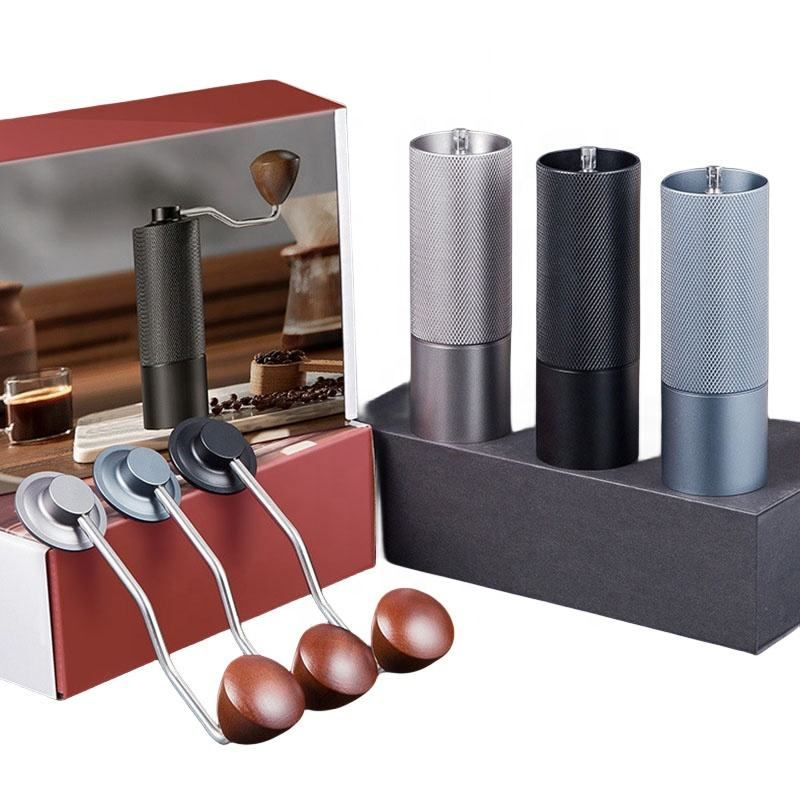
Packaging is critical for customer experience. Fully custom-designed retail boxes with your brand’s graphics, messaging, and instructions are essential for physical store products.
They greatly enhance unboxing experiences for e-commerce customers. You can find excellent inspiration for modern coffee product packaging on design platforms like Behance.
Structural changes (full ODM) involve modifying grinder physical design. This includes creating unique body shapes or developing new adjustment mechanisms.
This requires creating new molds or tooling, representing significant upfront NRE (Non-Recurring Engineering) costs and very high MOQ.
Customization | Typical MOQ Impact | Cost Impact | Best For |
Laser Etched Logo | Low | Low | Quick-to-market brands |
Custom Color (Anodizing) | Medium | Medium | Brands wanting unique identity |
Custom Packaging | Medium-High | Medium | Retail-focused brands |
Structural ODM | High | High | Established brands with large volume |
To begin exploring what’s possible for your brand, you can review our customization options and start conversations with our design and engineering team.
Grinder Costs and Profitability
Successful products are profitable ones. Understanding the full financial picture, from factory quotes to final retail prices, is essential for building sustainable businesses.
This section demystifies sourcing financial aspects, helping you calculate true costs and develop pricing strategies that ensure healthy profit margins.
Deconstructing Unit Cost
Factory-quoted prices, typically FOB (Free On Board) prices, are only the beginning of your total product cost. To accurately calculate profit margins, you must determine your Landed Cost—the total cost to get one unit from factory to your warehouse.
Here’s a breakdown of Landed Cost components:
- Unit Price (FOB): This is per-unit cost from the factory. It includes product manufacturing and packaging, delivered to designated departure ports.
- International Shipping: You have two main options: sea freight or air freight. Air freight is much faster (days vs. weeks) but significantly more expensive. Sea freight is far more cost-effective for bulk orders but requires longer lead times and more careful inventory planning.
- Tariffs & Duties: These are taxes your country’s government imposes on imported goods. Rates vary dramatically by product category and origin country. Research these costs using official government resources like the U.S. International Trade Commission’s tariff database to avoid unexpected expenses.
- Insurance & Local Logistics: This includes insuring goods during transit and ground transportation costs to move products from destination ports to your final warehouse or fulfillment center.
Understanding MOQ and Volume
MOQ, or Minimum Order Quantity, is the smallest order factories will accept. This covers their fixed costs for setting up production runs, including machine configuration, material sourcing, and labor allocation.
While MOQs can sometimes be negotiated, especially for sample runs, it’s fundamental to manufacturing business. Remember the power of volume.
Higher order volumes almost always result in lower per-unit prices. Factories benefit from economies of scale. When requesting quotes, always ask for pricing at several volume tiers to understand potential cost savings.
A Basic Pricing Model
Once you have final Landed Cost per unit, you can develop pricing strategy. A classic, simple starting point for wholesale and retail is Keystone pricing.
The basic formula is: Landed Cost x 2 = Wholesale Price. Then, Wholesale Price x 2 = Retail Price (MSRP).
This 2x markup at each stage aims to provide 50% gross margin for both wholesaler (your brand) and retailer. However, this is just a starting point. As explained in many expert guides on pricing strategies, your final price must be adjusted based on brand positioning, competitive landscape, perceived value, and marketing costs.
Premium products can often command higher margins. Products in competitive entry-level markets may require lower margins to gain market share.
Making Your Strategic Choice
You now have a comprehensive framework for how to choose a manual coffee grinder for your market. We’ve journeyed from microscopic details of burr sharpness to macroeconomic views of pricing strategy.
You understand how to analyze grinder core components, match features to specific target markets, rigorously vet manufacturing partners, and calculate true costs of bringing your product to life.
The right choice for your brand isn’t about finding the “best” grinder in isolation. It’s about making strategic decisions that carefully balance quality, features, and cost to fit your brand’s unique marketplace position. This informed approach minimizes risk and maximizes your potential for profitability and long-term success.
Ready to find the perfect manual coffee grinder solution for your business? Our team has expertise to guide you from product selection and customization to final delivery.
Contact our sourcing experts today to discuss your project and get a personalized quote.
As a professional manufacturer specializing in the research, development, and production of Coffee machine accessories, we not only offer a diverse product selection but also support OEM/ODM customization to meet the needs of diverse markets and customers. With consistent quality control, fast delivery, and innovative designs, our coffee machines are used by numerous brands and channels worldwide. Whether you're a distributor, wholesaler, or brand owner, we can provide you with reliable solutions to help you grow your business. Contact us to explore potential collaboration opportunities.
Facebook
Twitter
LinkedIn
WhatsApp
Categories: Uncategorized


