


05.12.2025
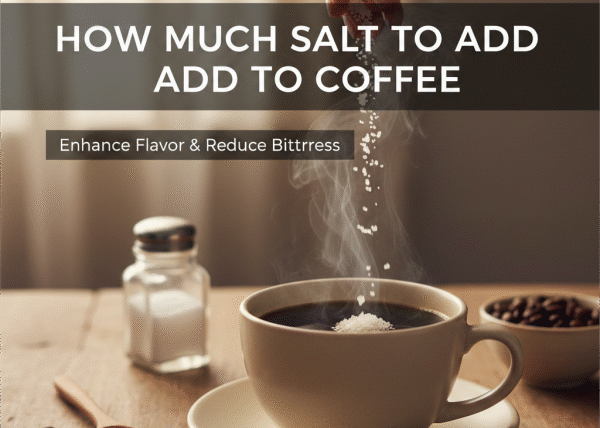
This guide will show you exactly how much salt to add to coffee for a better cup. If your morning brew tastes too bitter, there’s a surprisingly simple solution already in your kitchen.
For a standard 8-ounce cup of coffee, you only need a tiny pinch of fine-grain salt. We’re talking about roughly 1/16th to 1/8th of a teaspoon. This starting point neutralizes bitterness without making your coffee taste salty.
This isn’t just folklore. It’s a scientifically proven coffee salt trick. Salt naturally blocks bitterness—a principle chefs and food scientists have used for centuries to balance flavors.
In this complete guide, we’ll explore the science behind why this works. We’ll give you exact measurements and a step-by-step process to find your personal perfect ratio. We’ll also cover which salts and coffees work best for this technique. Plus, we’ll highlight common mistakes you must avoid.
Table of Contents
The Science of Sip
Understanding why adding salt to coffee works transforms a simple hack into a repeatable technique. The magic happens on your tongue at a microscopic level.
Blocking Bitter Receptors
Your tongue is covered in thousands of taste buds. Each one has receptors for the five basic tastes: sweet, sour, salty, bitter, and umami.
When you drink bitter coffee, compounds like chlorogenic acid lactones and phenylindanes bind to your bitter taste receptors. They send a “bitter!” signal to your brain.
Here’s where salt steps in. Sodium ions (Na+), the “salty” part of salt, have a unique ability. According to research in journals like Nature, these sodium ions can physically bind to and block those bitter taste receptors.
Think of it as a bouncer at a club. The sodium ion occupies the entrance to the bitter receptor. It prevents the bitter compounds from getting in. Your brain therefore receives a much weaker bitterness signal, or none at all.
The Magic of Enhancement
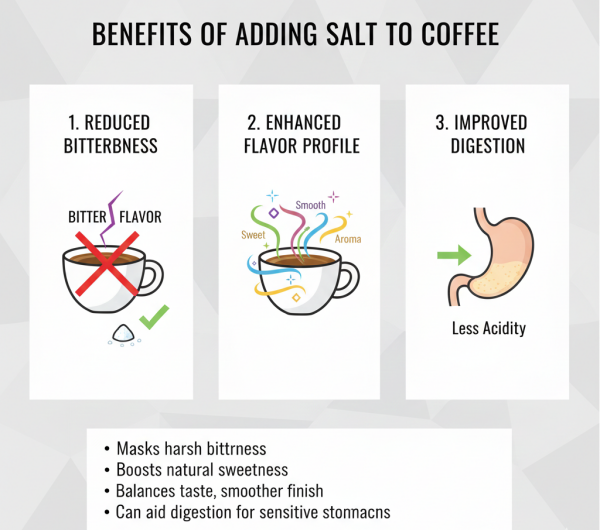
Salt doesn’t just subtract bitterness—it also adds dimension. By suppressing overwhelming bitter notes, salt allows other, more subtle flavors in the coffee to emerge.
This is a fundamental principle in culinary arts. Chefs add a pinch of salt to caramel to cut cloying sweetness and bring out deeper, toasted notes. They sprinkle it on watermelon to make the fruit taste even sweeter.
The same applies to coffee. When bitterness is muted, you can more easily perceive the natural sweetness, fruity acidity, or rich, umami-like notes of your coffee beans. This concept is well-documented by culinary authorities like Serious Eats, who explain how salt enhances sweetness.
The result? A more balanced, rounded, and complex cup of coffee. You’re not just masking a flaw—you’re revealing the coffee’s hidden potential.
The Golden Ratio
Finding the precise amount of salt for your brew is key. The goal is to reduce coffee bitterness, not create a savory beverage. This section provides the actionable numbers you need.
The “Pinch” Method
For your first attempt, the “pinch” method is most intuitive. A “pinch” is simply the amount of fine-grain salt you can pick up between your thumb and index finger.
It’s an imprecise measurement by design. But it forces you to start small. You can always add more, but you can’t take it away. This is your safest first step.
Precision Measuring
For those who prefer accuracy, we can translate the “pinch” into more concrete terms. A good universal starting ratio is approximately 0.15 grams of salt for a 12-ounce pot of coffee.
This small amount is often a scant 1/8 teaspoon. But even that can be too much for a single cup. It’s crucial to scale down appropriately.
For a single 8-ounce cup, you’re looking for an amount less than 1/16th of a teaspoon. It’s just a few dozen grains of salt.
To make this easier, here’s a clear reference table.
Coffee Volume | Recommended Starting Amount of Salt | Visual Cue |
6-8 oz Cup (180-240ml) | A tiny pinch / < 1/16 tsp | A few grains |
12 oz Mug (350ml) | A small pinch / ~1/16 tsp | A light dusting |
32 oz French Press (1L) | 1/8 to 1/4 tsp | A small mound |
The Warning Sign
The rule is simple: if you can taste the salt, you’ve added too much.
The effect should be subtle. The coffee should taste smoother, less harsh, and perhaps a little sweeter. It should not taste salty. If it does, halve the amount on your next attempt.
The "How-To" Masterclass
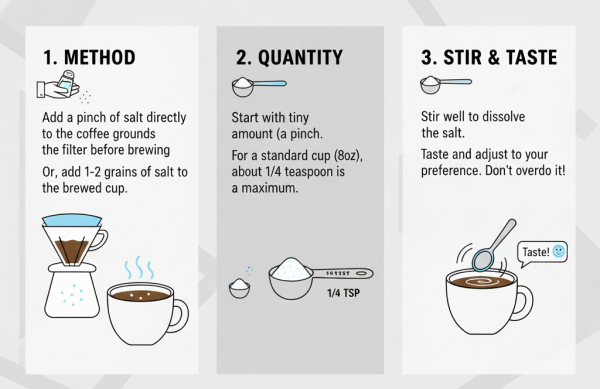
Knowing how much salt to add is only half the battle. Knowing how and when to add it ensures you get the best possible result every time.
Timing is Everything
You have two main options for when to introduce the salt: before you brew or after.
Adding salt to the coffee grounds before brewing is our recommended method. This works best for drip machines, French press, pour-over, and Aeropress. Sprinkling the salt over the grounds allows it to dissolve evenly as hot water passes through. It integrates seamlessly into the final brew. This method ensures consistent flavor distribution.
Alternatively, you can add salt directly to your cup of brewed coffee. This is great for fixing a single cup that turned out too bitter, like the pot at the office. It’s also useful when you’re first experimenting to find your ideal amount. The main drawback? It can be harder to dissolve the salt completely. This potentially leads to an uneven taste experience.
Choosing The Right Salt
Not all salts are created equal. Your choice can significantly impact the final taste of your coffee.
- Recommended: Fine Sea Salt or Pink Himalayan Salt. These salts dissolve cleanly and are typically free from additives. Their neutral mineral profile won’t interfere with your coffee’s delicate flavors.
- Avoid: Iodized Table Salt. The iodine added to this common salt can impart a distinct and unpleasant metallic or chemical off-taste to your coffee. It’s the number one mistake people make.
- Use with Caution: Coarse-grain salts, like some Kosher salts or sea salt flakes. While they are pure, their large crystals dissolve much more slowly. This can lead to inconsistent results. Some sips will be bland while others have overly salty pockets. If you must use them, grind them finer first.
For a deeper dive into the composition of different salts, geological resources can explain the mineral differences that affect taste, such as those from culinary science departments.
Which Coffees Benefit
While the salt trick can be applied to any coffee, some types benefit more dramatically than others.
Dark Roasts are prime candidates. The intense roasting process that creates those deep, smoky flavors also develops more bitter-tasting compounds. A touch of salt can smooth out the harsh edges of a French or Italian roast.
Robusta-heavy blends also respond well. Robusta beans are naturally higher in caffeine and bitter compounds compared to their Arabica counterparts. Salt is very effective at taming this inherent bitterness.
Over-extracted coffee is where salt truly becomes a rescue mission. If you’ve ground your beans too fine, used water that’s too hot, or let your brew steep for too long, you’ll get a punishingly bitter cup. Salt can make that cup drinkable.
Budget or instant coffee often possesses harsh, one-dimensional bitter flavors. Salt can significantly mellow these out. It makes a cheap cup of coffee much more palatable.
If your coffee is consistently bitter, salt is a great fix. But it’s also worth re-examining your brewing method. Our Ultimate Guide to Perfect French Press Coffee can help you troubleshoot and refine your technique from the ground up.
Salt as a Diagnostic Tool
Beyond being a simple hack, adding salt can become an expert diagnostic tool. If you find yourself needing salt every single morning, your coffee is trying to tell you something about your brewing process.
What “Needing” Salt Says
Think of recurring bitterness not as a flaw in the coffee, but as feedback. Using salt to fix it is fine. But understanding the root cause empowers you to make a perfect cup without any additions.
Let’s diagnose the potential culprits behind that persistent bitterness.
Potential Brewing Flaws
Your daily need for salt often points to one of four common brewing errors. Identifying and fixing these will elevate your coffee game permanently.
The problem could be your grind size. If your coffee grounds are too fine for your brewing method, the water extracts too much from them. This includes an excess of bitter compounds. This is called over-extraction. The solution is to adjust your grinder to a coarser setting. A quality burr grinder is essential for this level of control. Explore our reviews on Why a Burr Grinder is a Game-Changer to see how it can transform your brew.
Another issue might be your water temperature. Water that is too hot, typically above 205°F (96°C), can scald the coffee grounds. This violent extraction pulls out harsh, bitter flavors. The solution is simple: after your kettle boils, let it sit for 30 to 60 seconds before you pour.
Your brew time could also be the culprit. The longer water is in contact with the coffee grounds, the more compounds it extracts. A French press left to steep for ten minutes will be far more bitter than one steeped for four. The solution is to time your brews accurately and shorten them if they consistently taste bitter. For official brewing standards, resources from the Specialty Coffee Association (SCA) provide the gold standard for parameters like time and temperature.
Finally, the problem might be your beans. Very dark, oily roasts are inherently more bitter. Similarly, lower-quality or stale beans can have unpleasant, harsh flavors. The solution is to experiment. Try a medium roast from a local roaster or explore single-origin beans known for their smoother flavor profiles. The bean is the heart of the flavor. Learn how to pick the perfect bag in our guide to Choosing the Best Coffee Beans.
The Home Barista Experiment
The numbers and ratios in this guide are a fantastic starting point. But to truly master this technique, you must become a home barista scientist. This step-by-step experiment will help you calibrate the perfect amount of salt for your specific coffee and your unique palate.
We ran this exact test in our lab with a particularly bitter batch of dark-roast coffee. The difference between the control cup and the cup with the “recommended” dose was astonishing. The harsh, almost burnt edge was completely gone. It was replaced by a smooth, chocolatey note we hadn’t been able to taste before.
Gather Your Equipment
To run this experiment properly, you’ll need a few simple items:
- One large batch of freshly brewed coffee (use a consistent method you know well).
- Three or four identical mugs to ensure consistency.
- Fine sea salt (or another non-iodized fine-grain salt).
- A set of measuring spoons, specifically a 1/8 and 1/16 tsp if you have them.
- A glass of plain water for cleansing your palate between sips.
- A pen and paper to jot down your tasting notes.
The Calibration Method
Follow these steps precisely to conduct your taste test.
- Step 1: Brew Your Control. Brew your coffee and pour an equal amount into each of the three or four mugs. Leave Mug #1 completely plain, with no salt. This is your “control”—the baseline against which you will measure all changes.
- Step 2: The Tiny Pinch. In Mug #2, add the smallest possible amount of salt. We’re talking about just a few visible grains. Stir it thoroughly until it’s completely dissolved.
- Step 3: The Recommended Dose. In Mug #3, add what this guide recommends as a starting dose. For an 8-ounce cup, this would be a level 1/16th of a teaspoon. Again, stir until fully dissolved.
- Step 4 (Optional): The “Too Far” Dose. In Mug #4, intentionally add too much salt. Double the amount from Mug #3. The purpose of this cup isn’t for enjoyment, but for education. It will teach you what “too salty” tastes like. This helps you identify that threshold in the future.
How to Taste Like a Pro
Now, it’s time to taste your results. Approach this methodically.
First, take a sip of your control cup (Mug #1). Swirl it around your mouth. Pay close attention to the level of bitterness. Is it sharp on the sides of your tongue? Does it have a harsh aftertaste? This is your baseline.
Now, take a sip of water to cleanse your palate.
Next, move to Mug #2, the one with the tiniest pinch of salt. Take a sip. What has changed? Is the sharp edge of the bitterness gone? Does the coffee feel “softer” or “rounder” in your mouth? Can you detect any new flavors, perhaps a hint of sweetness or fruit that was hidden before?
Cleanse your palate again.
Move to Mug #3, with the recommended dose. Taste it carefully. Compare it to both Mug #1 and Mug #2. Is the improvement more dramatic? Is the coffee significantly smoother? Crucially, can you taste any saltiness?
Finally, after another palate cleanse, bravely taste Mug #4. The immediate salty flavor will be obvious. This confirms the upper limit.
By comparing these cups, you’ll discover which one you prefer. That specific amount of salt is your perfect ratio for that specific coffee. Repeat this experiment whenever you try a new type of bean to dial in the perfect flavor every time.
A Note of Caution
While adding salt to coffee is a fantastic technique, it’s important to be aware of common mistakes and potential health considerations. It’s a flavor enhancer, not a magic wand.
Common Mistakes to Avoid
To ensure you’re improving your coffee, not just changing it, steer clear of these pitfalls.
- Do not expect salt to rescue truly terrible coffee. If your beans are old, stale, or improperly stored, salt can only do so much. It can’t bring back flavors that are no longer there.
- Do not use salt as a permanent crutch to ignore bad brewing habits. If your coffee is always bitter, refer back to the “Diagnostic Tool” section and fix the root cause in your process.
- Do not add so much that your coffee becomes a savory broth. The goal is an imperceptible amount that works in the background. The moment you taste salt, you’ve gone too far.
Sodium and Your Health
It’s crucial to address the health aspect of adding sodium to your diet.
The amount of salt used in this technique is very small. A 1/8 teaspoon of salt contains approximately 290 milligrams of sodium.
For most people, this is a negligible amount. However, individuals on a strict low-sodium diet—often for managing high blood pressure or kidney disease—should be mindful of any added sodium, no matter how small.
According to health organizations like the U.S. Food & Drug Administration (FDA), the daily recommended limit for sodium is less than 2,300 milligrams per day. The pinch of salt in your coffee is a small fraction of this total. If you have health concerns, it’s always best to consult with your doctor.
Conclusion: A Pinch of Wisdom
You now have a complete guide on how much salt to add to coffee. This simple, scientifically-backed method is a powerful tool in any home barista’s arsenal.
We’ve shown that a tiny pinch of salt is a barista-approved technique to combat bitterness, reduce harshness, and unlock the natural sweetness hidden within your coffee beans. It transforms a good cup into a great one.
We’ve given you the starting ratios, the science, and the step-by-step process. But the key takeaway is that the real magic lies in experimentation. Use this guide not as a rigid rulebook, but as a map to begin your own journey of taste discovery.
Go forth and brew with new confidence. Your perfect, smooth, and delicious cup of coffee is just a pinch away.
As a professional manufacturer specializing in the research, development, and production of Coffee machine accessories, we not only offer a diverse product selection but also support OEM/ODM customization to meet the needs of diverse markets and customers. With consistent quality control, fast delivery, and innovative designs, our coffee machines are used by numerous brands and channels worldwide. Whether you're a distributor, wholesaler, or brand owner, we can provide you with reliable solutions to help you grow your business. Contact us to explore potential collaboration opportunities.

Facebook
Twitter
LinkedIn
X
Categories: Coffee/Brewing Tips Product Knowledge


