
Quick answer: handled is the safer default; handleless is a tested preference
For most beginners, shared coffee stations and high-volume cafés, a handled milk pitcher is the better default because it provides a repeatable orientation and normally keeps most fingers away from the hot body when used as intended. A handleless pitcher can be better for a barista who wants unrestricted rotation, a palm-style grip or a hand position closer to the vessel’s mass. It is not automatically more precise. Sleeve stability, grip diameter, heat protection, size, balance, spout alignment and milk texture still decide the result.
Key takeaways
- Choose handled for the lowest-risk start. It suits training, fast handoffs, mixed-skill teams and users who want one obvious grip reference.
- Choose handleless for a specific movement benefit. Direct body grip can support free rotation and a forward-tilted palm hold, but the benefit must appear in repeatable pours.
- Handleless does not mean bare metal. Many usable designs rely on a fitted silicone or insulated sleeve. Coverage, texture, thickness, retention and care matter.
- A handle does not force one hold. Loop, ribbon and open-ended handles can support pencil, throttle, fingertip and hybrid grips depending on the geometry.
- Neither format fixes the fundamentals. Wrong capacity, poor microfoam, off-center spout, unstable fill or unsuitable cup geometry can overwhelm a grip advantage.
- B2B buyers must specify the complete grip system. Use dimensions, material declarations, functional tests and a golden sample—not words such as ergonomic or non-slip alone.
| Decision factor | Handled pitcher | Handleless pitcher |
|---|---|---|
| Grip reference | Obvious and repeatable | User must index from sleeve, rim, logo or thumb position |
| Rotation freedom | Depends on handle opening and chosen hold | Unobstructed rotation around the body |
| Heat separation | Hand is usually farther from the hot wall | Depends directly on sleeve or insulated grip design |
| Shared-station use | Quick to identify, pick up and hand off | Works best when users understand the intended grip |
| Cleaning variables | Handle joints, welds, fasteners and crevices | Sleeve removal, hidden moisture, residue and fit |
| Storage width | Handle adds external width | Compact cylindrical profile |
| Best starting user | Beginner, busy café, shared equipment fleet | Experienced user with a verified palm/direct-grip preference |
| Main buying risk | Poor clearance, sharp edges, misalignment or weak attachment | Heat discomfort, sleeve slip, oversized grip or trapped residue |
Fast recommendation: if you are undecided, buy the handled version first. Move to handleless only when a matched A/B test shows better repeatability without new heat, sleeve-movement or cleaning problems.
Need handled, handleless or matched comparison samples?
Send Coffmach the capacity, spout, grip reference, finish, logo, packaging, quantity and target user so the sample set controls the variables that matter.
How the grip system changes orientation, balance and movement
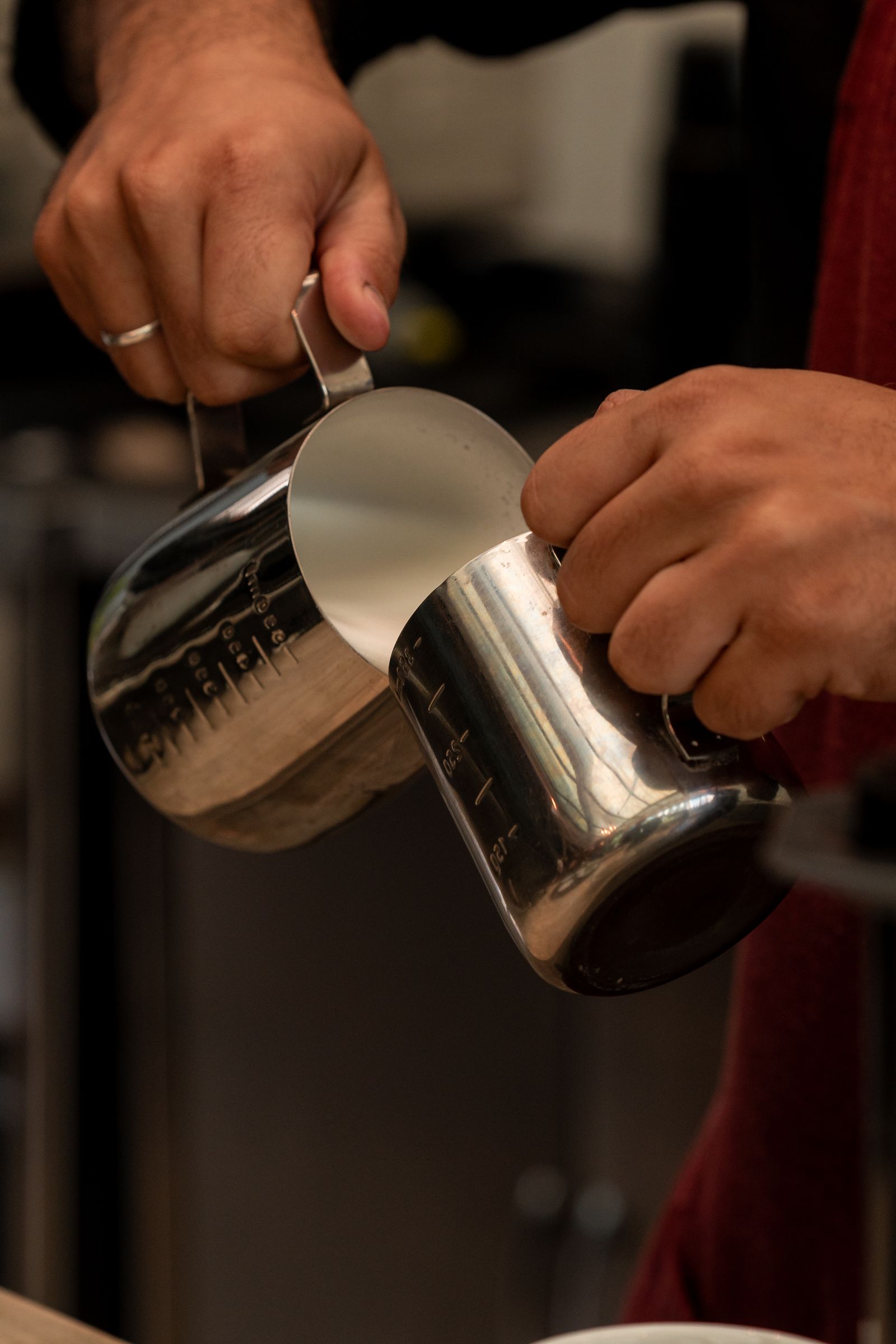
A handled pitcher has a loop, ribbon, tab or frame attached to the vessel. A handleless pitcher removes that projection so the hand grips the cylindrical or tapered body, normally through an insulated or high-friction zone. Commercial listings may call it handle-free, handless, palm-grip, sleeve-grip or competition style. These are descriptive names rather than common technical standards.

1. Indexing and repeatability
A handle acts like a tactile compass. Once the thumb, index finger and knuckles find a familiar location, the outlet tends to return to a familiar orientation. That can simplify a routine heart or tulip and helps a second barista identify how the pitcher is intended to be held. However, this benefit depends on the handle being aligned with the spout and comfortable for the user’s hand.
Handleless removes the fixed compass. That can feel free because the hand may start anywhere, but it also creates more possible start positions. Consistent users create a new index from the spout, rim, sleeve seam, logo or thumb location. If the hand shifts around the body between pours, the wrist path and effective spout angle can shift too.
2. Center of mass and perceived balance
A direct body grip places the hand closer to the mass of steel and milk. Some users experience this as compact or connected. A handle places part of the hand farther away and can provide leverage. Neither feeling proves accuracy. Balance depends on empty weight, normal milk fill, body taper, handle mass, grip point and the distance from the hand to the changing center of mass.
The balance also changes within one pour. The tool becomes lighter, the liquid level drops and the wrist angle steepens as the cup fills. A pitcher that feels neutral at pickup can feel nose-heavy during the final cut. Evaluate the complete movement from the high mixing stream to the low drawing phase and lift—not only an empty hold in a showroom.
3. Wrist rotation and drawing height
Handleless designs let the hand rotate around the body without a loop contacting the fingers. This can help a palm or cradle-style user reorient the vessel and tip the spout forward. Barista Hustle describes the palm grip as particularly effective with handleless pitchers and notes that its forward tilt can help the user approach drawing height.[4] The same source also stresses that the best grip is the one that permits relaxed, fluid motion rather than tension.
Handled designs can still offer substantial freedom. Pencil, throttle, fingertip and hybrid holds use different parts of the handle and body. An open ribbon may accept several styles, while a tight loop may restrict large hands. Fellow reports that diverse barista grip preferences led its Eddy team toward an open-ended ribbon handle rather than one prescribed hold.[3]
4. Heat feedback and protection
Direct contact can provide information about vessel position and temperature, but touch is not a calibrated thermometer and comfort thresholds vary. A sleeve may reduce heat transfer while also muting tactile feedback or increasing the grip diameter. A handle generally separates fingers from the wall, although a thumb placed on the metal can still receive temperature feedback.
Safety boundary: never assume that handled means heatproof or that handleless includes adequate insulation. Follow the exact manufacturer instructions. Subminimal, for example, publishes different compatibility guidance for the handled and handleless FlowTip variants and provides separate safety manuals.[1][2] That is a model-specific example, not permission to heat other pitchers directly.
5. Cup clearance and work-surface height
Clear white lines require the spout to approach the beverage surface. A palm grip may naturally tilt a handleless outlet forward. A bulky loop, tight finger position or high work surface can occasionally limit the preferred approach. Conversely, a well-spaced handle can keep knuckles away from the hot wall and cup rim while maintaining a stable angle.
The cup is part of the geometry. Rim diameter, wall angle, handle orientation, fill level and how far the cup can be tilted determine the available path. Test the pitcher with the cups used in service before attributing access entirely to the grip system.
When a handled milk pitcher is better
A handled pitcher is usually better when one tool must work for many people, when speed and predictable handoff matter, or when a learner is connecting spout position, wrist movement, cup angle and flow. The handle gives an obvious index and normally reduces the need to wrap fingers around the hot body.
Why handled works well
- Clear grip location for beginners and rotating staff.
- Useful reference for keeping an aligned spout on center.
- Less direct wall contact when the handle is used as designed.
- Fast pickup and handoff during service.
- Wide availability across capacities, spouts and finishes.
- No separate sleeve to lose, twist or reinstall.
What can go wrong
- Loop may be narrow, far from the body or wrong for the hand size.
- Edges, joints or welds can be uncomfortable or difficult to clean.
- Misaligned handle can teach an off-center wrist reference.
- Projection takes more rack and travel-kit width.
- Fixed geometry may obstruct a preferred palm hold.
- Attachment adds production and durability variables.
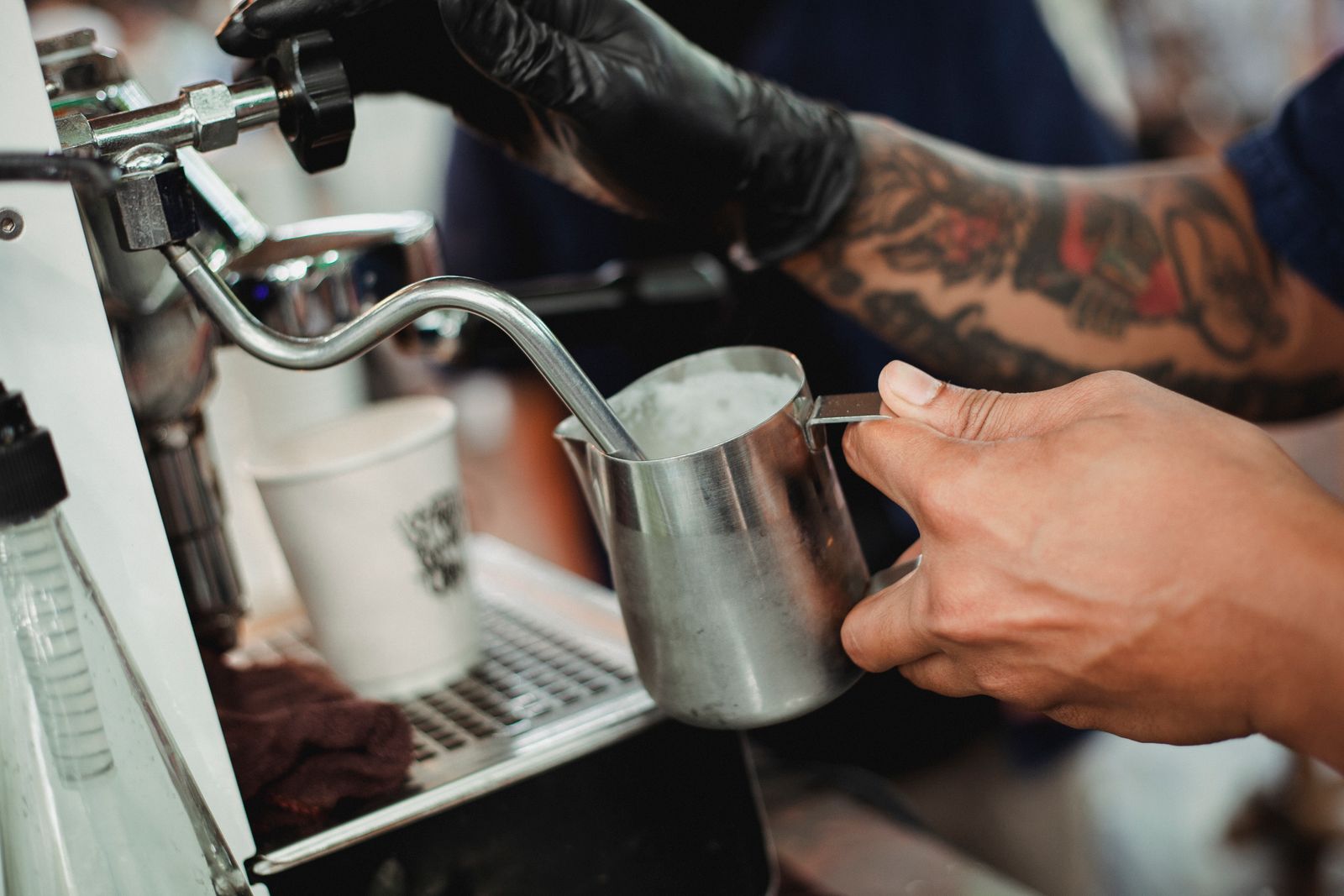
For a café fleet, the strongest handled design is not necessarily the largest loop. Check whether representative users can grip it without pinching, excessive stretch or sharp pressure points. Confirm that the attachment is robust, the handle centerline relates correctly to the spout, and wet hands can pick up the filled pitcher confidently. A well-designed open or ribbon handle may support both conventional and palm-adjacent holds.
When a handleless milk pitcher is better
Handleless becomes useful when the barista has stable milk technique and has identified a specific grip limitation. Direct body contact may support free rotation, a compact palm hold or a forward angle that makes drawing height easier to reach. It also creates a narrow external profile for a specialist station or travel kit.
Why handleless can help
- Hand can start at different positions around the body.
- No loop obstructs rotation or finger movement.
- Grip can sit closer to the vessel’s mass.
- Palm hold may tilt the outlet toward drawing height.
- Compact profile suits storage and transport.
- Replaceable sleeves may offer texture or color variants.
What can go wrong
- Sleeve may rotate, creep, stretch or become slick when wet.
- Insulation and coverage may be inadequate for normal use.
- Thick sleeve can mute feedback or enlarge grip diameter.
- Hidden milk, detergent or moisture can collect underneath.
- Removable part creates replacement and inventory needs.
- Freedom can reduce repeatability without a stable index.

For handleless products, evaluate the supplied surface rather than the category name. Sleeve thickness, hardness, internal ribs, coverage height, edge transitions, texture, dry/wet friction and retention determine whether the user can control the filled body. A secure new sleeve may behave differently after repeated washing or thermal cycling, so qualification should include the intended care method.
Do not improvise an unrelated sleeve on a hot steel vessel. Fit, material compatibility and heat exposure are product-specific. If a sleeve twists during a filled pour, stop using the unit until the cause is corrected. An unapproved adhesive can create cleaning, food-service and replacement problems rather than solving the design.
How to choose by user, drink and café workflow
Grip preference is personal, but the purchasing decision should still be systematic. Start with the primary user and service environment, then match capacity, normal fill, spout and body before comparing the grip. A 350 ml handleless sharp-spout pitcher and a 600 ml handled round-spout pitcher are not a fair grip test.
| User or setting | Recommended start | Why | What to verify |
|---|---|---|---|
| Home beginner | Handled, recipe-matched size | Clear orientation while learning milk, height and flow | Comfort, spout alignment and easy cleaning |
| Intermediate learner | Handled baseline plus matched handleless trial | Reveals whether direct grip actually improves the motion | Same body, spout, fill, cup and milk |
| Busy mixed-skill café | Standard handled fleet | Simple pickup, handoff, indexing and training | Handle durability, rack fit and wet-hand grip |
| Experienced latte-art station | User-tested handled or handleless | Specialist workflow can justify a personal grip | Repeatability across shift conditions |
| Training school | Matched comparison set | Students learn how grip changes movement without other variables | Same nominal capacity and outlet family |
| Retail distributor | Handled core SKU; handleless specialist SKU | Covers mainstream and preference-led demand | Instructions, returns, sleeve replacements and target buyer |
| Private-label brand | Define user before format | Prevents novelty from replacing a real value proposition | Representative-user test and golden sample |
Capacity and working fill come first
Capacity changes filled weight, milk depth, liquid head and the angle required before the stream begins. Too much milk can make either format tiring and slow to rotate. Too little milk can require a steep finish and expose separated foam. Use a size matched to the recipe before deciding whether the grip feels balanced. Coffmach’s milk-jug size guide provides the capacity context.
Spout alignment and microfoam can dominate the comparison
A comfortable grip cannot compensate for an outlet that points away from the body axis. Inspect the spout head-on, compare the handle or sleeve reference, and observe whether a water stream pulls sideways. Then run a milk test. Silky microfoam must leave the outlet as one integrated emulsion; dry foam can lodge at the tip, while rested milk can separate before the first line. Coffmach’s barista guide to using a milk frothing pitcher explains the complete steaming and pouring sequence.

Run a fair handled vs handleless A/B test
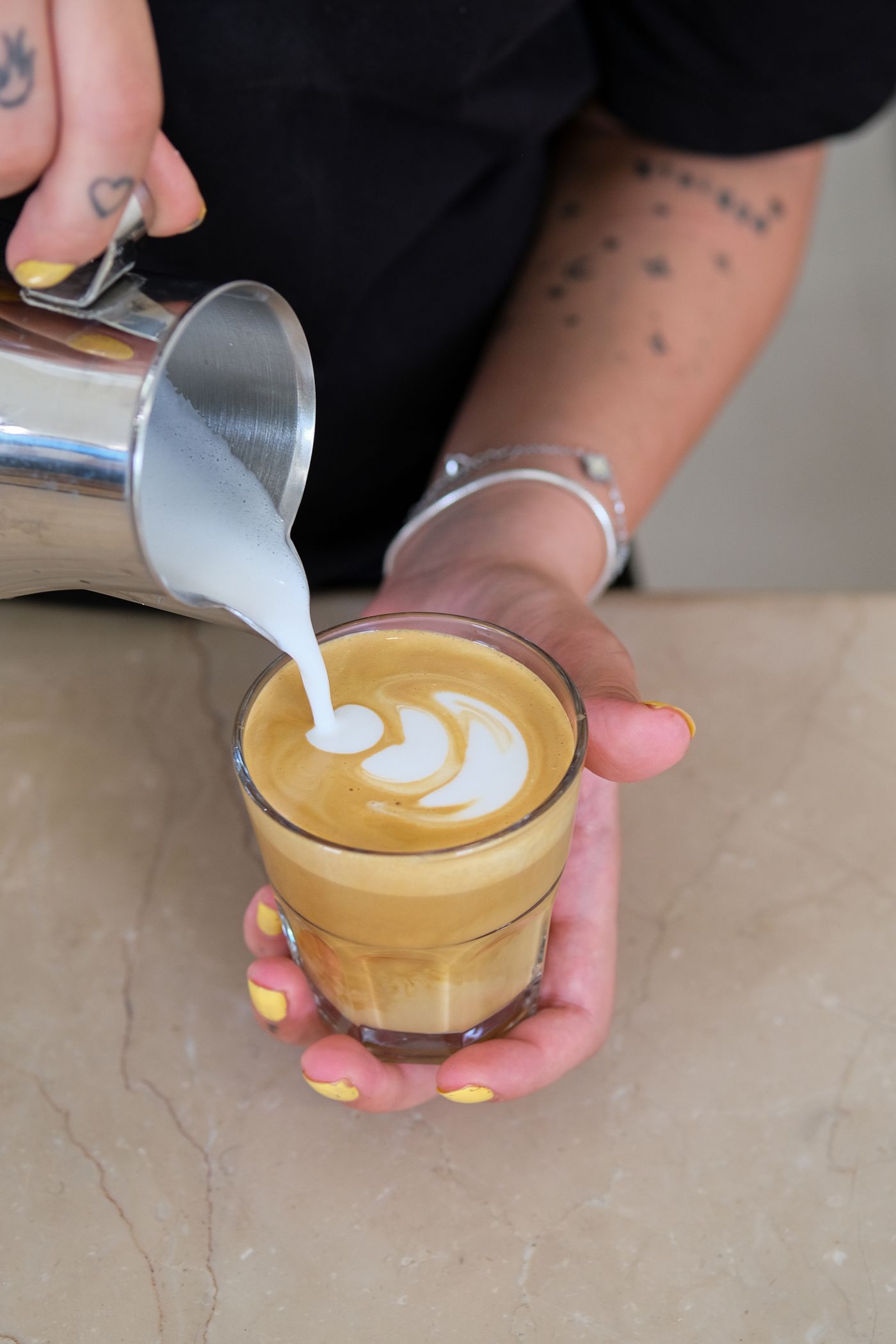
The best answer is local and repeatable. Use pitchers that match as closely as possible in nominal capacity, body, wall construction, outlet, finish and empty weight. If the available models differ, record every difference and keep the conclusion narrow.
- Match the tools. Select one handled and one handleless pitcher with the same nominal capacity and outlet family. Weigh them empty and note any body or finish difference.
- Fix the working fill. Dose the same cold milk by mass. Record the product, starting temperature, aeration, final endpoint, swirl and delay before pouring.
- Use one cup and base. Keep the espresso or practice liquid, cup model, fill target, steam wand and work-surface height constant.
- Start with a simple heart. It reveals centering, approach height, basic flow and clean stopping without a specialist pattern masking the grip issue.
- Add a layered pattern. A tulip or rosetta tests repeatable placement, rotation and control as the pitcher becomes lighter.
- Alternate order. Switch which pitcher is used first. Code tools or photos when possible so an observer scores the result rather than the brand.
- Record several pours. Score symmetry, contrast, placement, clean cut, leftover milk, sleeve movement, perceived heat, grip change and confidence.
- Repeat with representative users. For a café or retail SKU, judge group repeatability—not one expert’s best cup.
Decision rule: if handleless wins, it is the better tool for the tested user, milk, cup, pattern and workflow. The result does not prove that all handleless pitchers are superior or that every barista should switch.
Troubleshooting grip-related problems
| Symptom | Likely cause | Quick confirmation | Corrective action |
|---|---|---|---|
| Pattern rotates between pours | Changing body index or off-center handle | Mark thumb position and water-stream centerline | Standardize index or reject misaligned units |
| Hand shakes near the finish | Excess tension, poor balance or uncomfortable diameter | Reduce grip force; test matched empty and filled tools | Change grip point, size or handle geometry |
| Handleless sleeve rotates | Wet interface, stretch, contamination or poor fit | Clean/dry as instructed and mark sleeve position | Replace correct sleeve or reject retention failure |
| Handle feels too hot | Material, attachment or unapproved direct heating | Review exact instructions and normal-use temperature | Stop incompatible use; replace damaged component |
| Handle pinches fingers | Opening or clearance does not fit the user | Test representative hand sizes with working fill | Choose wider/open handle or adjust drawing |
| Residue under sleeve | Incomplete removal, drying or edge sealing | Inspect after the stated cleaning cycle | Clarify care method and redesign drainage/access |
| Grip is secure dry but slick in service | Water, milk or detergent changes friction | Run documented wet-hand and contamination checks | Change texture/material or add handling controls |
Cleaning, heat and safe use
Rinse promptly, wash according to the manufacturer’s instructions and inspect food-contact surfaces, edges, joints, coatings and grip parts. Do not publish one dishwasher claim for a whole category: a stainless body, coating, adhesive, sleeve, plastic handle and decorative part may have different limits.
For handleless pitchers, determine whether the sleeve should be removed for cleaning and drying. Inspect underneath for milk, detergent, moisture, discoloration, tears, stretching or lost friction. Reinstall it in the intended orientation and confirm it cannot rotate or creep during a normal filled pour. For handled pitchers, inspect attachment points, welds, fasteners, crevices, edge finish and movement. Stop using a pitcher with a loose, cracked, sharp, distorted or thermally damaged grip.
Decent Espresso’s latte-art guide advises a comfortable hold, avoiding the lower hot zone and gripping firmly without excessive tension.[5] That becomes a practical buying criterion: the grip system should let the intended user maintain control without forcing contact with an unsafe or uncomfortable area.
OEM and wholesale specification for handled and handleless pitchers
For an importer or private-label brand, handled versus handleless is a system-level choice. Translate the desired experience into dimensions, materials, approved samples and functional tests. Appearance approval alone cannot control balance, heat, grip stability, cleaning or alignment across a production lot.
Specify the complete handled pitcher
- Capacity, body dimensions, working fill, wall thickness and weight
- Handle type, opening height/width, band width and angle
- Distance from body, attachment coordinates and spout centerline
- Edge radius, knuckle clearance and thumb contact area
- Weld or fastening method and prohibited sharp points
- Project-defined load, cycle, impact, heat and corrosion checks
Specify the complete handleless pitcher
- Grip diameter and taper at the intended hand position
- Sleeve material declaration, thickness, hardness and texture
- Coverage, edge profile, color, odor and replacement availability
- Acceptance limits for rotation, axial creep, stretch and tearing
- Dry, wet, detergent and warm-use grip test conditions
- Installation, cleaning, drying and replacement instructions
Approve alignment and function
Retain a signed golden sample and dimensioned drawing. Check spout centerline, handle or sleeve reference, body symmetry, base flatness, lip finish, empty weight, filled balance and stream direction. A water test can screen gross misalignment, but a milk test is still needed because microfoam does not behave like water. Test every capacity and any finish that changes construction or grip.
| Characteristic | Suggested check | Project pass logic | Buyer reason |
|---|---|---|---|
| Centerline | Front-view fixture or image overlay | Within drawing tolerance | Prevents the grip reference from teaching a sideways pour |
| Handle geometry | Gauge opening, clearance, angle and attachment | Matches drawing and golden sample | Controls hand fit and balance |
| Handle integrity | Project-defined static/cyclic test and visual inspection | No looseness, cracking, sharp edge or distortion | Protects durability and normal handling |
| Sleeve fit | Rotation and axial-movement method on coded units | Movement stays within agreed limit | Protects direct-body control |
| Sleeve ageing | Agreed cleaning and thermal cycles, then repeat fit test | No unacceptable stretch, tear, odor or loss of grip | Finds problems that new-sample inspection misses |
| Functional pour | Defined fill, cup, milk, operator and scorecard | Meets repeatability criteria | Confirms the complete tool in intended use |
| Care and labeling | Instruction, artwork and packaging review | Matches approved compatibility and care claims | Reduces misuse and avoidable returns |
RFQ checklist
- Target customer, hand-size range, skill level, drink menu, usage volume and priority patterns.
- Handled, handleless or both; reference sample; capacity; cold-milk working range; body and outlet concept.
- Handle drawing or sleeve material specification, thermal boundaries, care instructions and replacement plan.
- Material, finish, color, measurement marks, logo method, artwork location and packaging.
- Golden-sample process, dimensional tolerances, cosmetic limits, functional test, defect definitions and reports.
- Order quantity, destination, compliance responsibilities, timeline, carton protection, spare parts and commercial terms.
Use Coffmach’s OEM and private-label coffee milk jug guide for the wider design-control, sampling, branding, inspection and packaging sequence. For café durability and fleet decisions, also see the commercial coffee milk jug buying guide.
Turn the preferred grip into a testable product specification
Send the reference sample or drawing, capacity, working fill, spout, grip geometry, thermal boundary, finish, branding, packaging, quantity and destination.
Handleless vs handled milk pitcher FAQ
Is a handleless milk pitcher better for latte art?
Not universally. It can help a barista who pours better with a direct palm grip, free rotation or a hand position closer to the body. It can also make indexing less obvious and increase dependence on sleeve fit and heat protection. Compare matched pitchers with the same milk, cup, fill and patterns.
Are handleless milk pitchers safe to hold when steaming?
Only when the specific product is designed and instructed for that use. A fitted sleeve or insulated zone may reduce heat transfer, but limits vary. Do not hold a bare hot metal body, improvise a sleeve or infer direct-heating compatibility from the category name.
Why do professional baristas use handleless pitchers?
Some prefer unrestricted rotation, a palm-style grip, close center-of-mass control or a forward pitcher angle for particular patterns. Other professionals use handled pitchers, including open ribbon designs. Professional use demonstrates a workflow preference rather than a universal performance hierarchy.
Is a handled milk pitcher better for beginners?
Usually, yes. The handle gives a clear orientation and normally limits direct wall contact when used correctly. Beginners can concentrate on microfoam, pouring height, flow and cup angle before testing grip freedom. Correct size and spout alignment still matter.
Can I hold a handled pitcher by the body?
Some baristas use hybrid or palm-adjacent holds, but direct contact depends on temperature and construction. Keep fingers away from uncomfortable hot zones and use only a hold that remains controlled. If body grip is essential, a purpose-designed handleless model with verified insulation is clearer.
Does a handle make latte art less precise?
No. A well-aligned handle can improve repeatability by providing a fixed index, and an open handle can support several holds. Precision depends on hand position, relaxation, spout geometry, body balance, milk texture, working fill, cup angle and practice.
How do I stop a silicone sleeve from slipping?
Use only the sleeve designed for the pitcher, install it according to instructions, keep mating surfaces clean and dry as specified, and replace stretched or damaged parts. If it rotates during a filled pour, stop using the tool until the cause is corrected. Do not add unapproved adhesive.
Which format is better for a busy café?
Handled is generally the safer default because it is intuitive to pick up, easy to orient and simpler to standardize across staff. A café can add handleless specialist tools after representative baristas test heat, sleeve stability, cleaning, rack layout, handoff and repeatability under service conditions.
What should an importer test on a handleless pitcher?
Test sleeve material, dimensions, fit, rotation, axial movement, dry/wet grip, behavior after agreed cleaning and thermal cycles, edge comfort, body diameter, spout alignment, filled balance and milk-pour performance. Define methods and limits rather than using only subjective terms such as non-slip.
Technical sources and image credits
- Subminimal — FlowTip Milk Jug. Official handled-versus-handleless example with published dimensions, weight, capacity, grip materials, care and variant-specific compatibility.
- FlowTip Handle Safety Manual and FlowTip Handleless Safety Manual. Model-specific safety and use instructions.
- Fellow — Perfecting Steamed Milk: The Making of Eddy. First-party development account covering user testing, personal grip preferences, ribbon-handle design, alignment, thickness and prototype iteration.
- Barista Hustle — Milk Pitcher Grips. Technical training reference on throttle, palm, pencil and other grips and how they change movement and drawing height.
- Decent Espresso — Everybody Latte Arts. Training resource covering comfortable grip, avoiding the hot lower body, relaxed holding and pouring posture.
- Coffmach — Coffee Milk Jug. Product and customization context for capacities, materials, marks, branding, finishes and packaging.
- Coffmach — What Size Milk Jug for 2 Coffees?. Capacity and working-fill context.
- Coffmach — How to Use a Milk Frothing Pitcher. Steaming and pouring technique context.
- Coffmach — Choose the Right Commercial Coffee Milk Jug. Café durability, fleet and purchasing context.
- Coffmach — OEM & Private Label Coffee Milk Jug. Sampling, branding, quality inspection and packaging framework.
- Each article image is credited beneath the photograph to its product owner or photographer. The page uses real pitchers and real pouring/steaming scenes; it contains no generated diagrams or product illustrations.