How Accurate Does an Electric Gooseneck Kettle Need to Be?
Short answer: most pour-over users do not need laboratory-grade thermometry. A well-tested kettle that repeatedly brings mixed bulk water to roughly ±1–2 °C of the intended setting near normal brewing temperatures, without a large hidden overshoot or wide hold swing, is usually enough. A 1-degree setting step is a resolution claim—not proof of ±1 °C accuracy.
How much accuracy is enough?
For everyday brewing, the useful target is not a pretty decimal on the screen. It is a kettle that lands in a predictable band, repeats that result, and does not overshoot after the ready signal. The ranges below are practical editorial benchmarks—not a universal kettle standard, an SCA kettle certification limit, or a legal tolerance.
| Use case | Useful target | What matters most | Buying implication |
|---|---|---|---|
| Home pour-over | About ±2 °C near the normal recipe setting | Repeatable readiness, modest overshoot, easy pouring | Choose measured stability over extra display digits |
| Recipe development | About ±1 °C under a defined test condition | Low bias, low trial-to-trial variation, known heat loss | Ask for a tolerance and test method, not just “1-degree control” |
| Cafe or training station | ±1–2 °C plus strong cycle-to-cycle repeatability | Recovery, hold behavior, cleaning, duty rating, service | Test the actual volume and electrical version used at the station |
| OEM / private label | Acceptance limit matched to the printed claim | Reference uncertainty, sampling, traceability, production transfer | Do not print “±1 °C accuracy” until the claim is substantiated |
A product can be repeatable but biased, or accurate at one fill and unstable at another. Always attach the condition to the number.
Best default: choose a kettle that is demonstrably repeatable around your usual 90–96 °C brewing settings. Pay for tighter verified performance when you are isolating recipe variables, training tasters, competing, or supporting an objective product claim—not merely because the screen shows more decimal places.
Temperature accuracy is not one number
Product pages often compress several different performance ideas into “precision.” The BIPM/JCGM VIM defines measurement accuracy as closeness of agreement with a true quantity value and notes that accuracy is qualitative, not a number to assign by itself. A useful kettle specification turns the marketing phrase into a defined measurand, error limit, and test condition.
Setpoint resolution
The smallest temperature change a user can request. A dial moving from 92 to 93 °C has 1 °C setting resolution; it does not tell you where the water lands.
Display resolution
The smallest change shown on screen. NIST warns that displayed digits do not establish actual measurement resolution.
Error or bias
Observed error is reference bulk-water temperature minus the target. A repeated −1.2 °C result is a bias, not evidence that the kettle is “precisely wrong.”
Repeatability
How closely the same unit agrees with itself under the same conditions. 92.0 °C every cycle can be repeatable but biased; 91–95 °C swings are poor repeatability.
Stability / hold band
How much temperature changes over time. A 93 °C average can hide a controller that cycles from 91 to 95 °C during hold mode.
Overshoot / settling
Overshoot is the peak above target; settling time is how long the water takes to enter and remain inside the acceptance band after readiness.
Specification rule: name the measurand every time: sensor indication, mixed bulk water, water at the spout, or water at the coffee bed. A tolerance without a location and time is incomplete.
The temperature chain from display to coffee
An electric gooseneck kettle is a small feedback-control system. The user selects a target; a sensor reports a local condition; the controller switches or modulates power; convection and heat loss move the water toward a bulk condition; then the spout, dripper, and coffee bed add new thermal losses.
Why a display and thermometer can disagree
A probe touching the wall can read a hot or cold local region. A probe in the middle can read a different point than the kettle sensor. A reading taken 45 seconds after the chime includes heat loss; a reading taken during active heating includes gradients. Control probe position, immersion depth, mixing, fill, lid state, and timing before declaring a fault.
For pour-over, the coffee-bed contact temperature is the most relevant brewing condition. The kettle can directly control only its own thermal system, so its specification should say which link in the chain was measured.
PID can help, but the acronym is not the result
On/off control and hysteresis
A simple controller turns the heater fully on below one threshold and fully off above another. The gap is hysteresis. Water keeps absorbing heat after power is removed, so the kettle may overshoot, cool, and restart. With well-matched thresholds, heater power, geometry, and sensor response, this architecture can still make a useful kettle.
PID and power modulation
A proportional–integral–derivative controller estimates correction from present error, accumulated error, and rate of change. Paired with responsive sensing and power modulation, it can reduce large relay swings. It cannot repair sensor bias, poor placement, delayed thermal response, weak mixing, or inconsistent production tuning.
Compare the measured behavior
- Maximum error at readiness and after settling
- Peak overshoot above the target
- Time to enter and remain inside the acceptance band
- Temperature range through a defined hold period
- Repeatability across identical cycles and permitted fills
- Recovery, switching life, noise, rated power, and workflow
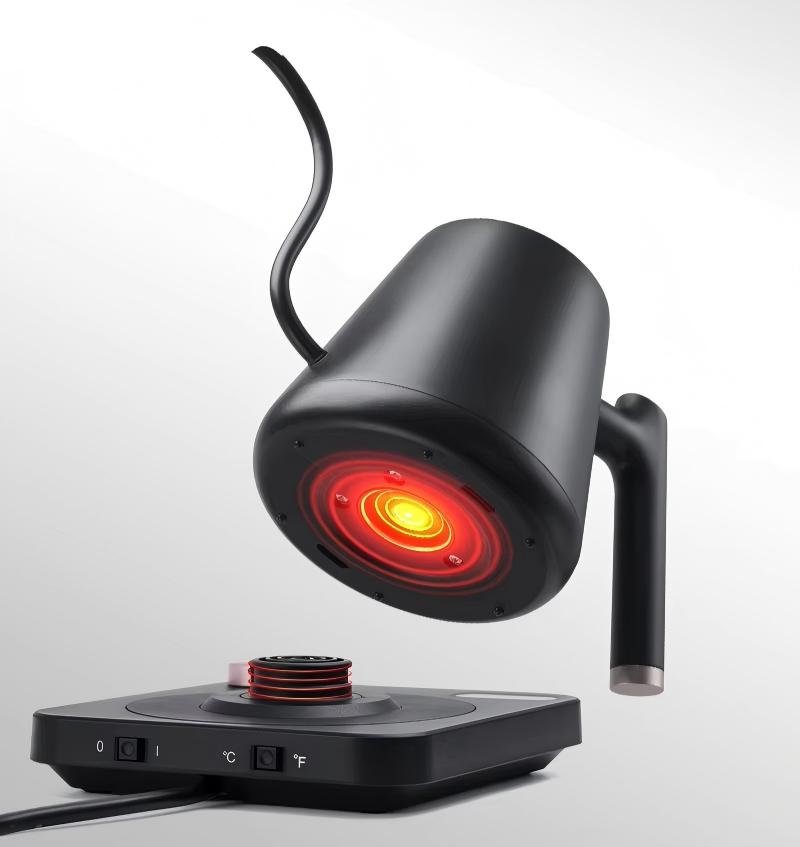
A configurable product platform can change capacity, finish, controls, power version, logo, and packaging. Confirm the exact electrical and control configuration before transferring a tolerance from one model to another.
How to check a kettle at home
A home check can reveal a large bias, unstable cycling, or a fill-dependent problem. It is not an accredited calibration or production-compliance test. Use a reference thermometer with documented error or uncertainty small enough to judge the band you care about; a probe with a 1-degree display cannot prove a 0.5-degree appliance error.
- Read both manuals.Confirm permitted fill, water-only use, hot-surface warnings, and the thermometer’s immersion instructions.
- Choose a representative condition.Use the volume and setpoint you normally brew with, such as 500–600 mL at 93 °C. Record starting water and room temperature.
- Position the probe consistently.Keep it in the water away from the heater, sensor cover, wall, and bottom. Avoid steam and splash exposure.
- Record a time series.Log display and reference at the ready signal, after a defined settling period, and several points during hold.
- Repeat at least three cycles.Then test a smaller permitted fill if small brews matter. Do not infer full-range performance from one convenient volume.
- Report the summaries.Calculate observed error, repeatability range, peak overshoot, and hold swing. Contact the manufacturer if behavior is unsafe or outside a published tolerance.
Simple calculations
Write the B2B specification before the claim
A private-label buyer needs a reproducible method before approving an accuracy statement. Agree it during sample development, repeat it on the golden sample, transfer it to production inspection, and use exactly the same definition in the report, manual, carton, website, and after-sales policy.
| Test item | Define it | Why it matters |
|---|---|---|
| Claim and measurand | Example: mixed bulk-water deviation from setpoint at the ready signal | Stops display resolution being sold as water accuracy |
| Electrical variant | Rated voltage, frequency, plug, heater power, supply variation | Heating rate and tuning can differ by market version |
| Water and fill | Minimum, normal, and maximum fill; starting temperature; water composition; lid state | Thermal mass, mixing, and scale potential change the result |
| Setpoints | Lower-use, coffee-range (for example 93 °C), and practical near-boil point | One successful point does not prove range performance |
| Environment | Ambient temperature, pressure/altitude, airflow, and stabilization | Makes samples comparable and prevents false near-boil failures |
| Reference system | Probe type, calibration status, uncertainty, immersion, position, acquisition interval | Determines whether the evidence can support the tolerance |
| Timing | Ready definition, settling period, hold duration, sample interval, pour delay | Captures overshoot and cycling instead of one convenient reading |
| Replicates and units | Cycles per unit, number of units, preconditioning, sequence | Separates repeatability from unit-to-unit production variation |
| Acceptance metrics | Maximum error, bias, repeatability, overshoot, hold swing, failure rule | Turns “stable temperature” into an auditable decision |
| Production control | Golden sample, fixture, sampling plan, records, rework, traceability | Keeps approved performance after pilot production |
Quick spec builder
Select a use case to generate a starting sentence for an RFQ or internal specification. It is a drafting aid, not a validated product claim.
Specify mixed bulk-water temperature at 93 °C and 600 mL: target ±2 °C, record ready signal, settling, hold swing, and three repeat cycles.
B2B buying rule: write the test method before writing the packaging claim. If supplier, laboratory, and buyer do not measure the same temperature at the same place and time, the tolerance is not yet a usable specification.
Common temperature problems
| Observed symptom | Likely mechanism | How to confirm | Practical response |
|---|---|---|---|
| Display reaches target but reference is low | Sensor bias, probe mismatch, reference error, or heat loss after readiness | Repeat with controlled probe location and timing | Use the model’s method; seek service if outside tolerance |
| Temperature keeps rising after the chime | Thermal inertia, aggressive tuning, premature ready logic | Log the peak for several minutes after readiness | Define settling time or reject overshoot beyond the limit |
| Hold mode swings widely | Broad hysteresis, relay cycling, small fill, poor tuning | Record high and low readings through a defined hold | Use a validated fill or a model with measured stability |
| Normal fill is accurate; small fill is not | Sensor coverage and heater-to-water ratio change with volume | Repeat at minimum, normal, and maximum permitted fills | Choose a model validated for small batches |
| Kettle will not reach 100 °C | Local boiling point, rated voltage, supply issue, or control fault | Check altitude, pressure, voltage, and vigorous boiling | Use an altitude feature; never force an impossible setpoint |
| Accuracy worsens after months | Scale, sensor-area deposits, base contact, or component drift | Descale per manual, then repeat the same test | Service or replace if maintenance does not restore behavior |
Safety and compliance are separate from accuracy
Temperature accuracy is a performance characteristic, not a substitute for appliance safety. IEC 60335-2-15:2024 covers electrical appliances for heating liquids for household and similar purposes and addresses hazards rather than promising a coffee-temperature tolerance. Confirm the applicable standard, certification route, intended duty, destination market, and exact model documentation with qualified laboratories.
An NTC sensor, PID label, memory function, or dry-boil feature does not prove a complete product. Coffmach’s gooseneck kettle page describes temperature-control and OEM/ODM product concepts; confirm the exact sensor, controller, power version, validated tolerance, food-contact documentation, and duty before publishing a claim.
Frequently asked questions
Is ±1 °C accuracy necessary for pour-over coffee?
Usually not. Most home users are well served by a kettle that repeatedly reaches within about ±1–2 °C of intended mixed bulk-water temperature and avoids large overshoot. A verified ±1 °C target is more valuable for recipe experiments, sensory training, competition routines, or product claims.
Does a 1-degree setting mean the kettle is accurate to 1 degree?
No. It describes the smallest user adjustment. Accuracy requires comparison with a suitable reference under defined conditions. Sensor bias, display rounding, thermal gradients, overshoot, or hold cycling can all exceed one degree.
Is ±1 °F the same as ±1 °C?
No. One degree Celsius equals 1.8 degrees Fahrenheit, so ±1 °F is the tighter band. A 1 °F setting step is about 0.56 °C; a 0.5 °F step is about 0.28 °C. Put the unit beside every tolerance.
Does PID guarantee better kettle accuracy?
No. Well-tuned PID can reduce overshoot and cycling, but it cannot correct an inaccurate sensor, poor placement, weak mixing, unsuitable heater, or inconsistent production tuning. Compare measured error, repeatability, overshoot, and hold stability.
Why does my thermometer disagree with the kettle display?
The two devices may measure different locations and times, and either can have error. Control immersion, avoid wall contact, use the same fill, define the reading time, and repeat the test. The reference needs documented error or uncertainty small enough to judge the kettle band.
Does altitude make an electric kettle less accurate?
Altitude mainly changes the local boiling point. At higher elevation, water boils below 100 °C, so a 100 °C target may be unreachable in an open kettle. Use local pressure or an altitude-corrected boiling point for near-boil testing.
How often should I verify kettle temperature?
There is no universal home interval. Verify when a new unit arrives if performance matters, after descaling, when brew behavior changes, after repair or impact, or on a defined quality schedule for cafes and B2B programs. Keep the method consistent.
Can I recalibrate a gooseneck kettle myself?
Only if the manufacturer provides a supported procedure for that exact model. Do not open the base or apply unofficial firmware adjustments; electrical risk and warranty consequences are possible.
What should a private-label brand print on its specification sheet?
Print the setpoint range and increment separately from a verified tolerance. If a tolerance is claimed, define measured location, fill, voltage, ambient conditions, ready/hold timing, reference method, and applicable models. Use identical wording in the lab report, golden-sample approval, manual, carton, website, and inspection plan.
Need a custom electric gooseneck kettle?
Send Coffmach the destination market, capacity, rated voltage, temperature range, accuracy or stability claim, hold behavior, control-panel requirements, order quantity, logo, packaging, and documentation needs. The team can prepare a model comparison and sample test plan before a claim is printed.
Technical sources
- BIPM/JCGM VIM 2.13 — Measurement accuracy: accuracy is closeness of agreement with a true value and is not assigned a numerical value by itself.
- NIST/SEMATECH — Measurement-system resolution: displayed digits do not establish actual resolution.
- NIST — Thermometer verification: boiling-point checks require elevation and barometric-pressure correction.
- Specialty Coffee Association — Certified Home Brewer requirements: 92–96 °C at the coffee-bed contact point for certified automatic brewers.
- Scientific Reports — Brew temperature, at fixed brew strength and extraction: compares 87, 90, and 93 °C while adjusting grind and brew time to hold strength and extraction.
- Scientific Reports — Impact of beverage temperature on consumer preferences: defines brew, post-brew, holding, post-pour, and tasting temperature; the study observed average post-brew temperature about 8 °C below brew temperature in its setup.
- Federal Trade Commission — Advertising substantiation: objective product claims need a reasonable basis before dissemination.
- IEC 60335-2-15:2024: safety scope for electrical appliances heating liquids for household and similar purposes.
- Coffmach — Gooseneck Kettle: current product/OEM-ODM context; exact tolerance, duty, and compliance documents require project confirmation.
Editorial note: ±1–2 °C is a practical buying benchmark derived from the supplied brief, not a universal standard. Model manuals, validated test methods, target-market regulations, and the exact quoted configuration remain controlling.