09.12.2025
Busy professionals need the best coffee milk jugs for cafes and coffee shops. The answer lies in durability, precision, and efficiency. Time equals money. The right tools become your most valuable assets behind the bar.
Every professional coffee environment needs two essential workhorses. A 12oz (350ml) jug and a 20oz (600ml) jug. Both should be made from high-quality, 304-grade stainless steel. They must have a well-defined, sharp spout for accurate pouring.
These specific choices are industry standards for good reasons. They reduce milk waste while increasing workflow speed. They provide essential tactile feedback during steaming. They withstand the demands of high-volume settings.
This guide will explain why these are the benchmark for professional coffee tools. We will explore material science, spout engineering, size optimization, and handle ergonomics. Our goal is to help you make smart purchasing decisions. The right choice enhances your coffee service, reduces costs, and improves your final product.
Table of Contents
Quick Comparison Table
We’ve summarized the primary jug types and their roles in commercial settings to streamline your decision-making. This isn’t a review of specific brands. It’s a strategic overview to help procurement managers and shop owners identify the right tools quickly.
Jug Type/Size | Primary Use Case | Key Benefit | Ideal For |
12oz / 350ml (Classic Stainless) | Single lattes, flat whites, cortados | Precision, minimal milk waste, excellent control | Quality-focused shops, detailed latte art, single-drink orders |
20oz / 600ml (Classic Stainless) | Two small drinks or one large drink | High efficiency during rush hours, versatility | All high-volume cafes, standard for most bar workflows |
Teflon-Coated Jug (All Sizes) | Dedicated milk types (e.g., alt-milks) | Faster cleaning, easy milk-level visibility (dark colors) | Shops prioritizing workflow speed and clear allergen separation |
Jug with Integrated Thermometer | Training new baristas, ensuring consistency | Removes guesswork, standardizes temperature for every drink | Chains, training centers, shops with less-experienced staff |
More Than a Container
A milk jug is not just a passive container. It’s an active tool that directly impacts your cafe’s profitability and quality. Many coffee businesses make the costly mistake of underestimating its importance. The right commercial milk frothing pitcher is an investment. It pays dividends in speed, waste reduction, and customer satisfaction.
Impact on Service Speed
Every second counts in a busy cafe. The difference between a well-designed jug and a poorly made one can be several seconds per drink. A jug with proper balance and an ergonomic handle allows baristas to move fluidly. They go from the espresso machine to the cup smoothly.
A precise spout enables confident, fast, and clean pours. No hesitation or messy drips. These saved seconds add up dramatically over a hundred-drink morning rush. They directly reduce customer wait times and prevent bottlenecks at the bar. For a deeper dive into optimizing your bar, resources from publications like Barista Magazine Online often discuss workflow and efficiency in great detail.
Controlling Milk Waste
Milk is a significant and fluctuating cost for any coffee shop. Using the wrong size jug is one of the most common sources of preventable waste. When a barista overfills a large jug for a small drink, the excess steamed milk almost always goes down the drain.
Consider this simple calculation. Your baristas waste just 50ml (about 1.7oz) of milk per drink due to using oversized jugs. Your cafe serves 200 milk-based drinks a day. That’s 10 liters of wasted milk daily. Over a year, that amounts to over 3,600 liters of milk. This represents thousands of dollars in lost profit. The best coffee milk jugs for cafes and coffee shops are sized correctly for your menu.
Ensuring Quality Consistency
Brand reputation is built on consistency. A customer who receives a perfectly textured flat white on Monday expects the same quality on Friday. This should happen regardless of which barista is on shift. A standardized set of professional jugs is a cornerstone of this consistency.
When every barista uses the same high-quality tools, it removes a significant variable from the drink-making process. They learn the specific heat transfer properties of the metal. They master the precise pouring dynamics of the spout. This shared equipment knowledge ensures that every latte, cappuccino, and flat white meets your quality standard.
Anatomy of a Jug
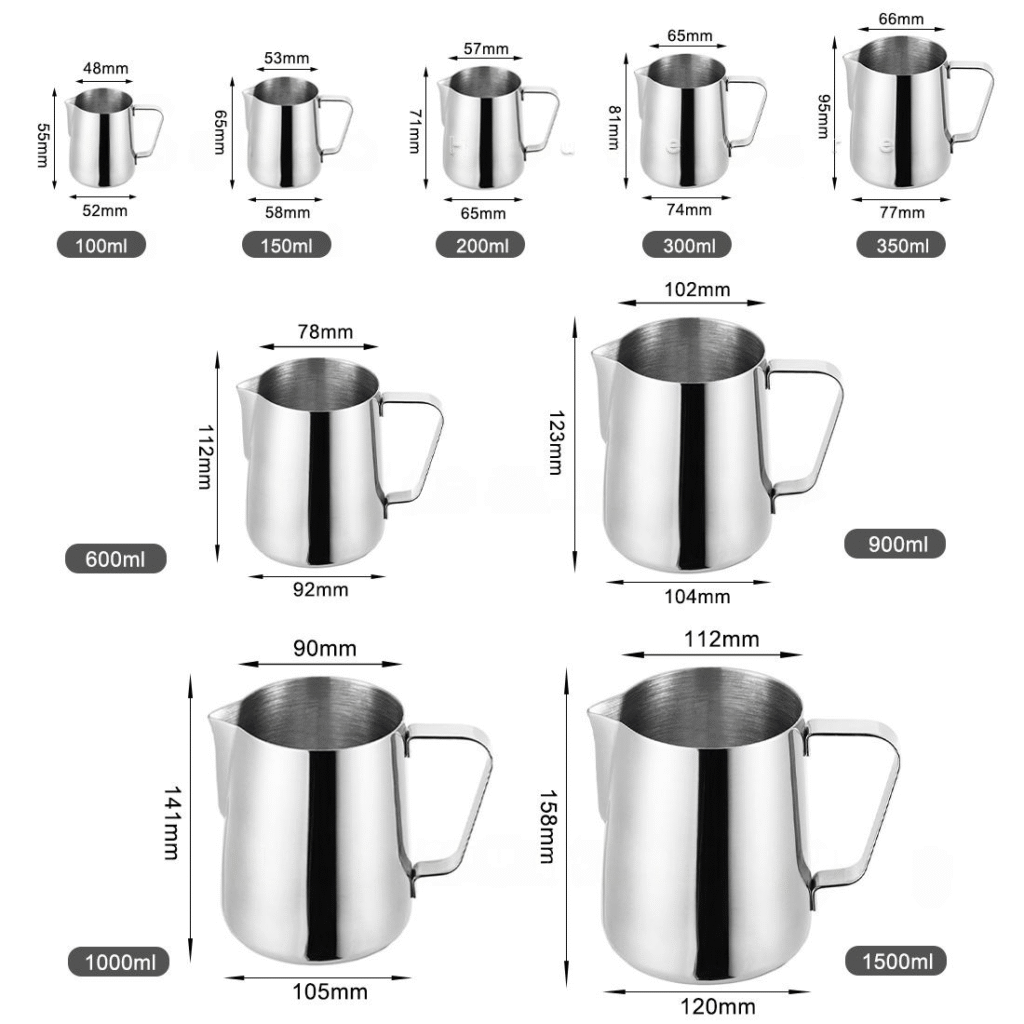
You must understand a milk jug’s components to choose the right one. Each element plays a functional role. This includes everything from the steel alloy to the handle weld. This buyer’s checklist will help you evaluate a pitcher like a seasoned professional.
Material Matters
The material of your milk jug is the most critical factor. It influences durability, hygiene, and the steaming process itself.
304-grade stainless steel is the undisputed industry standard for a stainless steel milk pitcher. There are good reasons for this. Also known as 18/8 steel (referring to its 18% chromium and 8% nickel content), this alloy is food-grade. It’s highly resistant to rust and corrosion. It’s exceptionally durable. Its key benefit for baristas is heat transfer. As the milk heats, the metal provides clear, immediate tactile feedback. This allows experienced baristas to gauge temperature by hand with remarkable accuracy. This ensures milk is never scalded and is consistently steamed to the perfect temperature.
Teflon and other coated jugs have gained popularity for their non-stick properties. The key advantage is speed of cleaning. Residual milk slides off easily with a quick rinse. Darker coatings also provide high contrast against white milk. This makes it easier to see the fill level. However, these coatings are the weak point. They can be scratched by metal thermometers or abrasive cleaning. They will eventually wear down, requiring jug replacement. They are an excellent choice for specific applications, like a dedicated pitcher for sticky alternative milk. But they may not be the best primary workhorse. When sourcing equipment, it is wise to see a range of high-quality coffee machine accessories to compare these options.
Size and Capacity
Matching the jug to your menu is a fundamental strategy for efficiency and waste reduction. Steaming the right amount of milk is key. You need enough milk to properly texture. But not so much that you’re pouring profit down the drain.
- 8-12oz (240-350ml): This is the specialist jug. It’s perfect for one small-to-medium sized drink like a cortado, flat white, or small latte. Using this size ensures minimal waste. It gives the barista a large canvas relative to the milk volume. This is ideal for pouring detailed latte art.
- 20oz (600ml): This is the versatile, all-purpose workhorse. Its capacity is ideal for making two smaller drinks (like two flat whites) at once. It’s also perfect for a single large latte or cappuccino. Nearly every high-volume cafe should have a deep inventory of this specific size.
- 32oz+ (1000ml+): The largest jugs are for batch production. They are less common for espresso-based drinks. But they’re invaluable for steaming large quantities of milk for hot chocolates, mochas, or chai lattes during a rush. They are not designed for precision pouring or latte art.
The Spout
The spout is where art and function meet. Its shape dictates the level of control a barista has over the pour. This directly impacts both latte art quality and service cleanliness. A poorly designed spout leads to drips, messy pours, and slower service.
We find that a sharp, defined spout offers pin-point control. This is often found on a latte art pitcher for professionals. It channels the milk into a fine, precise stream. This is essential for creating intricate designs like rosettas, swans, and tulips. The narrow exit gives the artist control over the finest lines.
Conversely, a wider, more rounded spout is more forgiving. It’s excellent for creating bold, high-contrast patterns like hearts and simple stacked tulips. This shape is often better for beginner baristas. It promotes a more integrated flow of milk. This makes it easier to set a good canvas before starting the design. The choice between them often comes down to the style of latte art your cafe wants to be known for.
Handle and Ergonomics
A barista may steam hundreds of pitchers in a single shift. Over time, the ergonomics of the handle become a significant factor in their comfort. This can even prevent repetitive strain injuries.
The handle must be securely attached to the body of the jug. This is typically done with spot-welding. A weak weld is a common failure point on cheap pitchers. The design of the handle matters too. Whether it’s an “open” C-shape or a “closed” complete loop is a matter of personal preference. But it must be comfortable to hold and provide a sense of balance when the jug is full. The weight of the jug itself is also important. A thicker-walled jug is more durable. But an excessively heavy one can cause fatigue.
Optimizing Cafe Workflow
The best coffee milk jugs for cafes and coffee shops are not used in isolation. They are part of a larger system. Implementing a “fleet” strategy for your jugs can dramatically improve your bar’s speed, safety, and organization.
The One-Jug-Per-Drink Rule
For the highest standards of quality and hygiene, use a fresh, clean jug for every single drink. Re-steaming milk or adding fresh milk to already-steamed milk is poor practice. It compromises the taste and texture of the final drink. It can introduce unwanted flavors.
When milk is steamed, its sugars break down and it becomes sweeter. Re-steaming this milk can scald it, creating a burnt taste. Furthermore, using a dirty jug can introduce old, sour milk into a fresh drink. Enforcing a strict one-jug-per-drink rule is non-negotiable for any professional cafe. This requires an adequate supply of clean jugs.
Color-Coding for Allergens
Cross-contamination with allergens is a serious health and safety concern. A robust system for managing different milk types is not just good practice. It’s a critical responsibility. Using color-coded jugs is the clearest and most effective way to manage this.
We strongly advise dedicating specific colored jugs for each milk type. You can also use colored silicone bands on the handles of standard jugs. For example: black for oat milk, blue for soy milk, and green for almond milk. Reserve standard stainless steel for dairy. This visual system makes it nearly impossible for a barista to accidentally grab the wrong jug during a high-pressure rush. This simple strategy builds immense trust with customers who have allergies or dietary preferences. This is a key topic covered by food safety authorities like the FDA on allergen management.
Establishing Workflow Zones
An organized bar is an efficient bar. We’ve seen cafes reduce their drink prep time by up to 20% simply by implementing a clear jug rotation system. This prevents chaos and keeps the bar moving smoothly.
Create a dedicated “clean” zone and a “dirty” zone. The clean zone should have stacks of ready-to-use jugs, sorted by size. The dirty zone should ideally be located next to a pitcher rinser and a dump sink. This is where used jugs are placed for cleaning. The barista’s motion should be a simple loop. Grab a clean jug, steam the milk, pour the drink, and immediately place the used jug in the dirty zone before starting the next order. This eliminates hesitation and clutter.
The Business Case

When sourcing equipment, it’s tempting to focus on the upfront price. However, for a tool used hundreds of times a day, the Total Cost of Ownership (TCO) is far more important. Investing in a quality commercial milk frothing pitcher is a strategic decision. It provides a clear return on investment.
Durability vs. Price
A cheap, thin-walled milk jug is a false economy. It will dent easily when dropped. A dent on the inside wall can disrupt the circular vortex needed to create silky microfoam. Thin handles can bend or break off entirely. You may find yourself replacing these cheap jugs two or three times a year.
A professional-grade jug made from thicker 304-grade stainless steel is built to withstand the commercial environment. It resists dents. Its handle is robustly welded. Its spout will maintain its shape. The cost of one high-quality jug that lasts for years is ultimately far lower than the recurring cost of replacing multiple inferior ones.
The Hidden Cost of Inconsistency
Cheap jugs often suffer from poor manufacturing quality control. You might buy a case of ten jugs from the same brand and find that each one has a slightly different spout shape. This inconsistency is a nightmare for baristas trying to maintain quality.
One day their pour is perfect. The next, it’s messy and uncontrolled. This can lead to poorly made drinks that need to be remade. This wastes time and milk while eroding barista confidence. A reputable supplier of professional coffee tools ensures that every jug they produce meets a precise specification. This guarantees that your team has a consistent and reliable tool every time. Discussions on the operational costs of running a cafe, as seen on platforms like Perfect Daily Grind, often highlight how small equipment inconsistencies can impact the bottom line.
Why Certifications Matter
When looking at coffee shop equipment suppliers, look for certifications. A certification like NSF (National Sanitation Foundation) is a powerful indicator of quality and safety. It shows a manufacturer’s commitment to excellence.
To earn an NSF certification, a product is rigorously tested for material safety. This ensures no harmful chemicals like lead can leach into the milk. It’s tested for design, ensuring it’s free of sharp edges or crevices that could harbor bacteria. It’s tested for cleanability. As you can verify on the NSF International official website, this third-party verification provides peace of mind. The product is safe for public food service.
Investing in professionally manufactured jugs is a strategic decision. For businesses looking for reliable, bulk, or even custom solutions, working with a specialized manufacturer is key. For instance, a supplier focused on high-quality accessories, such as the Coffee Milk Jug from Coffmach, ensures you receive products designed specifically for the rigors of a commercial environment.
Best Practices for Care
Proper maintenance protects your investment. It extends the life of your milk jugs and upholds the highest standards of hygiene in your cafe. A simple, consistent cleaning protocol is essential.
The Post-Drink Rinse
This is the most critical step and it is non-negotiable. Immediately after a drink is poured, the milk jug must be rinsed with cold water. Hot milk contains proteins (casein) and sugars (lactose). These will cook onto the hot metal surface if left to sit. This creates a stubborn film that is difficult to clean and can harbor bacteria. A blast from a pitcher rinser is the most efficient way to do this.
Deep Cleaning Protocol
A daily deep clean is necessary to remove any accumulated milk stone or oils. Use a dedicated dairy cleaning solution. This is formulated to break down milk proteins and fats effectively.
- DO: Use a soft cloth or a non-abrasive sponge for cleaning.
- DO: Soak the jugs daily or weekly in a solution of dairy cleaner and hot water. Follow the manufacturer’s instructions.
- DON’T: Use steel wool, abrasive powders, or harsh scouring pads. These will create micro-scratches on the steel surface, including inside the spout. These can become breeding grounds for bacteria and make the jug harder to clean over time.
- DON’T: Let milk sit in a jug for any extended period. Rinse immediately.
For guidance on the best cleaning agents, consult resources from leading manufacturers like Urnex, who specialize in coffee equipment cleaning solutions.
Inspecting for Damage
Incorporate a regular inspection into your cleaning routine. Check jugs for deep scratches, significant dents on the interior, or any signs of damage to the handle welds. A severely damaged jug is a hygiene risk. It can also affect the quality of milk texturing. It should be retired from service. For wholesale inquiries or questions about the best coffee milk jugs for your specific setup, get in touch with our team.
Conclusion
Selecting the right milk jug is more than a simple purchase. It’s an investment in the quality, speed, and professionalism of your coffee program. The best coffee milk jugs for cafes and coffee shops are not an expense. They’re a foundational tool for success.
To summarize, your strategy should be built on three pillars. First, choose the right material and sizes. 304-grade stainless steel jugs in 12oz and 20oz capacities are your non-negotiable foundation.
Second, focus on workflow. Implement a system using multiple, color-coded jugs to maximize efficiency. This ensures consistency and guarantees allergen safety.
Finally, invest for the long term. A high-quality, durable, and well-designed jug is a small price to pay for a better bottom line. It gives you a more confident team and a consistently excellent product that keeps your customers coming back.
As a professional manufacturer specializing in the research, development, and production of Coffee machine accessories, we not only offer a diverse product selection but also support OEM/ODM customization to meet the needs of diverse markets and customers. With consistent quality control, fast delivery, and innovative designs, our coffee machines are used by numerous brands and channels worldwide. Whether you're a distributor, wholesaler, or brand owner, we can provide you with reliable solutions to help you grow your business. Contact us to explore potential collaboration opportunities.