


09.10.2025
Many people think you need a thousand-dollar machine for cafe-quality results. This is wrong and expensive thinking.
The truth? A few smart, low-cost tools can transform your coffee’s flavor without emptying your wallet. This guide shows you exactly which items to buy.
We’ll focus on cheap coffee accessories that actually work. These will turn your daily brew from okay to amazing. Your journey to better coffee starts right here.
Table of Contents
Why Accessories Outweigh Machines
In coffee, we follow a simple rule: “Garbage In, Garbage Out.” Even the best machine can’t fix poorly prepared coffee.
Think about it this way. A professional oven can’t bake a great cake if you measure ingredients wrong or mix them poorly. Coffee works the same way.
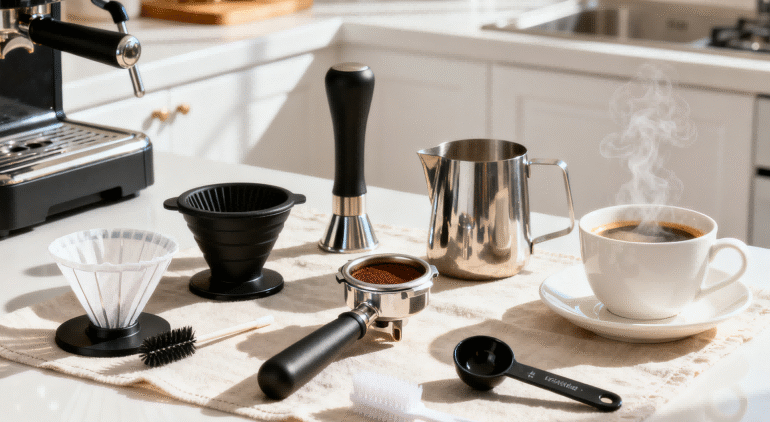
Your accessories control the most important brewing factors. These include grind consistency, dose accuracy, water distribution, and tamping pressure. Master these, and you’ll improve any espresso shot or pour-over.
The secret to repeating that “perfect cup” you sometimes make by accident is consistency. Accessories make consistency possible. While your machine matters, the tools you use with it unlock its true potential. These value coffee gear upgrades are the key.
Category 1: Non-Negotiable Essentials
This section covers your two most critical purchases. No matter how you brew, these accessories give you the biggest flavor improvement for your money. They are the true essential coffee accessories for beginners.
A Quality Burr Grinder
Your most important purchase is a quality burr grinder. This isn’t hype—it’s the foundation of good coffee.
Let’s explain the key difference. A blade grinder uses a spinning blade to chop beans like a propeller. This creates a mix of large chunks and fine powder.
A burr grinder uses two rough surfaces to crush beans into uniform pieces. You can adjust the distance between these surfaces to control the final size.
This uniformity changes everything. During brewing, water pulls flavor from coffee grounds. If you have dust and boulders, water will over-extract the dust, creating bitter flavors. At the same time, it will under-extract the boulders, creating sour notes. You get a muddled, unbalanced cup.
A consistent grind from a burr grinder ensures even extraction. Every particle releases its flavor at roughly the same rate. This creates a balanced, sweet cup that clearly shows the coffee’s characteristics.
Switching from pre-ground coffee or a blade grinder to a quality burr grinder is amazing. You’ll first notice the aroma—the smell from freshly ground beans is intense and incredible. The taste difference is dramatic.
For tight budgets, a high-quality manual ceramic burr grinder offers great value at $25-$50. If you can spend more, an entry-level electric conical burr grinder at $100-$150 is a fantastic long-term investment. This is the best budget coffee grinder category to start with.
- Consistent Grind Size: This leads to balanced and even extraction.
- Adjustable Settings: Lets you “dial in” your grind for any method, from coarse for French press to fine for espresso.
- Unlocks Flavor: Grinding just before brewing preserves delicate oils that disappear within minutes of grinding.
A Digital Scale with Timer
Your second must-have item is a digital coffee scale with timer. This tool brings science and repeatability to your brewing.
A common beginner mistake is measuring coffee with a scoop. Volume measurement is wildly inaccurate. A scoop of dark, oily roast weighs much less than a scoop of light, dense roast. This means your coffee-to-water ratio changes every time you open a new bag.
We’ve all experienced this. You brew a perfect cup one morning, then follow the same steps the next day and it tastes terrible. This frustration almost always comes from imprecise measurement. A simple coffee scale with timer, often just $20-$25, fixes this problem forever.
A scale lets you accurately measure two key variables: the weight of your coffee grounds (the “dose”) and the weight of brewing water (the “yield”). The relationship between these numbers is your brew ratio—the core recipe for any coffee.
For example, a common espresso ratio is 1:2. This means 18 grams of coffee grounds should produce 36 grams of liquid espresso. For pour-over, a common ratio is 1:16, or 20 grams of coffee to 320 grams of water. A scale makes hitting these targets easy.
The built-in timer is equally important. It lets you monitor total brew time or extraction time. For espresso, this shows how quickly water flows through the coffee puck. For pour-over, it helps you pace your pouring to hit your target time.
A scale gives you control over the four pillars of a coffee recipe:
- Dose: The exact amount of coffee you start with.
- Yield: The exact amount of brewed coffee you end with.
- Ratio: The precise relationship between coffee and water.
- Time: The total duration of the extraction process.
Category 2: Espresso Game-Changers
For home espresso lovers, a few affordable upgrades can dramatically improve your shots. These tools tackle the most common problems with puck preparation and extraction. They help you pull consistently delicious espresso.
A Proper Tamper
Most entry-level espresso machines include a flimsy, poorly fitting plastic tamper. It feels cheap because it is. Replacing it with a proper, weighted metal tamper is a small change with big impact.
Tamping isn’t about pressing down as hard as possible. The goal is creating a level and evenly compacted puck of coffee grounds inside the portafilter. This uniform density forces water to flow evenly through the entire coffee bed.
If your tamp is uneven, water will exploit the less dense areas. This is called “channeling.” It creates a shot that’s both sour (from under-extracted dense spots) and bitter (from over-extracted channels).
A quality tamper, typically stainless steel with a comfortable handle, gives you the feedback and stability needed for even pressure. The weight of the tamper does much of the work. Using one provides confidence and control that a plastic toy simply can’t.
Before buying, check your machine’s specifications. While 58mm is the commercial standard, many home machines use smaller sizes like 51mm or 54mm. A tamper that fits your basket precisely is essential.
The WDT Tool
The Weiss Distribution Technique (WDT) tool is a barista’s secret weapon. It’s become one of the most effective and cheap coffee accessories that work. It’s a simple device—often just a handle with several thin needles—used to break up coffee clumps.
When you grind coffee for espresso, it often comes out clumpy and unevenly distributed in the portafilter basket. Tamping these clumps creates hidden pockets of high and low density.
A WDT tool solves this problem. By stirring the grounds with needles, you break up every clump and evenly distribute the coffee particles. The visual change is striking: you turn a lumpy, uneven mess into a perfectly uniform, fluffy mound of coffee.
This simple action is the most effective way to prevent channeling. It ensures that when you tamp, you create a puck of uniform density. This is required for even extraction.
While you can buy professional WDT tools, DIY solutions work wonderfully too. This reinforces the budget-friendly theme. A wine cork with sanitized acupuncture needles or a 3D-printed tool can be just as effective. This is one of the best value coffee gear upgrades you can make.
The Bottomless Portafilter
A bottomless portafilter has had its bottom and spouts removed, exposing the underside of the filter basket. While it creates a beautiful visual of espresso extraction, its true purpose is diagnostic. It’s a window into your puck preparation quality.
The benefits become clear when you see what it reveals. It provides instant, clear feedback on your technique.
What to Look For | Problem Signs (and what they mean) |
A single, centered stream forming after a few seconds. | Spurting/Spraying: This is channeling in action. Water is bursting through a weak point in the puck. |
The stream looks thick, like warm honey. | “Bald Spots”: Areas on the basket where no coffee flows. This indicates poor distribution; the coffee is too dense in that spot. |
Even, dark color with “tiger striping.” | Fast-Flowing Blonde Streams: Can indicate a grind that’s too coarse, insufficient dose, or severe channeling. |
Using a bottomless portafilter for the first time can be messy and humbling. It will expose every flaw in your distribution and tamping. But by showing you exactly what’s wrong, it tells you exactly what to fix. It’s the fastest way to learn proper puck preparation and is invaluable for anyone serious about perfect espresso.
Category 3: Pour-Over Upgrades
For those who enjoy the ritual and clarity of pour-over or the convenience of drip coffee, a couple of smart upgrades can significantly elevate your brew. These focus on improving water delivery and removing unwanted flavors.
The Gooseneck Kettle
The difference between a standard kettle and a gooseneck kettle is all about control. A standard kettle dumps a large, turbulent stream of water, making precision impossible. A gooseneck kettle, with its long, thin spout, lets you pour a slow, steady, precise stream exactly where you want it.
This control is crucial for pour-over coffee essentials like the V60 or Chemex. Even extraction depends on evenly saturating all coffee grounds. A gooseneck kettle allows gentle, circular pours that saturate the coffee bed without disturbing it. This prevents channels from forming.
It gives you direct control over flow rate, which is key for managing total brew time. You can add water slowly to extend contact time or more quickly to shorten it, all while maintaining gentle application.
Affordable stovetop gooseneck kettles are widely available and offer all the precision you need. An electric version with variable temperature control is a fantastic but pricier upgrade. It lets you dial in exact water temperature for different beans. To understand where this fits into broader brewing, exploring various coffee brewing methods explained can provide valuable context.
Better Paper Filters
This simple upgrade is often overlooked. Not all paper filters are equal. Generic, mass-market filters from supermarkets are often thick, which can slow your brew and lead to over-extraction. Worse, they can add a woody or papery taste to your cup.
For best results, use filters designed by your brewing device’s manufacturer. For a Hario V60, use Hario filters. For a Kalita Wave, use Kalita filters. These are engineered with proper thickness and flow rate to work with the brewer’s design.
Whatever filter you use, here’s a crucial tip: always rinse the paper filter with hot water before adding coffee grounds. Place the filter in your dripper, put it over your mug or server, and pour enough hot water through to thoroughly wet the entire filter.
This does two things: it washes away any paper dust and flavor, and it preheats your brewing device and vessel. This simple step ensures the only thing you taste is the coffee itself.
Budget-Based Upgrade Paths
To make this guide practical, we’ve organized our recommendations into a tiered purchasing plan. This eliminates guesswork and provides a clear, step-by-step path based on your budget.
$50 Starter Pack
This tier gives you the biggest bang for your buck. It solves the most common beginner problems for the lowest cost.
- Priority 1: Digital Scale with Timer (~$20-$25)
- Priority 2: Quality Manual Burr Grinder OR an Espresso WDT Tool (~$25-$30)
The logic is simple. The scale introduces measurement and repeatability. For methods like French press or drip, the manual grinder provides consistent grind. For espresso users who already have a machine with pressurized basket, the WDT tool will improve shot consistency more than a new grinder at this price.
$150 Power-Up Pack
This is the true hobbyist’s foundation. It provides core tools needed for consistent, high-quality coffee with virtually any brew method.
- Priority 1: Entry-Level Electric Burr Grinder (~$100-$130)
- Priority 2: Digital Scale with Timer (~$20-$25)
This combination is transformative. An electric burr grinder offers convenience and quality. When paired with a scale, it gives you a complete, repeatable workflow. This is the definitive setup for anyone getting serious about coffee.
$200+ Espresso Pro Kit
This kit builds on the Power-Up Pack, adding specialized tools an espresso enthusiast needs for cafe-quality puck preparation and shot diagnostics.
- Foundation: The “$150 Power-Up” (Electric Burr Grinder + Scale)
- Add-on 1: Bottomless Portafilter (~$30-$50)
- Add-on 2: Quality Heavy Tamper (~$20-$40)
- Add-on 3: WDT Tool (~$10-$20)
This complete set gives you everything needed to diagnose and perfect espresso shots. You can distribute, tamp, and watch the results in real-time, making adjustments until you achieve perfect extraction. Remember, maintaining your gear is the most ‘affordable’ upgrade of all. Learning how to properly clean a coffee machine ensures it performs its best for years.
Accessories You Can Skip
Building trust means advising you not just on what to buy, but what to avoid. Your money is limited, and it’s better spent on high-impact items. Here are accessories you can probably skip, at least for now.
- Expensive Distribution Tools: A spinning or self-leveling distribution tool can cost over $150. A simple WDT tool for $15 achieves 95% of the same result—breaking up clumps and evening out grounds. Master the basics with a WDT tool first.
- Puck Screens (for beginners): A metal puck screen placed on top of your tamped coffee can help with thermal stability and keeps your machine’s group head cleaner. However, it’s a fine-tuning tool. If you haven’t solved channeling issues yet, a puck screen can mask problems rather than help solve them. Master distribution and tamping first.
- Temperature-Controlled Kettles (on tight budgets): While amazing for precision, these can be costly. A simple stovetop gooseneck kettle and thermometer (or just waiting 30-60 seconds after water boils) will get you into the ideal 195-205°F (90-96°C) range. This is more than good enough to start.
- Novelty Mugs or Cups: The vessel your coffee is in has zero impact on extraction quality. Focus on what goes inside the cup before focusing on the cup itself.
Instead of buying these lower-impact gadgets, your money is almost always better spent on higher quality, freshly roasted coffee. Exploring the best coffee beans for espresso or pour-over will impact your final cup far more than any accessories listed here.
Your Journey Starts Now
Your journey to truly exceptional coffee at home begins not with a new machine, but with a new philosophy. Control, consistency, and measurement are the pillars of great brewing.
The core message of this guide is to start with essentials. A quality burr grinder and digital scale are, without question, the most important affordable coffee machine accessories worth buying. They are the foundation upon which all other skills are built.
Remember that skill, practice, and the right foundational tools will always outperform an expensive, automated machine paired with poor technique and inconsistent preparation.
As a professional manufacturer specializing in the research, development, and production of coffee machines, we not only offer a diverse product selection but also support OEM/ODM customization to meet the needs of diverse markets and customers. With consistent quality control, fast delivery, and innovative designs, our coffee machines are used by numerous brands and channels worldwide. Whether you're a distributor, wholesaler, or brand owner, we can provide you with reliable solutions to help you grow your business. Contact us to explore potential collaboration opportunities.
Facebook
WhatsApp
Twitter
LinkedIn
Categories: Buying/Customization Guide Product Knowledge Uncategorized


