ESPRESSO TOOLS · TAMPER COMPARISON · BUYING GUIDE
8 Espresso Tamper Types Compared for Even, Firm Pucks
A practical, transparent comparison of eight tamper architectures—what each mechanism actually controls, where it fits in a coffee workflow, and how to choose a tool that matches the basket rather than a marketing pressure number.
Quick answer: the best tamper is the one that fits and repeats
Do not choose from the highest advertised pressure. First confirm basket fit, clean entry, usable travel at the normal dose and comfortable handling. Then select the mechanism that removes the most relevant source of variation—tilt, unclear stopping point, repetitive strain or multi-user inconsistency.
- Basket fit and level entry matter more than a large pressure number.
- Self-leveling controls angle; spring-loaded or calibrated describes feedback or force behavior. They are not the same feature.
- Distribution happens before tamping. A flat-looking puck does not prove even density underneath.
- Automatic tampers can improve a high-volume workflow, but require compatibility, counter-space and service checks.
- A dry spent puck is not a reliable score for a tamper; compare controlled extractions instead.
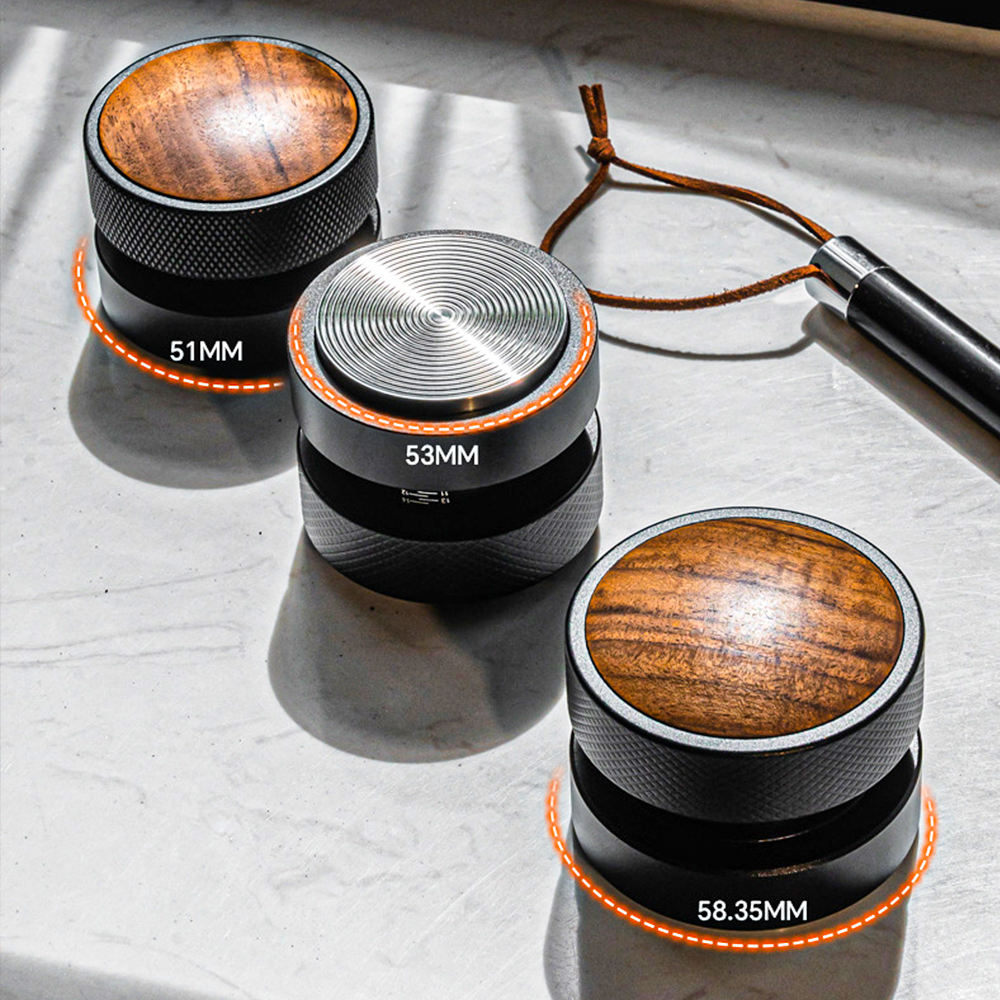
- For wholesale, qualify the tamper with the named basket families—not only a nominal 51mm, 53mm or 58mm label.
| Use case | Best starting architecture | Why | Check before buying |
|---|---|---|---|
| Most home users | Self-leveling + spring/stop | Helps control angle and gives a repeatable routine | Base fit and enough travel at the normal dose |
| Experienced single user | Precision-fit manual | Direct feedback, easy cleaning and few wear parts | Handle comfort and safe edge clearance |
| Beginner or shared station | Self-leveling collar | Reduces the most visible preparation error: tilt | Whether the guide references the basket rim evenly |
| Busy multi-user café | Automatic tamper | Fast, programmed cycle with reduced repetitive pressing | Portafilter compatibility, cleaning, space and service plan |
| Tight budget | Solid classic manual | Strong results are possible without a moving mechanism | Correct base diameter—not handle weight alone |
What “compared” means in this guide
This is a design-and-workflow comparison of eight common tamper architectures. It does not present eight named retail products as laboratory-tested winners. Individual products can combine several functions or perform differently because their base diameter, basket, mechanism, recipe and manufacturing tolerances differ.
Each architecture is assessed with the same seven practical questions: Does it fit the basket? Does it help the base stay level? Does it create a useful completion cue? Can it reach the normal dose? Is it comfortable during repeated use? Is it fast and clean? Can it be inspected, cleaned and supported?
Even
The tamped surface is level relative to the basket and the coffee was distributed as uniformly as practical before compression.
Firm
The loose bed has become a stable compact puck. More normal hand force produces little useful change, so repeatedly pushing harder is not a quality target.
Repeatable
The tool and routine make it easier for the same operator—or several operators—to produce similar preparation without hiding unresolved grind or distribution issues.
Eight espresso tamper types compared
The labels below describe typical mechanisms, not a universal product hierarchy. For example, a spring-loaded tamper can also be self-leveling, while another spring only returns the handle. Confirm the actual construction before treating category language as a specification.
| Tamper architecture | Level help | Completion cue | Maintenance | Best fit |
|---|---|---|---|---|
| 1. Lightweight stock tamper | Low | None | Easy | Temporary starter tool |
| 2. Classic flat-base manual | Technique-led | User feel | Easy | Simple value upgrade |
| 3. Precision-fit manual | Technique-led | User feel | Easy | Experienced single user |
| 4. Self-leveling collar | High | Varies | Easy–medium | Beginner and shared station |
| 5. Spring-loaded / calibrated | Varies | Medium–high | Medium | Repeatable home routine |
| 6. Impact / force-release | Medium–high | High | Medium | Clear finish signal |
| 7. Palm / depth-limited | High | Depth-led | Easy–medium | Compact low-profile use |
| 8. Automatic coffee tamper | High | High | Service-led | High-volume café |
1. Lightweight stock tamper: a useful baseline
A small plastic or lightweight accessory tamper can compress coffee, but it is often undersized, shallow or awkward to hold. Its issue is rarely low mass alone. A wide edge gap and small grip make a straight, stable press harder to repeat. Use it to learn the basic motion, then replace it once the grinder and basket are understood.
2. Classic flat-base manual tamper: best budget design
A handle fixed directly to a flat metal base offers direct feedback, quick cleaning and few failure points. A well-fitted manual tamper can prepare an excellent puck. The trade-off is that the user controls the angle and stopping point every time. It remains a strong value choice when the base fits the basket and the handle supports a neutral wrist.
3. Precision-fit manual tamper: best simple upgrade
This is the classic format with a base selected more closely for a named basket. Better wall coverage can reduce the untamped edge ring, but bigger is not automatically better. Baskets taper, coatings and tolerances vary, and an overly close base can scrape, bind, trap grounds or lift the puck on withdrawal.
4. Self-leveling collar tamper: best for angle control
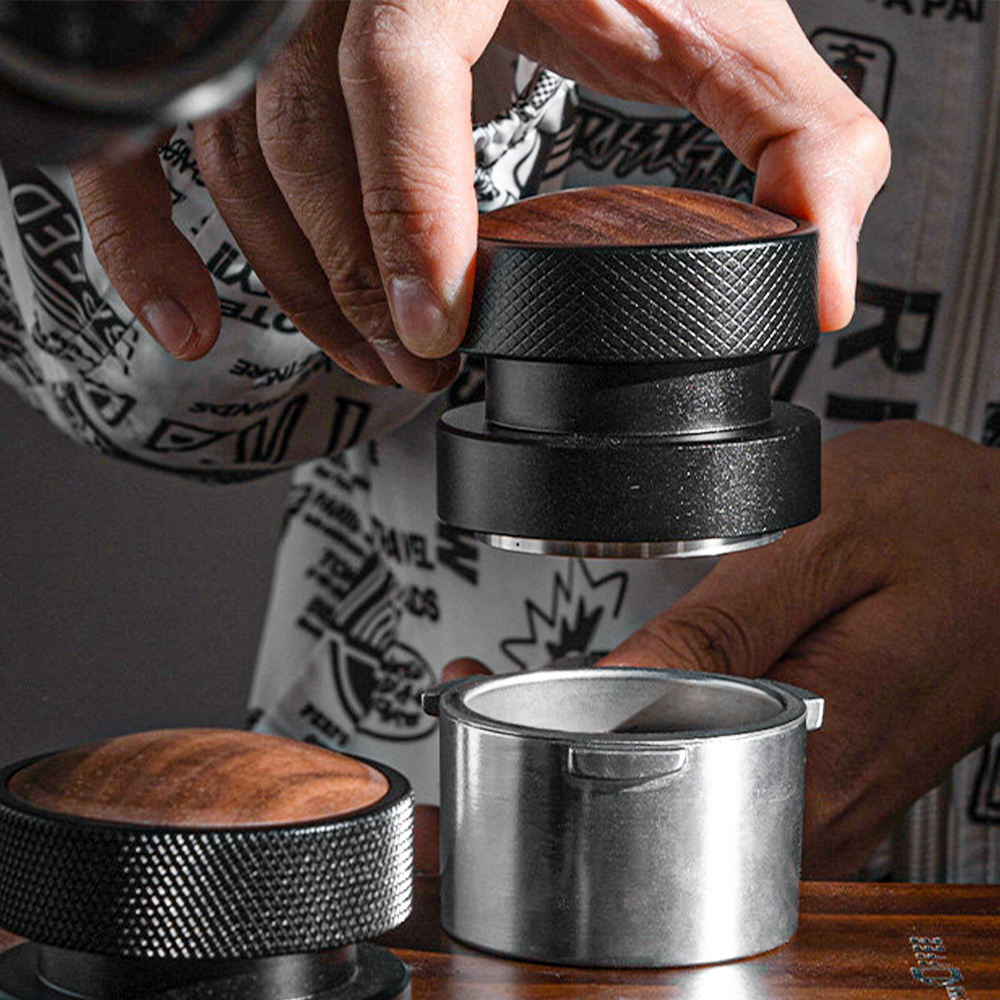
A self-leveling tamper uses a plate, flange or collar that rests on the basket rim while the base travels down. The rim reference helps the base stay perpendicular to the basket, directly addressing tilted pucks. It does not guarantee a particular force or ensure that the base reaches an unusually low dose; verify usable travel with the actual recipe.
5. Spring-loaded or calibrated tamper: best all-round architecture
A spring can resist the press, return the handle, create a click or work with a stop. A calibrated mechanism is intended to signal or limit a stated force. Those terms overlap but are not interchangeable. The most useful combination for many homes is a basket-referencing guide plus smooth travel and a clear completion cue—not a spring number on its own.
6. Impact or force-release tamper: best clear feedback
An impact or force-release mechanism stores force and then clicks, releases or disconnects at a defined event. Its benefit is an unmistakable finish signal, which can discourage pushing harder after the bed is already compact. Check noise, cleanability, adjustment access and service life; the event still cannot correct poor distribution or bad fit.
7. Palm or depth-limited tamper: best compact option
A palm tamper is pressed through a low-profile body rather than a tall handle. Many include a fixed or adjustable collar. The wide top can feel stable and the rim reference can help with levelness, but a repeatable depth is not universal compaction. Reset and test whenever the basket or dose changes.
8. Automatic coffee tamper: best for a busy café
An automatic tamper uses a powered, programmed cycle. It can reduce operator-to-operator variation and repetitive wrist loading, while adding cost, footprint, cleaning routines, power needs and a service dependency. Published pressure ranges and base options always belong to the individual model; the real decision is whether the machine, portafilters, baskets, recipes, counter layout and backup plan work as one system.
Build a basket-matched tamper range
Coffmach offers standard and custom coffee tampers in 51mm, 53mm, 58mm and other project-specific sizes, with material, handle, finish, logo and packaging options for wholesale and OEM/ODM work.
Fit, levelness and force: the three checks that decide more
Measure the basket—not the machine label alone
A nominal 58mm portafilter family does not guarantee a 58mm, 58.3mm, 58.4mm or 58.5mm tamper will fit every basket. The useful measurement is the basket’s internal diameter at the depth where the base actually travels. A close base can improve coverage; an oversized base can bind as the basket narrows.
For cafés, retailers and private-label projects, test representative baskets rather than one ideal sample. Check entry, full travel, vertical release and clearance with dry coffee present. Reject combinations that scrape, trap grounds, lift the puck or cannot reach the normal dose.
Flat, convex, patterned or coated base?
A flat base is the clearest general-purpose starting point because the puck surface is easy to inspect. A convex base changes the puck geometry and should be compared against a flat base with the same coffee and recipe—not assumed to prevent channeling. Patterned bases can leave visible grooves, but a clean pattern does not prove uniform density or better extraction. Select the finish for its food-contact suitability, cleanability and durability in the intended market.
A repeatable test to run with physical samples
Use this protocol when comparing actual tampers. It avoids the largest evaluation error: changing the grinder, dose, distribution, basket and tamper at the same time. Define the acceptance rules before reviewing results.
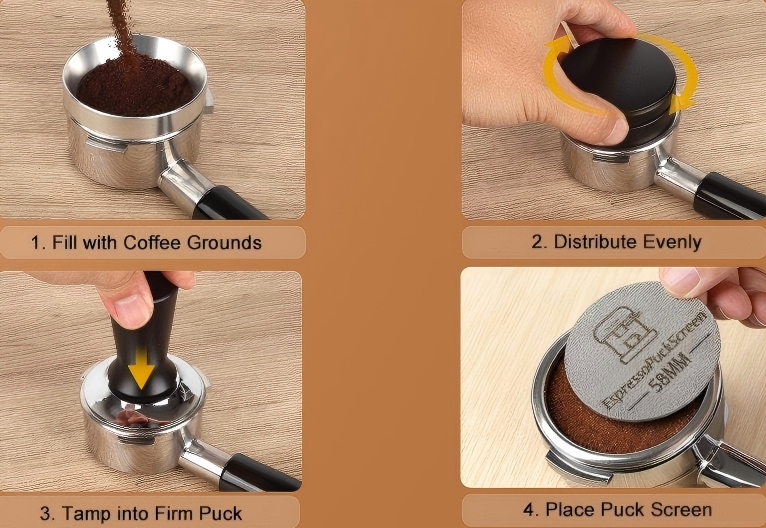
If a published page later claims measured winners, disclose the exact samples, baskets, coffee, recipe, repetitions, operators, instruments, calibration status, data spread and limitations. Until then, architecture-level conclusions are the honest, useful comparison.
Buying paths and B2B specification checklist
For beginners
Choose a correctly sized flat-base self-leveling tamper. A spring or stop is useful when it gives a clear, consistent finish cue. Confirm base size, collar contact and travel at your normal dose.
For experienced home users
Choose a precision-fit classic manual design when you already tamp level and value direct feedback, quick cleaning and minimal maintenance.
For busy cafés
Shortlist automatic tampers when volume, staff variation and repetitive strain justify them. Trial every portafilter and basket, and price cleaning, service, downtime and backup workflow.
For a retailer, importer or private-label brand, build the range around customer problems rather than cosmetic variants alone. A useful ladder may include a value manual tamper, a precision-fit manual model, a self-leveling spring model and a café-oriented automated solution. Tie each SKU to stated basket families and measurable specifications.
- Base: nominal and measured diameter, tolerance, profile, flatness, edge geometry, pattern, finish and alignment.
- Compatibility: target basket part numbers, normal dose range, collar contact, usable travel and any puck-screen allowance.
- Mechanism: spring function, adjustment range, cycle test, contamination resistance, disassembly instructions and replacement parts.
- Ergonomics: handle height and diameter, palm surface, weight, centre of mass, grip texture and station clearance.
- Quality control: gauge method, sampling plan, golden sample, visual limits, functional test, packaging protection, traceability and change control.
- Commercial details: logo method, colour, packaging, barcodes, manuals, MOQ, sample plan, lead time, warranty and destination market.
Request basket-fit confirmation before bulk production
Send the target baskets, base size, mechanism, materials, finish, logo, packaging, quantity and destination. A sample program against the real basket system reduces fit and workflow risk before a production order.
Frequently asked questions
What is the best espresso tamper for most people?
A correctly sized flat-base tamper with a stable self-leveling guide and a useful spring or stop cue is the most practical starting point for most users. It helps reduce tilt and makes the movement easier to repeat, provided the base fits and reaches the normal coffee dose.
Is a 58.5mm tamper better than a 58mm tamper?
Not automatically. A larger base may reduce the loose edge ring in a compatible precision basket, but it may scrape or bind in another basket. Choose from the actual internal basket profile and manufacturer compatibility guidance—not the larger number.
How hard should I tamp espresso?
Press smoothly and vertically until the loose bed is compact and stable, then stop. A repeatable movement is more useful than trying to hit one universal pressure number by feel. Follow the individual tool or machine guidance where it is provided.
Does a spring-loaded tamper make better espresso?
It can make preparation more repeatable when the spring provides a useful cue or the tool also controls levelness. It cannot correct the wrong grind, uneven distribution, poor basket fit or insufficient travel.
Is a self-leveling tamper the same as a calibrated tamper?
No. A self-leveling tamper references the basket rim to reduce tilt. A calibrated tamper signals or limits a stated force. A product may include both features, one or neither.
Can a tamper prevent channeling?
No tamper can guarantee it. A level, correctly fitted tamp removes one avoidable source of variation, while channeling can also result from grind distribution, clumps, dose, basket condition, puck damage, water delivery and machine condition.
Should a café buy an automatic coffee tamper?
Consider one when service volume, multiple operators or repetitive strain creates a meaningful operating cost. Trial it with every portafilter and basket, then include cleaning, service response, counter layout and a manual backup procedure in the decision.
Why does my tamper lift or crack the puck?
The base may be too close-fitting, dirty, damp, poorly finished or withdrawn at an angle. Coffee may also be trapped above an oversized edge. Clean and dry the base, lift vertically, verify clearance and inspect the basket for taper or damage.
Technical sources and image credits
- Coffmach — Coffee Tamper. Internal product information on available sizes, materials, customisation and sample evaluation.
- Breville — Bambino Plus Instruction Book. An official model-specific example that illustrates why tamping guidance belongs to a defined machine workflow.
- PUQpress — Automatic Tampers. Official category reference for powered tamper systems; published settings are model-specific.
- Normcore — Coffee Tools. Official product-family reference for spring and self-leveling tamper mechanisms.
- Pullman — Precision Coffee Tools. Industry reference for basket-specific precision tamper fit and compatibility checking.
- Systematically Improving Espresso: Insights from Mathematical Modelling and Experiment. Peer-reviewed framework for controlled espresso experiments and interacting preparation variables.
- All article images are Coffmach’s own real product and coffee-workflow photographs from the Coffee Tamper product page. Each image is credited directly below it in plain text; neither the images nor their credits are clickable.