MATERIAL GUIDE · MILK PITCHER DESIGN · B2B BUYING
304 Stainless Steel Coffee Milk Pitcher: Why Material and Thickness Matter
A 304 stainless steel milk pitcher is a sound all-purpose choice when its surface, forming, rim, spout, handle and cleaning instructions are controlled. Wall thickness is a separate decision: it changes mass, rigidity, dent resistance and hand feel, but it does not by itself guarantee better microfoam or a better pour.

Quick answer: select the complete pitcher, not a grade label alone
- 304 is an alloy designation; it does not state wall gauge, jug weight, spout accuracy or finished-product compliance.
- Thickness affects mass, stiffness and tactile heat response. It is not a universal “professional” ranking.
- Milk is heated mainly by steam condensing and mixing in the pitcher; gauge alone cannot promise a fixed steaming time.
- Rim, spout, handle and local thinning after forming can matter more than an advertised nominal sheet gauge.
- For food-contact projects, evaluate the complete finished article: surface, markings, coating boundaries, fabrication, cleaning and target-market documentation.
- Request matched-capacity samples and test them with the same milk dose, steam setting and temperature endpoint.
What “304 stainless steel” means for a milk pitcher
Type 304 is an austenitic chromium-nickel stainless steel. It is common in food-and-beverage equipment because it combines practical corrosion resistance with useful toughness and formability. Those qualities suit a pitcher body that must be shaped into a tapered shell, a controlled rim and a formed spout, then joined to a handle without leaving sharp edges or hard-to-clean traps.
The grade name is important, but it is only the starting point. A finished milk pitcher also depends on the actual material supplied, surface condition, forming, welding, polishing, decorations or coatings, cleaning chemistry and intended market. A listing that says “304” does not, by itself, prove a particular batch chemistry, local wall thickness, food-contact documentation or pour performance.
| The claim can indicate | The claim does not prove |
|---|---|
| An intended 304-family stainless material choice | Traceability for the delivered batch without supporting documentation |
| Potential for a durable, smooth, cleanable metal surface | A centered spout, round rim, strong handle or consistent wall thickness |
| Useful resistance in appropriate coffee-service conditions | Immunity to chloride exposure, unsuitable cleaners, trapped soil or fabrication defects |
| A material grade | Wall gauge, empty weight, coating system or tactile heat feedback |
World Stainless notes that hygienic food-and-beverage performance comes from material selection together with fabrication, surface finish, design and maintenance. This is the more useful purchasing model: avoid relying on a generic “food-grade” label as the complete quality verdict.
Does milk pitcher thickness matter?
Yes—when it changes a measurable or usable outcome. A lighter wall can reduce wrist load and let the outer wall feel warmer sooner. A thicker wall normally adds steel mass and can make the body, rim and spout more resistant to everyday deformation when the geometry and forming are sound. Neither effect means that one thickness is automatically better for every barista.
Do not confuse nominal sheet thickness with the finished wall everywhere on the pitcher. A pitcher is formed from sheet; processes such as drawing, spinning and stretch-forming can redistribute material. Outokumpu’s forming guidance specifically notes that thinning can occur during spinning and stretch-forming. A supplier should therefore define whether the quoted number is incoming sheet, a finished local measurement, or a design target.
Relatively thin / light
Often feels agile and gives faster tactile feedback. It can be a good fit when low empty weight and quick hand cues are priorities, provided the rim and body remain robust.
Balanced construction
Seeks a repeatable compromise among comfort, rigidity, price and capacity. Compare complete samples rather than assuming the middle gauge is right.
Relatively thick / heavy
Can feel planted and resist local dents better. The trade-off is more mass, potentially more fatigue in a busy shift and a more gradual wall-temperature cue.
Why thickness is not a microfoam promise
Steam-wand frothing is driven mainly by steam condensation, circulation, air incorporation, milk composition, starting temperature, wand position and final temperature. The pitcher wall is an important boundary and a useful feedback tool for the hand, but it is not the only route that heats the milk. A well-formed lighter pitcher can outperform a poorly balanced heavy one; two pitchers with the same quoted gauge can also feel different because capacity, taper, base, handle and finish differ.
Rim, spout, handle and capacity often matter more than gauge
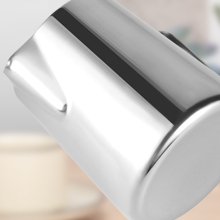
Thickness influences latte art indirectly through weight, inertia, grip confidence and the ability of the metal to preserve the intended shape. It does not set the stream width on its own. The spout opening, lip radius, projection, centerline, pitcher tilt, milk flow and cup geometry are more direct controls of the pattern in the cup.
Inspect the functional zones
- Rim: should be smooth, round and free from sharp edges or finish intrusion.
- Spout: should match the approved profile and release a centered stream at the intended tilt.
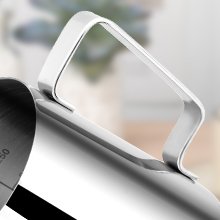
- Handle and joints: should feel aligned and stable when the pitcher is filled to its working level.
- Body and base: should sit flat, avoid oil-canning and resist normal nesting and handling.
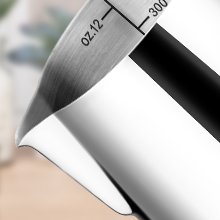
- Capacity marks: should be legible and match the stated usable-fill reference, not only the overflow volume.
For a barista-facing project, test a simple heart and a detailed pattern using coded, matched-capacity pitchers. Ask several users to score steam control, fatigue, stream centering, line placement and cleaning. That tells you whether extra steel solves a real workflow problem.
Capacity changes the decision
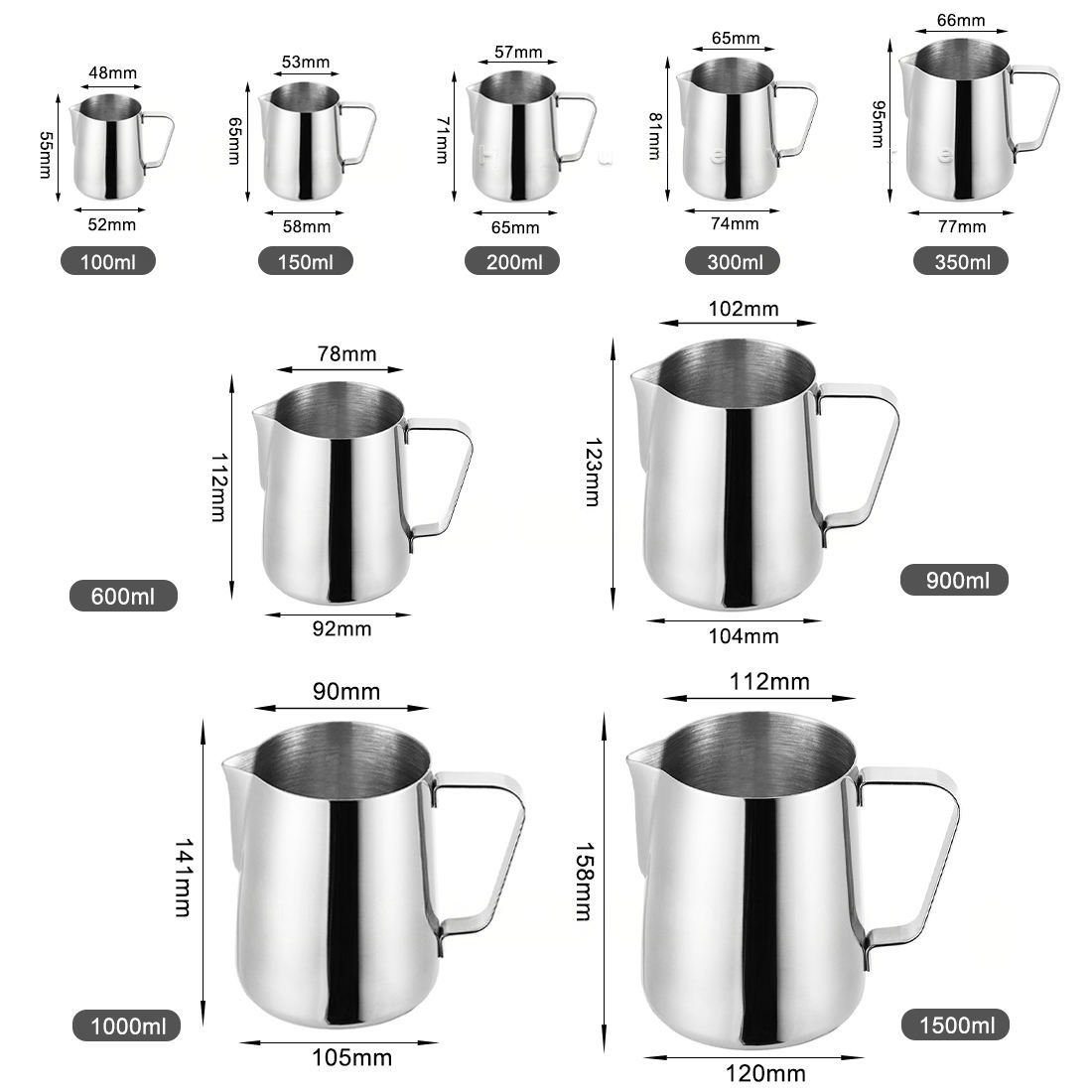
Do not compare a small light pitcher with a large heavy one and attribute the whole difference to wall thickness. A larger capacity adds steel area and a larger milk dose; both change mass, balance and heating behavior. For fair sample selection, compare pitchers with similar capacity and body shape, then record empty weight, working-fill weight and the actual milk dose used during steaming.
Coffmach’s milk pitcher range includes several capacities and optional measurement marks. For an OEM brief, state both the nominal capacity and the intended working fill so the form, marks and balance are evaluated in context.
304 vs 316: do not mix corrosion resistance and thickness
304 and 316 answer a material-selection question; 0.7 mm, 0.8 mm or 1.0 mm answer a dimensional question. Type 316 adds molybdenum and is often selected for stronger resistance in more aggressive chloride environments. That does not make 316 automatically necessary for a normal milk pitcher, nor does it make a 316 pitcher heavier or more rigid by definition.
| Question | What to specify | Why it matters |
|---|---|---|
| Material | Declared grade, product form and batch traceability requested | Supports the corrosion, fabrication and target-market evidence discussion |
| Wall construction | Incoming sheet target, finished local map, tolerance and measurement method | Controls mass, local robustness and manufacturing consistency |
| Surface and decoration | Interior finish, exterior finish, logo/marking process and care limits | Protects cleanability and visual durability |
| Functional performance | Capacity, spout profile, handle alignment, pour and durability tests | Confirms that the finished product works as intended |
For products sold into the European Union, food-contact materials must be assessed against the applicable EU framework and good-manufacturing-practice requirements. Treat material identity as part of the evidence set; the exact finished article, intended use, coatings, inks, residues, traceability and destination-market requirements must also be considered.
Cleaning and care preserve 304 stainless performance
Stainless steel is not maintenance-free. Routine care should remove milk promptly, wash with a suitable detergent and soft non-metal tool, rinse thoroughly and air-dry. Milk residue, chloride-containing chemicals, carbon-steel wool, rough abrasives and trapped moisture can undermine a good surface and create complaints that are mistakenly blamed on the metal grade.
- Rinse after use so milk film does not bake onto a hot inner wall.
- Use cleaner and sanitizer concentrations approved for the operation and surface; follow label and local food-service requirements.
- Avoid carbon-steel wool and unverified chloride solutions on stainless; they can transfer iron or damage the surface.
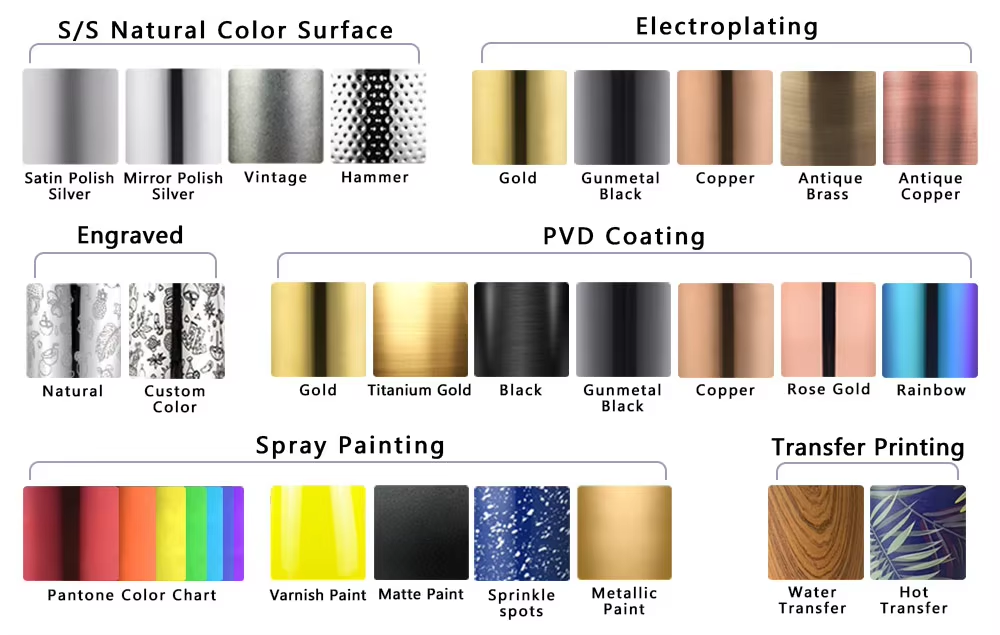
- For coloured, printed or coated pitchers, confirm care limits for the whole product—not just the bare steel substrate.
- Inspect spout, rim, handle joints and internal marks for trapped residue, peeling finish, sharp edges or loose joints.
How to verify a pitcher before placing a bulk order
A reliable comparison separates material verification, dimensional inspection, durability and barista performance. Keep the method written and use coded samples where possible. Do not draw a production conclusion from one attractive showroom sample.
Wholesale and OEM RFQ checklist
For a private-label or wholesale 304 stainless steel milk pitcher, specify the performance you need rather than relying on a short “304, thick wall” description. This prevents a supplier from guessing at important details and gives your team a basis for comparing samples.
| Specification area | What to send or confirm |
|---|---|
| User and workflow | Café volume, drink range, milk dose, steam system and temperature-control method |
| Geometry | Nominal capacity, usable fill, body diameter and height, taper, base, rim, spout profile and handle/handleless choice |
| Material and thickness | Declared grade, incoming sheet target, finished local-thickness points, tolerance and measurement method |
| Finish and branding | Interior/exterior finish, colour, logo process, marks, coating-free food-contact boundaries and cleaning requirements |
| Acceptance tests | Golden sample, dimensional check, heat-response test, handle/impact test, cleaning cycles and functional pour test |
| Commercial details | Quantity, packaging, barcode/insert needs, destination market, required documents and delivery schedule |
Specify your 304 milk pitcher with confidence
Send Coffmach the target capacity, preferred spout, wall/weight target, finish, logo, packaging and destination market. We can support sample comparison, drawing review and an OEM/ODM quotation.
Frequently asked questions
Is 304 stainless steel good for a milk frothing pitcher?
Yes, 304 is a common practical choice for milk pitchers when the finished product has a smooth, cleanable surface and suitable fabrication. The grade alone is not a complete quality guarantee: confirm the capacity, wall construction, rim, spout, handle, finish and cleaning limits for the actual pitcher.
Is a 1 mm milk pitcher better than a 0.7 mm one?
Not universally. A 1 mm construction can add mass and dent resistance, while a 0.7 mm construction can feel lighter and give faster tactile feedback. Capacity, body geometry, rim reinforcement, spout alignment and the user’s technique determine which one works better.
Does a thicker pitcher steam milk more slowly?
A thicker wall adds thermal mass and increases the through-wall path, but steam-wand heating is governed mainly by steam condensation and mixing in the milk. Do not promise a fixed time increase from gauge alone. Compare actual pitchers with the same dose, machine setting and measured endpoint.
Does 304 stainless steel tell me the wall thickness?
No. 304 identifies an alloy grade; thickness is a separate dimensional specification. A supplier should state both, together with the relevant tolerance, finished measurement locations, surface finish and product weight.
Can I judge milk temperature by touching a thick pitcher?
You can learn the feel of a consistent pitcher, but a thicker or coated wall may delay what your hand feels. Calibrate with a thermometer when changing pitcher construction, milk dose, steam power or grip. Use touch as a validated personal cue, not as an absolute measurement.
When should a buyer consider 316 instead of 304?
Consider 316 when the actual service environment, cleaning chemistry or corrosion-risk assessment calls for stronger resistance in more aggressive chloride conditions. It is not automatically needed for every normal coffee-service pitcher. Assess the full use case and destination-market requirements.
How do I verify a finished pitcher wall thickness?
Agree a method before setting a limit. Depending on the accessible location and sample plan, this may use a suitable contact micrometer, prepared cross-sections on sacrificial samples or specialized ultrasonic equipment validated for thin curved metal. Define points, instrument, resolution and repeatability.
What should I ask before buying custom milk pitchers in bulk?
Ask for a dimensioned drawing, stated material, wall/weight target, finish, logo process, capacity and fill marks, packaging details, sample approval plan, cleaning guidance, inspection report and the tests that production units must pass. The more exact the intended workflow, the better the supplier can control the result.
Technical sources and image credits
- Coffmach — Coffee Milk Jug. Product context for material options, capacities, finishes, markings, logos, packaging and OEM/ODM support.
- worldstainless — Food and beverage industry. Technical context on material selection, hygienic design, fabrication and stainless use in food and beverage equipment.
- worldstainless — Stainless Steel in the Food and Beverage Industry. Grade context for AISI 304 and 316 and food-and-beverage service conditions.
- Outokumpu — Forming of stainless steel. Forming, springback and thickness-thinning context.
- European Commission — Food Contact Materials. Official EU food-contact material framework.
- British Stainless Steel Association — Cleaning Methods for Stainless Steel. Practical cleaning and surface-care guidance.
- All five article images are real Coffmach product or product-use images from the Coffee Milk Jug landing page. The image captions are plain text and are not clickable.