


09.12.2025
For making two standard-sized coffees (6-8 oz / 180-240 ml), the best choice is a 600ml (20 oz) milk jug. This is the industry standard.
This size strikes the perfect balance. It holds enough cold milk and provides the extra space needed for the milk to expand into silky microfoam.
You’ll have enough control for precise pouring and latte art. Plus, it won’t be too heavy or awkward to handle.
But is this always the right answer when considering what size milk jug for 2 coffees works best for you?
The details matter. Whether you’re stocking a cafe, working as a professional barista, or perfecting your home coffee routine, this guide covers everything you need to know.
We’ll explore the science behind steaming milk and give specific advice for your situation.
Table of Contents
The Science of 600ml
The 600ml recommendation isn’t random. It’s based on the physics of creating perfect microfoam.
That glossy, paint-like texture depends on the right balance of volume, space, and fluid movement. Understanding these principles helps you master milk steaming tips and make quality beverages every time.
- Optimal Milk Volume: Fill your pitcher just below the inner base of the spout. For two standard cappuccinos or lattes, you need about 300-360ml (10-12 oz) of cold milk.
- A 600ml jug filled to this level is at 50-60% capacity. Professional baristas use this as their ideal starting point.
- Sufficient Headspace for Expansion: During steaming, you add air to the milk through “aeration” or “stretching.” This can make the milk expand by 30-50%. Non-dairy alternatives sometimes expand even more.
- A 600ml jug gives you this necessary headspace. A smaller pitcher, like 350ml for two drinks, would overflow immediately. This creates a mess and prevents proper texturing.
- The Perfect Vortex: After aeration, you create a whirlpool or “vortex.” This spinning motion mixes the air, breaks down large bubbles, and creates smooth, silky microfoam.
- The width and depth of a 600ml jug work perfectly for creating a stable vortex with standard steam wands. A smaller jug creates chaos instead of smooth spinning. A much larger jug, like 1000ml, often needs more steam power than many machines can provide.
- Pouring Control & Latte Art: A half-full pitcher offers the best balance for pouring. It’s not so heavy that it tires your wrist, but it has enough milk for detailed latte art on two separate cups.
- This control matters. Trying to pour two drinks from a nearly-full 350ml jug or a mostly-empty 1000ml jug hurts your precision. This affects how your final milk jug coffees look.
A Guide to Jug Sizes
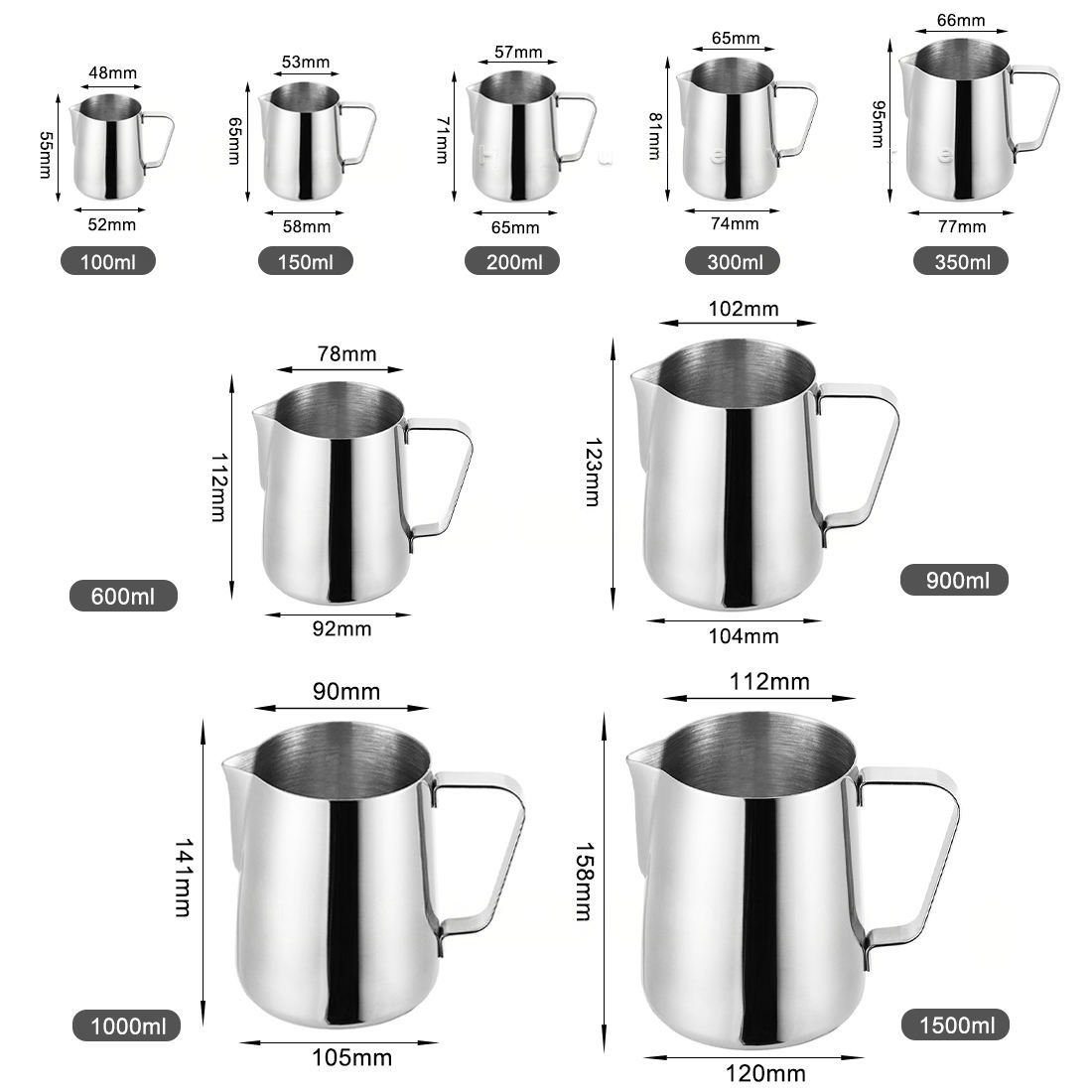
The 600ml is the most versatile choice. But a professional setup or dedicated home station will have several sizes. Each one serves a specific purpose to maximize quality and minimize waste.
This milk pitcher size guide breaks down common options and their best uses. Understanding this helps you figure out how much milk for 2 cappuccinos you need and which tool fits the job.
Jug Size (Capacity) | Best For (Number of Coffees) | Primary Use Case & Notes |
350ml (12 oz) | 1 Small Coffee | Home & Pro: Perfect for a single 6-8 oz flat white, cappuccino, or cortado. Gives you excellent control and zero milk waste. Essential for specialty coffee bars focused on single-drink quality. Core part of home barista essentials. |
600ml (20 oz) | 1-2 Standard Coffees | The All-Rounder: The focus of our guide. The ideal barista milk jug 600ml works for two standard lattes, two cappuccinos, or one large 12-16 oz takeaway coffee. Most versatile and essential size for almost any coffee setup. |
750ml (25 oz) | 2-3 Small Coffees | High-Volume Hybrid: Less common size that bridges the gap. Useful in busy cafes for making multiple small drinks (like macchiatos or piccolos) at once. Slightly less precise for detailed latte art compared to 600ml. |
1000ml (34 oz) | 3-4 Coffees / Batch Steaming | The Workhorse: Commercial milk pitcher for high-volume settings. Steam large quantities for multiple orders at once. Not recommended for detailed latte art – foam separates while pouring first drinks. Weight makes precise pouring difficult. |
1500ml+ (50 oz+) | Batch Steaming Only | Commercial Only: Only for batch-steaming large amounts of milk for filter coffee additions or multiple hot chocolates. Never used for individual espresso drinks in specialty settings due to lack of control and massive foam separation. |
For consistent drink quality, follow Specialty Coffee Association (SCA) standards for drink sizes. This helps you match your jug to your cups perfectly.
Advice for Your Needs
The right equipment choice depends on your role and goals. A purchasing manager has different priorities than someone perfecting their home latte. Here’s tailored advice for each situation.
For Wholesalers
As a wholesaler or purchasing manager, you want to stock items that help your clients succeed. Your inventory should reflect real cafe workflows.
Make the 600ml jug your core stock. This is your bestseller and should be about 60% of your inventory. It answers the main question of what size milk jug for 2 coffees is needed.
The 350ml jug is your second priority. This should be around 30% of your pitcher inventory. Every cafe needs these for single-drink orders, from small specialty shops to larger chains.
The 1000ml jug fills a niche but essential role – the remaining 10% of your stock. High-volume clients and hotels need these for batch steaming during busy periods. Independent specialty cafes order them less often.
When sourcing pitchers, focus on quality markers you can highlight to customers. Look for durable, food-safe 304-grade stainless steel, clear internal measurement lines (laser-etched is premium), and comfortable, well-welded handles. These features signal professional-grade tools.
For reliable, high-quality manufacturing for bulk orders and custom solutions, partner with an experienced supplier. Explore our manufacturing capabilities to see how we meet your specific needs.
For Professional Baristas
As a working barista, every second counts. Your priorities are speed, consistency, quality, and comfortable workflow. Your tool choices directly impact all four.
The most efficient setup is a two-jug system. Keep plenty of both 600ml and 350ml jugs available. Never steam milk in a 1000ml jug and split it for latte art – the foam will separate by your second cup.
Let the order dictate your workflow. Use the barista milk jug 600ml for all double-drink orders and large takeaway cups (12 oz and above). This ensures enough textured milk for the complete order.
Use the 350ml jug for all single 6-8 oz drinks. This cuts milk waste significantly, helping your cafe’s profits. It also gives you better control for high-quality latte art pitcher work.
Consistent temperature is non-negotiable. Experienced baristas can judge by hand, but regular thermometer checks help with training and standards. Aim for 60-65°C (140-150°F) to optimize sweetness and texture.
For continuing education and workflow efficiency tips, Barista Hustle provides industry-leading insights for coffee professionals.
For Home Enthusiasts
As a home coffee lover, you want to recreate the cafe experience and improve your skills without wasting ingredients. The right gear makes this journey much more enjoyable.
If you’re buying just one jug for your home barista essentials collection, choose the 600ml. It offers the best versatility. Perfect when guests visit and you need two coffees, but still manageable for a single large coffee.
The ideal home setup is a pair: one 350ml and one 600ml. This combination handles every scenario. Use the 350ml for your daily single cappuccino to minimize waste. Bring out the 600ml when making drinks for you and a partner.
Practice is key, but using milk gets expensive. Here’s a great tip: fill your 600ml jug to the spout base with cold water and add one drop of dish soap. This mixture mimics milk’s stretching and texturing properties, letting you practice steaming technique for free.
Building your perfect home coffee station can feel overwhelming with so many choices. If you need personalized advice on selecting gear that matches your machine and goals, contact our experts for guidance.
Beyond Size: Key Features
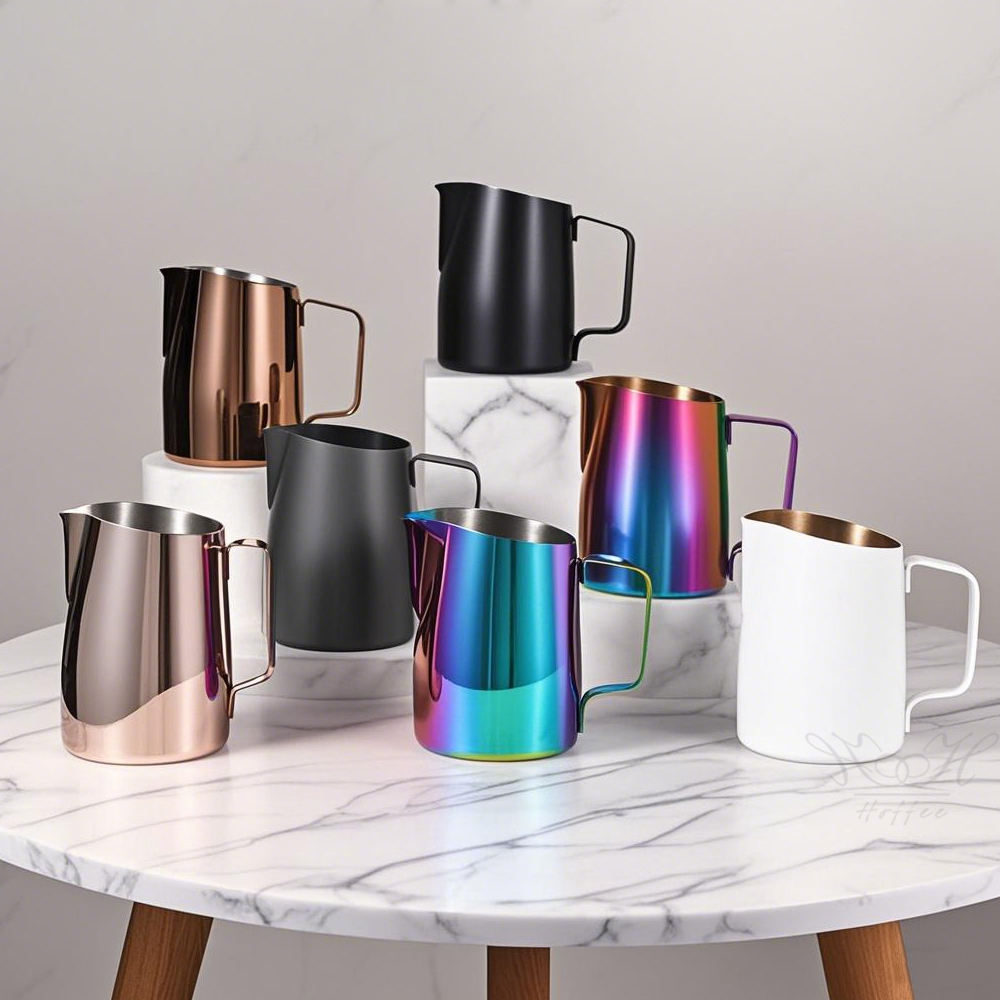
Choosing the best milk frothing jug involves more than picking the right coffee pitcher volume. Several design features separate professional tools from basic ones. These details directly impact your control, consistency, and final latte art quality.
A well-designed spout is absolutely critical for latte art. The shape determines milk flow and the level of detail you can achieve.
A sharper, more defined spout (often on “tulip” or “narrow” style jugs) offers greater precision. This allows intricate patterns like detailed rosettas, swans, and tulips by giving you fine-line control.
A wider, more traditional rounded spout is more forgiving for beginners. It’s excellent for classic, bold patterns like hearts and simple rosettas, promoting smoother, broader foam flow.
Professional milk jugs are almost exclusively made from 304-grade stainless steel. This material is chosen for several important reasons.
It’s highly durable, rust and corrosion resistant, and completely food-safe. It’s also an excellent heat conductor, which is crucial. This lets you use your hand on the jug side as a reliable thermometer, feeling temperature progress as you steam.
Steel thickness also matters. Thicker walls (around 1mm) provide slightly better insulation, giving you more time to texture milk before it gets too hot. Thinner walls heat up faster, requiring more speed and experience.
The handle must provide comfortable and secure grip. Remember, the jug will be full of scalding liquid. A stable grip is essential for safety and pouring control.
An open-top handle (welded at top and bottom but open on the side) is preferred by many baristas. This design allows various grip styles, like holding the handle itself or bracing your thumb on top for added stability.
For perfect consistency and reduced waste, internal measurement lines are revolutionary. These laser-etched or stamped markings inside the jug let you pour exactly the right amount of milk every time, without separate measuring cups or scales.
This is vital in cafes for cost control and equally valuable for home users wanting to perfect their ratios. Jugs like the Coffee Milk Jug – coffmach are designed with these professional features, offering control, durability, and precision spouts for both cafe and home use.
The American Iron and Steel Institute provides detailed information on stainless steel grades like 304, confirming its superior food-safe qualities for kitchen and cafe equipment.
Steaming for Two: A Guide
Knowing what size milk jug for 2 coffees to use is the first step. Now let’s walk through using that 600ml jug to create perfectly textured milk for two drinks. These milk steaming tips are based on professional barista techniques.
- Start Cold. Always use cold milk straight from the refrigerator. Pour it into your cold 600ml jug. Fill to the bottom of the spout’s V-shape – around 300-360ml (10-12 oz). Cold starts give you more time to texture before reaching final temperature.
- Purge the Wand. Before steaming, point your steam wand over the drip tray and turn it on for a few seconds. This purges condensed water from the wand, ensuring you don’t inject hot water into your milk, which would dilute it.
- Submerge and Angle. Submerge the wand tip just below the milk surface. Position slightly off-center and at a slight angle. This positioning is crucial for encouraging the milk to spin in a whirlpool.
- Aerate (Stretch). With the wand positioned, turn steam to full power. Immediately lower the jug so the wand tip is at the surface. You should hear a distinct but gentle “tsss-tsss” or “ch-ch” sound, like paper tearing. This is air being introduced. For lattes and flat whites, do this for only 3-5 seconds.
- Incorporate (Texture). After brief aeration, raise the jug slightly to sink the wand tip deeper. The “tearing” sound should stop completely. Keep the wand off-center to maintain a strong, silent vortex. You should see milk spinning rapidly in a whirlpool. This phase breaks down air into microfoam and creates smooth, glossy texture.
- Monitor Temperature. Keep one hand firmly on the jug side throughout. As milk heats up, you’ll feel temperature rise. The moment the jug becomes too hot to hold comfortably for more than a second, it has reached the ideal 60-65°C (140-150°F). Immediately turn off the steam wand.
- Tap and Swirl. Once steam is off, remove the wand and wipe it clean immediately with a dedicated cloth. If you see visible bubbles on the milk surface, tap the jug firmly on the counter once or twice to pop them. Then continuously swirl the milk. This keeps foam and liquid integrated and maintains that glossy, wet-paint appearance.
- Pour Immediately. Don’t let the milk sit. Microfoam begins separating within seconds. Pour about half for your first coffee, creating your latte art design, then pour the remainder for the second coffee.
For fantastic visual demonstration of this process, watch tutorials from world-class baristas like James Hoffmann on YouTube, who expertly breaks down milk steaming physics.
Troubleshooting Steaming Mistakes
Even with right equipment and technique, things can go wrong. Understanding what causes common milk steaming problems is key to fixing them and improving consistency. Here’s how to diagnose and solve frequent issues.
Problem: My milk is bubbly and stiff, like bubble bath foam.
- Cause: This common mistake usually comes from introducing too much air (over-aerating) at the beginning. It can also happen from not creating a strong enough vortex to incorporate the air you did introduce.
- Solution: Reduce aeration time. Make the “tsss-tsss” sound for a shorter period, maybe only 1-2 seconds. Then focus intently on sinking the wand and achieving a powerful, silent whirlpool for most of the steaming time. The vortex creates silkiness.
Problem: My milk is hot but thin, with no foam at all.
- Cause: This is the opposite problem. The steam wand was likely buried too deep from the start, so no air was ever introduced. You effectively only heated the milk.
- Solution: Pay close attention to initial wand placement. Ensure the tip is just at or barely below the milk surface when you start. You must hear that “paper tearing” sound at the beginning to confirm air is being drawn in before you submerge the wand for texturing.
Problem: My milk tastes flat, burnt, or strangely less sweet.
- Cause: You’ve overheated the milk, taking it past 70°C (160°F). At these high temperatures, milk proteins denature and break down completely, destroying texture. The lactose (milk sugars) also begins to scald, eliminating natural sweetness and creating cooked or burnt flavor.
- Solution: Be more vigilant with temperature control. Use your hand on the jug side and stop steaming the moment it becomes too hot to touch. It’s always better to be slightly under-temperature than over. Consistency beats maximum heat for delicious milk.
The science behind why overheating ruins milk flavor is fascinating. Food science resources like Serious Eats offer deep dives into molecular changes in milk proteins and sugars at different temperatures.
Your Perfect Pour
In the quest to answer what size milk jug for 2 coffees is best, the 600ml (20 oz) jug stands out as the clear winner. Its design offers unmatched versatility, control, and efficiency for the most common coffee orders.
It empowers you to create two beautiful, cafe-quality milk jug coffees with perfect texture and minimal waste. This works whether you’re a professional or passionate home user.
However, a true master knows that the right tool is more than just its size. A great jug combines ideal volume, precision spout, quality material, and thoughtful, ergonomic design.
By considering spout shape, steel grade, and helpful features like internal measurement lines, you’re not just buying metal. You’re investing in consistency, quality, and the daily pleasure of perfectly crafted coffee.
Ready to find the perfect tools for your coffee journey? Explore our full range of professional-grade coffee accessories at coffmach.com.
As a professional manufacturer specializing in the research, development, and production of Coffee machine accessories, we not only offer a diverse product selection but also support OEM/ODM customization to meet the needs of diverse markets and customers. With consistent quality control, fast delivery, and innovative designs, our coffee machines are used by numerous brands and channels worldwide. Whether you're a distributor, wholesaler, or brand owner, we can provide you with reliable solutions to help you grow your business. Contact us to explore potential collaboration opportunities.

Categories: Buying/Customization Guide Product Knowledge


