


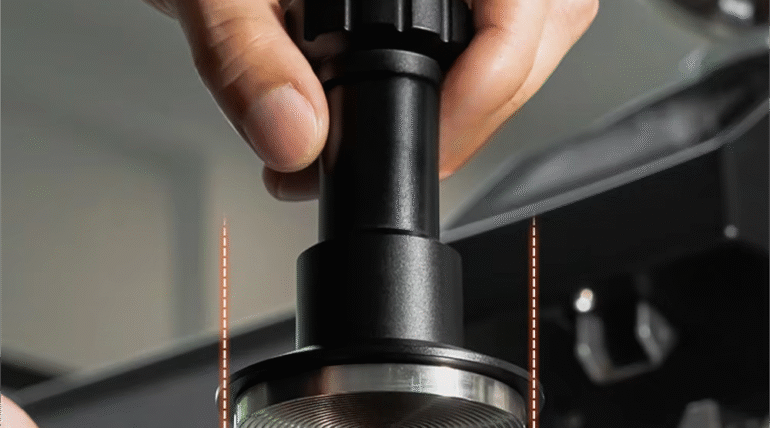
19.11.2025
The industry standard for how much force to tamp coffee is 30 pounds (or about 13.6 kg).
But here’s the real secret. Perfect espresso isn’t about hitting an exact number. It’s about achieving a consistent and level tamp every single time.
This guide will clear up the confusion around coffee tamping pressure. We’ll move beyond abstract numbers. Instead, we’ll focus on the practical skills you need to pull better shots.
In this article, you will learn:
- Why tamping is crucial for balanced extraction.
- What happens when you tamp too hard or too soft.
- A step-by-step technique for a perfect, consistent tamp.
- How to troubleshoot common espresso problems related to tamping.
Table of Contents
Why Tamping Matters
The Goal of Tamping
Before we discuss force, let’s clarify why we tamp. When you press down on those loose coffee grounds, you’re trying to accomplish three specific goals.
Your primary aims are to:
- Remove air pockets and pack the loose grounds into a dense, uniform puck.
- Create a perfectly flat and level surface across the entire bed of coffee.
- Establish even resistance that will challenge the water from your espresso machine.
Controlling Flavor Extraction
Think of your tamped coffee puck as a small, carefully built dam. Your espresso machine pushes hot water through it at roughly nine times atmospheric pressure (9 bars).
A properly prepared puck forces this high-pressure water to flow evenly and slowly through all the coffee grounds. This measured contact time allows the water to extract the oils, sugars, and acids that create a balanced, rich, and delicious shot of espresso.
If the puck isn’t tamped well, the water will find any weakness. It will rush through the path of least resistance. Baristas call this channeling.
This uneven flow means some grounds get over-extracted (creating bitter flavors) while others are barely touched. The result? A flawed, sour, and weak shot of coffee. Proper tamping is your first and best defense against channeling.
The 30-Pound Standard
Origin of the Rule
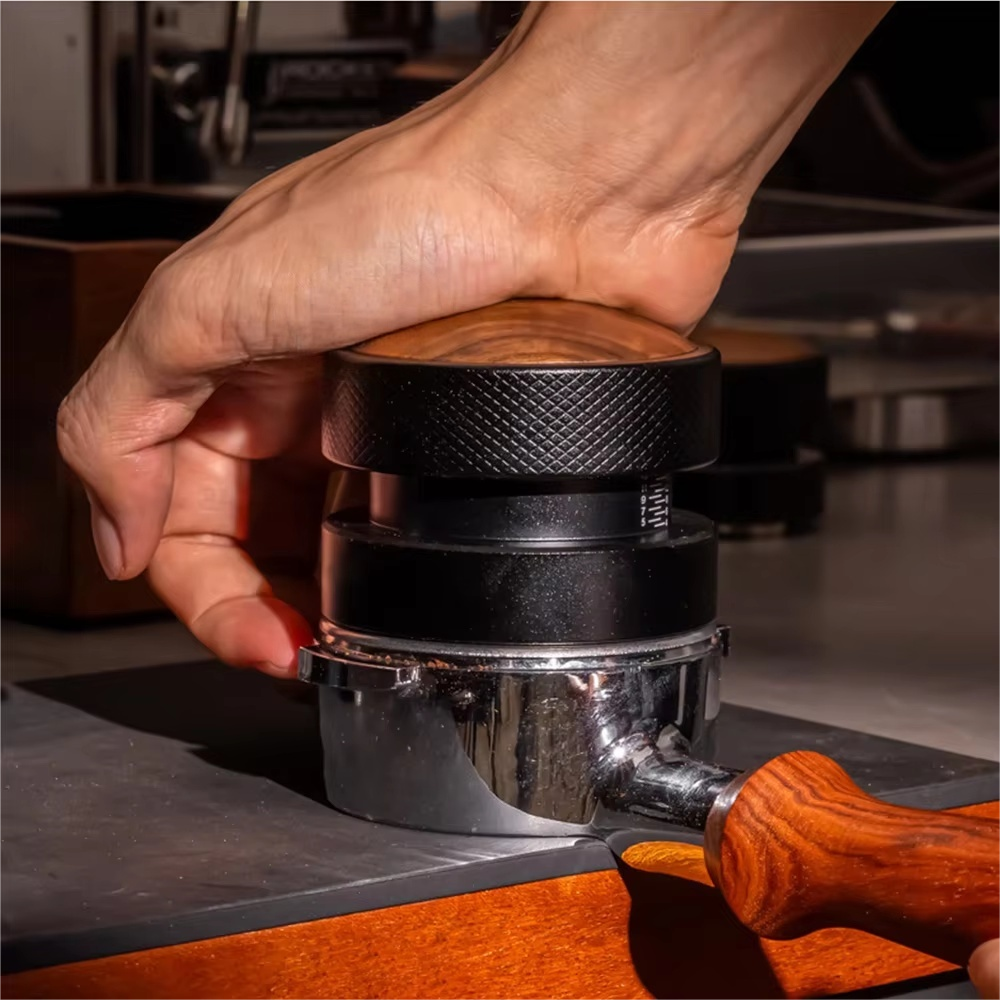
The 30-pound benchmark is a long-standing guideline in the professional barista community. It’s not random.
This amount of force was identified as reliable pressure to achieve near-full compaction of the coffee grounds. At this point, the coffee bed is about as dense as it can get.
Applying much more force, like 40 or 50 pounds, results in very little additional compaction. The 30-pound rule serves as a useful and effective guideline. But it’s not an unbreakable law of espresso.
Why Consistency Is King
Your espresso machine is a precision instrument that thrives on repetition. It performs best when every variable stays the same from one shot to the next.
Tamping force is one of these variables. But its consistency is far more critical than its exact numerical value.
Imagine you tamp with 25 pounds of force for one shot and 35 pounds for the next. You’ve introduced a huge variable that will directly change your extraction time and flavor profile. This makes it impossible to “dial in” your coffee grinder and recipe with any accuracy.
A consistent tamp creates a predictable and stable foundation. Whether it’s 20 pounds or 40 pounds doesn’t matter as much. It allows you to confidently make adjustments to other variables, primarily your grind size, to perfect your shot. A consistent but “wrong” pressure is better than an inconsistent one.
Consistent vs. Inconsistent Tamping
The difference in results is dramatic. A stable tamping routine is the foundation of repeatable, delicious espresso. Chasing a different pressure every time is a recipe for frustration.
Feature | Consistent Tamping (e.g., always 25 lbs) | Inconsistent Tamping (e.g., 20-35 lbs) |
Shot Time | Predictable and repeatable. | Erratic; shots run too fast or too slow. |
Flavor Profile | Balanced and consistent from day to day. | Unpredictable; can be sour one day, bitter the next. |
Channeling Risk | Low, as the puck density is uniform. | High, due to uneven density and micro-fractures. |
Dialing-In | Easy; you can confidently adjust grind size. | Nearly impossible; you’re chasing a moving target. |
This focus on variables and their relationships is a core concept in modern coffee theory. For a deeper dive into extraction, resources like the Barista Hustle Espresso Compass are invaluable for visualizing how variables interact.
Diagnosing Your Tamp
Understanding how much force to tamp coffee involves learning to read the results in your cup. Your taste buds and your stopwatch are the ultimate judges of your technique.
Signs of Under-Tamping
We often see beginners make this mistake. In an effort to be gentle, they press too lightly. They fail to create enough density in the coffee bed. The result is almost always a disappointing, weak shot.
The symptoms of tamping too lightly are clear:
- Taste: The espresso tastes overwhelmingly sour, acidic, and thin. It lacks sweetness, body, and the rich flavors you expect.
- Visuals: The shot runs very fast. A shot that should take 25-30 seconds might gush out in just 15. The stream will look pale and watery. The resulting crema will be thin, light-colored, and bubbly.
- The Puck: After brewing, the used coffee puck will look muddy, soupy, and waterlogged. It won’t hold its shape when you knock it out.
The cause is simple. An under-tamped puck doesn’t provide enough resistance. The pressurized water blasts through it too quickly. This doesn’t allow for enough contact time to properly extract the desirable sugars and oils. This is the classic definition of under-extraction.
Signs of Over-Tamping
This issue is slightly more complex. Due to the principle of diminishing returns, it’s difficult to “over-tamp” with force alone once you surpass the 30-40 pound mark.
However, combining excessive force with a grind setting that’s already too fine can choke your machine. This leads to a stalled and unpleasant extraction.
The symptoms of this scenario are also distinct:
- Taste: The espresso is intensely bitter, burnt, and astringent. Astringency is that unpleasant, dry, and chalky sensation that coats your entire mouth.
- Visuals: The shot struggles to come out. It may start as a few dark, slow drips before a very thin stream appears. A shot that should take 25-30 seconds might take 45 seconds or more. The crema can be dark, splotchy, and thin.
- The Puck: The used coffee puck will be rock-hard and very dry. It may be difficult to knock out of the portafilter.
The cause here is excessive resistance. The coffee puck is so dense that the water struggles to penetrate it evenly. This extremely long contact time over-extracts the bitter-tasting chemical compounds from the coffee grounds. Legendary coffee expert James Hoffmann explains these concepts masterfully in his videos on understanding extraction.
A Guide to Perfect Tamping
The Prerequisite: Distribution
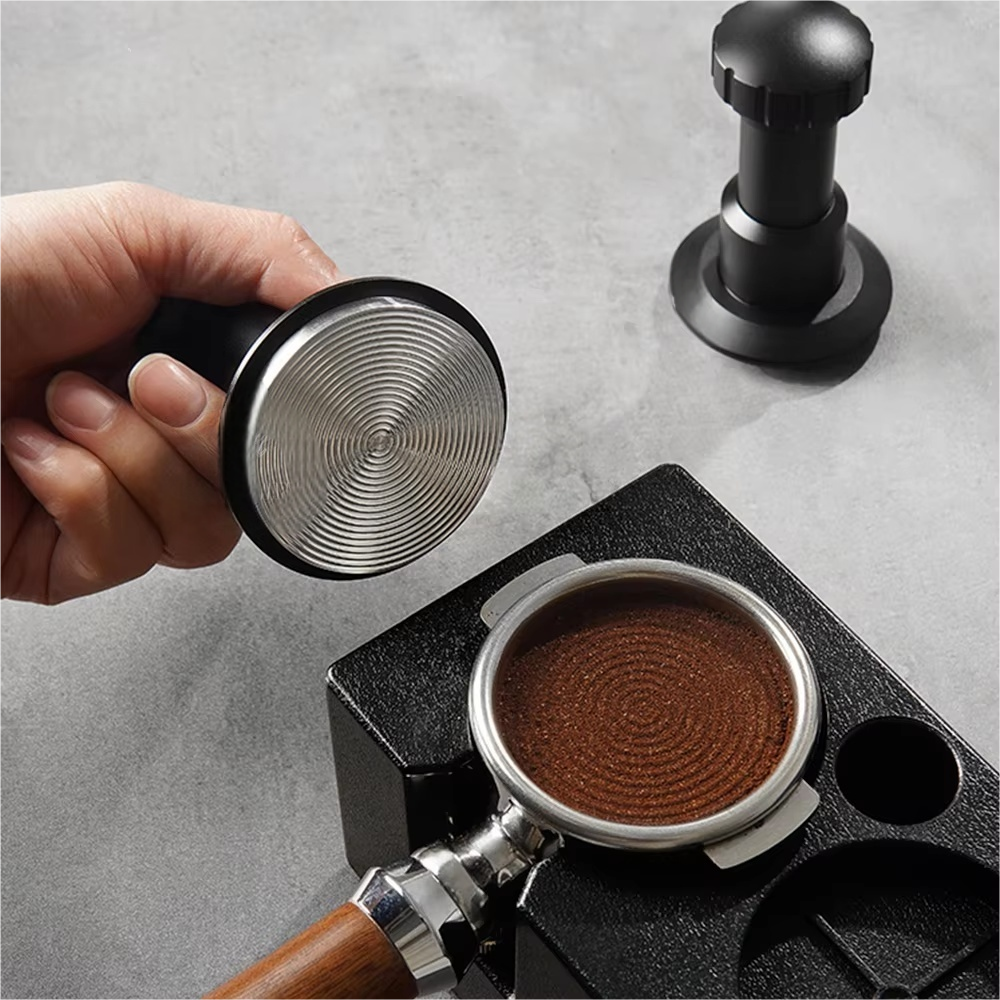
A perfect tamp is impossible without a perfectly prepared bed of grounds. Your technique begins before you even pick up your tamper.
Your loose coffee grounds must be evenly distributed in the portafilter basket. Any clumps must be broken up. Any mounds must be leveled out.
Use a Weiss Distribution Technique (WDT) tool—a small tool with fine needles—to rake through the grounds. Alternatively, you can gently tap the side of the portafilter with your hand to help the grounds settle.
Tamping an uneven bed of coffee will create areas of high and low density. This is a guaranteed cause of channeling, no matter how much force you use.
A 5-Step Tamping Technique
- Stand comfortably at your counter. Place the portafilter on a level, sturdy surface like a tamping mat. Your tamping arm’s wrist should be perfectly straight, not bent. Grip the tamper handle like a doorknob. Rest your fingers on the metal base for stability and to feel if the tamp is level.
- Level Entry
- Rest the tamper on top of the grounds. Before applying any pressure, use your fingers on the base to feel the gap between the tamper and the rim of the portafilter basket. Ensure it’s perfectly parallel and level.
- The Initial Press
- Apply very light, gentle pressure of just a few pounds. This settles the grounds and creates an initial compact surface. It helps prevent the main tamp from disturbing the level bed.
- The Main Tamp
- Keep your wrist straight. Align your elbow directly above the tamper. This ensures you’re applying pressure vertically, not at an angle. Press down firmly and smoothly until you feel the coffee bed stop compressing. This is where you apply your consistent target pressure. Hold for a moment, then release the pressure smoothly.
- The Polish (Optional)
- Without applying any downward pressure, give the tamper a gentle, quarter-turn spin on the surface of the puck. This can smooth out any loose particles on the surface. Be careful: don’t press down while twisting. This can break the seal between the puck and the basket walls, creating a path for channeling.
How to Calibrate Your Arm
But how do you know what 30 pounds of pressure feels like? You can train your muscle memory with a simple tool you already have: a bathroom scale.
- Place your portafilter on a bathroom scale and set it to zero. If you’re worried about the spouts, use a block of wood or a rolled-up towel instead.
- Place your tamper on top of the portafilter or block.
- Assume your tamping stance—straight wrist, elbow above—and press down as if you were tamping coffee.
- Watch the number on the scale. Try to hit 30 pounds consistently. Press, release, and repeat. Do this ten or twenty times.
- You’ll be surprised how quickly your body learns the feeling of that specific pressure. This simple exercise is one of the fastest ways for a beginner to build consistency.
Choosing the Right Tamper
A good tamper is a crucial, long-term investment for any espresso enthusiast. It should feel good in your hand and have solid weight. Most importantly, it must fit your portafilter basket snugly.
Using a tamper that’s too small for your basket is a primary and often overlooked cause of channeling. It leaves an untamped ring of loose coffee around the edge of the puck. The water will immediately exploit this weakness.
For those seeking a reliable and well-made tool, a high-quality tamper is essential. The Coffee Tamper from coffmach provides a solid stainless steel base and an ergonomic handle. These are key features that help achieve the levelness and consistency we’ve been discussing.
When you explore our complete collection of coffee tools, you’ll notice that high-quality materials and thoughtful design are common themes. This commitment to quality is shared by other respected industry brands like the Italian manufacturer Motta, known for their durable barista accessories.
Beyond Tamping Force
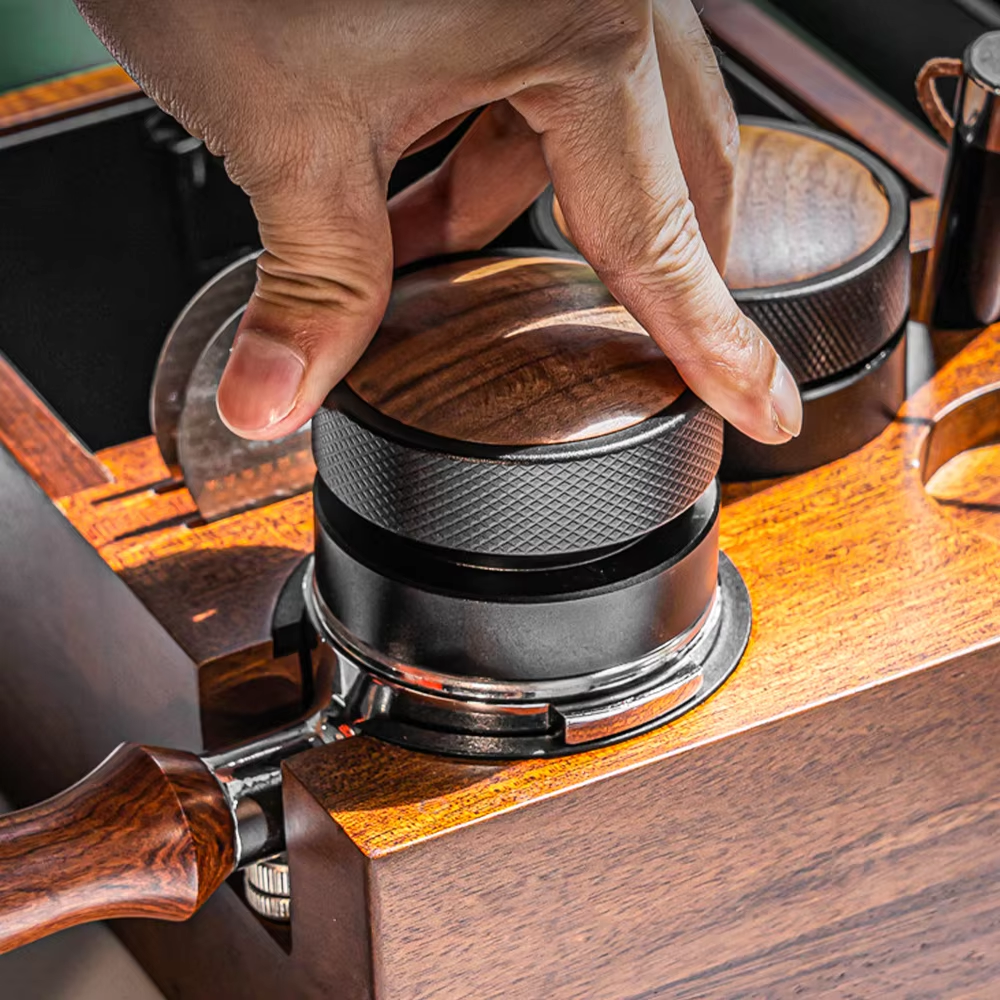
If you’ve mastered a consistent tamping routine but your espresso shots still don’t taste right, it’s time to look at the other key variables in the extraction equation.
Tamping force is important, but it doesn’t exist in isolation. It works in partnership with several other factors that you control.
Grind Size
This is the number one variable you’ll adjust to “dial in” your espresso each day. The relationship between grind size and shot time is direct and simple. Your tamping force should remain consistent while you make these adjustments.
- If your shot runs too fast (under-extracted/sour), you need to grind finer to create more resistance.
- If your shot runs too slow (over-extracted/bitter), you need to grind coarser to create less resistance.
A high-quality burr grinder is essential for making good espresso. Blade grinders produce an inconsistent mix of boulders and dust. This makes balanced extraction impossible. Brands like Baratza are renowned in the coffee community for the consistency and quality of their grinders.
Dose Amount
The dose is the weight of dry coffee grounds you put in your portafilter basket. This variable affects the “headspace”—the small gap between the top of the tamped coffee and the machine’s shower screen.
A larger dose will reduce this headspace, which can affect water dispersion and how the puck feels to tamp. A smaller dose will increase it.
The most important thing is to be consistent. Use a digital scale that measures to at least 0.1 grams to weigh your dose for every single shot. A typical double espresso dose is between 16 and 20 grams.
Tamper-to-Basket Fit
We mentioned this earlier, but it’s so critical it deserves its own section. A mismatch between your tamper and basket diameter is a hidden killer of good espresso.
Many home and commercial machines are marketed as using a 58mm basket. But this is often a nominal size. High-performance, precision baskets are often manufactured to a more exact size, like 58.4mm, 58.5mm, or even larger.
Using a standard 58.0mm tamper in a 58.5mm basket leaves a 0.25mm untamped ring of coffee around the entire perimeter. This is a superhighway for channeling.
For the best results, use digital calipers to measure the inner diameter of your specific basket. Purchase a tamper that fits as snugly as possible without binding. This small detail makes a massive difference in shot quality and consistency.
Your Path to Consistency
Mastering how much force to tamp coffee is ultimately a journey of feel and rhythm, not just numbers. The 30-pound standard is a fantastic starting point and reliable guide. But it’s not the final destination.
Your true goal is to build a preparation routine that’s unshakably consistent. From dosing and distributing to tamping and pulling the shot.
Listen to your machine. Taste your espresso critically. Don’t be afraid to experiment. By focusing on a level bed of grounds and a repeatable tamping pressure, you eliminate a major variable from the complex equation of espresso. This single act of consistency unlocks the door to truly delicious, cafe-quality espresso at home.
Continue to explore the world of brewing by checking out more coffee tools and tips on our site. As you deepen your knowledge, always trust information from authoritative bodies like the Specialty Coffee Association (SCA) to guide your journey. Happy brewing.
As a professional manufacturer specializing in the research, development, and production of Coffee machine accessories, we not only offer a diverse product selection but also support OEM/ODM customization to meet the needs of diverse markets and customers. With consistent quality control, fast delivery, and innovative designs, our coffee machines are used by numerous brands and channels worldwide. Whether you're a distributor, wholesaler, or brand owner, we can provide you with reliable solutions to help you grow your business. Contact us to explore potential collaboration opportunities.

Facebook
Twitter
LinkedIn
WhatsApp
Categories: Coffee/Brewing Tips Product Knowledge


