


12.11.2025
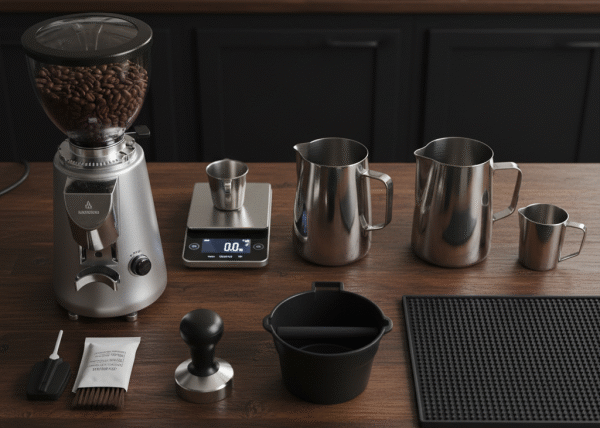
The best coffee machine accessories for cafes and coffee shops focus on three things: consistency, speed, and quality. You need essentials like a high-quality grinder, precision scale, calibrated tamper, and various milk pitchers. For excellence, consider upgrades like a distribution tool (WDT), auto-tamper, and advanced water filtration system.
This guide answers the key question: Which Coffee Machine Accessories Are Best for Cafes and Coffee Shops?
We know the challenges you face. Cafe owners need to make smart investment decisions. Head baristas want seamless workflow. Equipment distributors must stock the right products. This is your go-to resource for purchasing decisions that boost efficiency, quality, and profits.
This article breaks down essential versus upgrade accessories. We’ll give you a buyer’s guide for key items. Plus, we’ll show you how to choose tools based on their business impact.
Table of Contents
The Foundation: 7 Essential Accessories
Here’s the must-have list for any professional coffee shop. No confusion, no guesswork. New cafe owners and B2B buyers can use this as their baseline purchasing checklist.
1. The Commercial Burr Grinder
The grinder is your coffee operation’s heart. It’s arguably more important than the espresso machine for consistent, high-quality extraction.
A great grinder ensures uniform particle size. This is the foundation of a balanced shot. Look for burr type (conical vs. flat), dosing method (on-demand vs. doser), and low grind retention.
When choosing a grinder, pair it with the right machine. Check out our range of commercial espresso machines to find the perfect match.
2. The Precision Coffee Scale
A precision scale guards consistency in a professional cafe. It removes guesswork from the most critical variables in espresso preparation.
Its main job? Accurately measure the dose (ground coffee), yield (liquid espresso), and extraction time. This data lets baristas follow a recipe perfectly. Every customer gets the same great-tasting coffee.
For cafe use, you need 0.1-gram accuracy, built-in timer, water resistance, and fast response time. It must keep up with busy workflow.
3. The Calibrated Tamper
Tamping compresses coffee grounds into a dense, level puck inside the portafilter. This creates resistance against water from the espresso machine.
An even tamp ensures water flows uniformly through the coffee bed. This prevents channeling and leads to full, even extraction. A standard tamper works, but a calibrated tamper is better for teams. It clicks at preset pressure. Every barista applies the same force every time.
- Flat Base: Most common and reliable choice. Straightforward to use and excellent for creating a level coffee bed.
- Convex Base: Has a slight curve. Can help reduce side-channeling by pushing grounds towards basket edge, but requires more skill.
4. Milk Pitchers
Milk pitchers are your latte art canvas and the tool for perfectly textured milk. You cannot run a cafe with just one.
A cafe needs multiple sizes to reduce waste and improve efficiency. A 12oz (350ml) pitcher works for single cappuccinos or flat whites. A 20oz (600ml) pitcher handles larger lattes or steaming for two small drinks at once.
Spout design directly impacts the final product. A narrow, sharp spout allows intricate, detailed latte art. A wider, traditional spout works better for basic, high-volume pours.
5. The Knock Box
A knock box is simple but vital for clean, efficient workflow. It’s a container with a sturdy bar across the top for “knocking” out used coffee pucks from the portafilter.
It provides quick, clean, dedicated space for puck disposal. This prevents baristas from banging expensive portafilters on trash can edges. That can cause damage and create mess.
Countertop models suit lower-volume shops. High-volume cafes should invest in an in-counter knock box (or “chute”) that deposits pucks into a larger bin below the counter.
6. Cleaning Supplies
Proper cleaning is key to machine longevity and protecting your coffee’s taste. Neglecting this step is a costly mistake.
Essential cleaning items include a group head brush for scrubbing the shower screen, backflush basket (also called blind filter), and specialized espresso machine cleaning powder.
Poor cleaning has severe consequences. Coffee oils build up, turn rancid, and give every shot a bitter, off-taste. Scale and coffee residue can clog internal components. This leads to expensive repairs.
Clean machines are crucial. According to Urnex, a leading cleaning solutions provider, regular maintenance is vital for both flavor and machine health.
For complete maintenance routine, check our selection of coffee machine cleaning supplies.
7. The Tamping Mat
A tamping mat is a small, inexpensive piece of silicone or rubber. It protects both your equipment and countertops.
It provides stable, non-slip surface for tamping. This improves consistency and safety. More importantly, it prevents metal portafilter spouts from scratching or denting counters. It also protects the portafilter from damage.
Level Up: 5 High-Impact Accessories
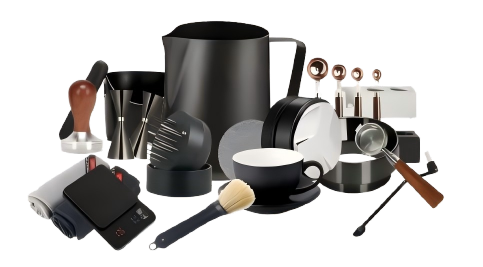
These accessories aren’t strictly essential for day-one operation. But they offer significant returns on investment in consistency, speed, and quality. They’re the next strategic step for established cafes and ambitious new owners.
1. Coffee Distribution Tool
Problem: Even with a great grinder, coffee grounds can be clumpy and unevenly distributed in the portafilter basket. This leads to channeling, where water finds the path of least resistance. Result? A sour, under-extracted shot.
Solution: A coffee distribution tool, such as a WDT (Weiss Distribution Technique) tool with fine needles or an OCD-style spinner. It breaks up clumps and evenly distributes grounds. This creates a homogenous coffee bed, leading to more uniform extraction, higher extraction yield, and noticeably better-tasting espresso.
We’ve observed the tangible difference a WDT tool makes. The post-extraction puck is drier and more uniform, with no visible holes. Clear sign of a superior shot.
The science behind this is well-documented by coffee experts like Barista Hustle, who have detailed the extensive benefits of the Weiss Distribution Technique.
2. Automatic Tamper
Problem: In a cafe with multiple baristas, ensuring everyone tamps with the same pressure is nearly impossible. This variance leads to inconsistent shot times and flavors. Additionally, repetitive tamping can cause repetitive strain injury (RSI) for baristas.
Solution: An automatic tamper, like a Puqpress, completely solves this problem. It delivers the exact same tamping pressure, perfectly level, every single time. This removes a major human variable from the equation. Result? Absolute consistency and improved ergonomics for your team.
3. Advanced Water Filtration
Problem: Standard tap water contains minerals and impurities that cause two major issues. First, limescale builds up inside your expensive espresso machine, restricting flow and damaging heating elements. Second, inconsistent or undesirable mineral content (like high chlorine) negatively affects your coffee’s flavor.
Solution: A dedicated commercial water filtration system. For ultimate protection and quality, a system combining reverse osmosis (RO) to strip water clean, followed by remineralization cartridge to add back ideal minerals for coffee extraction. This is the gold standard. It protects your investment and provides perfect water for optimal flavor.
Coffee is 98% water. The Specialty Coffee Association (SCA) has specific, detailed standards for water used in brewing. These cover pH, total hardness, and alkalinity. Meeting these precise standards is impossible without proper filtration and treatment system.
4. Puck Screen
Problem: During extraction, fine coffee grounds can be pulled upwards, sticking to the group head’s shower screen. This requires constant, vigorous cleaning between shots. It can affect water distribution for the next shot if not cleaned perfectly.
Solution: A puck screen is a thin, metal mesh disc placed directly on top of tamped coffee before brewing. It creates a physical barrier, keeping the group head almost perfectly clean. It also further improves water dispersion across the coffee surface, contributing to even more uniform extraction.
5. Portafilter and Basket Variety
Problem: A standard double-spouted portafilter with single basket size limits your diagnostic capabilities and versatility.
Solution: Your accessory kit must include multiple portafilter baskets, primarily for single and double shots, to match your menu offerings. Crucially, you should also have a bottomless (or naked) portafilter. This tool has no spouts, exposing the bottom of the basket. It’s the single best diagnostic tool for identifying channeling and other extraction flaws. It allows baristas to see espresso forming and make technique adjustments.
The Strategic Buyer's Guide
To help you decide where to invest, we’ve analyzed these coffee machines and accessories based on their impact on three key cafe metrics: Efficiency (speed/workflow), Consistency (shot-to-shot quality), and Customer Experience (perceived quality/speed), relative to their cost.
Accessory | Impact on Efficiency | Impact on Consistency | Customer Experience | Relative Cost |
Precision Scale | Medium | High | Medium | Low |
Calibrated Tamper | Medium | High | Medium | Low |
Distribution Tool (WDT) | Low | High | High | Low |
Automatic Tamper | High | High | High | High |
Water Filtration | Medium | High | High | Medium-High |
Extra Milk Pitchers | High | Low | Medium | Low |
Bottomless Portafilter | Low | High (Diagnostic) | High (Visual) | Low-Medium |
An Automatic Tamper scores ‘High’ on efficiency because it reduces a multi-second, variable step into an instant, repeatable action. This saves valuable time during rush. A Precision Scale, while low-cost, has ‘High’ impact on consistency. It’s the only way to guarantee your core recipe is followed for every shot.
The Barista's Workflow
Here’s how a world-class barista integrates these tools into a seamless process, from order to delivery. We’ve seen this process cut shot prep time by valuable seconds while virtually eliminating channeling.
Step 1: Pre-Shot Ritual
First, place the portafilter on the precision scale. Press the tare button to zero it out.
Dose coffee directly from the on-demand grinder into the portafilter until the scale displays target weight for your recipe.
Use the WDT tool with circular, stirring motion to break up all visible clumps. Create a fluffy, evenly distributed bed of grounds.
Gently tap the portafilter once or twice on the tamping mat to settle grounds into a flat surface.
Tamp using calibrated tamper to ensure consistent pressure. Or place the portafilter into automatic tamper for perfectly level and consistent bed in under two seconds.
Step 2: Extraction and Milk
Lock the portafilter into the group head. Place cup and scale underneath. Immediately start the shot and timer on the scale.
While the shot extracts, pour cold, fresh milk into appropriately sized milk pitcher for the ordered drink.
Steam milk to desired temperature and texture, creating silky microfoam.
Watch the scale closely. Stop the shot when target liquid yield is reached. The entire extraction should fall within your target time window, typically 25-32 seconds.
Step 3: Post-Shot Cleanup
As soon as the shot finishes, immediately knock the used puck firmly into the knock box. The puck should come out as a single, dry piece.
Wipe the basket clean with dry cloth. Flush the group head for a second to rinse away residual oils. Use the group head brush to scrub the screen.
This entire sequence, from scale to knock box, ensures every single coffee is made with the same methodical precision. This is the hallmark of a truly professional cafe.
For those looking to perfect their technique, attending a workshop or getting certified through an organization like the American Barista & Coffee School can provide invaluable hands-on training.
Making the Right Choice
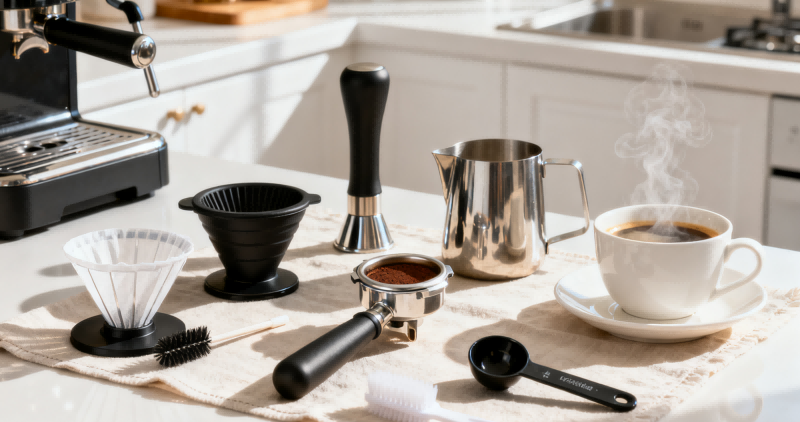
This section provides specific buying advice on key accessories where options can be overwhelming. We’ll help you avoid common purchasing mistakes.
Tampers: Materials and Weight
When selecting a tamper, you’ll encounter various materials and weights.
- Material Comparison: Stainless steel base is the undisputed industry standard. It’s durable, non-reactive, and heavy enough for solid feel. Handles are often aluminum, wood, or plastic. Aluminum is light and can be anodized in different colors. Quality hardwood handle offers premium feel.
- Weight: A heavier tamper doesn’t mean better tamp. The goal is control and consistency, not brute force. A calibrated tamper makes the tool’s weight even less relevant. The mechanism ensures correct pressure is applied regardless of user’s strength.
Milk Pitchers: Spout and Steel
Milk pitcher details matter immensely for latte art and workflow.
- Spout Shape: Sharp, defined spout, like those on many specialized latte art pitchers, offers superior control for pouring intricate designs. Traditional, more rounded spout is generally more forgiving for beginners and faster for simple pours.
- Material: Always choose 18/8 food-grade stainless steel. This material provides ideal balance of heat transfer—allowing barista to feel milk temperature through the pitcher—and durability for demanding cafe environment.
Many competitive baristas have strong preferences. For example, Latte Art World Champion Lance Hedrick often discusses the nuanced differences in pitcher design and how it impacts flow rate and pouring technique.
Grinders: Flat vs. Conical Burrs
The debate between flat and conical burrs is deep. But for cafe owners, the choice has practical implications.
- Flat Burrs: These burrs tend to produce more unimodal, or uniform, particle size distribution. This is often preferred for highlighting clean, bright, and acidic notes in single-origin espressos.
- Conical Burrs: These burrs naturally produce bimodal distribution, meaning a mix of both fine and coarse particles. This can create richer, more blended-tasting espresso with heavy body. Often more forgiving and excellent for milk-based drinks.
The choice often depends on your coffee menu and brand identity. If you need help deciding, our experts can guide you through our collection of commercial coffee grinders.
For incredibly deep technical analysis of this topic, the research on coffee particle distribution by Jonathan Gagné is essential reading for any true coffee geek.
Conclusion: Equipping For Success
Equipping your cafe for lasting success begins with a clear strategy for your accessories. It’s not about having every tool. It’s about having the right ones.
Start with non-negotiable essentials: great grinder, precision scale, calibrated tamper, multiple milk pitchers, and proper cleaning supplies. These form the bedrock of quality and consistency.
Then, strategically invest in upgrades that align with your specific goals. If your priority is absolute consistency across a large team, an automatic tamper is wise investment. If you aim to be the pinnacle of quality in your area, a WDT tool and advanced water filtration system are must-haves. The answer to “Which coffee machine accessories are best for cafes and coffee shops?” truly depends on your ambition and operational needs.
By investing in the right tools, you’re building a foundation for exceptional coffee, efficient workflow, and thriving business that keeps customers coming back. Equip your team for success. The quality of every cup will speak for itself.
As a professional manufacturer specializing in the research, development, and production of Coffee machine accessories, we not only offer a diverse product selection but also support OEM/ODM customization to meet the needs of diverse markets and customers. With consistent quality control, fast delivery, and innovative designs, our coffee machines are used by numerous brands and channels worldwide. Whether you're a distributor, wholesaler, or brand owner, we can provide you with reliable solutions to help you grow your business. Contact us to explore potential collaboration opportunities.

Facebook
Twitter
LinkedIn
WhatsApp


