


12.11.2025
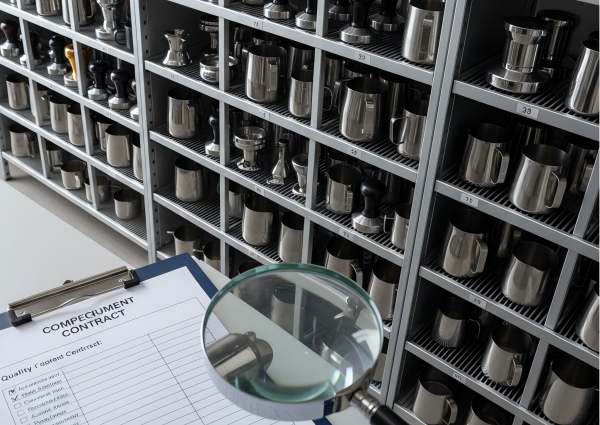
When you’re buying coffee machine accessories in bulk, what to look for goes far beyond the lowest price tag. Success means building a supply chain you can count on. This guide helps coffee equipment distributors, e-commerce entrepreneurs, and coffee chain buyers source with confidence.
Here’s your roadmap:
- Vet suppliers carefully. Don’t just browse online catalogs. Use a systematic scorecard to check factory credentials, production capacity, and communication skills.
- Never compromise on quality control. From your first sample to final shipment inspections, define clear standards for materials, function, and finish.
- Negotiate smart. Understanding cost structures helps you get better prices, payment terms, and minimum order quantities.
- Master logistics. Know your packaging requirements and shipping terms to avoid hidden costs and delays.
- Think long-term. Build partnerships, not just purchase orders.
Table of Contents
Strategic Bulk Buying
Smart bulk purchasing is more than a cost-cutting tactic. It’s a foundation for sustainable business growth in the competitive coffee market.
This isn’t about saving pennies per unit. It’s about creating a scalable, profitable brand that can compete and win.
Beyond Cost Savings
The obvious benefit of bulk orders is lower per-unit costs. When you order thousands instead of hundreds, economies of scale kick in.
Lower costs mean higher profit margins. Consolidated shipping also reduces freight expenses significantly.
These savings give you capital for marketing, product development, or more competitive pricing. That’s real competitive advantage.
Brand and Customer Experience
Consistency builds trust. When customers buy your products online, in stores, or through partners, they expect the same quality every time.
A single, qualified bulk supplier ensures this consistency. Every milk pitcher weighs the same. Every tamper has the same finish. Every gasket fits perfectly.
This reliability protects your brand reputation and reduces negative reviews. For commercial coffee machine parts sourcing, consistency is everything.
Supply Chain Stability
Global markets are unpredictable. Price swings, shipping delays, and material shortages can hurt your business overnight.
A reliable bulk supplier reduces these risks. Strong partnerships provide better visibility into production schedules and potential problems.
You avoid stockouts that damage e-commerce rankings and retail relationships. This stability protects your business continuity.
Vetting and Qualifying Suppliers

Finding the right supplier requires a systematic five-step process. This framework turns an overwhelming search into a manageable, data-driven decision.
1. Sourcing Channels
Your search for wholesale coffee accessories starts across multiple channels. Each has unique benefits.
Digital platforms like Alibaba and Global Sources offer huge selections. They’re great for research but need careful verification. Look for suppliers with years of platform experience, verified credentials, and high response rates.
Trade shows like World of Coffee or HOST Milano offer face-to-face meetings. You can handle products, meet teams, and assess professionalism directly.
Industry referrals are often most reliable. Ask non-competing peers for recommendations. Trusted referrals can shortcut much of the initial screening.
2. Initial Screening
Once you have potential suppliers, start quick screening to eliminate unqualified candidates.
Check company profiles. Verify business licenses and operating history. Factories operating over a decade are usually more stable.
Review their product focus. Do they specialize in coffee machine accessories or sell everything? Specialists typically have better technical knowledge and quality control.
3. Deep-Dive Evaluation
This critical step in coffee equipment supplier vetting uses a scorecard for objective comparison. This structured approach removes emotion and focuses on key metrics.
The Supplier Vetting Scorecard provides practical evaluation criteria.
Criteria | What to Look For | Ideal Response |
Company Credentials | Verified status on platforms, export history, key export markets (e.g., North America, EU). | 10+ years in business, verified, exports to your target market. |
Certifications | Quality management (ISO 9001), social compliance (BSCI). | Possesses valid ISO 9001 and/or BSCI certificates. |
Production Capacity | Factory size (sq. meters), number of employees, stated monthly output for your product category. | Clear figures provided, capacity comfortably exceeds your order volume. |
Technical Capability | In-house R&D team, OEM/ODM experience, mold-making ability for new designs. | Dedicated engineering team, extensive portfolio of OEM/ODM projects. |
Communication | English proficiency of sales contact, response time (under 24 hours), clarity of answers to technical questions. | Fluent English, fast and detailed responses. |
References | Willingness to provide contact information for 1-2 existing clients in non-competing regions. | Eager to provide references and confident in their client relationships. |
Certifications like ISO 9001 matter beyond logos. ISO 9001 shows the factory has a documented, audited Quality Management System for consistent output.
For private label coffee accessories, technical capability is crucial. OEM/ODM experience shows they can turn your designs into reality. Ask about their custom manufacturing services and review past projects.
4. RFQ and Samples
Send formal Request for Quotation (RFQ) documents to shortlisted suppliers. Clear RFQs get accurate responses.
Include product specifications (materials, dimensions, weight, finish), order quantities, packaging requirements, and target prices. More detail means more accurate quotes.
Always request and pay for samples. A supplier’s willingness to produce quality samples, even for a fee, shows commitment. Paying signals you’re a serious buyer.
5. Red Flags
Watch for warning signs during the vetting process that indicate problematic suppliers.
Refusing to provide business licenses, certifications, or references is a major red flag. Transparency builds trust.
Vague answers about materials or production processes are concerning.
Demanding 100% upfront payment, especially outside secure platforms like Alibaba Trade Assurance, is very risky.
If sample quality is poor, it reflects their best effort. Mass production won’t be better.
Quality and Consistency
Your brand reputation depends on product quality. Comprehensive quality control is essential for bulk purchases. This section covers everything from benchmark samples to final shipments.
The “Golden Sample”
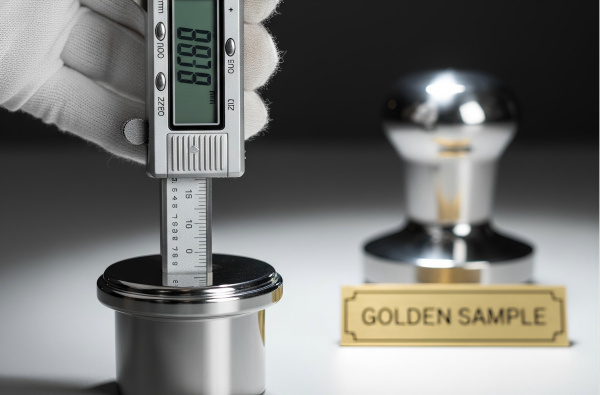
Once you approve a sample, it becomes your “Golden Sample.” This physical benchmark measures all mass-produced units.
Don’t just approve visually. Document everything meticulously. Take high-resolution photos and videos from all angles. Measure dimensions with calipers. Record exact weight.
This documentation becomes part of your contract. It gives you objective tools to resolve quality disputes later.
Quality Inspection Checklist
Create detailed Quality Inspection Checklists for every product. Use these for your own checks and provide them to third-party inspectors. This is core to professional quality control for coffee products.
Here are examples for common accessories.
For Metal Accessories (Tampers, Milk Pitchers):
- Material: Specify exact steel grades like 304 food-grade stainless steel. Verify with handheld XRF analyzers if needed. Learn about stainless steel grades from reputable sources.
- Workmanship: Feel milk pitcher spout edges—smooth or sharp? Check handle-to-body welds—seamless or rough? Quality welds are smooth and clean.
- Finish: Check under bright lights for scratches, polishing marks, or coating inconsistencies. For bulk coffee tampers and pitchers, finish indicates production care.
- Function: Does the tamper base fit 58mm portafilters precisely without sticking or wobbling? Is weight correct and handle secure?
For Silicone & Rubber Accessories (Gaskets, Tamping Mats):
- Material: Check for odors. Strong chemical smells indicate low-grade materials or improper curing.
- Finish: Look for excess “flashing”—thin extra material from molding. Bend gaskets—do they show white stress marks or feel brittle? They should be flexible and return to shape.
- Dimensions: Group head gasket inner and outer diameters must be exact. Even small deviations can cause poor seals.
For All Products:
- Packaging: Are retail boxes free of scuffs and printing errors? Do barcodes scan correctly? Is the product secure?
- Consistency: Pull 5-10 random units during inspections. Compare them side-by-side. Are they identical in color, weight, and finish? This quickly gauges production consistency.
Pre-Shipment Inspections
Never ship bulk orders without Pre-Shipment Inspections (PSI). This is your final chance to catch problems before goods leave the factory and you pay final balances.
You can send your own agent or hire professional third-party services like QIMA, Bureau Veritas, or SGS. For most buyers, third-party services are more cost-effective.
These inspections typically use AQL (Acceptable Quality Limit) standards. AQL is a statistical method determining maximum defective units allowed in batches. For consumer goods, AQL 2.5 is common, meaning no more than 2.5% can have minor defects.
The Art of the Deal
Negotiation is critical in any coffee shop procurement guide. To negotiate confidently, understand costs and available levers.
This isn’t about squeezing suppliers. It’s about creating fair, sustainable deals for both parties.
Understanding Cost Structure
To negotiate intelligently, understand what you’re paying for. Accessory prices are sums of their parts. Here’s a sample cost breakdown for stainless steel milk pitchers.
Cost Component | Description | Typical % of Cost | Negotiation Lever |
Raw Materials | Stainless steel, handle material. | 30-40% | Lock prices based on commodity markets; larger orders let suppliers buy materials cheaper. |
Manufacturing | Stamping, welding, polishing, labor. | 20-30% | Larger volumes reduce per-unit setup and labor costs. |
Tooling/Molding | (For new designs) One-time cost. | N/A (amortized) | Co-invest, commit to high volumes for amortization, or pay separately. |
Packaging | Retail boxes, printing, protective inserts. | 5-10% | Simplify designs, use standard sizes, or order packaging in larger bulk. |
Overhead & Margin | Factory profit, admin, R&D. | 20-30% | Negotiate based on long-term partnership value and consistent future orders. |
Key Negotiation Levers
Price is only one deal component. Often the best value comes from negotiating other terms.
Volume Breaks: Always ask for tiered pricing. What’s the price for 1,000, 5,000, and 10,000 units? This helps plan growth.
Payment Terms: This hugely impacts cash flow. New suppliers may want 50% deposit and 50% before shipment. Fair standard terms are 30% deposit and 70% after PSI passes but before shipment.
Incoterms: Negotiating from EXW (Ex Works) to FOB (Free On Board) can save significant local logistics hassles and costs. We’ll cover this more next.
Long-Term Agreements: Use future business promises as leverage. Suppliers offer better terms to partners than one-time buyers. This builds lasting supplier partnerships.
MOQ (Minimum Order Quantity): If supplier MOQs are too high for new product launches, ask about paying small premiums for lower quantity test runs. You can also ask about combining orders with similar products from other customers.
Mastering Logistics
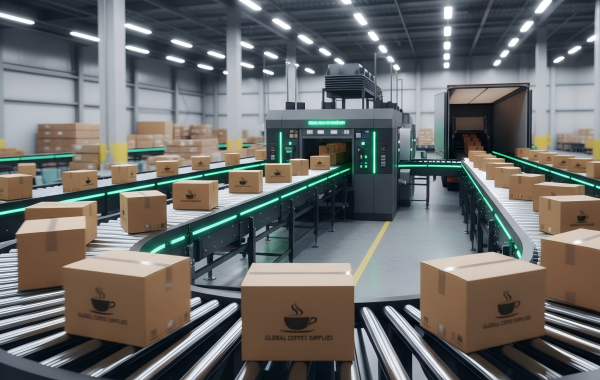
Getting products from factory floors to your warehouse safely and cost-effectively completes the puzzle. Mastering logistics for importing coffee machine accessories is crucial.
Packaging for Protection
Your products face rough journeys. They’ll be loaded, unloaded, and potentially dropped multiple times. Packaging is their only defense.
Specify inner packaging. For polished steel tampers, this might be soft poly bags or custom foam inserts preventing scratches.
Define master carton specifications. Insist on double-walled corrugated cardboard. Set maximum weights per carton (15kg or 35lbs) to make them manageable and less likely to be dropped. You can specify cartons must pass corner drop tests.
Use clear shipping marks. Label each master carton with SKUs, quantities, carton numbers (1 of 200), country of origin, and required handling symbols. This is critical for customs clearance and warehouse receiving.
Decoding Incoterms
Incoterms® are globally recognized rules defining seller and buyer responsibilities. Understanding basics is essential to avoid unexpected costs. The International Chamber of Commerce (ICC) is the definitive source.
Incoterm | Who is Responsible? | Best For |
EXW (Ex Works) | You (buyer) handle everything from factory doors, including loading trucks in origin countries. | Buyers with agents or offices in origin countries. High risk, high control. |
FOB (Free On Board) | Suppliers handle all costs and risks until goods load onto vessels at designated ports. You take over from there. | Most buyers. Most common and balanced term, providing good cost control without local transport hassles. |
DDP (Delivered Duty Paid) | Suppliers handle everything, including shipping, customs, duties, and final delivery to your warehouse. | Buyers wanting maximum convenience and willing to pay premiums. Least cost control. |
For most buyers sourcing from Asia, FOB is recommended. It gives control over expensive international shipping legs, allowing you to choose freight forwarders.
Choosing a Freight Forwarder
Freight forwarders are your logistics partners. They don’t own ships or planes but orchestrate entire shipping processes, from booking space and handling customs to arranging final delivery.
Get quotes from multiple forwarders. Compare rates for sea and air freight. Sea freight is cheaper but slower (30-40 days), while air freight is fast (5-10 days) but significantly more expensive. Major carriers like FedEx offer comprehensive international shipping guides.
Your forwarder handles complex paperwork, but you’re ultimately responsible for providing accurate information. Clear communication is key.
Conclusion: Your Action Plan
Buying coffee machine accessories in bulk is a defining capability for serious coffee industry players. Moving from price-first to value-first strategies transforms simple purchases into competitive advantages. You build brands on foundations of quality, reliability, and profitability.
Your action plan is clear and repeatable.
- Vet rigorously: Use scorecards to choose partners, not just suppliers. If you’re looking for partners meeting these high standards, learn about our manufacturing process.
- Control quality obsessively: Trust but verify at every stage, from golden samples to pre-shipment inspections.
- Negotiate intelligently: Understand complete cost structures to create long-term win-win deals.
- Plan logistics proactively: Define packaging and shipping terms clearly to protect investments and avoid costly surprises.
- Build for the long term: Cultivate true partnerships with suppliers that foster mutual growth and resilience in changing markets.
Following this professional framework means you’re not just buying parts. You’re building the backbone of your coffee business.
As a professional manufacturer specializing in the research, development, and production of Coffee machine accessories, we not only offer a diverse product selection but also support OEM/ODM customization to meet the needs of diverse markets and customers. With consistent quality control, fast delivery, and innovative designs, our coffee machines are used by numerous brands and channels worldwide. Whether you're a distributor, wholesaler, or brand owner, we can provide you with reliable solutions to help you grow your business. Contact us to explore potential collaboration opportunities.
Facebook
Twitter
LinkedIn
WhatsApp


