


31.10.2025
The quest for the perfect home-brewed coffee starts with good beans. But it’s perfected with the right grind. You’ve figured out your water temperature. You’ve mastered your brew time. Yet something’s still missing. This brings you to the most important piece of equipment—one that’s often overlooked: the coffee grinder.
The key question becomes obvious. Are manual coffee grinders better than electric ones? The internet buzzes with passionate debates on both sides. This can leave newcomers feeling confused rather than confident.
This guide cuts through that noise. We’ll explore real-world differences between manual and electric grinders. We’ll compare grind quality, cost, user experience, and portability. Our goal is simple: give you a clear framework to decide which tool fits your coffee journey.
Table of Contents
The Quick Answer
Want a fast takeaway? Here it is: for flavor potential per dollar and unmatched portability, yes, a manual grinder often wins. For speed, high-volume brewing, and push-button convenience, no—an electric grinder takes the crown.
But this simple answer misses the point. The better question isn’t “Are manual grinders better?” It’s “Is a manual coffee grinder better for you?”
To answer that, consider what matters most to you. We’ll help you explore these factors:
- Your budget and what you expect for your money.
- Your daily coffee habits (how many cups you make).
- Where you plan to drink your coffee (at home, in the office, or on a mountaintop).
- How much you value the process and ritual of making coffee.
These questions will guide you to the grinder that suits your lifestyle. Not just one that’s “better” on paper.
Manual vs. Electric
To understand the trade-offs, let’s compare these grinder types head-to-head. Here are six key areas that will impact your daily coffee experience.
Feature | Manual Grinder | Electric Grinder |
Grind Quality & Value | Exceptional consistency for the price; outperforms electrics in same range. | Requires a higher investment ($300+) for comparable consistency. |
Cost | Lower entry point for high-quality burrs ($80 – $250). | More expensive due to motor, electronics, and housing ($150 – $1000+). |
User Experience | A quiet, tactile, and mindful ritual. | A fast, loud, and efficient routine. |
Portability | Excellent. Compact, lightweight, and requires no power. Ideal for travel. | Poor. Bulky, heavy, and requires an electrical outlet. |
Noise Level | Very quiet. A gentle, low-frequency hum. | Very loud. A high-pitched, disruptive whine. |
Durability | Extremely durable. Simple mechanics with few failure points. Can last a lifetime. | Less durable. Motors and electronics can fail over time. |
Grind Quality and Consistency
Grind consistency is the most important factor for brewing delicious coffee. When coffee beans are ground, you want uniform particle sizes.
Inconsistent grinding creates a mix of large particles (“boulders”) and very fine particles (“fines”). During brewing, water over-extracts the fines, creating bitterness. It under-extracts the boulders, leaving a sour, weak taste. The result is a muddled, unbalanced cup.
This is where high-quality manual grinders shine. Their simple, direct-drive design and stable internal structure produce remarkably consistent grinds. A well-made hand grinder often matches the uniformity of electric grinders costing two or three times more. Coffee experts at Perfect Daily Grind explain that uniform particles are key to clean, sweet, balanced extraction.
Cost and Value
When buying a coffee grinder, you’re primarily paying for burr quality and mechanism stability. This is where manual coffee grinders offer undeniable value.
A $150 manual grinder often contains burrs and bearing systems you’d only find in $400+ electric models. Why the huge price difference? With manual grinders, your money goes directly into components that matter for flavor: precision-engineered burrs and robust construction.
There’s no motor, complex electronics, or fancy digital display inflating the cost. You’re paying for pure grinding performance. This makes it the most cost-effective path to café-quality taste at home.
The User Experience
Choosing between manual and electric is choosing between ritual and routine. Electric grinders offer routine: add beans, push button, receive grounds in seconds. It’s fast, efficient, and detached.
Using a hand coffee grinder is ritual. It forces you to slow down and engage with the process. You feel tactile feedback as burrs slice through beans. You hear the quiet, satisfying crunch. You smell incredible aromas that bloom as grounds collect in the catch cup. For many, this mindful five-minute process becomes a cherished morning moment.
Portability and Convenience
Here, there’s no contest. Manual coffee grinders are the ultimate portable solution. They’re compact enough to fit inside an AeroPress. Lightweight enough for any backpack. Durable enough to withstand travel rigors.
Since they’re completely unplugged, you can make exceptional coffee anywhere you can boil water—hotel rooms, campsites, office desks, or remote cabins. This freedom to have great coffee anywhere is often the deciding factor. Electric grinders, by contrast, are tethered to kitchen counters.
The Noise Level
The first time you use an electric grinder at 6 a.m., you understand its biggest social drawback. Most electric grinders produce loud, high-pitched whines that easily wake sleeping partners, children, or roommates.
Manual grinders are silent achievers. They produce gentle, low-frequency whirring sounds barely audible in the next room. This quality-of-life benefit is a game-changer for early risers or anyone in shared spaces. You can grind coffee peacefully without announcing it to the entire household.
Durability and Maintenance
Simplicity leads to longevity. Manual grinders have very few moving parts. This means very few things can break. There’s no motor to burn out, no circuit board to fry, no complex auger system to jam.
Well-made manual grinders, crafted from stainless steel or aluminum alloy, are investments that can genuinely last lifetimes with minimal care. Cleaning is straightforward, as most can be easily disassembled to brush old grounds from burrs.
While manual grinders are built to last, they aren’t for everyone. For those prioritizing speed over portability, exploring electric grinder options might be better.
Anatomy of a Grinder
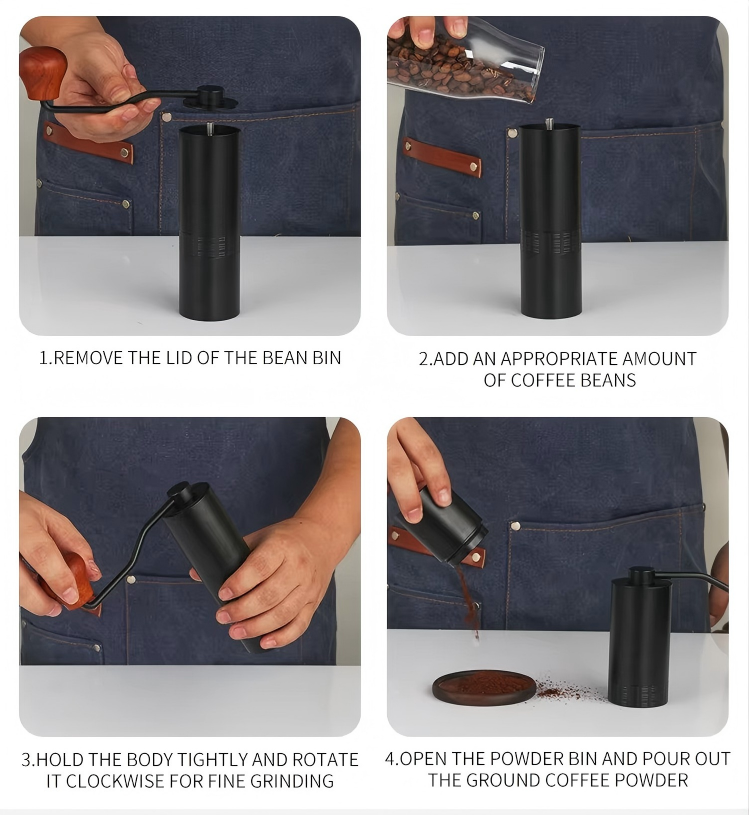
Not all manual grinders are created equal. The market floods with cheap, sub-$30 models featuring wobbly handles and ceramic burrs. These create frustrating experiences and poor-tasting cups.
Understanding what goes on “under the hood” separates $20 toys from $200 precision instruments. These components define great manual coffee grinders.
The Heart: Burrs
Burrs do the actual grinding work. Their material and geometry are critical. Most manual grinders use conical burrs. The key difference lies in material.
Ceramic burrs are common in entry-level grinders. They hold edges for long periods and don’t conduct much heat. But they’re brittle and can chip or break if small stones find their way into beans. They also grind much slower than steel.
Stainless steel burrs are the standard for premium manual grinders. They’re significantly sharper, allowing faster cuts through beans with less effort. They’re also far more durable. These burrs are often precision-machined (CNC) to create complex geometries designed to minimize fines and produce consistent grind profiles optimized for pour-over or espresso.
The Hero: Axle and Bearings
This is the secret to consistency and what truly separates budget grinders from premium ones. Burrs are mounted on central axles. In cheap grinders, this axle is held by simple plastic or metal sleeves. As you turn the handle, the axle wobbles, causing burr distance to change constantly. This wobble primarily causes inconsistent grinds.
Premium grinders solve this with dual-bearing systems. They place one bearing at the axle top and another near the burrs. These bearings lock axles firmly in place, eliminating wobble. This stability ensures burrs remain perfectly parallel throughout entire rotations, resulting in exceptional grind consistency. When you hold well-engineered grinders, you can feel it: rotation is smooth, stable, and effortless—clear signs of quality.
Ergonomics and Build
Grinders should be joyful to use, not chores. Build quality and ergonomics play huge roles in daily experience. High-quality grinders use durable, lightweight materials like aluminum alloy or stainless steel for main bodies.
Handle design, length, and knob shape all affect leverage and comfort during grinding. Good designs make grinding 20 grams of coffee feel effortless and quick, usually taking under a minute.
Well-designed grinders combine all these elements. For instance, the Manual coffee grinder – coffmach is engineered with focus on stable axles and durable steel burrs. It provides great entry points into quality grinding without huge investments. It brings together essential premium grinder components in accessible packages.
Who Needs a Manual Grinder?
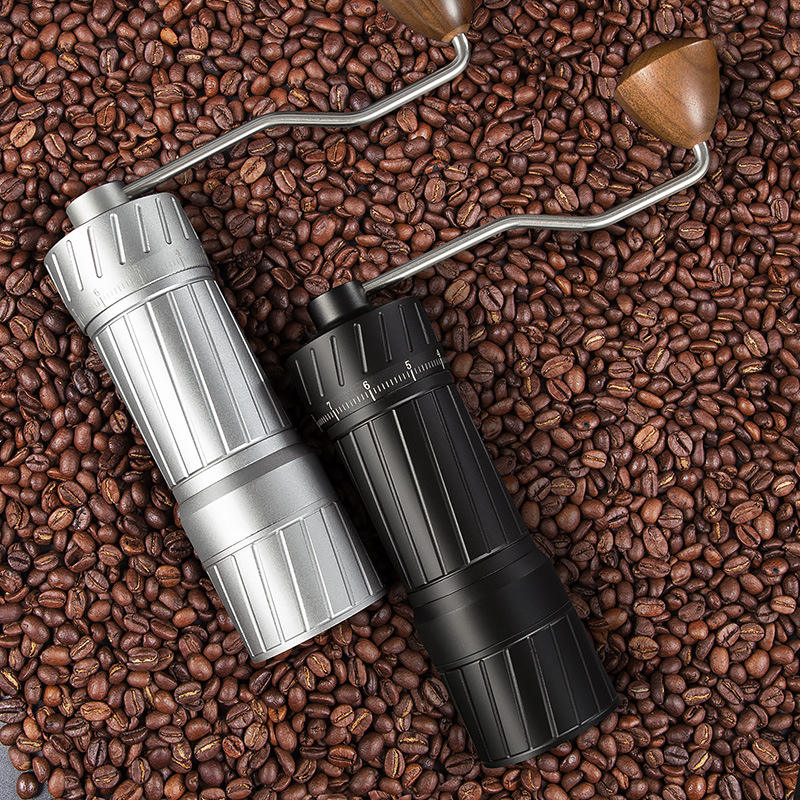
Now that you understand mechanics and trade-offs, let’s connect them to real-world needs. Manual coffee grinders aren’t just tools—they’re solutions for specific coffee drinker types. See which profile fits you best.
The Aspiring Home Barista
Your goal is unlocking maximum flavor from specialty coffee beans without spending fortunes on equipment. You’re willing to trade some time for significant taste quality leaps.
For you, manual grinders are perfect starting points. They offer:
- Access to “pro-level” grind consistency at entry-level prices.
- Ability to fine-tune grind sizes for different brewing methods like pour-over, French press, or AeroPress.
- Deeper understanding of how grind size impacts extraction—fundamental barista skills.
The Traveler and Adventurer
Your goal is having great coffee wherever you go, whether on business trips or backcountry trails. You refuse to settle for instant coffee or hotel room pods.
Portable coffee grinders are essential travel companions. They provide:
- Total independence from power outlets.
- Compact, lightweight form factors fitting easily into any bag.
- Durability to handle being knocked around in suitcases or backpacks.
The Minimalist Coffee Lover
Your goal is simple, uncluttered kitchens and mindful morning routines. You appreciate beautifully designed, functional objects that serve single purposes well.
Manual grinders fit perfectly into your philosophy. They offer:
- Small footprints that keep countertops clear.
- Quiet, meditative processes contrasting with modern life noise, aligning with “slow coffee” movement principles.
- Aesthetic appeal, with many grinders being beautifully crafted objects you’ll proudly display.
The Wholesale or Retail Buyer
Your goal is understanding core manual grinder advantages to make smart procurement decisions or effectively market them to customers. You need to know key selling points.
From business perspectives, manual grinders offer:
- High-value propositions appealing to budget-conscious and discerning customers alike.
- Exceptional durability and simple mechanics, leading to low return rates and high customer satisfaction.
- Products tapping into growing market segments, including specialty coffee, outdoor recreation, and minimalist lifestyles.
Understanding these benefits is key to building compelling product catalogs. To learn more about our company’s philosophy on quality coffee equipment, you can read about us here. For specific wholesale inquiries, feel free to contact us directly.
When Electric is Smarter
To provide truly balanced views, we must acknowledge that manual grinders aren’t universal solutions. In several clear scenarios, electric grinders are superior and more practical choices.
High-Volume Needs
If you regularly make coffee for large families, brew for offices, or serve guests, the time and effort required to hand-grind large bean quantities becomes impractical. Electric grinder speed is non-negotiable in these situations. Pushing buttons and getting 60 grams of coffee in 20 seconds is necessary convenience.
Convenience is King
Some users simply value “push-button” lifestyles. Their morning routines are packed. The primary goal is getting good coffee as quickly and effortlessly as possible. For these users, time and physical effort saved by electric grinders will always outweigh ritualistic and portable benefits of manual ones. There’s no right or wrong preference—it’s about personal priorities.
Dialing in Espresso
While high-end manual grinders are fantastic for espresso, “dialing in” shots can be more convenient on specialized electric espresso grinders. Dialing in requires making very small, frequent grind size adjustments to perfect extraction times. According to the Specialty Coffee Association (SCA), precision is paramount for espresso. Stepless or micro-step electric grinders make these tiny tweaks faster and more repeatable, which can significantly advantage espresso workflows.
Conclusion
So, we return to our original question: are manual coffee grinders better? As we’ve seen, the answer isn’t simple yes or no. The right grinder aligns with your priorities.
Manual coffee grinders are better if you prioritize flavor quality per dollar, portability, quiet operation, and hands-on, rewarding coffee rituals. They represent the most affordable paths to exceptional coffee.
Electric grinders are better if you prioritize speed, convenience, and high-volume brewing. They’re right tools for busy households and those valuing efficiency above all else.
Choosing the right grinder is the first and most impactful step toward more enjoyable and flavorful coffee journeys. It’s more than just a tool—it’s your partner in daily pursuit of the perfect cup.
As a professional manufacturer specializing in the research, development, and production of Coffee machine accessories, we not only offer a diverse product selection but also support OEM/ODM customization to meet the needs of diverse markets and customers. With consistent quality control, fast delivery, and innovative designs, our coffee machines are used by numerous brands and channels worldwide. Whether you're a distributor, wholesaler, or brand owner, we can provide you with reliable solutions to help you grow your business. Contact us to explore potential collaboration opportunities.

Facebook
Twitter
LinkedIn
WhatsApp
Categories: Buying/Customization Guide Product Knowledge


