C o f f e e - f a c t o r y
Ever wondered what are the parts of a coffee machine called? You’re about to discover a fascinating world. Coffee machines range from simple drip brewers to gleaming commercial espresso machines. The component names might seem confusing at first, but learning them is your key to better coffee.
 
This knowledge gives you power. You’ll transform from a basic user into someone who can fix problems and maintain their equipment. You’ll truly appreciate the engineering behind every cup.
 
We’re here to be your complete guide. We’ll explain every lever, knob, and internal part for major machine types. This gives you confidence to chat with baristas, solve problems, or make smarter purchases.

Table of Contents

Universal Coffee Machine Components

Most machines share a few core parts, no matter how complex they are. These form the foundation of any brewing system. Understanding these universal components gives you a solid base before we explore specific machine details.
 
We’ve organized these basic coffee machine parts into a simple table. This helps you quickly learn each part’s name, function, and typical location.
Part Name
Primary Function
Commonly Found In
Water Reservoir / Tank
Holds the cold water that will be used for brewing.
Espresso, Drip, Pod, Super-Automatic Machines
Heating Element
Heats the water from the reservoir to the optimal brewing temperature.
All electric coffee machines.
Housing / Body
The external casing that protects the internal components and provides the machine’s structure.
All machines.
Drip Tray
A removable tray that sits under the dispensing area to catch drips, spills, and overflow.
Espresso, Pod, Super-Automatic Machines
Control Panel / Buttons
The user interface, including power switches, brew buttons, and programming options.
All electric machines.

Espresso Machine Parts Explained

Detailed introduction of espresso machine
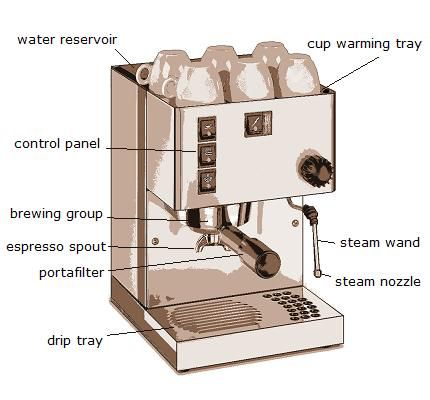
The espresso machine sits at the heart of serious coffee setups. It’s complex equipment where pressure, temperature, and precision work together. To master espresso, you need to understand coffee maker parts and how they function in this specific context.
 
Let’s follow water’s journey as it becomes perfect espresso. This detailed section targets enthusiasts and professionals who want complete machine knowledge.
 

Water and Heating System

 
This powers the entire machine. These parts take water, heat it precisely, and deliver it under intense pressure. The system’s quality and design directly affect performance and consistency.
 
Everything starts at the water reservoir. This removable plastic or glass tank holds fresh, cold water. Commercial and high-end home machines often use direct plumbing instead, providing constant water supply.
 
Water then moves to the pump. The pump creates the high pressure needed for true espresso extraction. Industry standard is 9 bars of pressure. You’ll find two types: vibratory pumps (smaller, common in home machines) and rotary pumps (larger, quieter, found in commercial and prosumer machines).
 
Next, water enters the boiler. This metal tank contains the heating element and forms the machine’s thermal core. Boiler design massively impacts workflow. Single boilers must switch between lower brewing temperature (around 93°C / 200°F) and higher steaming temperature (around 120°C / 250°F), requiring waiting periods.
 
Heat exchanger machines have one large steam boiler with a brew water tube running through it. This allows simultaneous brewing and steaming. Dual boiler machines represent the top tier, featuring separate dedicated boilers for brewing and steaming. They offer ultimate temperature stability and performance.
 
Many advanced machines include a PID Controller. This stands for Proportional-Integral-Derivative. It’s sophisticated digital control that replaces simple thermostats, pulsing the heating element to maintain incredibly accurate water temperature, often within one degree. This stability ensures shot-to-shot consistency.
 

The Grouphead Assembly

 
The grouphead is where magic happens. It’s the heavy metal component on the machine’s front where brewing becomes visible. Its main job is receiving pressurized hot water from the boiler and distributing it evenly over coffee grounds in the portafilter.
 
The most famous design is the E61 grouphead – a large brass component that’s externally mounted. It’s known for thermal stability, heated by water circulating from the boiler. It also includes mechanical pre-infusion, which gently wets the coffee puck before applying full pressure. This reduces channeling and improves extraction.
 
Inside the grouphead, you’ll find the dispersion screen (often called shower screen). This perforated metal disc is the last part water touches before hitting coffee. It turns the single water stream from the boiler into a gentle, even shower, ensuring uniform coffee puck saturation.
 
The group gasket creates a seal between grouphead and portafilter. This thick rubber or silicone ring sits inside the grouphead. When you lock the portafilter in, the gasket compresses to create a high-pressure, watertight seal. Since it faces constant heat and pressure, this is one of the most common maintenance parts requiring replacement.
 
For machines with high-quality groupheads, check our guide to the best espresso machines.
 

Portafilter and Baskets

 
These are the hands-on parts you use for every shot. The portafilter (sometimes called group handle) is the device with a handle and metal basket that holds ground coffee. You lock this into the grouphead to start brewing.
 
Portafilters come in two main styles. Spouted portafilters have one or two spouts on the bottom that guide espresso into your cup. Bottomless portafilters (also called naked portafilters) have no bottom or spouts. They expose the filter basket’s bottom, letting you watch extraction happen.
 
We’ve found that switching to a bottomless portafilter is the best way to diagnose tamping and distribution problems. You can see channeling in real-time – where water punches through the puck – appearing as spurts or uneven streams. This visual feedback is invaluable for improving technique.
 
The filter basket sits inside the portafilter. This metal basket holds the coffee grounds. They come in different sizes: single shot, double shot, or triple shot baskets for different coffee doses.
 
Filter baskets are either pressurized or non-pressurized. Pressurized baskets have one small bottom hole that artificially creates pressure and foam-like crema. They’re forgiving for beginners using pre-ground coffee or basic grinders. Non-pressurized baskets have hundreds of tiny holes and rely entirely on fine, even coffee grind to create resistance and pressure. These are standard for professional and enthusiast use, allowing true crema and nuanced extraction.
 

Steam and Hot Water System

 
This system handles milk-based drinks and other hot water needs. It separates basic espresso makers from machines capable of producing lattes, cappuccinos, and Americanos.
 
The most prominent feature is the steam wand. This articulated metal arm injects high-pressure steam into milk, simultaneously heating it and creating fine-textured microfoam. The steam wand tip has small holes – typically one to four – which affect power and vortex patterns in milk.
 
A steam knob or lever controls the steam wand. Knobs provide variable steam pressure control, while levers often work as simple on/off switches (though some offer secondary, lower-pressure positions).
 
Many machines include a separate hot water dispenser. This simple spout provides hot water directly from the boiler. It’s perfect for making Americanos (espresso shots topped with hot water) or pre-heating cups before brewing, which helps maintain finished drink temperature.

Drip Coffee Maker Parts

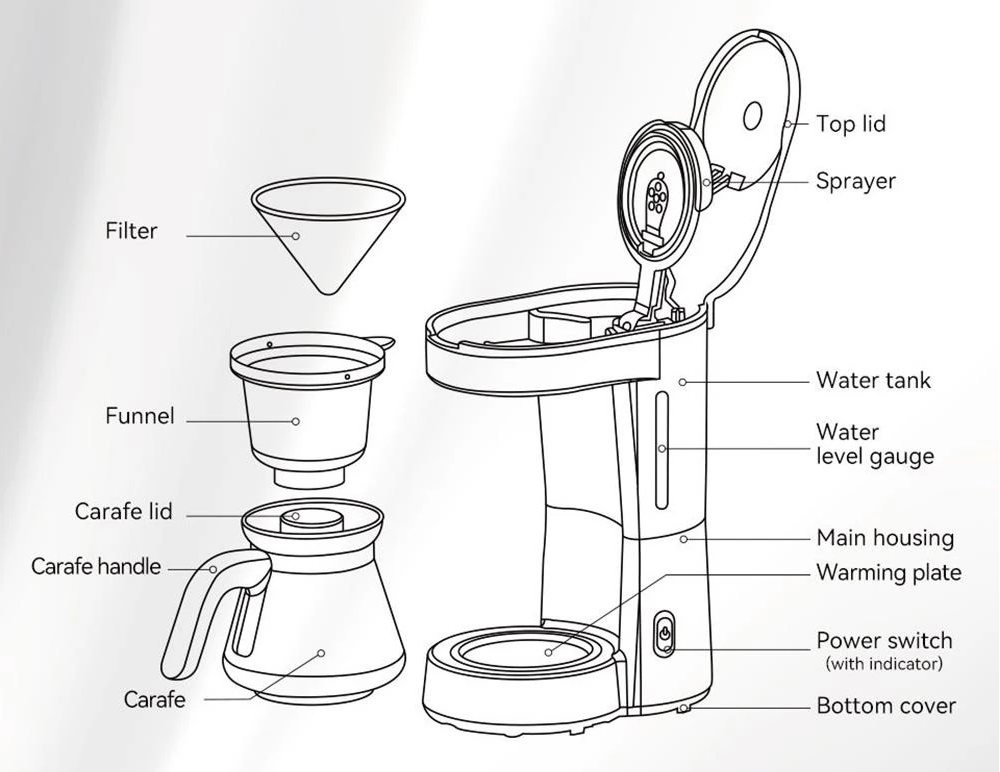
The automatic drip coffee maker is a modern kitchen icon, loved for simplicity and convenience. While less complex than espresso machines, understanding its components still helps you brew better coffee and maintain your machine. Let’s walk through typical coffee maker parts from top to bottom.
 
Water Reservoir: This holds cold water for brewing. Most reservoirs have measurement lines (4, 6, 8 cups) to help match water amounts to coffee grounds.
 
Showerhead: After heating, water travels up a tube and disperses over coffee grounds via the showerhead. This part’s design is crucial. Simple, single-hole designs can create channels in the coffee bed, causing uneven extraction. Multi-hole showerheads provide much better coverage, saturating grounds more evenly for balanced flavor.
 
Filter Basket: This cone-shaped or flat-bottomed holder contains your coffee filter. It can be removable or a swing-out drawer. Some machines include permanent filters – usually fine mesh gold-tone metal or plastic – as reusable alternatives to paper filters.
 
Carafe (Pot): The carafe catches brewed coffee. Two main types exist, and the difference matters. Glass carafes are classic but must sit on hot plates to stay warm. Thermal carafes have double-walled, vacuum-insulated construction like thermoses. They keep coffee hot for hours independently.
 
Hot Plate (Warming Plate): This heating element sits at the machine’s base, directly under glass carafes. Its only purpose is keeping brewed coffee warm. However, continuous heating can “cook” coffee, developing bitter, burnt, or stale tastes over time. This is why many coffee lovers prefer thermal carafe machines.

Common Issues and Troubleshooting

Knowing what are the parts of a coffee machine called becomes most useful when problems arise. By connecting symptoms to specific components, you can quickly diagnose issues and often fix them yourself. This knowledge is fundamental to effective coffee machine maintenance.
 
We’ve created a troubleshooting guide to help identify likely culprits behind common coffee machine failures. This turns abstract part knowledge into practical, actionable advice.
The Problem (Symptom)
The Likely Culprit (Part Name)
What to Check or Do
Espresso shot is watery / has no crema
Portafilter Basket / Grinder
If you’re using a non-pressurized basket, the issue is almost certainly your coffee grind. It is too coarse to provide enough resistance. The problem lies with your grinder’s setting or quality, not the espresso machine itself.
Water leaking around the portafilter
Group Gasket
The rubber gasket inside the grouphead is likely old, hardened, or has coffee grounds stuck to it. Clean it with a brush. If it’s hard to the touch or cracked, it’s time to replace it.
Machine is on but water isn’t heating
Heating Element / Thermostat
This usually points to an internal electrical failure. Check if a thermal fuse has tripped (some machines have a reset button). Otherwise, this often requires professional service.
Drip coffee tastes bitter or burnt
Hot Plate / Carafe Type
If you are using a glass carafe, the hot plate is continuously cooking your coffee. To avoid this, drink the coffee immediately after brewing or transfer it to a separate thermal flask. The best solution is to use a machine with a thermal carafe.
Machine is making loud, unusual noises
Pump / Scale Buildup
A vibratory pump can become louder if it’s struggling to pull water through a system clogged with limescale. This is a clear sign that it’s time to descale your machine.
No water is coming from the grouphead
Pump / Scale Buildup / Water Reservoir
Ensure the reservoir is seated correctly and has water. If the pump is making noise but no water is flowing, you may have a severe scale blockage or an air lock in the pump. Descaling is the first step.
Steam wand has very little power
Steam Wand Tip / Scale Buildup
The tiny holes in the steam wand tip can become clogged with dried milk. Use a dedicated tool or a paperclip to clear them. If the problem persists, the boiler or steam lines may have significant scale buildup.
We find that regular descaling is the number one thing you can do to extend machine life and maintain performance. For a complete walkthrough on this crucial task, see our full guide on how to clean your coffee machine.

Essential Accessories and Upgrades

Understanding your machine’s parts is just the first step. Next comes surrounding it with the right tools. The right coffee machine accessories can elevate your coffee from good to exceptional, improving consistency, workflow, and final taste. These aren’t just add-ons – they’re crucial coffee machine components for complete setups.
 

For Better Brewing

 
These tools directly impact extraction quality, giving you control over the variables that matter most.
 
A quality burr grinder is the single most important accessory you can buy. It grinds coffee beans into uniform particles, essential for even extraction. Blade grinders create mixtures of fine dust and large chunks, leading to brews that are simultaneously bitter and sour. Learning about burr grinder parts, like flat or conical burrs, is a topic itself. Great grinders are non-negotiable. Check our recommendations for the best coffee grinders on the market.
 
A coffee scale with 0.1-gram precision changes everything. It lets you weigh coffee beans (the dose) and resulting liquid espresso (the yield), giving precise brew ratios. This is the key to consistency and repeatability.
 
For espresso, good tampers are essential. Plastic ones that come with many machines are inadequate. Heavy, solid metal tampers let you apply firm, even pressure to coffee grounds, creating dense and level pucks that resist channeling.
 
For enthusiasts perfecting puck preparation, distribution tools are the next step. These can be WDT (Weiss Distribution Technique) tools using fine needles to break up clumps, or leveling tools that rest on portafilters and evenly groom ground surfaces before tamping.
 

For Milk Mastery

 
If you enjoy lattes, cappuccinos, or flat whites, these tools help achieve silky, perfectly textured milk.
 
Dedicated milk frothing pitchers are musts. Stainless steel construction helps you judge temperature by feel, and shapes promote swirling vortexes that incorporate air evenly. Spout design is critical for pouring detailed latte art.
 
Clip-on milk thermometers remove guesswork from steaming. They let you consistently hit the “sweet spot” of 60-65°C (140-150°F), where milk is sweetest, without accidentally scalding it and creating undesirable flavors. If your machine lacks steam wands, dedicated milk frothers are fantastic alternatives.

For Flawless Maintenance

Proper coffee machine maintenance relies on having correct cleaning supplies ready.
 
Grouphead brushes are specially designed tools with angled heads that let you scrub group gaskets and dispersion screens on espresso machines, clearing away old coffee grounds without burning hands.
 
Using correct cleaning agents is crucial. Descaling solution is acidic product used to dissolve mineral buildup (limescale) inside boilers and pipes. Backflushing detergent is different product designed to remove coffee oils and residue from groupheads, shower screens, and portafilters.
 
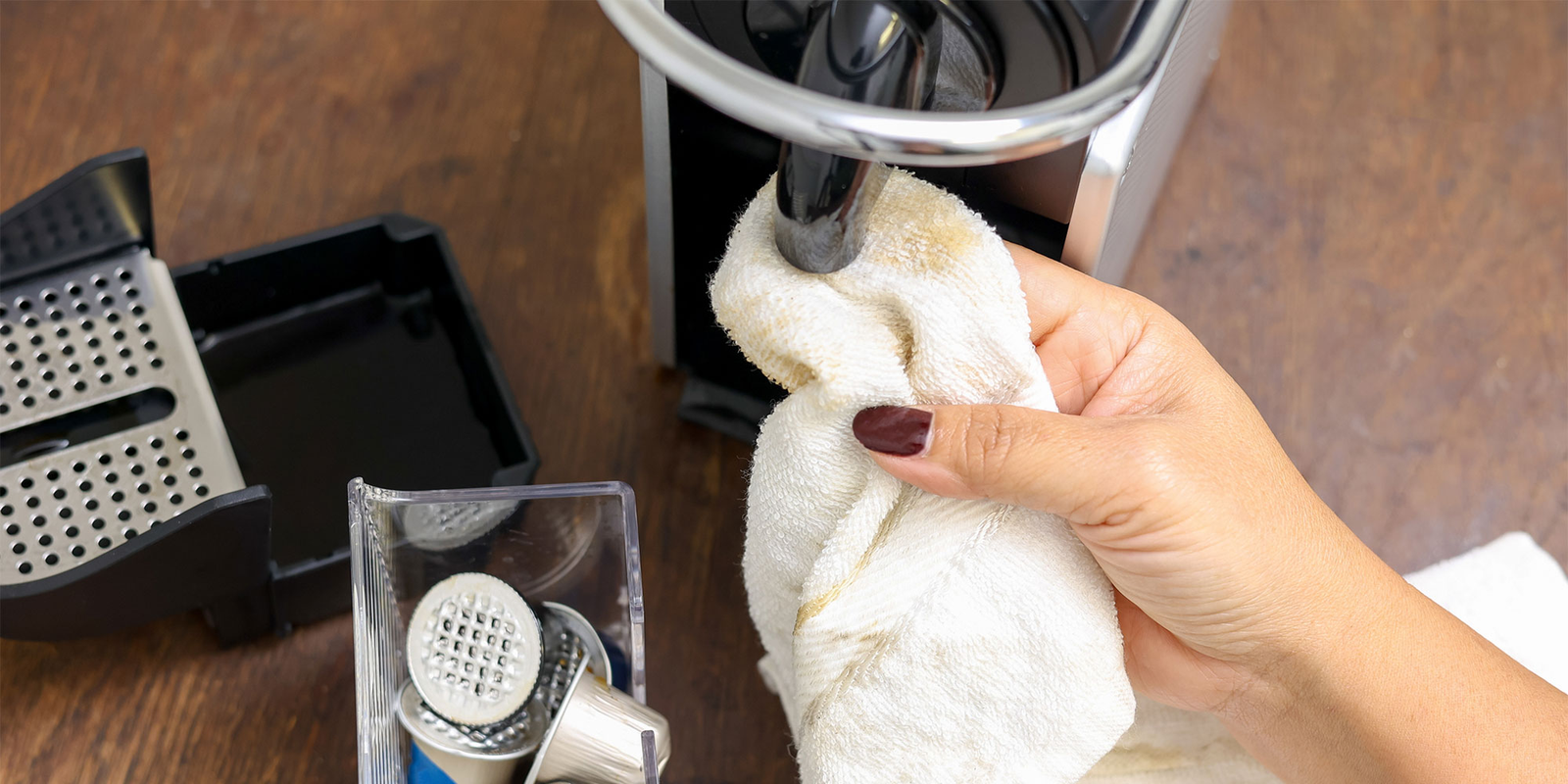
Finally, dedicated microfiber cloth sets are invaluable. Use one exclusively for wiping steam wands after every use to prevent milk from drying on them. Use others for cleaning portafilters and wiping down polished stainless steel machine bodies.

Conclusion

You no longer need to ask what are the parts of a coffee machine called. You now have detailed maps of your machine’s inner workings, from water reservoir to steam wand tip. This knowledge forms the foundation for mastery.
 
Understanding these coffee machine components empowers you to diagnose problems, speak confidently about equipment, and most importantly, understand why your brewing process yields its results. It’s the first and most critical step toward making consistently better coffee, whether in professional cafés or at home.
 
Stay curious, perform regular maintenance, and enjoy the process. You are now your machine’s expert.
 
Now that you know your machine inside and out, the next step is pairing it with perfect beans. Explore our curated selection of coffee beans for espresso to elevate your brew.
As a professional manufacturer specializing in the research, development, and production of coffee machines, we not only offer a diverse product selection but also support OEM/ODM customization to meet the needs of diverse markets and customers. With consistent quality control, fast delivery, and innovative designs, our coffee machines are used by numerous brands and channels worldwide. Whether you're a distributor, wholesaler, or brand owner, we can provide you with reliable solutions to help you grow your business. Contact us to explore potential collaboration opportunities.
cnmmagnet
Facebook
LinkedIn
WhatsApp
Twitter

Contact Us

FIll out the form below and we will cantact you as soon as possible